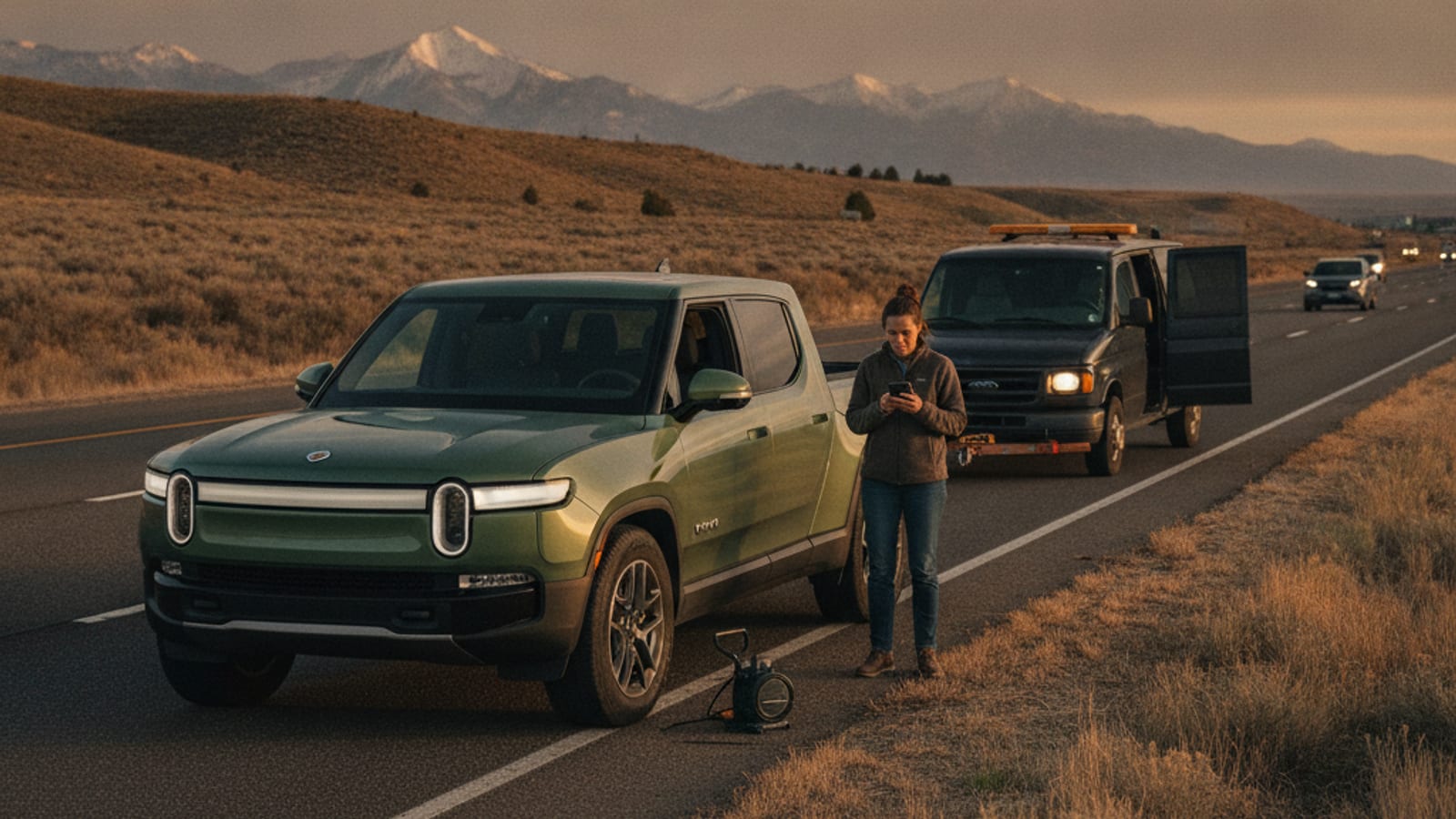
Rivian Highway Assist is the driver-assistance system on the R1T and R1S. It is not roadside assistance. It will not bring a charge to a stranded Rivian on a Colorado highway. CDOT Safety Patrol will not bring a charge either. It will jump a 12-volt battery on listed metro segments. If your pack sits at zero, you need a mobile EV charging referral, not a clear lane back to traffic. Call (720) 738-6950 for that match in the Denver metro.
Highway Assist drives the car, it does not rescue it
Rivian markets Highway Assist as a hands-on driver feature. It handles steering, acceleration, and braking on mapped roads. It reads lane markings and paces with traffic. It is meant to take work off the driver on a long pull west on I-70. It is not designed to recover your car from a dead pack on the shoulder.
The system requires power from the traction pack to run. If the pack is empty, Highway Assist stays off. So does the rest of the car. The system is unavailable at the moment you need it most. That gap is the reason a referral number belongs in your phone before you leave the metro.
The companion feature on a Rivian is Driver+. It is the lane-change and hands-free stack that includes Highway Assist. Same caveat. Driver+ runs on traction-pack power. Driver+ does not place a service call either.
Rivian’s own roadside program is a separate product
Rivian roadside assistance is reached through the Rivian app and the center display. The app is the cleanest path when you still have signal. The program is included for the duration of the New Vehicle Limited Warranty. The published menu covers flat tires, lockouts, tows, and a jump when the 12-volt is dead. It does not list Level 2 charging on the shoulder.
Treat Rivian roadside as your first call when you still have signal and the car is otherwise whole. Confirm what the dispatch will actually do before you wait. If the pack is at zero and your day is on the line, that confirmation is the moment to call for a local charge. The operators we refer bring a 240V Level 2 source. They quote you before any cable goes in.
CDOT Safety Patrol is free, and it does not bring a charge
CDOT Safety Patrol is a free state program run out of CDOT’s Division of Maintenance and Operations. The published menu is flat tires, jump-starts, emergency fuel, minor mechanical help, debris removal, and incident support. The Safety Patrol page does not mention electric vehicles. The companion CDOT “my car broke down” page does not mention EV charging either. That silence is the gap your roadside plan has to cover.
Front Range metro coverage runs on I-25 South from 120th Ave to Arapahoe Rd. It also runs on I-70 East from Wadsworth to Airport Blvd, and on portions of US-6, C-470, and I-225. The I-70 Mountain Corridor is covered Morrison to Vail. CDOT’s published hours on the Front Range are 6:00 to 9:30 a.m. and 2:30 to 7:00 p.m. on weekdays. Weekends run 10:00 a.m. to 7:00 p.m. Mountain Corridor hours run 6:00 a.m. to 7:00 p.m. Friday through Sunday and during significant weather. Don’t wait on a patrol that’s off shift.
The free patrol is the right call for a dark 12-volt. It is the wrong call for an empty pack. Skip it when the gauge was at zero before you stopped.
The I-70 climb is where drivers notice the gap
A Rivian R1T or R1S owner leaving the metro for a ski weekend faces a different math. Idaho Springs sits at 7,526 feet. That town has the last Tesla Supercharger before the Eisenhower-Johnson Memorial Tunnel at 11,158 feet, the highest point on the U.S. Interstate system. Georgetown has no Supercharger in the current inventory. Add a winter traction law, ski traffic, a heater running against sub-freezing air, and your buffer can vanish on the grade. A Rivian that leaves the metro with a comfortable margin can roll to a stop west of Georgetown with no public stall in reach. Idaho Springs is the planned top-up before the climb, and it is the last flat ground before the grade.
Recurrent Auto studied more than 30,000 U.S. EVs in winter. At 32 degrees, EVs kept about 78 percent of max range. At 20 degrees, that drops to about 70 percent. The best model held 88 percent. The worst held 69 percent. Heat-pump vehicles held about 10 points more at 32 degrees. Cold plus grade plus heater is a real combination. Treat your Idaho Springs top-up as the last confirmed charge before the tunnel.
The useful counterpoint is regen on the descent. A widely cited InsideEVs analysis says descending recovers roughly two-thirds of the energy spent climbing. A Lucid Air GT used about 3 percent of its battery over a 77-mile descent from Loveland Pass. A Hyundai Ioniq 5 used about 10 percent over a 75-mile descent. Drivers dial regen down on icy descents for traction. Coming down off Loveland Pass is real range. It is not a charge truck.
E-470 will jump you, not charge you
Stall on E-470 and you’re on a cashless toll loop. Pull to the shoulder and stay out of the lanes. Dial *470 for E-470’s own roadside assistance. The published menu is flat tires, fluid top-offs, jump-starts, phone help, and debris removal. E-470 does not publish an EV charging service. No EV toll discount exists on E-470. *CSP is *277 for State Patrol.
On the shoulder: the rules and the safe call
CRS 42-4-1202 covers a disabled vehicle on a highway. You may not stop on the paved main-traveled part. The exception is a vehicle so disabled it cannot be moved off. Hazard lights must be on under CRS 42-4-230. Outside that lane is the safer place to wait. Stay in the car if that’s the safer choice. Stay visible to traffic in any case.
CRS 42-4-1803 covers abandoned vehicles. The statute sets no fixed hour count. An officer decides on reasonable grounds. No Colorado statute treats a disabled EV as a special class. A stranded Rivian is governed by the same disabled-vehicle statutes as any car. There is no EV carve-out in Colorado law.
If the car is on a listed CDOT segment during published hours, that free jump covers a dark 12-volt. Skip the wait when the pack was already at zero. The 12-volt runs computers, contactors, and door locks. When it dies, the whole car looks finished. The traction pack may still hold plenty of energy. That split is what decides a jump from a charge.
January’s normal low around Denver sits near 18 degrees. A long sit in a cold lot can kill the 12-volt. If the dash showed low range first, treat it as an empty pack. If the car sat dark through a freeze, start with the 12-volt.
What a mobile EV charge looks like in this case
Charge Pro DEN is a referral line for stranded drivers. We don’t own trucks. We don’t employ technicians. We match you with an independent local operator. They quote you before any cable goes in. They bill you directly for the work they do.
A Rivian driver gets a native NACS plug on the cable. The kit is a 240V Level 2 source. Typical charging time adds about 10 to 20 miles. That add happens in 15 to 30 minutes of charging. The clock starts when charging starts, not before. It is not an arrival time, and we don’t promise one. Those miles let you drive under your own power to the next stall. For an empty pack, use out-of-charge recovery. For the broader choice on the metro, read mobile EV charging.
Operators we refer handle Rivian, Tesla, and every major EV brand. They carry NACS and CCS adapters on the truck. A stuck charge port is a latch problem, not a tow problem. Ask the operator about the port before anyone hooks a winch.
From a Colorado highway shoulder
Turn your hazards on and stay visible to traffic. Pull to the outside shoulder if the segment has one. Stay in the car if that’s the safer choice. If you’re on a listed CDOT Safety Patrol segment, check the clock. During published hours, that free jump is for a dark 12-volt. Skip it when the pack was already at zero.
If the car is otherwise fine and the pack is empty, call for range. A mobile EV charging referral adds that range in place. We serve the Denver metro from the plains to the foothills. The operator quotes you before they start work. Call (720) 738-6950 when you want that match. Treat it as a referral number, not a rolling promise.
For the broader OEM-versus-local script, read Tesla, AAA, and a local mobile rescue.
Frequently asked questions
Does Rivian Highway Assist include roadside charging?
No. Highway Assist is a driver-assistance feature. It needs traction-pack power to run. When the pack is empty, the system is off. Rivian roadside assistance is a separate program reached through the Rivian app and center display. The published menu does not list Level 2 charging. An independent mobile charge is the path that actually adds range.
Will CDOT Safety Patrol bring a charge to a Rivian on I-70?
No. CDOT Safety Patrol’s published menu is tires, jumps, fuel, minor mechanical help, debris removal, and incident support. The Safety Patrol page and “my car broke down” page mention nothing about electric vehicles, EV charging, or a charging-specific service. Coverage on the I-70 Mountain Corridor runs Morrison to Vail, with hours 6:00 a.m. to 7:00 p.m. Friday through Sunday and during significant weather. The patrol will jump a dark 12-volt. It will not charge an empty pack.
What does Rivian roadside assistance cover on a Colorado highway?
Rivian roadside assistance is included for the duration of the New Vehicle Limited Warranty. Access is through the Rivian app and center display. The published menu covers flat tires, lockouts, tows, and jump-starts for a dead 12-volt. Confirm the dispatch details in the app before you wait. A local operator remains the path for a Level 2 charge on the shoulder.