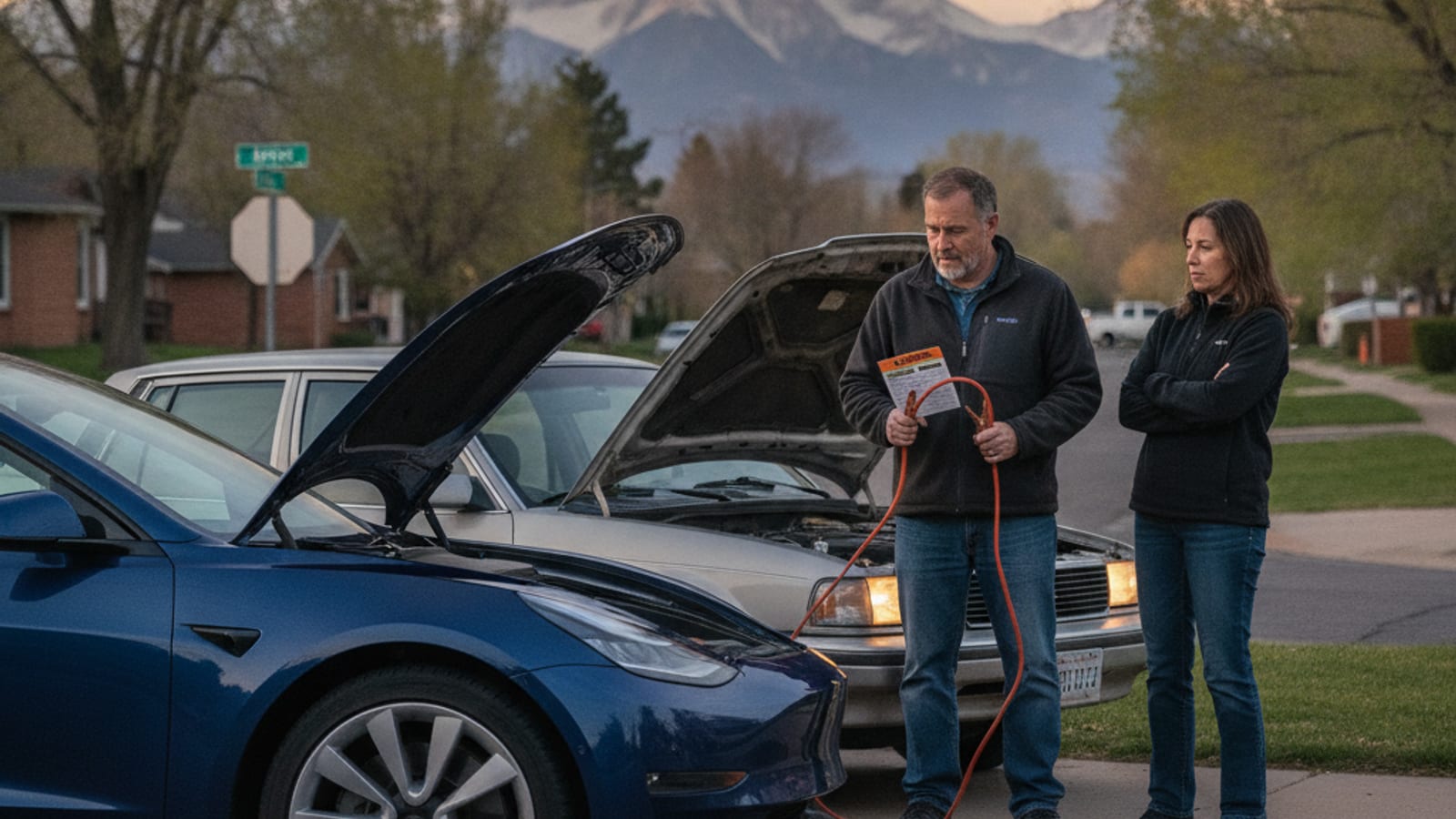
Risks of using a Tesla to jump a gas car are real, even when the clamps seem to fit. Tesla’s own owner materials warn that the 12-volt system on most current Teslas is not designed to push current into another vehicle. A Denver metro shoulder, with trucks rolling past at highway speed, is the wrong place to find out the hard way. If a stranger asks you to jump them, the polite answer is no, and the right answer is the state’s free patrol on a covered segment. If your own Tesla will not wake after a bad attempt, an independent operator we refer can jump or replace the 12-volt on site. They quote you before any cable goes in. Call (720) 738-6950 when you want that match.
Tesla’s own warning lives in the manual
Tesla’s captured Model Y jump page says the Model Y cannot be used to jump-start another vehicle. Other Tesla years and models can differ. Open that year’s Tesla manual before any cable comes out. Tesla roadside is requested in the Tesla app. Out-of-range assistance may be available but is not financially covered. Current Tesla Model Y books describe a lithium-ion low-voltage battery once the hood is open. Hood terminals unlatch only.
The captured line matters because the manual is the only source Tesla will not argue with. A driver who tries anyway and ends up with a dark Tesla has no manufacturer path to point at. The argument happens between the driver and the warranty desk.
Why the 12-volt is not a stranger’s starter
A Tesla’s low-voltage battery runs computers, contactors, and door locks. It does not deliver the starter-motor current a gas car’s battery does. A Tesla has no alternator. A DC-DC converter charges the 12-volt from the traction pack while the car is on.
Pushing current backwards through that system, or into a dead short on a gas car, can knock out the converter or damage wiring. The car that came to help is now the car that needs help. That is the worst possible place to be on a Denver shoulder.
A metro shoulder is the wrong place to find out
Denver traffic moves fast. I-25, I-70, US-36, and C-470 see heavy truck and commuter flow. CRS 42-4-1202 allows a disabled vehicle on a highway shoulder if the vehicle cannot be moved further, with hazards on. That is a legal place to sit, not a safe place to test a stranger’s wiring.
Hazards stay on. Stay in the car if that is safer. Stay visible. Keep a phone line open. The right calls live a few buttons away.
What the state’s free patrol actually does
CDOT Safety Patrol covers listed metro freeway segments: I-25 South from 120th Ave to Arapahoe Rd, I-70 East from Wadsworth to Airport Blvd, portions of US-6, C-470 and I-225, and the I-70 Mountain Corridor from Morrison to Vail. Their menu is flat tires, jumps, fuel, debris, and minor mechanical help. Their published pages mention nothing about electric vehicles or EV charging.
They will jump a 12-volt on a gas car. They will jump a 12-volt on a Tesla. Either job is in their scope. That is the safe path for both cars, and it costs the stranded driver nothing on a covered segment.
Published Front Range hours: 6:00 to 9:30 a.m. and 2:30 to 7:00 p.m. on weekdays. Weekends run 10:00 a.m. to 7:00 p.m. Mountain Corridor hours run 6:00 a.m. to 7:00 p.m. Friday through Sunday and during significant weather. Don’t wait on a patrol that is off shift.
What to do if a stranger asks you to jump them
Politely decline. Your car is the wrong tool. Point them at CDOT Safety Patrol if they sit on a covered segment. Outside that, a regular tow operator or mobile battery service is the right call. If they need an EV-specific rescue, that is a separate conversation.
For the broader answer to the same question, read Can you jump start a gas car from an EV on a shoulder. That post stays on the gas-car side. The mirror post, Can a Tesla jump another car in the metro, stays on the Tesla side. This one is the safety case against trying it on a Denver shoulder.
What to do if your Tesla will not wake after trying
A Tesla that just pushed current where it should not may go dark. The 12-volt is the most likely cause. The traction pack may still hold plenty of range. Hazards on, stay in the car if that is the safer choice, and call for help.
Operators we refer can jump a 12-volt on site. They can replace one on site when that is the job. The operator quotes the driver before any cable goes in. They bill the driver directly for the work they do. For the broader no-wake picture, read Tesla pack versus 12-volt replacement in Denver.
If a gas car really needs a jump on a Denver shoulder
Stay off the paved main-traveled part of the highway under CRS 42-4-1202. Hazards on per CRS 42-4-230. Call for the right help, not for the cables. E-470 drivers dial *470 for the loop’s free roadside. State Patrol is *CSP, which is *277. E-470 lists flat tires, fluid top-offs, jump-starts, phone help, and debris removal. E-470 does not publish an EV charging service.
Outside E-470, on listed CDOT Safety Patrol segments, the patrol is the free jump. Outside the listed segments, a regular tow or mobile battery call is the path. For a broader breakdown of what the state does and does not bring to a covered segment, read Tesla roadside will and will not cover. That post stays on the OEM side.
When your own Tesla is the car that needs help
Cold soak, phantom drain, a marginal 12-volt: that is the usual no-wake here. A Denver January’s normal low sits near 18 degrees. A week in a cold lot can kill the 12-volt while the traction pack still shows range. The 12-volt runs the contactors that wake the pack.
For the full metro-wide call, read mobile EV charging near me in the Denver metro. For the charge-in-place versus tow choice, read Charge in place or tow, what a stranded EV actually needs. For an empty pack on the shoulder, use out-of-charge recovery. We match you with an independent local operator. They bring a 240-volt Level 2 source or a 12-volt jump. They quote you before the cable goes in. The clock starts when charging starts, not before. For the broader rescue call, dial (720) 738-6950. Treat it as a referral number, not a rolling promise.
Why this matters on a metro shoulder
A gas-car driver stranded on I-25 or US-36 needs a jump that works the first time. A Tesla driver who tries to be the good Samaritan can walk away with a 12-volt that will not wake and a converter that needs a shop. The fix is to keep both cars in their lanes. CDOT Safety Patrol on covered segments handles gas cars. E-470’s *470 handles the loop. An independent operator we refer handles a Tesla no-wake. That is the three-line version of the answer.
Frequently asked questions
Can I jump a gas car from my Tesla?
Tesla’s captured Model Y jump page says the Model Y cannot be used to jump-start another vehicle. Other Tesla years and models can differ. Open that year’s Tesla manual before any cables come out. Tesla’s roadside path runs through the Tesla app, not through another driver’s car.
What happens if I try anyway?
The 12-volt system on most Teslas is not designed to push current into another vehicle. Damage to the DC-DC converter or wiring can leave your Tesla dark. The car that came to help becomes the car that needs help. On a Denver shoulder that is the worst outcome.
Is there a safe way to help a stranded driver?
Yes. CDOT Safety Patrol on covered segments and *470 on E-470 both jump 12-volt batteries. They have the right gear for both gas and electric cars. Outside those programs, a regular tow or mobile battery operator is the right call. Avoid using one EV to jump another on a public shoulder.
What if my Tesla will not wake after a bad attempt?
The 12-volt is the most likely cause. Operators we refer can jump a 12-volt on site, or replace one when that is the job. They quote before work starts. Call (720) 738-6950 to reach the referral line.