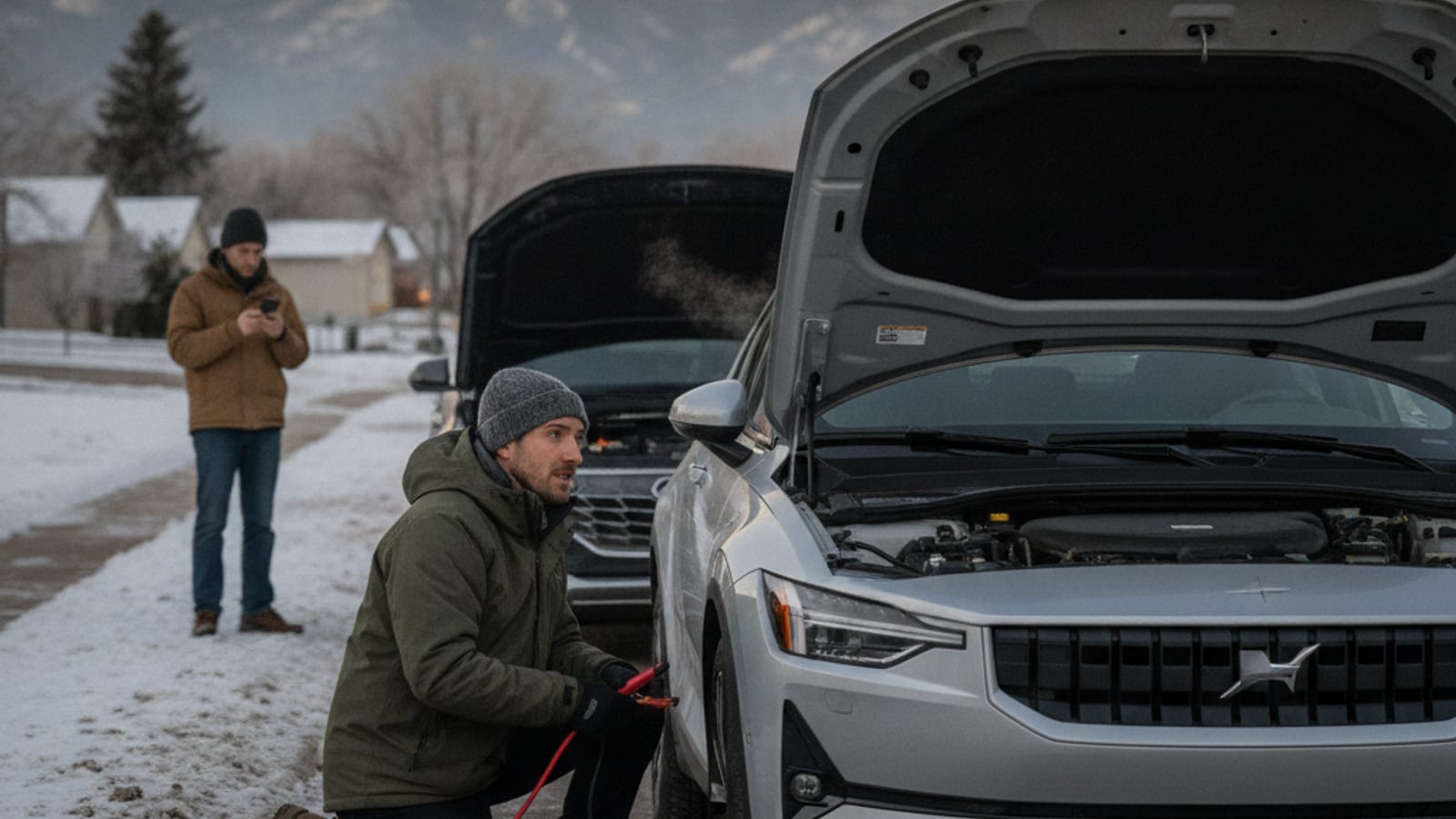
A Polestar 2 that won’t start in a Denver cold snap is almost always a dead 12-volt battery, not an empty traction pack. The traction pack can show plenty of range while the car looks completely dead. The 12-volt runs the computers, the contactors, the door locks, and the wake-up sequence that lets you drive. When it dies, the whole car looks finished. Call (720) 738-6950 and we match you with an independent local operator who jumps or replaces the 12-volt on site. They quote you before any cable goes in.
Why a Polestar 2 won’t wake after a cold night
The Polestar 2 is a real EV, but it still carries a 12-volt battery the way every modern car does. That battery powers the brain and the contactors. The traction pack powers the wheels. The two systems are separate. January’s normal low around Denver sits near 18 degrees, and a real cold snap can drop the metro below zero in a single night. The 2024 arctic blast took Denver from 47 to minus 19 in about 48 hours. A battery that was already marginal goes flat when the temperature dives that hard.
A Polestar 2 left at the airport for a week in January is a textbook case. The traction pack can still show range. The 12-volt phantom-drains a little every day running thermal management and security checks. After several cold nights, it doesn’t have enough left to wake the car. The screen stays dark. The doors stay locked. The charge port won’t open. None of that means the pack is empty.
Cold-soak is the same pattern on a Capitol Hill street, in a downtown garage, or in a Lakewood apartment lot. The 12-volt was already weak. The freeze finished it. The car looks finished too.
The split between empty pack and dead 12-volt
Drivers often confuse the two because both feel the same from the driver’s seat. The car doesn’t move. The dashboard doesn’t light up. The key fob stops responding. The difference shows up in what the car did before it died.
If the dash showed low range first, treat it as an empty pack. The car likely warned you. The traction pack ran down to its safety reserve. A flatbed tow to a stall or a mobile EV charging referral is the right call. The operator adds 10 to 20 miles of Level 2 range on site. You drive away under your own power.
If the car sat through a freeze and looked dead in the morning with no warning, the 12-volt is the more likely cause. The traction pack may still hold plenty of energy. A jump wakes the car without dragging it anywhere. Read jump start an EV 12 volt in Denver cold for the full picture.
The split matters because the wrong call wastes time. A flatbed to a stall when the 12-volt is dead means the new stall cannot wake the car either, and the driver is stranded at a different location. A jump when the pack is empty means the car wakes and dies again the moment the jumper comes off. Read the symptoms before you pick the tool.
What cold does to a Polestar 2 battery
Polestar builds the 2 in two main packs, a 64 kWh standard range and a 78 kWh long range, and the 12-volt inside the car is a lead-acid unit on most model years. Cold drops the chemical output of every lead-acid battery. Cold also drives the battery management system to wake more often and run the thermal management loop, which drains the 12-volt faster. The two effects compound. A 12-volt that was at 80 percent in October can be flat by January for no reason except the weather.
The Recurrent study of more than 30,000 U.S. EVs put the pack-level cold loss at about 78 percent of range retained at 32 degrees and about 70 percent at 20 degrees. Heat-pump cars hold about 10 points more than resistive-heater cars. That figure describes the traction pack, not the 12-volt. The 12-volt follows its own curve, and a marginal 12-volt at 70 degrees is a dead 12-volt at zero.
A Polestar 2 with a recent 12-volt replacement is a different story. The new battery tolerates a Denver winter without drama. A Polestar 2 with the original 12-volt past the four-year mark is the high-risk case.
Safe first checks before you call
A no-start Polestar 2 in a Denver lot leaves you with a few real checks and a long list of things to skip.
- Hazards on. CRS 42-4-1202 says a disabled vehicle can stop on the paved main-traveled part of a highway if it could not be moved off, with hazard lights on. Hazard lights are required by 42-4-230.
- Try the physical key blade if the fob stops responding. The Polestar 2 hides a key blade in the fob for the driver’s door.
- Look at the charge port. If the port light is dead and the unlock button does nothing, the 12-volt is the issue.
- Skip any plan that involves prying the pack open. The traction pack is high-voltage and not user-serviceable.
- Skip jumping the traction pack directly. The 12-volt is the only system designed to be jumped on a modern EV.
If the 12-volt is the cause, a small portable jump pack can wake the car in a few minutes. Match the procedure to that year’s owner’s manual and confirm the under-hood jump-post locations before you connect anything.
What the operators we refer actually do
Charge Pro DEN is a referral line for stranded EV drivers. We do not own trucks, and we do not employ technicians. We match you with an independent local operator in the Denver metro. That operator carries a 12-volt jump pack and, on most calls, a fresh 12-volt on the truck. They quote you before any cable goes in. They bill you directly for the work.
A 12-volt jump wakes the Polestar 2 in minutes. The operator connects leads to the under-hood jump posts and lets the car boot. Once the high-voltage contactors close, the traction pack starts supporting the 12-volt again. The driver can usually drive off the lot under their own power.
A 12-volt replacement takes longer. The operator pulls the old battery, fits a fresh one, and lets the car re-learn its battery profile. That is an on-site job in a parking lot, on a shoulder, or in a driveway. The operator handles the old battery and bills the driver directly.
We never promise an arrival time. We never name a price. We quote before work starts. That is the referral model, and it is the same model the operators we refer run on their own.
For a broader look at the 12-volt pattern across EV brands, read Audi Q4 e-tron 12-volt dead in the cold and Mercedes EQS 12-volt dead in Denver cold. The Polestar 2 fits the same pattern.
Where a Polestar 2 sits cold in Denver
The call mix in Denver splits by neighborhood pattern. Drivers in Denver on street parking, especially in Capitol Hill, Five Points, Baker, and the older apartment districts, leave their cars outside through every cold snap. More than half of Denver’s housing predates 1980, so a large share of renters don’t have a 240-volt plug at home. A Polestar 2 that lives on the street in Denver is the canonical cold-soak case.
The Denver Tech Center and Centennial office parks are the long-dwell case. A Polestar 2 in a parking structure all day loses 12-volt charge to phantom drain. By Friday, the car won’t wake.
Mountain and foothills drivers see the climb-and-cold case. A Polestar 2 left at a trailhead in Evergreen or Morrison in winter comes back to a flat 12-volt, especially at Red Rocks after a concert. The pack may still show range. The 12-volt won’t have enough left to wake the car.
Airport lots are the worst case. A Polestar 2 in a DEN economy lot for a week in January takes the cold-soak pattern and stretches it to the limit. The 12-volt dies. The pack keeps its charge. A jump on site is the right call.
How to handle a no-start in a parking lot
If the Polestar 2 won’t wake in a lot, the operator’s first move is the same move the driver would make. Hazards on. Doors locked or unlocked depending on the situation. Jump posts accessed under the hood. A small jump pack connects in minutes. The car boots. The dash lights up. The driver drives off.
If the 12-volt is too far gone to take a jump, the operator pulls and replaces it on site. The driver is back on the road without a flatbed tow to a shop. That is the difference a mobile operator makes on a Polestar 2 call in the Denver metro.
If the car has a separate problem, the operator can move the vehicle to a shop or arrange a tow. CDOT Safety Patrol and E-470 roadside assistance jump 12-volt batteries on their listed segments, but they do not bring a charge to a stranded EV. State Patrol handles abandoned-vehicle removal under CRS 42-4-1803 on officer discretion, not a fixed clock.
When the call is something else
Not every no-start is a 12-volt. A Polestar 2 that threw a high-voltage warning before it died has a different problem. A Polestar 2 that would not move after a charge cycle has a different problem. A Polestar 2 that died in a crash or a flood has a different problem. Read the symptoms before you call.
A high-voltage warning usually means a trip to a service center. A flatbed tow to a Polestar-authorized shop is the right call. The operators we refer do not work on high-voltage systems.
A flood or a crash leaves the car unsafe to jump. Treat it as a recovery job. Call 911 if anyone is hurt. Read stranded EV: charge, jump, or tow for the full breakdown.
When to skip the 12-volt theory
A Polestar 2 that shows the expected range on the dash, then drops to zero on the road, is an empty pack. A 12-volt jump won’t help. A mobile Level 2 charge adds the 10 to 20 miles you need to reach a stall. The car drives itself off the shoulder.
A Polestar 2 that loses range on a long climb from Golden up to Evergreen in cold weather is a different problem. The 12-volt is fine. The pack just ran out of margin because cold and grade ate the range. A mobile boost at the top of the hill, or a top-up at the bottom before you commit to the canyon, is the move.
Read EV range anxiety in the Denver metro for the full range pattern.
What you can do before the operator arrives
A stranded Polestar 2 driver can do a few useful things before the operator shows up. Stay in the car if that’s safer. Put on the hazards. Pull on a layer. Check the phone. Call us at (720) 738-6950 and we match you with an operator. The phone line is the referral line, not an ETA line. We tell you who is coming and let the operator quote the job.
If you have a small portable jump pack and you know the procedure, you can wake the 12-volt yourself. Confirm the post locations in that year’s manual before you connect anything. The pack will start supporting the 12-volt within minutes of boot.
If the 12-volt is too dead for a portable pack, leave the car and wait for the operator. A Polestar 2 with a totally flat 12-volt may not unlock the charge port, may not release the parking pawl, and may not let you shift into neutral. The operator carries the right gear for all of that.
How to keep the 12-volt alive through a Denver winter
A Polestar 2 owner can do a few things to lower the chance of a cold-morning dead battery. Plug the car in at home if you can. The traction pack will warm itself from grid power and the 12-volt stays topped up. A Polestar 2 left unplugged in a Denver cold snap is the high-risk case.
If you can’t plug in at home, drive the car at least once a week. A short drive with the heater on keeps the 12-volt above its safety floor and keeps the traction pack warm enough to support it.
A 12-volt past the four-year mark is the marginal case. A scheduled replacement before the first hard freeze of the year is cheaper than a weekend mobile call. Talk to a Polestar-authorized shop, not the operators we refer. The operators we refer replace 12-volt batteries on site when a driver is already stuck. They don’t sell maintenance.
Frequently asked questions
Is a Polestar 2 12-volt the same as a gas car 12-volt?
Functionally, yes. Both run the computers, the contactors, and the accessories. The Polestar 2 uses a smaller lithium or lead-acid 12-volt depending on model year. The jump procedure is similar. The Polestar 2 jump posts sit under the hood. Confirm the layout in the manual for your specific model year before you connect anything.
Can I jump a Polestar 2 from another car?
Yes, but the procedure matters. Connect the donor car’s 12-volt to the Polestar 2’s under-hood jump posts, not directly to the traction pack. Let the donor car run for a few minutes before you try to wake the Polestar. Once the Polestar boots, disconnect the donor and let the traction pack support the 12-volt on its own.
Will a Polestar 2 wake on its own once it warms up?
Sometimes, but it takes hours and the right temperature. A Polestar 2 in a heated garage may recover enough 12-volt charge overnight to wake on its own. A Polestar 2 left outside in a Denver cold snap will not recover on its own. The cold-soak drains the 12-volt faster than the chemistry can recharge it.
Does Polestar roadside assistance come to Denver?
Polestar runs a national roadside program. Open the Polestar app and request service. The app dispatches a contracted operator. The program covers certain services for certain model years. Confirm coverage in the app before you call. If Polestar’s program does not bring a 12-volt jump or a charge to your car, call (720) 738-6950 and we match you with a local independent operator who quotes before work starts.
How do I tell if my Polestar 2 12-volt is going to fail?
Look for the early signs. The car takes longer to wake. The screen flickers during boot. The doors unlock slowly. The 12-volt warning shows up in the Polestar app. Any of those signs in cold weather means a 12-volt failure is weeks away. Schedule a replacement at a Polestar-authorized shop before the next freeze.
Can a Polestar 2 lock you out when the 12-volt dies?
Yes. The Polestar 2 electronic locks run on the 12-volt. A dead 12-volt can leave the doors locked and the key fob unresponsive. The physical key blade in the fob opens the driver’s door manually. From there, the operator jumps the 12-volt under the hood. Read jump start a Tesla 12-volt on Model 3, Y, S, and X for a similar procedure, since the Polestar 2 follows the same general pattern.
If your Polestar 2 won’t start in a Denver lot, on a shoulder, or in your driveway, call (720) 738-6950. We match you with an independent local operator who quotes the jump or the 12-volt replacement before any cable goes in. We serve the Denver metro from the plains to the foothills.