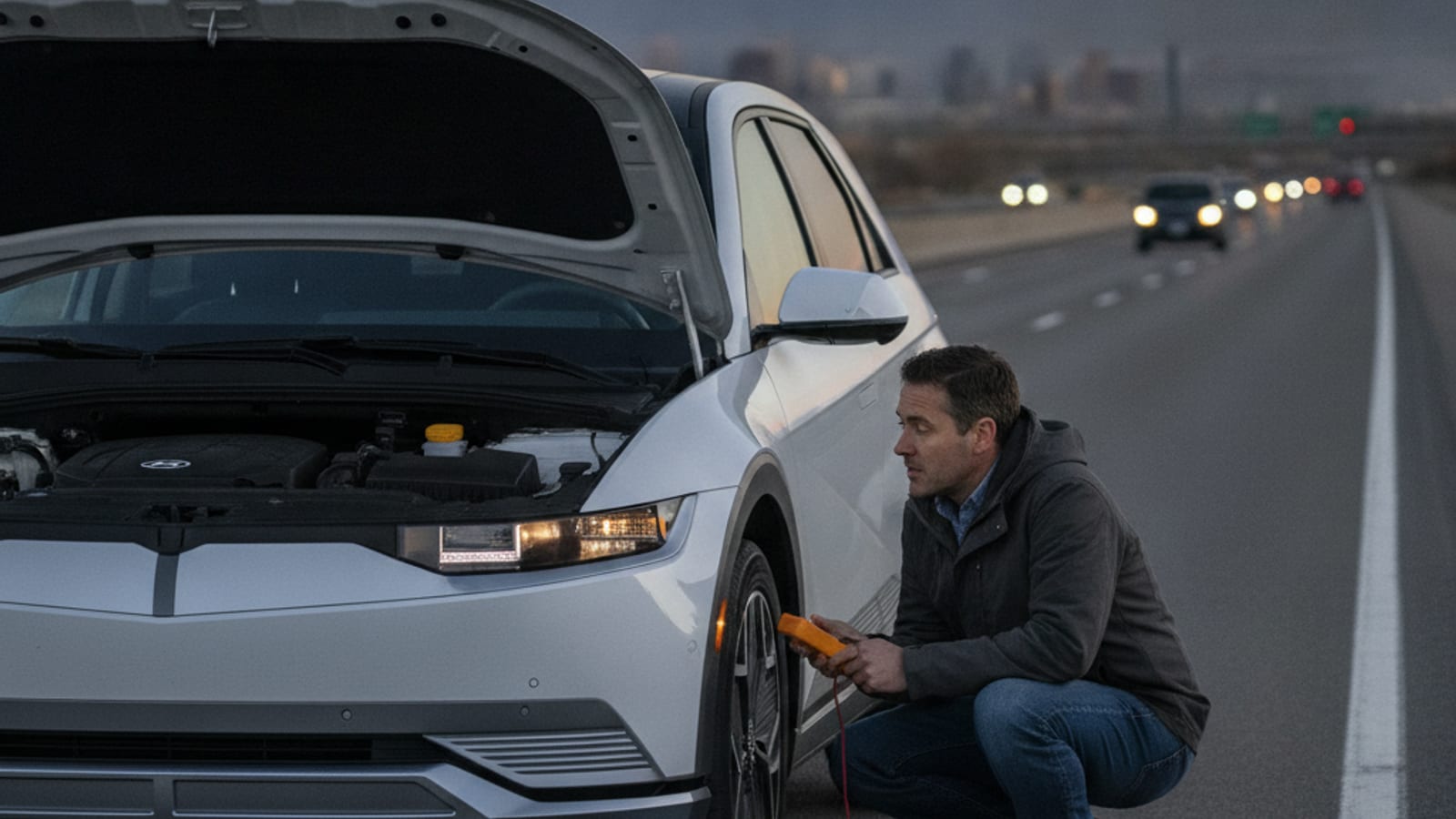
Mercedes EQS 12-volt battery dead in Denver cold is almost always a small battery, not the big one. The traction pack under the floor can sit near full while the 12-volt underneath the hood has dropped below the threshold the car needs to wake up. That is the usual story when a driver returns from a January trip and finds an EQS that will not unlock, will not respond to the fob, and looks completely dead. The traction pack is fine. The 12-volt is the problem. Call (720) 738-6950 and we will line up an independent local operator who can jump it or replace it on site. You pay them directly for the work they do.
The 12-volt is a separate battery from the traction pack
The EQS, like every modern EV, runs two electrical systems at once. The high-voltage traction pack sits under the floor and moves the car. A small 12-volt battery, the kind you would find in any gasoline car, runs the computers, the contactors that connect the high-voltage system, the door locks, the lights, the infotainment, and the wake-up sequence. When the 12-volt drops low enough, the car cannot close its contactors, so the traction pack is electrically invisible to the rest of the car. The dashboard stays dark. The fob does nothing. To the driver, the EQS looks finished.
The EQS hides its 12-volt in the front of the car, under the hood, in a place most owners never look. Mercedes-Benz has used AGM-style 12-volt batteries on the EQS for several model years, and newer builds moved to a lithium 12-volt. Both chemistries have the same problem in Denver cold: capacity drops as the temperature drops, and a battery that was marginal at home becomes unable to start the car after a week in a frozen lot.
Below about 15 degrees Fahrenheit, the battery management system wakes the car periodically to keep the traction pack warm. Each wake uses a small slice of the 12-volt’s charge. A week of those wakes in a January cold snap is enough to drain a tired 12-volt past the threshold the EQS needs. The car was not plugged in. The high-voltage pack was never in danger. The little battery just got used up.
A week in a DEN lot is the classic version
Denver International sits on open ground east of the metro. January is the worst month for a 12-volt there. NWS Boulder puts Denver’s normal January low around 18 degrees, with hard arctic drops on top of that. In January 2024, Denver went from 47 degrees to minus 19 in about 48 hours. A parking structure at DEN is unheated concrete. A surface lot is wind on top of cold on top of a parked car. Either one will eat a marginal 12-volt in a week.
The tell is the dashboard. A driver returning from a trip will see no response to the fob, no light under the door handle, no click from the charge port, and a dashboard that stays black when the brake pedal is pressed. The Mercedes me app may show the car as offline or may show range that looks fine, because the app reads the traction pack, not the 12-volt. This is the gap that confuses most owners: the big battery is healthy, the small battery is dead, and the car cannot tell the difference.
If the trip was less than a few days, the EQS usually wakes without trouble. The five-to-ten-day range is where calls start, especially when the trip covered a cold snap or a stretch below zero.
What to try before you call anyone
There are a few things an owner can do without tools, in the order that helps.
First, replace the fob battery. A weak fob looks identical to a dead 12-volt to the driver, and the fix is a five-minute swap. Mercedes fobs use a CR2025 in most recent years. The owner can check the manual. If the fob battery is more than a year old and the car is older than a year, this is worth a try before anything else.
Second, try the mechanical key. Every EQS hides a physical blade inside the fob. Pull the small latch on the fob, slide the blade out, and use it in the driver door lock cylinder. If the 12-volt is dead, the door will unlock mechanically but the alarm may sound when the door opens. That is normal. The alarm will time out.
Third, look at the headlights. If they come on at all, even dim, the 12-volt has some life. If they do nothing, the 12-volt is below the threshold. After that, the answer is a jump or a 12-volt replacement on site.
CDOT Safety Patrol jumps a 12-volt, not a traction pack
CDOT runs the Safety Patrol on covered metro freeway segments, including I-25 South (120th Ave to Arapahoe Rd), I-70 East (Wadsworth to Airport Blvd), portions of US-6, C-470 and I-225, and the I-70 Mountain Corridor from Morrison to Vail. Their menu is flat tires, jump-starts, emergency fuel, minor mechanical help, debris removal, and incident support. The Safety Patrol page and CDOT’s breakdown page say nothing about electric vehicles or a charging-specific service. They will jump a 12-volt. They will not bring a Level 2 charger to your bumper.
Front Range metro hours run 6:00 to 9:30 a.m. and 2:30 to 7:00 p.m. weekdays, with a 10:00 a.m. to 7:00 p.m. weekend window. Mountain Corridor hours run 6:00 a.m. to 7:00 p.m. Friday through Sunday and during significant weather. They cover listed segments only.
Two important gaps. Peña Boulevard, the road into DEN, is city-maintained, not an interstate, so it is not on the same published list. CDOT’s published patrol does not cover the airport terminal area. The cell-phone lot, the East and West garages, and the economy lots sit outside the published segment list. If the EQS will not wake in a DEN lot, calling Safety Patrol is not the right move. E-470 runs its own roadside line: pull to the shoulder and dial *470. *CSP (*277) reaches State Patrol. Both will jump a 12-volt. Neither publishes an EV charging service.
CRS 42-4-1202 lets a disabled vehicle sit on a paved shoulder if it cannot be moved further, with hazards on under CRS 42-4-230. On a state highway that is the safe place to be while help comes. A DEN lot is a private lot with private security, and a driver should follow the lot’s own instructions.
What an EQS jump actually looks like
A 12-volt jump on an EQS is not the same as jumping a gasoline car. The 12-volt terminals under the hood carry 12 volts and behave like any car battery once the hood is open. Standard jumper procedures work. The high-voltage pack does not need to be touched. A surge protector or a modern jump pack keeps the computers safe. The Mercedes-Benz owner’s manual gives the exact terminal locations for each model year; an owner can read those before any work begins.
After a jump, the EQS goes through a wake-up sequence. The dashboard comes up, a yellow warning may flash, and the car will be drivable. If the 12-volt was the only problem, the traction pack is unchanged and the car can drive to a charger or to a shop. If the 12-volt is older than four or five years, replace it soon. A replacement is a small job an operator can do on site in the same parking lot, and the right battery depends on the model year. AGM and lithium chemistries are not interchangeable; the operator should match the original spec.
A jump is the cheap and fast answer. A replacement is the durable answer. Either way, the operator quotes before any cable goes in.
What the operators we refer do
Charge Pro DEN is a referral line. We do not own trucks, we do not employ technicians, and we do not set prices for the visit. We match you with an independent local operator who serves the Denver metro from the plains to the foothills. They quote you before any work begins. They bill you directly for the work they do.
The kit for an EQS rescue is portable. Jumper packs, an AGM or lithium 12-volt in the right group size, and the patience to follow Mercedes’ own wake-up procedure after the cables come off. The operator will pull the 12-volt, swap it if a replacement is the job, and clear the warning lights once the car is awake.
Operators we refer also handle the empty-pack case. A 240-volt Level 2 source on a mobile platform adds about 10 to 20 miles in 15 to 30 minutes of charging. That is not an arrival time, and it is not a “we will be there in 10 minutes” promise. It is what a 240-volt Level 2 source can do once the cable is in. If the EQS sat at DEN with both a dead 12-volt and a near-empty pack, an operator handles the 12-volt first, then talks about adding range. For the broader choice between charging in place and a flatbed, read charge in place or tow.
For the empty-pack path that adds range in place rather than tows, see out-of-charge recovery. For the broader Denver-metro rescue script, see non-Tesla EV rescue in the Denver metro, since an EQS is not a Tesla and the path runs through the CCS adapter, not the native NACS plug.
Cold in Denver eats more than the 12-volt
The 12-volt is the headline problem on a week-long DEN sit, but cold also drains the traction pack faster than the trip meter predicts. Recurrent Auto studied more than 30,000 U.S. EVs in winter conditions. At 32 degrees, the average EV retains about 78 percent of its max range. At 20 degrees, that drops to about 70. Heat-pump vehicles hold about 10 points more at 32 degrees than resistive-heater EVs. So a morning commute that left a fully charged EQS at 100 percent can arrive at work with a noticeably lower buffer than the gauge showed at the start.
That is not a defect. That is the chemistry of lithium iron phosphate and nickel manganese cobalt packs in cold air. The cabin heater pulls power. The battery heater pulls power. The motors turn harder in cold grease. The pack self-protects by limiting regen and limiting peak output until the pack warms up.
What this means for the 12-volt problem: if a driver parked the EQS at, say, 80 percent at the airport in January and returned a week later to a dead car, the traction pack is probably at 60 or 70 percent, not at zero. That is plenty of pack. The 12-volt is the missing piece. A jump wakes the car and the driver can drive to a stall at their own pace.
When the EQS will not respond to anything
There is a smaller chance the car is not a 12-volt problem at all. If the high-voltage pack was genuinely drained to zero, the wake-up sequence will not run even with a fresh 12-volt, because the contactors have nothing to close onto. The Mercedes me app will show zero range, and the dashboard will not respond to a jump on the 12-volt alone. This is rare at DEN, since most drivers leave the pack above 50 percent for a trip, but it happens.
In that case the path is a flatbed to a charger or a shop. CRS 42-4-1202 lets a disabled vehicle sit on a shoulder with hazards on. The Colorado Towing Bill of Rights (HB22-1314) regulates nonconsensual tows: 24-hour written notice before most private-property tows, recovery of a vehicle after paying a set share of the fee, required acceptance of cash and cards, and no towing for expired plates alone. The Colorado Public Utilities Commission regulates towing carriers. Exact fee figures were not verified for this page. Read charge in place or tow for the call order.
When to call us
Call (720) 738-6950 when the EQS will not wake in a lot, on a shoulder, or in a driveway and the 12-volt is the suspected cause. We serve the Denver metro from the plains to the foothills. We line up an independent operator who quotes before work begins. Treat (720) 738-6950 as a referral number, not a rolling promise.
If the car is in a travel lane or another dangerous place, call 911 first.
Frequently asked questions
How do I tell if the EQS has a dead 12-volt or an empty pack?
The Mercedes me app reads the traction pack, not the 12-volt. If the app shows range, the pack is not empty. A dark dashboard, no fob response, no light under the door handle, and no charge port click are the 12-volt clues. A driver who parked for a week with range on the gauge and returned to a dead car is almost always looking at the 12-volt.
Will CDOT Safety Patrol jump an EQS?
CDOT Safety Patrol will jump a 12-volt on the segments it covers, including I-25 South, I-70 East, US-6, C-470, I-225 and the I-70 Mountain Corridor from Morrison to Vail. CDOT’s pages mention nothing about electric vehicles. They do not publish a charging service. Peña Boulevard is city-maintained and not on the same published list, so the airport lots sit outside the Safety Patrol’s published coverage.
Can an EQS be jumped like a regular car?
The 12-volt terminals under the hood carry 12 volts and behave like any car battery. Standard jumper procedures work. The high-voltage pack does not need to be touched. A surge-protected jump pack keeps the computers safe. The Mercedes owner’s manual gives the exact terminal locations for each model year. After the jump, the car runs through a wake-up sequence and a warning light may flash until the car drives a short distance.
How long does an EQS 12-volt last?
Most EQS 12-volt batteries last four to five years in mild climates. Denver cold cuts that. Repeated deep drains from long airport sits shorten the life further. A driver who has had two 12-volt no-wakes in a single winter should plan on a replacement. The operator matches the chemistry to the original spec.