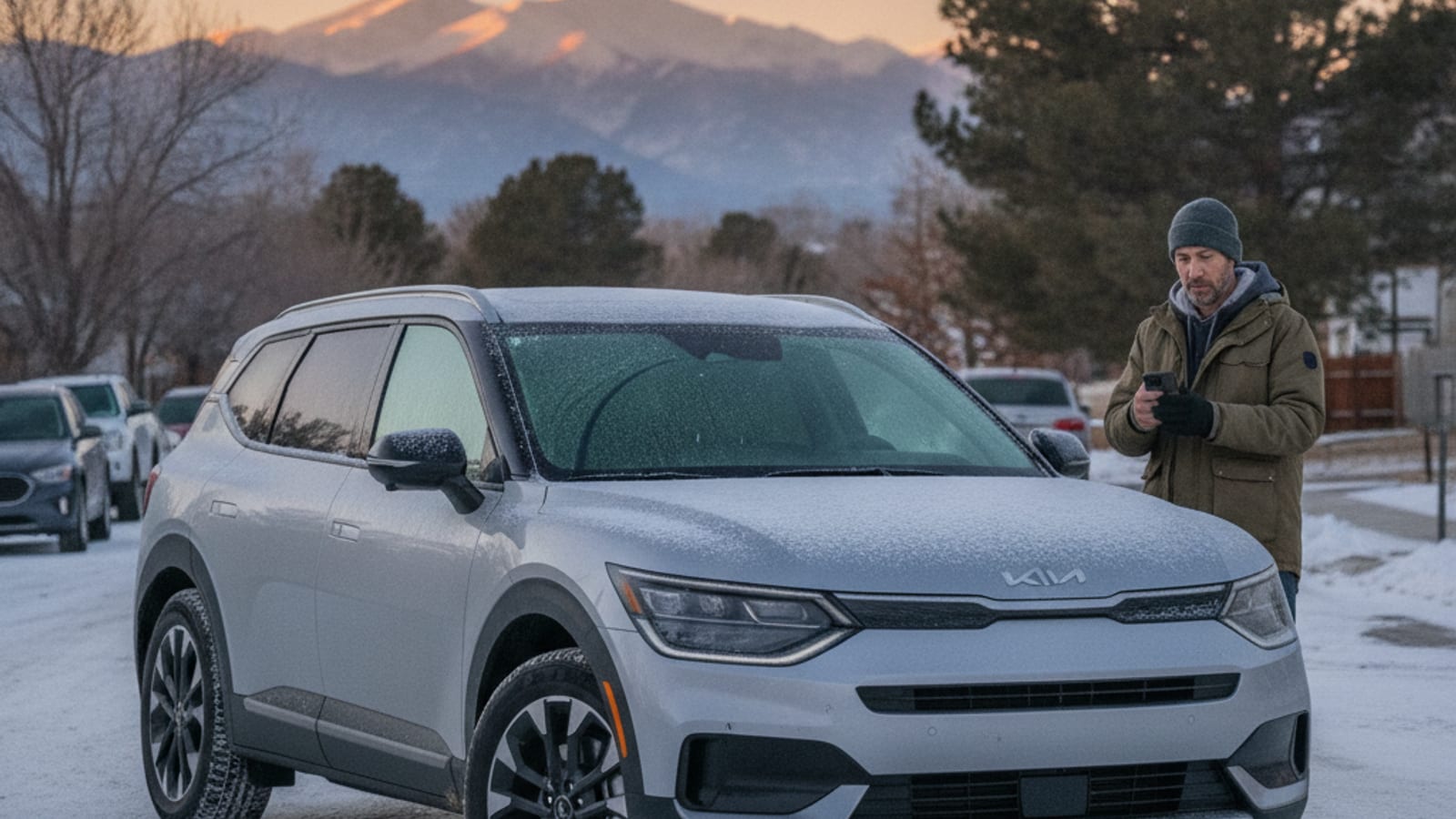
A Kia EV9 that won’t start after a cold Front Range night usually has a dead 12-volt battery, not an empty traction pack. The traction pack can still hold plenty of charge while the small accessory battery fails to wake the computers, contactors, and door locks. That is the usual no-start story in Denver, and it is the one that gets EV9s out of garages in Greenwood Village and the Tech Center after a January cold snap. If you are stranded, call (720) 738-6950. Charge Pro DEN is a referral line. The operator we match quotes you before any work starts.
What a no-start EV9 is actually telling you
An EV9 that won’t wake up looks broken in the worst way. No dash lights, no sounds from the start button, no response from the key fob or the phone-as-key. The hazard lights may or may not work. The big traction battery on the floor of the vehicle may still be sitting at 40 percent or 60 percent. The 12-volt is a smaller battery that runs the car’s brain, and when it fails, the whole vehicle looks finished.
The 12-volt in an EV9 is a lithium-ion or absorbed glass mat unit, depending on the build year. Either way, cold is hard on it. Below about 20 degrees, the chemistry gives up voltage, and the car’s systems start behaving oddly. Phantom drain from the battery management system running thermal management on cold nights pulls the 12-volt down while you sleep. After a few cold nights in a row, especially if the car sat outside or in a cold garage, the 12-volt is too low to wake the contactors that connect the traction pack.
Recurrent Auto studied more than 30,000 U.S. EVs in winter weather. At 32 degrees, the average EV kept about 78 percent of its warm-weather range. At 20 degrees, that fell to about 70 percent. The traction pack is more visible, but the 12-volt is the piece that quietly fails first on a Front Range cold night. For the broader cold-range story, see the cold weather range guide. That post covers the traction pack. This one is about the smaller battery that decides whether the car wakes up at all.
The 12-volt lives under the hood, but only when it does
The EV9 hides the 12-volt under the hood, near the front of the vehicle. Owners call out the front-trunk design and the fact that the traction pack sits low, but the 12-volt sits in the engine bay in a service position. That location matters for one specific reason. After a cold-soaked night on a Front Range driveway or in a Tech Center parking structure, that 12-volt is the first thing to check.
A driver should never assume the traction pack is empty when the EV9 won’t wake. The dashboard won’t show a state of charge because the dashboard won’t turn on. The phone app may still report a high pack percentage while the 12-volt is dead. That gap is the giveaway. A car whose app says 60 percent but won’t respond to the start button has a 12-volt problem, not a traction-pack problem.
For a deeper walk on what the 12-volt actually does in modern EVs, see what happens when an EV’s 12-volt dies. That post explains why the failure mode looks total. The short version is that the 12-volt runs every relay and every computer in the car, and the traction pack cannot put itself to work until those relays and computers close.
Cold-soak in a Tech Center garage
The Denver Tech Center sits along I-25 in Greenwood Village and Centennial. Office towers, hotel towers, and a handful of parking structures hold cars for eight to ten hours through a workday. In January, those structures sit cold, and a weak 12-volt battery does not get a chance to recover. It sits there slowly losing charge, the cabin preheat cycling on schedule, the security system checking in. By 6 p.m., the EV9 owner walks to the car, presses the brake, hits the start button, and nothing happens.
The same pattern shows up at Park Meadows in Lone Tree, the Streets at SouthGlenn in Centennial, and Fiddler’s Green in Greenwood Village. A long dwell in a cold structure is the textbook 12-volt killer. So is a long dwell at Denver International. A week in a cold DEN parking lot is enough to kill a marginal 12-volt battery, and the car looks finished even though the pack still holds a charge.
For a place-named take on the same call in the Tech Center corridor, see EV roadside assistance in Greenwood Village. That post is about the same long-dwell pattern that hits an EV9 in a DTC structure on a January night.
Try these checks before you call
A few minutes of checking can save the cost of a service call if the 12-volt isn’t actually dead, but most of the time it is. Here is the sequence the operators we refer use.
First, look at the key fob battery. A weak fob can keep the car from recognizing the start command. Replace the fob battery if the locks are sluggish. Second, try the mechanical key. The EV9 has one inside the fob. Use it to unlock the door manually. If the car still won’t wake, the 12-volt is the prime suspect. Third, turn on a high-voltage charger or try to plug in. If the charge port does not respond, the 12-volt is too low to close the contactors. That confirms the call.
What does not work is trying to push-start an EV9. There is no starter motor, and the traction pack cannot engage until the contactors close, and the contactors cannot close until the 12-volt is back above its threshold. A jump from another 12-volt source is the right move, not a push.
For the broader checklist, see can roadside jump an EV 12-volt. That post covers what an operator does on site, and it applies to the EV9 the same way it applies to any modern EV.
What a local operator does on site
Charge Pro DEN is a referral line. We do not own trucks or send a Charge Pro crew. We match you with an independent local operator who carries a 240-volt Level 2 source and a portable 12-volt jump pack. The operator calls you back with a quote before any cable goes in. You pay them directly for the work they do.
The on-site sequence for a 12-volt no-start looks like this. The operator confirms the symptom by checking the fob, the cabin accessory plugs, and the charge port. If the 12-volt is the prime suspect, the operator connects a portable jump pack to the front service terminals under the hood of the EV9. The car wakes when the 12-volt comes back above its threshold. The operator then leaves the car idling or plugged in for a short period so the DC-DC converter can top the 12-volt up from the traction pack.
If the jump holds, the operator hands the car back. If the 12-volt will not hold a charge, the operator can replace it on site with a fresh unit. The price of the replacement is part of the quote, and the operator bills you for the part and the labor. Either way, the EV9 drives away under its own power, and the flatbed stays parked.
Operators we refer cover mobile EV charging the same way. A driver whose pack is genuinely empty gets a 240-volt Level 2 boost that adds about 10 to 20 miles in 15 to 30 minutes of charging. That is charging time at the car, not an arrival promise. It is enough to reach a Supercharger or get home to Centennial or Highlands Ranch.
For the broader service menu, see EV roadside assistance in Denver and non-Tesla EV rescue. Those pages cover the same operator network for CCS-equipped vehicles like the EV9.
When the traction pack is actually empty
The EV9 has a usable battery around 76 to 100 kilowatt-hours depending on the trim. An empty pack is rare on a driveway, but it is real on the side of I-70 west of Golden, on the I-25 Monument Hill climb south of Castle Rock, and on a cold night at a trailhead in Evergreen or Conifer. Cold plus grade plus heater is the combination that eats range faster than the trip meter predicts. The pack can hit zero while the 12-volt is still healthy.
If the app showed a low state of charge before the car died, treat it as an empty pack first. The operator brings a Level 2 source to the bumper. The 10 to 20 miles that comes back in 15 to 30 minutes is enough to limp to a Supercharger. Lone Tree, Centennial, Highlands Ranch, Castle Rock, Conifer, and Idaho Springs all have Superchargers in the current inventory, and the operator knows which ones are open.
For the cold-mountain version of the same call, see EV died on I-70 in the cold. That post covers the corridor-specific rescue for an EV that actually ran out of pack on a Front Range climb.
How to keep the 12-volt alive through winter
A few habits extend the life of an EV9’s 12-volt through a Denver winter. Plug the car in overnight so the battery management system can keep the traction pack warm and run the cabin preheat from the pack instead of the 12-volt. Avoid leaving the car parked outside for a week at Denver International in January. If a long sit is unavoidable, ask a friend to start the car briefly midweek or use the app’s scheduled climate to keep the systems active.
If the 12-volt has already failed once, it is a maintenance item now. The operators we refer carry replacements and can swap on site. A fresh 12-volt in an EV9 costs less than a tow and less than a dealer appointment. The operator quotes the part and the labor, and the work happens in your driveway or at your office.
For a longer take on what else to check in a Front Range winter, see EV battery care in Denver winter. That post covers both the traction pack and the 12-volt, with the same cold-soak physics that drives the EV9 no-start call.
How to call from a Tech Center garage
A driver whose EV9 will not wake in a DTC structure should set the hazards on, stay out of traffic, and call (720) 738-6950. The line is answered by Charge Pro DEN. We match you to an independent operator covering the Tech Center corridor. The operator calls back with a quote. If you accept, the operator comes to the structure, jumps or replaces the 12-volt, and bills you directly. Charge Pro DEN does not set the price on any job. The operator does. CRS 42-4-1202 lets a truly disabled vehicle sit on the shoulder with hazards on, and the same rule applies in a structure when the car cannot be moved. CRS 42-4-230 requires the hazards to be on while the vehicle is stopped on a highway.
If the EV9 sits in a DEN lot rather than the Tech Center, the call is the same. Long-dwell cold-soak is the same problem in both places. The operators we refer cover the whole Denver metro from the plains to the foothills. They quote, they come, and they bill you directly. We match the call to the operator and step out of the way.
Frequently asked questions
Is a Kia EV9 that won’t start always a 12-volt problem?
No, but it usually is. The most common Front Range no-start on an EV9 is a dead 12-volt after a cold night, especially after a long dwell in a Tech Center or DEN parking structure. An empty traction pack is the other possibility and shows up on mountain climbs and highway shoulders. The operator confirms which one it is on site before any work starts.
Where is the 12-volt on a Kia EV9?
The 12-volt sits under the hood of the EV9, in a service position near the front of the vehicle. The traction pack sits low and out of sight, which is why a driver might assume the pack is empty when the dashboard goes dark. The 12-volt is the smaller battery that wakes the car, and it is the one that dies first in a cold soak.
Can a 12-volt jump from another car damage an EV9?
A 12-volt jump from a portable jump pack or another 12-volt source is safe when the polarity is correct and the voltage matches. The operators we refer use a portable lithium jump pack rated for EVs. A jump from a running gas car is also safe in principle but adds the risk of a voltage spike from the alternator. Use a portable pack when one is available.
Will the EV9’s warranty cover a dead 12-volt?
The Kia warranty covers the traction pack and most major powertrain components for eight years or 100,000 miles. The 12-volt is a wear item in the same way a 12-volt is a wear item on a hybrid or a gas car. A failed 12-volt after the basic warranty window is an out-of-pocket part, and the operators we refer carry replacements that can be swapped on site. The operator quotes the part and the labor before any work starts.