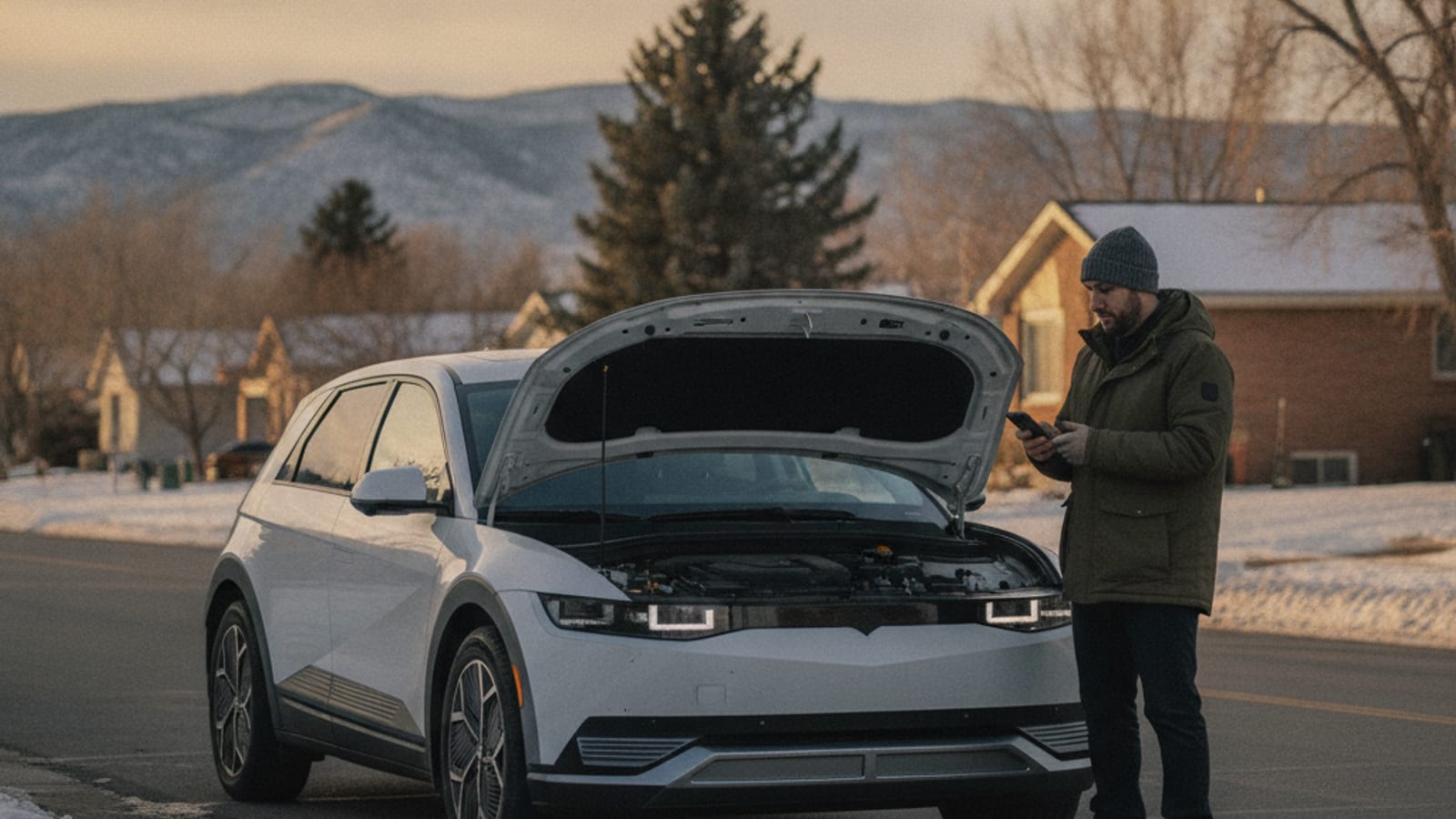
A Volvo XC40 Recharge or C40 Recharge that won’t start in the Denver cold is almost always a dead 12-volt, not an empty pack. The high-voltage traction battery can still show 40 or 60 percent on the dash. The small battery that wakes the computers is what failed. Call (720) 738-6950 if the car is dark and you want a local operator to look at it. We don’t diagnose the car over the phone. We connect you with a pro who quotes before any work starts.
Two batteries, and the smaller one runs the show
Every EV runs two electrical systems. The big pack moves the wheels. The 12-volt battery runs locks, infotainment, body modules, and the computers that bring high voltage online. On the XC40 Recharge and C40 Recharge, that small battery sits under the hood on the driver’s side. It is a conventional absorbed-glass-mat 12-volt. It has nothing to do with how many miles of range you have left.
When the 12-volt dies, the car looks finished. The fob does nothing. The center screen stays black. The doors may or may not unlock. The traction pack is irrelevant at that point, because nothing is asking it to wake up. A Recharge with 80 percent range left on the app can look completely dead on a curb because the small battery sagged below the threshold the modules need.
That pattern is the Cadillac Lyriq pattern, the Polestar 2 pattern, and the Tesla pattern. Volvo is no exception. Cold weather just makes it happen faster.
Why a Front Range freeze brings this on
Denver sits at 5,280 feet. The January normal low runs around 18 degrees. A normal Front Range January overnight can drop a weak 12-volt below its cranking threshold even when the pack is full. The January 2024 arctic blast swung Denver from 47 to minus 19 in about 48 hours. A battery that was marginal before that storm often failed during it.
Cold thickens the chemistry in any 12-volt battery. AGM batteries handle cold better than flooded lead-acid, but they are not immune. Once a 12-volt sags below about 11 volts, the modules that watch the car cannot boot cleanly. The high-voltage contactors stay open. The car stays asleep. The driver returns to a Volvo that looks like it has no power at all.
Several Front Range patterns push XC40 and C40 Recharge owners into this no-start zone:
- Street parking in older Denver neighborhoods with no home plug and no garage. Capitol Hill, Baker, Highlands, and parts of Wheat Ridge are the classic street-park zones.
- A long week parked at Denver International while the owner travels. Peña Boulevard is the only road in, and the lots sit exposed to wind and cold.
- Garage parking at a Tech Center office tower, where a marginal battery sags through a long weekday dwell.
- Foothills drives to Evergreen or Conifer, where the climb plus the heater eats a margin the owner thought was safe.
A Recharge that sat through any of those patterns can wake up dark. That is not proof the pack is empty.
How to tell the 12-volt from the traction pack
Open the Volvo Cars app if your phone still pairs. Read the state of charge. A healthy high-voltage percentage with a dark cabin is a 12-volt no-start. An empty pack with a living screen is a range problem. Those are two different rescues.
Watch the center display. A fully dark screen with a silent fob means the small battery is gone or very low. A dark screen with doors that still unlock means the 12-volt is weak but not dead. A screen that flashes on and then dies often means a body-module boot loop. A screen that loads and shows a yellow warning triangle is different again. Read the words on the screen and write them down before they cycle off.
Don’t treat a black screen as proof you ran out of miles. Drivers who street-park a Recharge in Capitol Hill hit this mix every cold week of January. The car sat, the small battery sagged, the pack never got a vote. What a mobile EV charging call is actually like explains what the operators we refer bring when the pack is the real problem.
If the pack truly is empty, that’s a different job. The pros we connect you with can bring a 240-volt Level 2 source with a CCS adapter that fits a Recharge. Charging time is usually 15 to 30 minutes. That typically restores about 10 to 20 miles of range. The clock starts when charging starts, not before. It is not an arrival time.
Where the XC40 and C40 hide the jump points
The XC40 Recharge and C40 Recharge put the 12-volt under the hood. Pull the hood release inside the cabin twice, then reach under the leading edge of the hood to find the secondary release. Lift the hood. The 12-volt sits on the driver’s side, in a service tray near the firewall.
You will see a red protective cover over the positive jump post and a bare metal ground point nearby. Use those posts. Do not clamp onto the battery terminals directly. The posts are designed for the jump current. The battery terminals can throw a spark or crack a vent if hit wrong.
If the hood will not release, the small battery may not have enough power to trip the latch. Volvo describes an emergency hood release in the owner’s manual for that year. Find that procedure before you assume the car needs a tow. A XC40 that will not pop its hood is still a candidate for a jump. The pro just has to find the alternate path in.
Connect a lithium jump pack or a second EV’s 12-volt booster to those posts. Red on the positive post under the red cover. Black on the bare ground point. Wait about 60 to 90 seconds for the modules to wake. Then press the brake and push start.
If the screens come back, leave the car in Ready for a few minutes before you drive. That lets the DC-DC converter start topping off the 12-volt from the traction pack. A 12-volt that is genuinely worn out may not hold that charge overnight. Plan a service appointment. A 12-volt that was just cold-soaked will usually hold it.
When it is the pack, not the 12-volt
Cold and elevation both tax the traction pack when you drive. Recurrent Auto’s winter study of more than 30,000 U.S. EVs found a clear pattern. EVs retain about 78 percent of max range at 32 degrees. They retain about 70 percent at 20 degrees, on average. The best models in their sample held 88 percent. The worst held 69 percent. AAA’s 2026 dynamometer study found about a 39 percent range loss at 20 degrees. Neither figure is a guess. They are the published averages.
A Recharge that ran the pack down to a real zero on a cold I-70 climb is not a 12-volt case. That car needs a Level 2 charge on site. The operators we refer bring a 240-volt source with a CCS adapter. They plug in, run the cable, and bring you enough range to reach the nearest DC fast stall or your home charger. Out-of-charge recovery is the service page for that job.
The Idaho Springs Supercharger sits at 7,526 feet. It is the last confirmed fast charge before the Eisenhower-Johnson Memorial Tunnel at 11,158 feet on the Denver side. A XC40 that reaches Idaho Springs with 10 percent still has a path. A XC40 that runs the pack dry at Loveland Pass has a much longer recovery story. Check the battery before you commit to the climb.
Front Range cold and the cabin pre-conditioning habit
XC40 and C40 Recharge owners who precondition the cabin while plugged in usually have a happier cold morning. The car pulls the heat from the wall, not the pack. Volvo’s app-based climate start works the same way. A Recharge that has been parked cold-soaked with no preconditioning is the car most likely to wake up sluggish, even when the 12-volt is fine.
A weak 12-volt plus a cold cabin is the worst combo. The modules draw extra current to run the heater on a cold start. That extra draw is what pulls a marginal 12-volt below the threshold. If the car starts but throws a low-voltage warning shortly after, treat that as a 12-volt health signal. It is not a pack problem. What a Tesla low voltage warning means walks the same pattern for a different badge. The principle holds.
Colorado shoulder law and the state’s free patrol
CRS 42-4-1202 covers a disabled vehicle on a highway. Outside a business or residential district, you may not stop or leave a vehicle on the paved main-traveled part of a highway, except a vehicle so disabled it is impossible to avoid stopping and to move it off the roadway. The hazard-lighting requirement under CRS 42-4-230 applies. Put the hazards on. Stay out of the travel lanes. That is the lawful posture for a XC40 stuck on a Front Range shoulder.
CDOT Safety Patrol covers listed segments. Denver-metro coverage includes I-25 South from 120th Ave to Arapahoe Rd, I-70 East from Wadsworth to Airport Blvd, and portions of US-6, C-470, and I-225. The I-70 Mountain Corridor is covered from Morrison to Vail. Published hours are limited. Front Range weekday windows are 6:00 to 9:30 a.m. and 2:30 to 7:00 p.m. Weekend hours run 10:00 a.m. to 7:00 p.m. Mountain Corridor hours run 6:00 a.m. to 7:00 p.m. on Fridays, Saturdays, and Sundays and during significant weather.
CDOT’s Safety Patrol and breakdown pages do not mention EV charging or a charging-specific service. They will jump a 12-volt battery on a listed segment during posted hours. They will not bring a charge to an empty pack. That gap is real and is why a local referral number matters.
On E-470, the loop’s own roadside assistance is reachable at *470. Pull to the shoulder, dial *470 for jump-starts, flats, fluid top-offs, phone help, and debris removal. *CSP (*277) reaches State Patrol. Neither line publishes an EV charging service. Ask whether the patrol truck carries EV charging equipment before you wait. Most do not.
What the operators we refer actually do
Charge Pro DEN is a referral line. It matches stranded EV drivers with independent local mobile rescue operators in the Denver metro. We don’t own trucks. We don’t employ technicians. We don’t set prices for the visit. We don’t promise an arrival window. We match you with an operator, and that operator quotes you before any cable goes in. You pay them directly for the work they do.
Those pros typically bring a 240-volt Level 2 source. A CCS adapter covers a XC40 or C40 Recharge. They can jump or replace a dead 12-volt on site. If the pack is empty, charging time is usually 15 to 30 minutes. That typically restores about 10 to 20 miles of range. The clock starts when charging starts, not before. Operators we refer work on Tesla and every major non-Tesla EV brand.
For a non-Tesla EV with a CCS port like the XC40, the right service page is non-Tesla EV rescue. For a pure 12-volt jump that the state patrol will not bring a pack for, Tesla 12V battery jump describes the same on-site pattern for any brand.
If the XC40 is at a residence and the traction pack is genuinely empty, mobile EV charging is the broader service. Same operator network. Same quote-before-work policy. The difference is the level of charge the operator brings, not the brand they cover.
When the warning is real, not a 12-volt
A persistent yellow triangle with the words “Service Required” or “Stop Safely” is a different problem. That message comes from the high-voltage system or the battery management system, not the 12-volt. A 12-volt jump will not clear those warnings. A car that boots clean and then refuses to enter Ready is a BMS fault, not a curb cure. Get it to a Volvo dealer or an independent shop with a Volvo scan tool. Do not force a charge into a Recharge with active high-voltage warnings.
A locked charge port is also not a 12-volt problem. If the latch will not release after a freeze, that is a port issue, not a pack issue. Charge port stuck in the cold walks that pattern for several brands. The XC40 and C40 use the same CCS latch family as most modern non-Tesla EVs. The cure is the same: warm the latch, do not yank the cable, do not pry the port.
What to do tonight if it just happened
You parked the Recharge on the street last night. This morning the fob does nothing and the cabin is dark. The pack probably still has range. Start with the small battery.
- Open the Volvo Cars app and read the state of charge. If the percentage is healthy, the 12-volt is the suspect.
- Pull the hood release twice and lift the hood. Look for the red protective cover on the driver’s side.
- Connect a lithium jump pack to the positive post under the red cover and the bare ground point nearby.
- Wait 60 to 90 seconds. Press the brake and push start.
- Leave the car in Ready for several minutes so the DC-DC converter can top off the 12-volt.
If you do not have a jump pack, or if the hood will not release because the 12-volt is too flat to trip the latch, call (720) 738-6950. The operators we refer carry lithium jump packs sized for an EV 12-volt. They can come to a Denver driveway, a Capitol Hill curb, an apartment lot in Lakewood, a Tech Center garage in Greenwood Village, or a DEN long-term lot in Aurora. They quote the work before they start.
A jump that dies again the next morning means the 12-volt is worn out. A second blackout inside 24 hours is a worn-battery signal, not a fluke. EV 12-volt dies again after a jump walks that case. Plan a Volvo service appointment for a replacement 12-volt, not a third jump.
Frequently asked questions
Why won’t my Volvo XC40 Recharge start in the cold?
The small 12-volt battery under the hood has sagged below the voltage the modules need. The traction pack can still hold plenty of range. A jump from a lithium pack or a second EV’s 12-volt booster wakes the modules and lets the high-voltage system come online.
Where is the 12-volt on a Volvo XC40 Recharge?
It sits under the hood, on the driver’s side, in a service tray near the firewall. There is a red protective cover over the positive jump post. A bare metal ground point sits nearby. Use those posts, not the battery terminals.
Can I jump a Volvo C40 Recharge from another car?
Yes. Use the under-hood jump posts, not the battery terminals directly. Red on the positive post under the red cover. Black on the bare ground point. Wait 60 to 90 seconds, then press the brake and push start.
Will CDOT Safety Patrol jump a dead 12-volt on a Volvo?
Yes, on listed segments during posted hours. CDOT does not publish an EV charging service, and the patrol will not refill an empty traction pack. A Volvo that boots clean after a jump can usually be driven to a charger.
What if the XC40 still won’t enter Ready after a jump?
That is a battery management system or high-voltage warning, not a 12-volt problem. Get the car to a Volvo dealer or an independent shop with a scan tool. Do not force a charge into a Recharge with active high-voltage warnings.
If your Volvo XC40 or C40 Recharge is dark in a Denver metro driveway, on a Front Range curb, or in a DEN long-term lot, call (720) 738-6950. The operators we refer jump or replace a 12-volt on site, or bring a Level 2 charge for an empty pack. They quote the work before it starts.