On a Front Range January morning, a GMC Hummer EV that won’t start is usually a dead 12-volt. Denver’s cold kills that small battery, not the Ultium pack. The truck goes fully dark. There’s no dash, no door response, and no center screen. Yesterday’s miles sit in a different battery. The pack can’t talk to the motors until the 12-volt boots the computers.
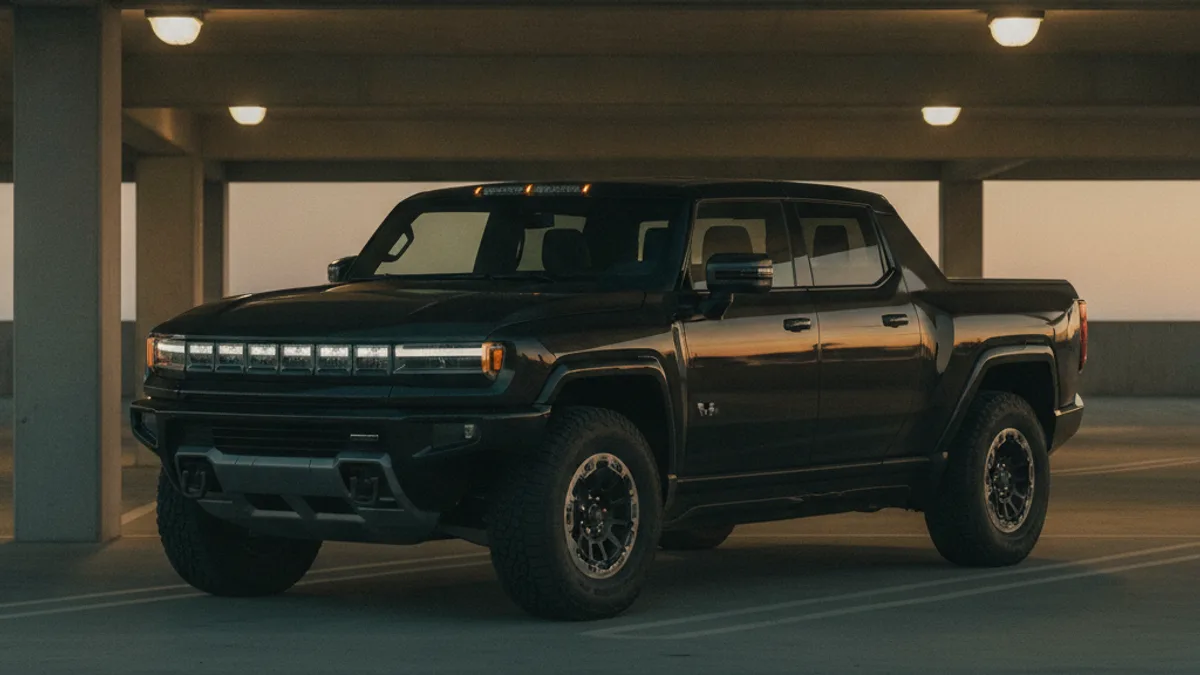
January cold makes a Hummer look fully dead
This failure shows up when the truck has sat through a hard night. Denver’s normal January low sits around 18 degrees, from NWS Boulder climate normals. You don’t need a record freeze. A parked Hummer in the teens is enough to sag a tired 12-volt.
The January 2024 arctic blast is the recent night people still talk about. Denver went from 47 degrees to minus 19 in about 48 hours, on January 16 and 17. A truck that sat through that swing can look totaled. The Ultium pack may still hold a normal charge. The 12-volt is a separate battery. Cold hits it first and shuts the whole truck down.
Denver’s official elevation is 5,280 feet at the west steps of the State Capitol. Evergreen sits around 7,200 feet. Idaho Springs is 7,526. Those overnight soaks keep drawing on a small battery while the truck sleeps.
The Ultium pack isn’t the battery that wakes the truck
The Ultium pack moves the Hummer. The 12-volt runs the low-voltage electronics that boot those high-voltage systems. Those electronics have to come up first. If the 12-volt sags too far, the handshake never finishes. You get a silent cabin. The truck won’t go into gear.
Other GM EVs fail the same way. A Chevy Silverado EV and a GMC Sierra EV share the Ultium layout. The Hummer makes the failure louder because almost every latch and screen is power-operated. When the 12-volt dies, the truck doesn’t limp. It goes blank.
A Hummer parked for weeks drains the 12-volt slowly. Alarm modules, cameras, and cabin preconditioning all nibble at it. A 12-volt that’s simply worn out does the same thing, only faster. Either path ends in a dark cabin. A jump can get you rolling. A battery at the end of its life will leave you dark again within a few days.
The shift warning is a voltage problem
Hummer EV drivers often see a “conditions unable to shift” message first. Other electrical warnings can stack on top of it. GMC’s published spec puts a resting 12-volt around 12.4 to 12.8 volts. A running system sits around 14.4 to 14.8 volts. Drop below that resting window and the truck’s computers start disagreeing with each other.
That shift warning isn’t a broken transmission. It’s a voltage problem wearing a gearbox label. Cycling power won’t fix it. Reloading the infotainment screen won’t fix it. Bring the 12-volt back into range with a jump or a charger on the posts. The errors usually clear once the voltage holds under load.
Don’t keep hammering the start sequence while it’s this low. You’re asking a weak battery for more current, not less.
Don’t shut the doors like you always do
The Hummer EV drops each window a fraction as a door opens. The glass then rises as the door shuts, so it doesn’t scrape the roof seal. That indexing needs 12-volt power. With the battery dead, it doesn’t run.
Close a door the normal way and the top of the glass can hit the sky panel or the A-pillar trim. The chip is easy to miss until morning light. Treat every door as a manual door until the 12-volt is back. Ease it shut, and don’t let the last few inches slam.
This is the habit that bites in a dark garage after a long sit at the Denver Tech Center in Greenwood Village. It’s the same habit in a DEN lot after a week away. The truck looks locked and lifeless. Your hands still want to throw the door closed, so don’t.
Use the footwell loop to open the eTrunk
GMC put the 12-volt in the front trunk, the eTrunk, on the passenger side. It sits under a plastic cover held by three tabs. That’s simple once the lid is open. The release is electric, so a dead 12-volt means the button and the fob won’t pop it.
There’s a mechanical workaround that needs no power. Sit in the driver’s footwell. Look left of the brake pedal, up behind the wiring harness. You want a silver wire with a small loop at the end. Pull that loop until you feel it give. The eTrunk should unlatch.
It’s tucked away, so the first try feels like fishing. Once it pops, lift the plastic cover by those three tabs. The battery and the jump posts are under it.
Jump the posts, then wait before you ready the truck
Under the cover you’ll see two terminals. The positive post sits under a red sliding door. Flip that door open and clamp onto the post. The negative post is to the left, next to a green connector. Clamp negative there the way you would on any 12-volt jump.
Clamp positive first, then negative. Give the system a minute before you ask the truck to wake. A standard jump pack is enough when the 12-volt is only sagging. A deeply discharged Hummer may need an AGM-rated charger left on those posts until voltage recovers. A pack-style jump that dies in seconds is a sign the battery is too far gone for a blip of current.
The connection order and the safety notes live in our guide to jumping an EV 12-volt. Read that before you guess at polarity on a dark driveway.
What the symptoms usually mean
| Symptom | Likely cause |
|---|---|
| Dashboard dark, doors dead | 12-volt fully discharged |
| ”Conditions unable to shift” | Resting voltage below GMC’s 12.4 to 12.8 volt window |
| eTrunk button and fob do nothing | 12-volt too low to power the electric release |
| Window hits trim when a door shuts | Indexing is off because the 12-volt is dead |
| No-start returns a few days after a jump | 12-volt won’t hold a charge and needs replacement |
If you’ve already jumped this truck more than once, stop treating it as a one-off. A 12-volt that won’t hold voltage needs to come out. Signs that an EV 12-volt is done show up as repeat dark mornings, not as a single cold night.
Front Range sits where this shows up
A week in a cold lot at Denver International is a textbook version. Peña Boulevard is the only road in. It’s an 11-plus-mile city-maintained freeway across open plains, not a state highway. East and West garages, shuttle lots, and economy lots all sit through the same January cold. Stall counts and whether charging is free there could not be confirmed from the airport’s own site. That doesn’t change the 12-volt story. A Hummer left a week in that cold can come back with miles still in the pack. The 12-volt still may not wake the truck. That’s a jump or an on-site 12-volt replacement, not a charge into the Ultium pack.
The same sit happens in a Tech Center garage in Greenwood Village. It also happens in the Park Meadows garage in Lone Tree after a long shop. Accessory draws plus cold plus hours of sleep is enough.
Hummer EVs also get used for what they’re built for west of town. Morrison and Red Rocks sit at that edge. Evergreen is a climb from there on SH-74. Idaho Springs sits on I-70, with a Supercharger on the Denver side of the Eisenhower-Johnson Memorial Tunnel. None of that helps if the 12-volt is already dead in a lot. You’re not out of miles. You’re out of the battery that turns the truck on.
On a freeway, the patrol can jump, not charge the pack
If the Hummer dies on a freeway, CRS 42-4-1202 is the disabled-vehicle rule. Outside a business or residential district, you can’t stop on the paved travel lanes. The exception is a vehicle so disabled you couldn’t move it off the roadway. Hazard lights have to be on, under CRS 42-4-230. A dark Hummer that won’t ready counts as disabled. Get it onto the shoulder if you can, and leave the hazards on. A violation is a class B traffic infraction.
CDOT Safety Patrol offers free help on covered metro freeway segments. That includes flat tires, jump-starts, emergency fuel, minor mechanical help, debris removal, and incident support. Coverage includes I-25 South from 120th Avenue to Arapahoe Road. It also includes I-70 East from Wadsworth to Airport Boulevard, plus portions of US-6, C-470, and I-225. The I-70 Mountain Corridor coverage runs Morrison to Vail. Front Range hours are 6:00 to 9:30 a.m. and 2:30 to 7:00 p.m. on weekdays. Weekends run 10:00 a.m. to 7:00 p.m. Mountain Corridor hours are 6:00 a.m. to 7:00 p.m. Friday through Sunday, and during significant weather.
Those patrol trucks will jump a 12-volt and change a tire. CDOT’s Safety Patrol page and its “my car broke down” page mention nothing about electric vehicles or bringing energy to a traction pack. Confirm current coverage on COtrip.org or the 511 line if you’re sitting on I-70. Don’t assume a patrol stop includes a charge to the Ultium pack.
E-470 is the eastern-metro cashless toll loop, run by the E-470 Public Highway Authority. A disabled driver pulls to the shoulder and dials *470 for jump-starts, or *CSP (*277) for State Patrol. Those pages don’t describe a pack charge. A 12-volt jump is in the published menu.
Colorado has no statute that carves out a disabled EV. The same shoulder rules apply as they do to a gas truck. Abandoned-vehicle timing under CRS 42-4-1803 is officer discretion, not a published clock.
What a referral operator brings to a dark Hummer
Charge Pro DEN is a referral line. It matches stranded EV drivers with independent local mobile rescue operators. It doesn’t hold a trade license, own trucks, or employ technicians. It doesn’t set prices or publish arrival times. The operator quotes you before they start, then bills you directly.
The pros we connect you with are licensed and insured. On a non-Tesla EV rescue they bring 12-volt jump gear for a large Ultium truck. They can use the manual eTrunk loop if the button is dead. They can tell you whether the 12-volt is holding or needs to be replaced on the spot.
If the Ultium pack is actually empty, that’s a different job. Operators bring a 240-volt Level 2 source to the car, with a CCS or J1772 adapter for a non-Tesla. That typically adds 10 to 20 miles of range in 15 to 30 minutes of charging. That’s charge time on the car, not a promise of when someone arrives.
We serve the Denver metro. A Hummer in Denver, Golden, Evergreen, Aurora, or Castle Rock is in the service area. Confirm the current quote with the operator before any work starts.
Call (720) 738-6950 when the truck is dark and you don’t want to fish for that footwell loop in the cold. The operator, not the brand, does the jump.
Frequently asked questions
Why won’t my GMC Hummer EV start when the pack still shows range?
The range figure is the Ultium pack. The 12-volt is what boots the truck and closes the contactors. If that small battery is dead, the pack can sit at 80 percent and you still get a black cabin. A 12-volt jump is the first fix, not a flatbed.
How do I open the eTrunk with a dead 12-volt?
The button won’t work, so look in the driver’s footwell. Left of the brake and up behind the harness, find the silver loop. Pull it until it gives. The eTrunk unlatches with no electrical power. Then lift the three-tab cover on the passenger side to reach the battery.
Why can’t I close the doors the normal way?
Window indexing needs 12-volt power. A dead battery means the glass doesn’t drop and rise. A normal slam can chip the window on the sky panel or A-pillar trim. Ease every door shut by hand until the 12-volt is jumped.