The GMC Sierra EV that felt overbuilt in Denver traffic can still run out of miles on I-70. The climb west of Golden isn’t a metro errand. Cold cuts the buffer. Grade spends it. A truck that looked fine in Wheat Ridge can sit dead on the shoulder before you reach Idaho Springs.
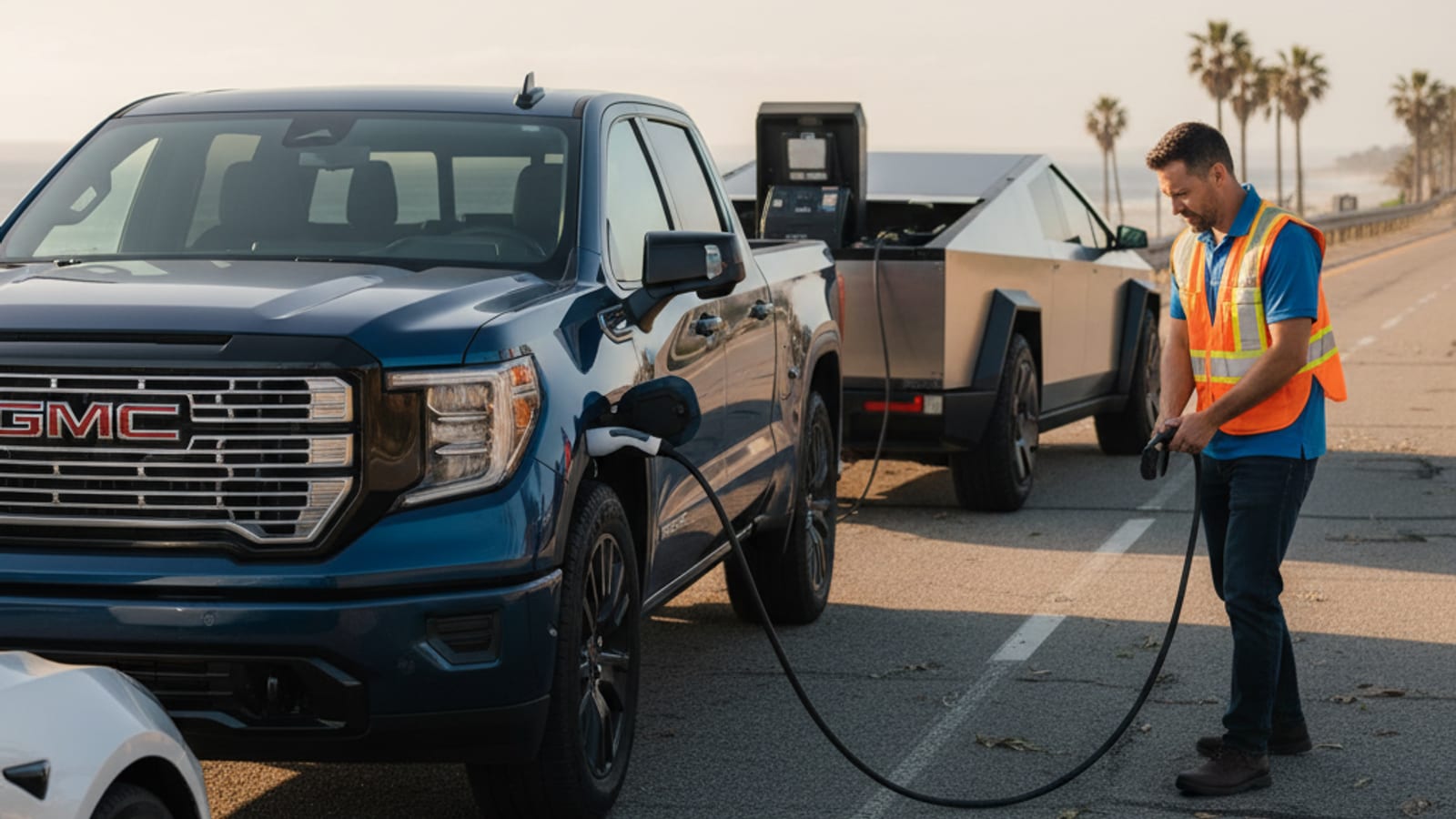
That search is GMC Sierra EV emergency charging. You already own the truck. You aren’t shopping for a garage wall unit. You need a plan for the moment the estimate lied. You need to know who can put energy in the port on a mountain interstate. You also need to know why a flatbed is often the wrong first call.
Charge Pro DEN is a referral line. We match stranded EV drivers with independent local mobile rescue operators. We don’t own trucks. We don’t employ technicians. We don’t set prices. We don’t promise an arrival window. The operator quotes you before any work starts. They bill you directly.
Why metro range isn’t mountain range
Denver sits at 5,280 feet on the State Capitol’s west steps. Golden is about 5,675 feet. Idaho Springs is 7,526. Georgetown is 8,530. The west portal of the Eisenhower-Johnson Memorial Tunnel is 11,158 feet. That’s the highest point on the U.S. Interstate system. A Sierra EV climbing that staircase is doing real work. Payload, a trailer, and a headwind make the draw worse.
Cold stacks on top of the grade. January’s normal low around the Front Range sits near 18 degrees. Denver’s all-time record is minus 29, set January 9, 1875. In January 2024 an arctic blast dropped the city from 47 degrees to minus 19 in about 48 hours. The pack has to heat itself. The cabin wants heat too. The motors still have to pull a heavy truck uphill.
Independent winter testing is blunt. Recurrent Auto studied more than 30,000 U.S. EVs. Packs retained about 78 percent of max range at 32 degrees. They retained about 70 percent at 20 degrees, on average. Heat-pump models held about 10 points more at 32. An AAA dynamometer study reported about 39 percent range loss at 20 degrees. Efficiency dropped about 35.6 percent in that same test. Your cluster in a Tech Center garage doesn’t show that math. I-70 does.
Regen on the way back down recovers a large share of the climb. A widely cited InsideEVs analysis puts recovery at roughly two-thirds of the energy spent going up. Corridor tests from Loveland Pass add color. A Lucid Air GT used about 3 percent of its battery over a 77-mile descent. A Hyundai Ioniq 5 used about 10 percent over 75 miles. Both credited regen. That’s helpful on a planned loop. It doesn’t help if you already stopped on the westbound shoulder. Drivers also dial regen down on ice for traction. That gives back less.
Towing a trailer, tools in the bed, and a rooftop box all raise the draw. The Sierra EV is a work truck. Treat it like one when you leave the metro. A buffer that felt generous on I-25 can vanish on the first long grade.
Wheat Ridge still feels like town
Wheat Ridge sits on I-70 before the foothills really take over. Golden is the last stop that still feels like the metro for a lot of westbound drivers. The Colorado School of Mines and the Coors brewery make Golden feel like a city pause, not a mountain commit. That’s the trap. Once you stay on I-70 past Golden, the grade is the job. Morrison and Red Rocks peel off toward SH-74. Evergreen is a climb of its own. Idaho Springs is already at 7,526 feet.
If you’re unsure whether you have the miles, the decision belongs in Golden. Turn around, charge, or call while you’re still on pavement that feels familiar. Waiting until the estimate hits single digits west of there is how a Sierra that still had metro range becomes a shoulder story.
The first minutes on an I-70 shoulder
When the truck starts to fade, look for a legal place to stop. CRS 42-4-1202 is the disabled-vehicle rule. Outside a business or residential district you may not leave a vehicle on the paved main-traveled part of a highway. The exception is a vehicle so disabled you can’t avoid stopping and can’t move it off the roadway. Hazards must be on under CRS 42-4-230. A violation is a class B traffic infraction. Plain read: if the Sierra truly can’t go farther, the shoulder with hazards on is the lawful place.
Do this, in order.
Turn on the hazards as soon as power starts to fade. Ease fully onto the shoulder if you can still roll. Stay in the cab unless the truck is in a worse spot than the traffic. Note mile markers. Note the next exit name. Note whether you’re eastbound or westbound. That’s what a dispatcher needs.
Colorado doesn’t use a fixed clock for abandonment. CRS 42-4-1803 to 1805 leave abandoned status to officer discretion on reasonable grounds. The statute sets no hour threshold. After a tow, notice and sale timelines apply. Don’t assume you can leave the Sierra overnight because a clock hasn’t run out.
COtrip.org and the 511 line are CDOT’s live source for I-70 closures. They also post traction-law and chain-law status. Traction law isn’t a calendar you memorize. CDOT activates Passenger Vehicle Traction Law by highway signage. In severe storms it can activate Passenger Vehicle Chain Law. Both show on COtrip. AWD or 4WD with M+S or winter tread at least 3/16 inch meets traction law. Two-wheel-drive vehicles need chains or an approved device. Check before you commit west of Morrison.
For the full shoulder sequence on this corridor, read Out of charge on I-70: what to do on the shoulder next.
Two ways a Sierra EV can look dead
An empty traction pack and a dead 12-volt battery can look the same from the driver’s seat. They’re not the same job.
The traction pack is the big battery that moves the truck. When it hits its protected floor, the Sierra won’t drive. Accessories may already have shut down. You need energy into the charge port.
The 12-volt runs computers, contactors, locks, and lights. If that small battery is flat, the truck may not wake. It may not unlock. It may not accept a charge even if the pack still has miles. Cold overnight soaks in a driveway are classic 12-volt jobs. So is a week in a cold lot at Denver International. A jump or an on-site 12-volt replacement is the fix. A long DC session isn’t.
If screens are dark and the fob does nothing, start with the 12-volt. If the truck drove until the range hit zero, then rolled to a stop with hazards still working, you’re looking at an empty pack. Tell the operator which one you think it is. They’ll confirm once they see the truck.
What CDOT and a toll road can do
CDOT Safety Patrol is free on covered segments. It handles flat tires, jump-starts, emergency fuel, minor mechanical help, debris, and incident support. Metro coverage includes parts of I-25 South from 120th Ave to Arapahoe Rd. It includes I-70 East from Wadsworth to Airport Blvd. It also covers portions of US-6, C-470, and I-225. The I-70 Mountain Corridor patrol covers Morrison to Vail.
Published hours on the Front Range are 6:00 to 9:30 a.m. and 2:30 to 7:00 p.m. weekdays. Weekends run 10:00 a.m. to 7:00 p.m. Mountain Corridor hours are 6:00 a.m. to 7:00 p.m. Friday through Sunday, plus significant weather.
The Safety Patrol pages mention nothing about electric vehicles. CDOT’s breakdown page is silent on EV charging too. That was confirmed on a 2026-09-18 read of both pages. The free state truck can jump a 12-volt and change a tire. It doesn’t bring a charge to a stranded EV. That’s a genuine hole in the state’s published guidance. It isn’t a knock on the patrol. It’s the limit of what they advertise.
E-470 is the eastern-metro loop. It’s all-electronic and cashless. A disabled driver pulls to the shoulder and dials *470. E-470’s own assistance covers flats, fluids, jump-starts, phone help, and debris. *CSP (*277) reaches State Patrol. E-470 doesn’t publish an EV-charging service. No EV-specific toll discount exists on that road.
I-25 North and US-36 Express Lanes were built with a minimum 8-foot outside shoulder. If you stall in those lanes, move to the right, outside shoulder. The I-70 Mountain Express Lane runs about 12 miles between the Veterans Memorial Tunnels near Idaho Springs and Empire Junction. Westbound has used dynamic tolling since November 25, 2024.
Colorado State Patrol handles crashes, enforcement, and dispatch. Abandoned-vehicle removal sits under CRS 42-4-1803. No Colorado statute addresses a disabled EV. None addresses mobile roadside EV charging. A stranded Sierra sits under the same disabled-vehicle rules as any other car.
Public charging if you can still roll
If the truck will still creep, a DC fast stall can end the night cleaner. The Sierra EV’s port standard depends on model year. Some trucks take CCS. Newer GM EVs have been moving to NACS. Filter the app for the plug you actually have. Don’t assume a Tesla Supercharger will take your truck. Confirm the site, the adapter, and your port in the app first.
Named sites you can plan around include Tesla Superchargers in Denver and Lakewood, which has three sites. Thornton, Northglenn, Westminster, Arvada, Brighton, and Longmont are on the inventory too. Castle Rock has 16 stalls. Highlands Ranch has 16. Centennial has 12. Lone Tree at Park Meadows has 10. Boulder has two sites. Idaho Springs has 8. Conifer has 8. EVgo lists 24 Colorado sites. Electrify America adds more DC fast coverage across the metro. PlugShare, ChargePoint, and the truck’s own nav are the live status tools. Inventory was pulled from NREL on 2026-09-18.
If you’re already stopped, walking to a stall isn’t a plan. A large pickup on an interstate shoulder isn’t a parking-lot problem. That’s when mobile EV charging is the useful call.
Idaho Springs is a common decision point for westbound drivers. The town sits at 7,526 feet on the Denver side of the tunnel. See EV charging in Idaho Springs if you still have enough roll to use a public stall there.
A portable cord is rarely the roadside answer
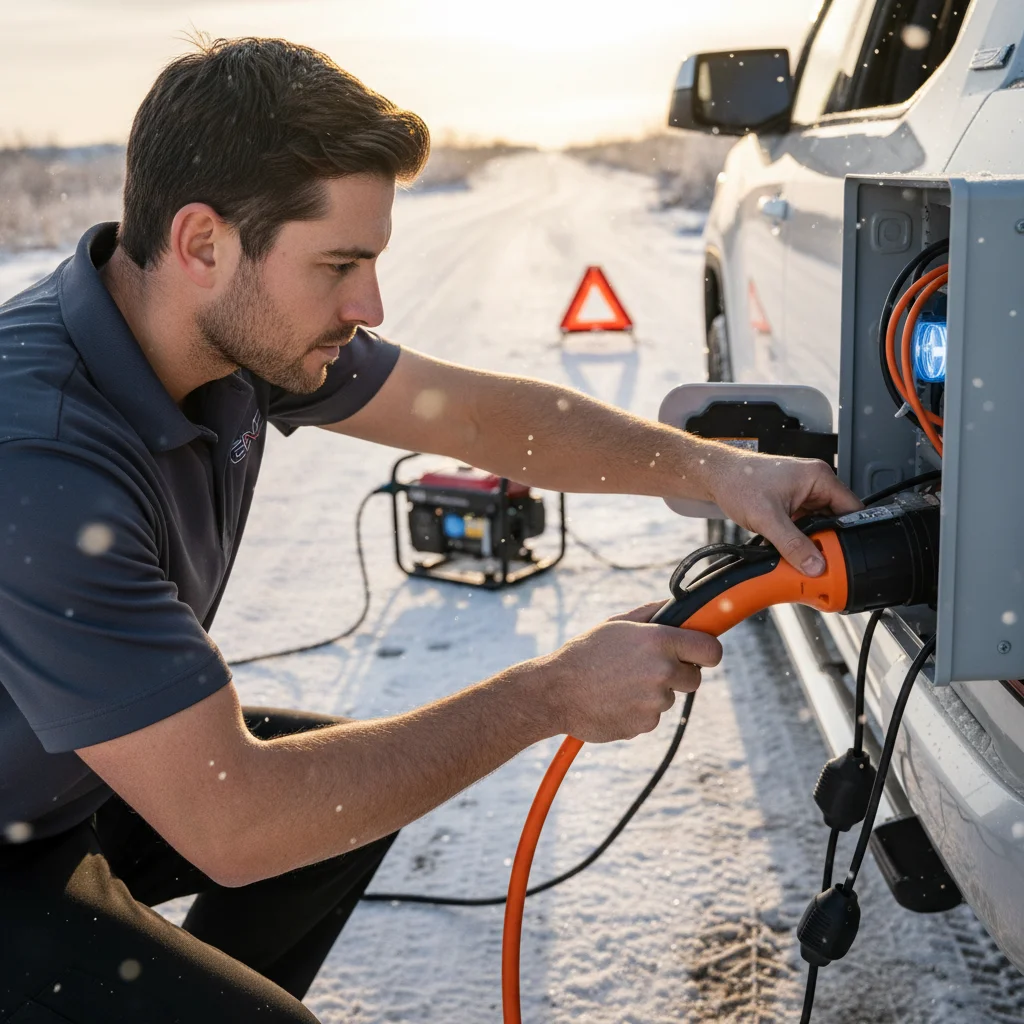
A Level 1 cord that plugs into a household outlet is too slow for a work-truck pack on a shoulder. You’d sit for hours to gain a handful of miles. A portable Level 2 unit needs a 240-volt receptacle. You almost never have one on I-70. Friends, shops, and RV pedestals are luck, not a procedure.
If you’re already in a driveway in Lakewood or Arvada and the wall unit failed, that’s a different night. On the interstate, don’t wait on a household outlet that isn’t there.
What a mobile operator actually brings
The operators Charge Pro DEN connects you with bring a 240-volt Level 2 source to the car. They carry a native NACS plug. They also carry a CCS or J1772 adapter for non-Tesla EVs. That covers a Sierra EV either way.
A typical session adds about 10 to 20 miles of range. Charging time is often 15 to 30 minutes once the cable is in. That window is charging time. It isn’t how long the operator takes to reach you. We don’t publish arrival times. We don’t publish hours. The operator tells you what they can do once they have your location and the truck’s state.
Ten to twenty miles is usually enough to reach a working public stall. It can also be enough to limp home if home is close. It isn’t a full pack. Nobody should sell you a full pack on the shoulder as the default job.
For a truck that hit true zero, out-of-charge recovery is the service name that matches the job. Because a Sierra isn’t a Tesla, non-Tesla EV rescue is the other page to read before you call.
The operator quotes before starting. Distance, time of day, how much range you need, and whether this is a 12-volt jump or a pack charge all move the price. We don’t set that number. The operator bills you directly.
Why a flatbed is often the slower path
A dead Sierra EV is a heavy electric truck with driven wheels. It shouldn’t be dragged on those wheels. That usually means a flatbed, not a simple hook. Loading on a narrow I-70 shoulder, in wind or snow, is its own delay. Then you still need a charger at the other end.
The Colorado Towing Bill of Rights, HB22-1314, took effect August 10, 2022. It regulates nonconsensual tows and requires written notice before most private-property tows. The Colorado Public Utilities Commission regulates towing carriers. Exact fee figures aren’t confirmed here. Ask the carrier to quote before the truck is hooked.
If the drivetrain is fine and the only problem is energy, charging in place avoids the load. It also avoids the yard and a second wait at a stall. If a control arm is broken, or the truck won’t go into the right tow mode, then a flatbed is the right tool. Match the call to the failure. What towing a dead EV in Colorado actually involves walks through the EV-specific parts.
Don’t wait on another EV to charge yours
Some trucks advertise onboard outlets. That power is for tools, coolers, and jobsite loads. It isn’t a standard way to refill another EV’s traction pack on a freeway shoulder. Bidirectional charging exists on some models. It isn’t a roadside protocol you should count on in a storm west of Golden.
If you want the honest version of that hope, read Can one EV charge another when you’re stuck on a metro freeway. Bring a mobile Level 2 source. Or roll to a public stall. Don’t block a second EV on the same shoulder while you experiment.
Manufacturer roadside, insurance, and a local operator
A new Sierra EV may include a factory roadside plan for a limited term. Read the card in the glovebox. Many of those plans still think in tows, jump-starts, and lockouts. They may not send a charger. Insurance roadside is often the same. You get a jump or a tow. You don’t get a 240-volt session.
If factory roadside offers a tow to the nearest dealer, ask two things. Does that dealer have an open stall. Can the truck be charged at the dealer. Then decide.
A local mobile operator is the option built for an empty pack on the shoulder. Charge Pro DEN refers that call. We don’t perform the work.
Keep the truck fed at home, on the right utility
The metro isn’t one electric company. Telling every Sierra owner to call Xcel is wrong.
Xcel Energy covers the core metro and Boulder County cities, including Denver, Aurora, Lakewood, Golden, Wheat Ridge, Boulder, and the Clear Creek towns of Idaho Springs, Georgetown, and Empire. Look up EV Accelerate At Home, the RE-TOU rate, and Xcel’s other EV programs on their site. Dollar amounts aren’t confirmed here.
CORE Electric Cooperative covers the south-metro Douglas County corridor: Centennial, Highlands Ranch, Lone Tree, Parker, Castle Rock, Castle Pines, plus Conifer and Bennett. COREV Charge is at capacity and closed to new applications, per CORE’s own page. COREV Connect is still described as accepting enrollments. Don’t call Xcel from Castle Rock.
United Power owns much of the north and northeast. It splits streets with Xcel inside Thornton, Northglenn, Westminster, Arvada, Broomfield, and Erie. It’s the electric utility for Brighton and serves Commerce City. Confirm by address. Those split cities change by street.
Longmont Power and Communications is municipal. Longmont rebate and public-charging questions go to the City, not Xcel.
A Level 2 at home is how a work truck stays ready. Overnight charging on a time-of-use rate, if your utility offers one, keeps I-70 trips from starting already thin. Confirm programs with the utility that actually serves your meter.
Plan the westbound trip like a climb
Start westbound with more pack than the cluster says you need for the miles. Grade and cold will spend it. Check the truck’s nav and PlugShare before you leave. Use a route planner that knows elevation. Confirm the plug type your Sierra actually has.
Watch COtrip for traction law before Morrison. A Sierra EV on summer rubber is a problem when the signs flip. Meet the posted rule, not a guess. The signs and COtrip are the authority. A blog isn’t.
If you’re heading to Red Rocks in Morrison, or home to Evergreen, the last flat miles aren’t the ones that drain you. The climb is. Leave the show or the office with a reserve. Don’t leave with a hope.
Colorado crossed 200,000 registered EVs by October 2025, per the Colorado Energy Office. Battery-electric vehicles were 12.5 percent of new Denver-metro registrations year-to-date through June 2026, per CADA’s Q2 2026 Auto Outlook. The honest share is roughly one in nine new metro vehicles, not one in three. Plan as if the next stall might be busy.
If the truck sat at DEN, not on I-70
Denver International is reached only by Peña Boulevard. That’s an 11-plus-mile city-maintained freeway from I-70. It runs exposed across open plains. Peña closed in the March 2019 bomb cyclone. DIA closed all runways in that storm too. A Sierra left for a week in a cold garage or economy lot often comes back with a dead 12-volt, not an empty pack. That’s a jump or a 12-volt swap. Stall counts and free-charging claims for DEN parking weren’t independently confirmed. Don’t count on a specific garage charger until you see it in a live app.
What to tell the operator when you call
Have this ready.
Your exact location: mile marker, direction, nearest exit. Whether hazards are on. Whether you’re fully on the shoulder. Whether the truck still wakes. Whether it shows a range number or sits dark. Plug type if you know it. Whether you’re towing. Weather and traction-law status if COtrip has it up.
Charge Pro DEN refers that call at (720) 738-6950. We match you with an independent local operator. They quote before they start. They bill you. We don’t promise when they will arrive.
Frequently asked questions
What actually moves the price of a mobile charge?
The operator sets the number, not Charge Pro DEN. Distance to you moves it. Time of day moves it. A 12-volt jump is a different job than a pack charge. How much range you need moves it too. A Sierra on I-70 west of Golden is a different dispatch than a truck in a Denver driveway. Ask for the quote before anyone plugs in. If the quote isn’t a fit, say so.
Will CDOT Safety Patrol charge a GMC Sierra EV?
No. CDOT Safety Patrol will jump a 12-volt on covered segments during published hours. They’ll change a tire and help with other listed roadside tasks. Their pages don’t mention EV charging. For an empty traction pack you need a public stall you can still reach, or a mobile Level 2 source. Use the patrol for the 12-volt and for scene safety. Don’t wait on them for a charge that isn’t in their program.
Can another EV charge my Sierra on the shoulder?
Don’t count on it. Onboard outlets on a Sierra are for tools and jobsite loads. They aren’t a standard traction-pack refill for a second EV. Bidirectional gear on some other models isn’t a freeway procedure. Call for a mobile charge. Or roll to a public CCS or NACS stall if you still can.