Two Model Ys on an I-25 shoulder can’t share a traction pack. Parking next to another EV doesn’t move miles from one car to the other. Most passenger EVs have no way to export pack energy. A few trucks can, through a 240-volt outlet. Independent operators bring that same kind of Level 2 source to the stranded car.
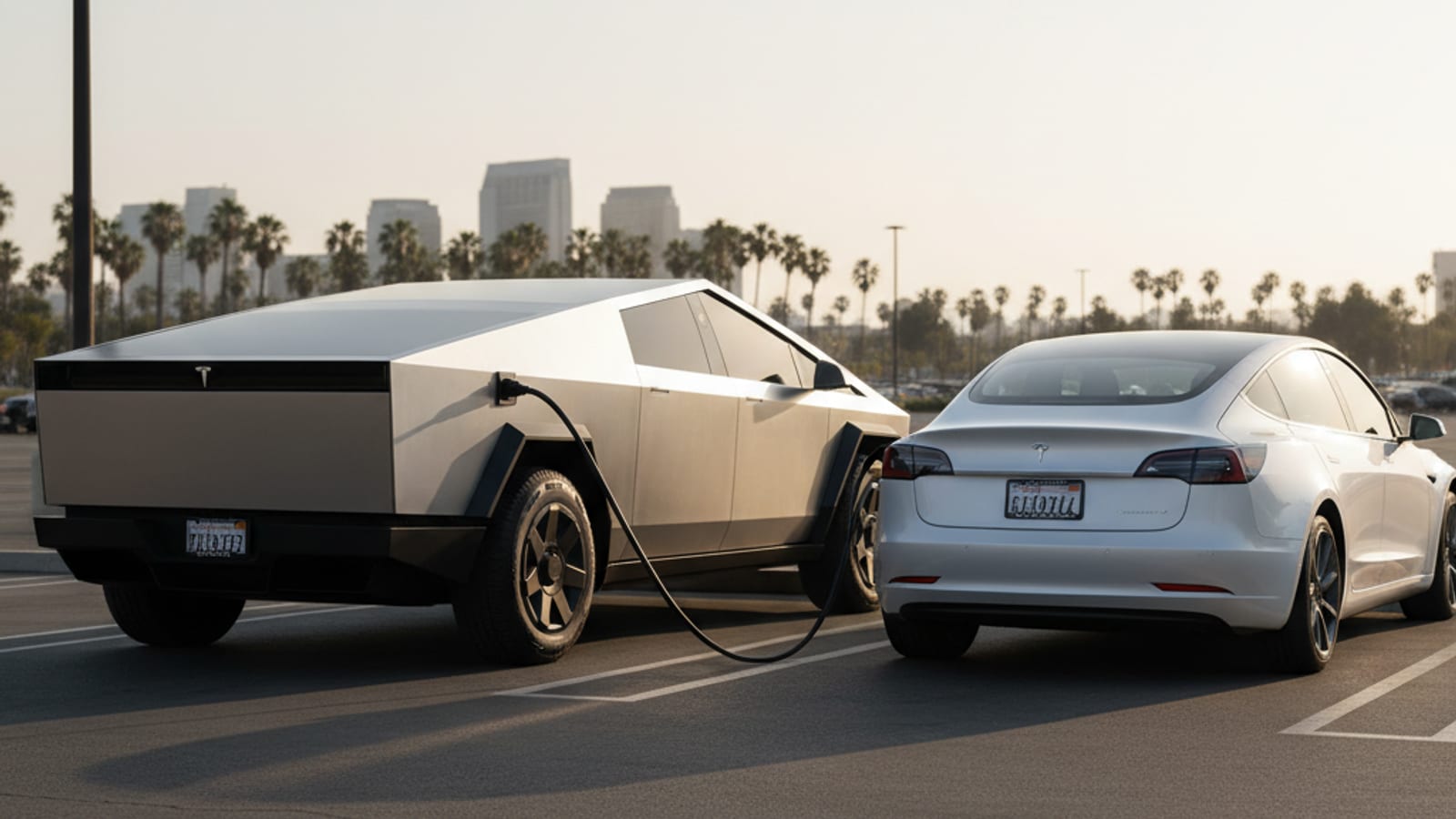
What this looks like on a Front Range freeway
Drivers ask this after a low-battery warning on I-25, I-70, or US-36. A friend in another Tesla offers to help. Both cars sit on the right shoulder with hazards on. CRS 42-4-1202 lets a truly disabled vehicle stay there. It doesn’t create a charging method. No Colorado statute covers EV-to-EV transfer or mobile charging. The same disabled-vehicle rules apply as they do to a gas car.
CDOT Safety Patrol covers I-25 South from 120th Ave to Arapahoe Rd. It also covers I-70 East from Wadsworth to Airport Blvd. Portions of US-6, C-470, and I-225 sit on the list too. The patrol can jump a 12-volt battery, change a tire, and clear debris. CDOT’s Safety Patrol pages mention nothing about charging an empty traction pack. Front Range hours are 6:00 to 9:30 a.m. and 2:30 to 7:00 p.m. on weekdays. Weekends run 10:00 a.m. to 7:00 p.m. E-470’s *470 line is the toll loop’s own help. You’ll get jumps and tires there, not a pack charge.
A second EV in the next lane still doesn’t fill your pack. It only helps if that vehicle can export 240-volt AC.
On the I-25 North and US-36 Express Lanes, CDOT built a minimum 8-foot outside shoulder. Move right if you stall. Don’t wait in a travel lane for a friend to back up.
Why a regular Tesla can’t feed another Tesla
A Model 3, Y, S, or X stores plenty of energy in the traction pack. The missing piece is an outlet that can send that energy out. The onboard charger turns wall AC into DC for the pack. It isn’t built to run that path backward at useful power. Tesla has shown bidirectional charging in lab demos and investor events. It isn’t a feature on those four models in the current fleet.
The 12-volt jumper points at the tow eye are a different system. They can wake another car’s 12-volt battery. They can’t fill a traction pack. If the screen is dark and the handles won’t release, start with the 12-volt. You may have a 12-volt failure, not an empty pack. That’s a jump, not an EV-to-EV charge.
Commuter EVs follow the same hardware choice. A Mustang Mach-E, a Polestar, and most sedans don’t expose pack power at a dryer-style outlet. Trucks sold with job-site and camp power are the ones that do.
Which EVs can export into another car
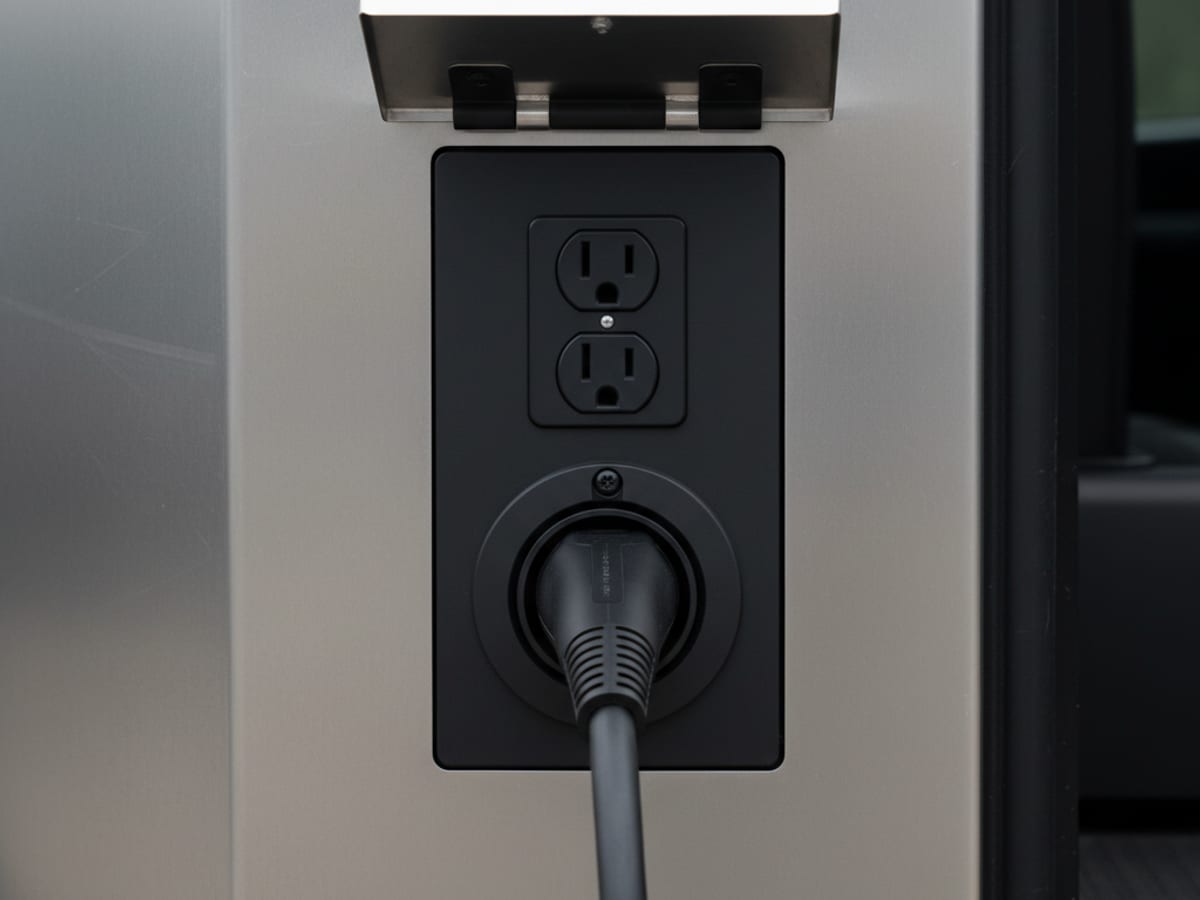
A Cybertruck with Pro Power has 240-volt outlets in the bed and the frunk. The bed-wall outlet is a NEMA 14-50, the same shape as many dryer plugs. Tesla rates that outlet up to 9.6 kW continuous. That’s enough to feed a portable Level 2 charger into another car’s NACS or J1772 port.
A Ford F-150 Lightning with Pro Power Onboard can do similar work. The extended setup also reaches 9.6 kW. The standard truck sits much lower, at 2.4 kW. Read our note on whether an F-150 Lightning can charge another EV on the roadside.
Hyundai Ioniq 5, Kia EV6, and Kia EV9 offer vehicle-to-load. They use an adapter on the charge port. Output is about 3.6 kW. That’s enough for tools or a small appliance. A Rivian R1T or R1S with camp outlets is 120-volt on those sockets. Not a plan for filling another pack on I-70.
The Silverado EV’s power takeoff is in that high-output group too. Lucid Air doesn’t currently export. Most Teslas in Denver traffic still can’t.
Adventure trucks export. Daily commuter EVs usually don’t. Don’t count on a random Model Y in the next lane.
What a roadside Level 2 visit actually is
Charge Pro DEN is a referral line. It doesn’t own trucks, and it doesn’t employ technicians. It matches stranded drivers with independent local operators. Those operators bring a 240-volt Level 2 source to the car. Tesla ports get a native NACS plug. CCS and J1772 cars get an adapter.
That stop isn’t a Supercharger session. Park Meadows in Lone Tree has a Supercharger. Highlands Ranch and Idaho Springs have Superchargers too. Those sites push far more power than a roadside Level 2 unit. Roadside charging is a bridge. Operators typically add 10 to 20 miles of range in 15 to 30 minutes of charging. That’s charging time on the cable, never an arrival time. The operator quotes you before work starts and bills you directly.
Read what a mobile EV charger brings to a stranded car. There’s also when a roadside Level 2 charger is the right call.
Cold changes how far those added miles go. Denver’s January normal low sits around 18 degrees. Recurrent Auto studied winter range on 30,000-plus U.S. EVs. They found about 78 percent of max range at 32 degrees. At 20 degrees, the average was about 70 percent. AAA’s 2026 dynamometer study pointed to about 39 percent range loss at 20 degrees. A climb toward Golden spends pack energy. Regen on the way back down returns a large share. Icy pavement is why some drivers ease regen off for traction. Size the boost for the road you still have to drive.
Why 240-volt AC shows up instead of a fast DC truck
A mobile DC fast charger is bulky, heavy equipment. High-voltage DC on an open shoulder also asks more of the setup. 240-volt AC uses the stranded car’s own onboard charger and its built-in protections. An operator can manage that cable on a live shoulder. You get enough miles to roll to a public stall, not a full pack.
That’s why the charging levels that actually help a stranded Denver EV matter. Level 1 from a 120-volt outlet is a trickle. A Supercharger is the fast public option once you can move. Level 2 in place is the middle that gets you off the shoulder. The mobile EV charging page explains how the referral works.
Don’t improvise this with a dryer cord from a neighbor’s truck. High-power AC needs the right cable, grounding, and a charger meant for the job. A melted connector on C-470 is a worse afternoon than waiting for a quoted operator.
If you stall on I-25, I-70, or Peña Boulevard
Put the hazards on and stay out of the travel lanes. On E-470, *470 reaches that road’s own assistance for jumps and tires. For an empty pack, you still need a charge source. Stranded with no charge on I-25 walks through the shoulder steps. Out-of-charge recovery is the service path when the pack is the problem.
Peña Boulevard is the only road into Denver International Airport. It’s city-maintained, not an interstate. A week in a cold DEN lot more often kills the 12-volt than the traction pack. Confirm which system failed before you ask anyone to charge the other car.
Home charging is a different question. Xcel Energy serves Denver, Aurora, Lakewood, Boulder, and much of the core metro. CORE Electric Cooperative covers the Douglas County south metro. That includes Castle Rock, Parker, Highlands Ranch, and Lone Tree. United Power covers much of the north and northeast. It splits streets with Xcel in Thornton, Westminster, Arvada, Broomfield, and Erie. Longmont Power and Communications is the City of Longmont’s utility. None of those programs put a plug on the freeway. Confirm your utility at home. On the shoulder, you need a mobile Level 2 source or a reachable stall.
Battery-electric vehicles were 12.5 percent of new Denver-metro registrations year-to-date through June 2026. Most of those cars still can’t charge yours.
If you need a match with a local operator, call (720) 738-6950. The operator sets the price and tells you what the visit includes before work starts.