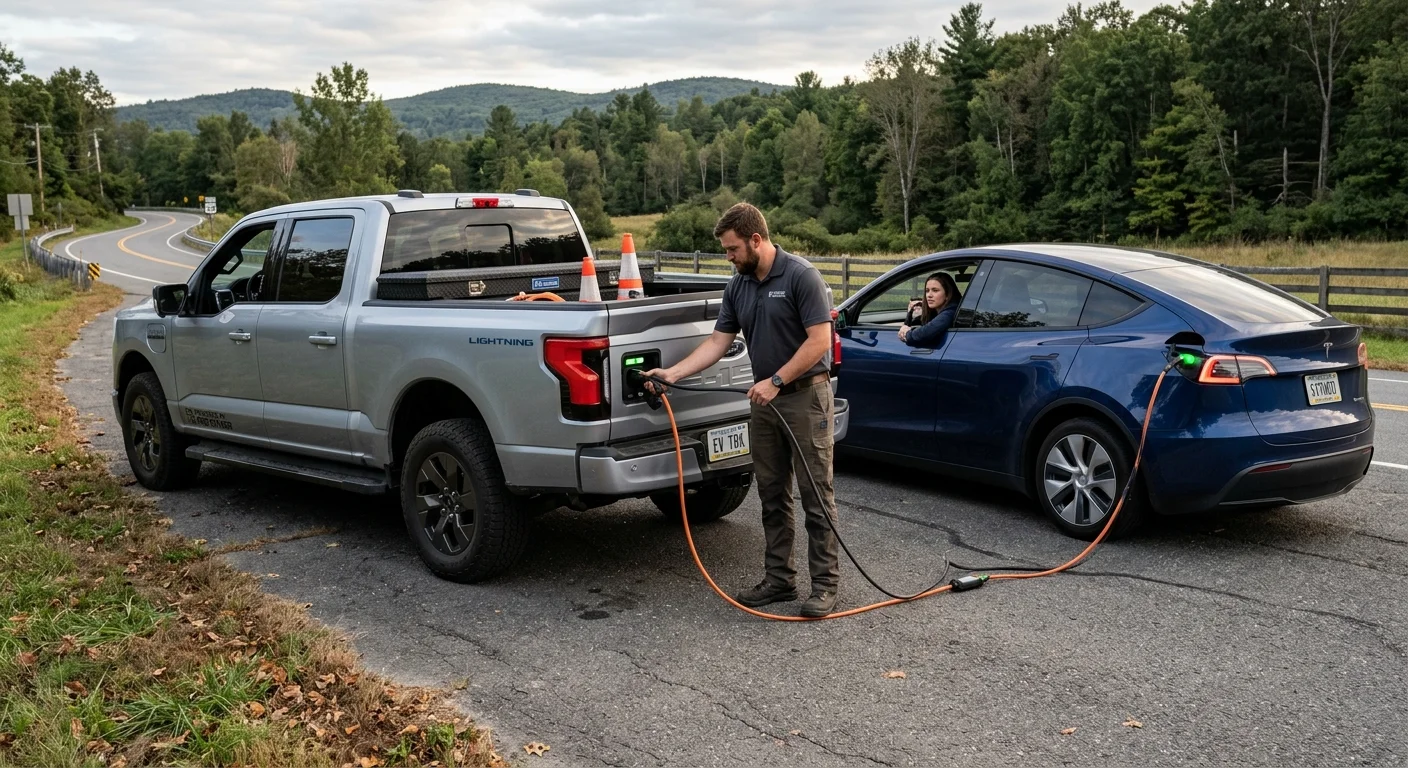
A Ford F-150 Lightning can feed another EV from its bed outlets. That’s still not a roadside rescue on I-25 or I-70. Pro Power Onboard is vehicle-to-load, not a dedicated charge truck. You need extra gear, time on the shoulder, and miles you’re willing to give away.
Sharing power isn’t the same as a rescue charge
Ford built Pro Power Onboard for tools, camp loads, and home backup. The current comes from AC outlets in the bed and cabin. It doesn’t come from the truck’s DC fast-charge port. That matters on a Front Range shoulder. You’re plugging a portable charger into a generator-style outlet. You’re not doing a truck-to-car DC handshake.
Higher trims can put out 7.2 kW or 9.6 kW. The base setup is 2.4 kW. Even the top figure is still Level 2 AC. It’s not a Supercharger session at Park Meadows or Highlands Ranch. A stranded pack still needs a prepared kit, not a favor from the next pickup.
What CDOT will do, and what it won’t
CDOT Safety Patrol can help on listed metro freeway segments. Coverage includes parts of I-25 South from 120th Avenue to Arapahoe Road. It also includes I-70 East from Wadsworth to Airport Boulevard. Portions of US-6, C-470, and I-225 are in the same program. The I-70 Mountain Corridor is covered from Morrison toward Vail.
Front Range weekday hours are 6:00 to 9:30 a.m. and 2:30 to 7:00 p.m. Weekends run 10:00 a.m. to 7:00 p.m. Mountain Corridor hours are 6:00 a.m. to 7:00 p.m. Friday through Sunday, plus significant weather.
The patrol handles flats, 12-volt jumps, emergency fuel, debris, and minor mechanical help. CDOT’s Safety Patrol pages mention nothing about EV charging. That absence was confirmed on both pages in September 2026. A Lightning sharing power isn’t filling a state product. The free patrol truck won’t bring a Level 2 cable to a dead pack.
E-470 is a cashless toll loop with its own help line. A disabled driver pulls to the shoulder and dials *470. That’s flats, fluids, jumps, phone help, and debris. *CSP reaches State Patrol on that road. E-470 doesn’t publish an EV-specific charge or toll discount.
CRS 42-4-1202 lets a genuinely disabled vehicle sit on the shoulder with hazards on. Stopping on the paved travel lanes without that excuse is a class B traffic infraction. There’s no Colorado statute for mobile EV charging. A stranded EV follows the same disabled-vehicle rules as any car. Abandoned-vehicle calls under CRS 42-4-1803 sit on officer discretion. The statute doesn’t set a fixed hour threshold.
On I-25 North and US-36 Express Lanes, CDOT built a minimum eight-foot outside shoulder. Move to that right shoulder if you stall. Don’t uncoil cables in a travel lane.
The kit most Lightning owners don’t carry
The bed outlet isn’t an EV plug. You need a portable EVSE with a NEMA 14-50 inlet. That plug matches the Lightning’s 240-volt receptacle. Then you need the right nose for the other car.
Most non-Tesla EVs here take J1772 on AC. A Chevy Bolt, Hyundai Ioniq 5, Volkswagen ID.4, or Mustang Mach-E wants that J1772 handle. A Tesla needs a J1772-to-NACS adapter on top of it. Skip either piece and you’ve got kilowatts with nowhere to go.
That’s the same family of problem as charging one EV from another. The Lightning is a stronger AC source than a passenger EV. It still isn’t plug-and-play rescue gear.
Check ratings on the EVSE and adapters before you try. Cheap cords get brittle after an 18-degree January night. Denver’s January normal low sits around 18 degrees. The January 2024 arctic blast dropped Denver from 47 to minus 19. That swing happened in about 48 hours, January 16 and 17. That’s a bad night to invent a wiring setup on the shoulder.
How many miles you actually add
Manage the clock. Pro Power Onboard, even at 9.6 kW, is a Level 2 drip.
A 2.4 kW bed setup adds about 8 to 10 miles per hour. That’s on a typical EV that will accept AC. A 7.2 kW trim is closer to 20 to 25 miles per hour. A 9.6 kW setup can reach about 30 to 35 miles per hour. Those are charging rates, not anyone’s arrival time.
Front Range geography eats those miles. Golden sits near 5,675 feet. Evergreen is about 7,200. The west portal of the Eisenhower-Johnson Memorial Tunnel is 11,158 feet. Climbing I-70 or SH-74 spends pack energy on elevation.
Recurrent Auto’s winter study used more than 30,000 U.S. EVs. On average they kept about 78 percent of max range at 32 degrees. At 20 degrees that figure was about 70 percent. AAA’s 2026 dynamometer study reported about 39 percent range loss at 20 degrees. A 20-mile gift in an hour can vanish on a cold climb.
A few miles to a known stall is a fair Lightning favor. Tesla Superchargers sit in Denver, Lone Tree at Park Meadows, Centennial, and Highlands Ranch. Lakewood, Boulder, Thornton, Castle Rock, and Idaho Springs have sites too. Sitting on the interstate for an hour still isn’t a good plan.
A dedicated mobile EV charging stop is built for the stranded-car job. The operators Charge Pro DEN connects you with bring a 240-volt Level 2 source. They use a native NACS plug. CCS or J1772 adapters cover non-Tesla EVs. Typical charging time adds 10 to 20 miles of range in 15 to 30 minutes. That’s charging time, never a promise of when someone arrives. You’re not draining a friend’s Lightning to do it.
When a Lightning assist makes sense
A driveway in Wheat Ridge is a different scene from a live freeway. A quiet lot after a Red Rocks show is calmer than I-70. If a neighbor woke short, Pro Power Onboard can cover a few miles. That’s the use Ford had in mind, along with camping.
It’s a poor fit when the car is dead on I-25 through Denver. It’s a poor fit on I-70 or C-470 toward the foothills. US-36 toward Boulder and Peña Boulevard out to the airport are the same problem. Wind on the plains east of Aurora makes a long cable setup worse. You’d stand on a live shoulder and give away your own miles. The other driver would still wait on a slow AC fill.
It’s also the wrong tool if the other car won’t wake at all. Many dead-EV calls here are a 12-volt, not an empty traction pack. A Lightning’s AC outlets won’t jump a sleeping computer. If a Lightning itself won’t ready after a cold soak, start with the 12-volt. See the Ford Lightning no-start note. That’s not a Pro Power demo.
Don’t use the truck as someone’s daily charger. You’d cycle your pack to feed theirs, then still need to charge your own. Routine miles belong on a home circuit. The metro spans Xcel Energy, United Power, CORE Electric Cooperative, and Longmont Power and Communications. Confirm the utility by address in split cities like Thornton, Westminster, Arvada, Broomfield, and Erie.
What a rescue charge actually brings
What a mobile charger brings is the EVSE and the adapters. The operator quotes before work starts. Charge Pro DEN doesn’t own the trucks. It doesn’t employ the technicians. Independent local operators bill the driver directly. They handle Tesla and every major EV brand. They can also jump or replace a dead 12-volt on site. That’s when the pack still has energy but the car won’t boot.
That’s the gap a generous Lightning can’t close. You might have kilowatts in the bed. You probably don’t have the portable EVSE or the NACS adapter. You also don’t have a safe hour on an I-25 shoulder. Level 2 at the roadside is the right call when the car needs miles, not a tow. Call that when you don’t have the Lightning kit.
If you’re the one who’s empty, stay in the vehicle with hazards on. Check COtrip for I-70 closures and traction-law status if you were heading into the mountains. Traction law activates by signage and COtrip, not a date you guess. Don’t walk a live lane looking for a Lightning. Call for a charge in place, or a tow if the car can’t take power.
Colorado crossed 200,000 registered EVs by October 2025. Battery-electric vehicles were 12.5 percent of new Denver-metro registrations year-to-date through June 2026. Sharing power between friends is still a courtesy, not a patrol.
If you need a charge, not a favor
If your pack is empty in the Denver metro, don’t wait on a stranger’s Lightning. Call (720) 738-6950. Charge Pro DEN will connect you with a local operator. That operator quotes you before starting and bills you directly.