Your Tesla or CCS car is sitting on the I-25 shoulder with hazards on. Colorado doesn’t have a special EV breakdown statute. A disabled electric car follows the same shoulder rules as any stalled vehicle.
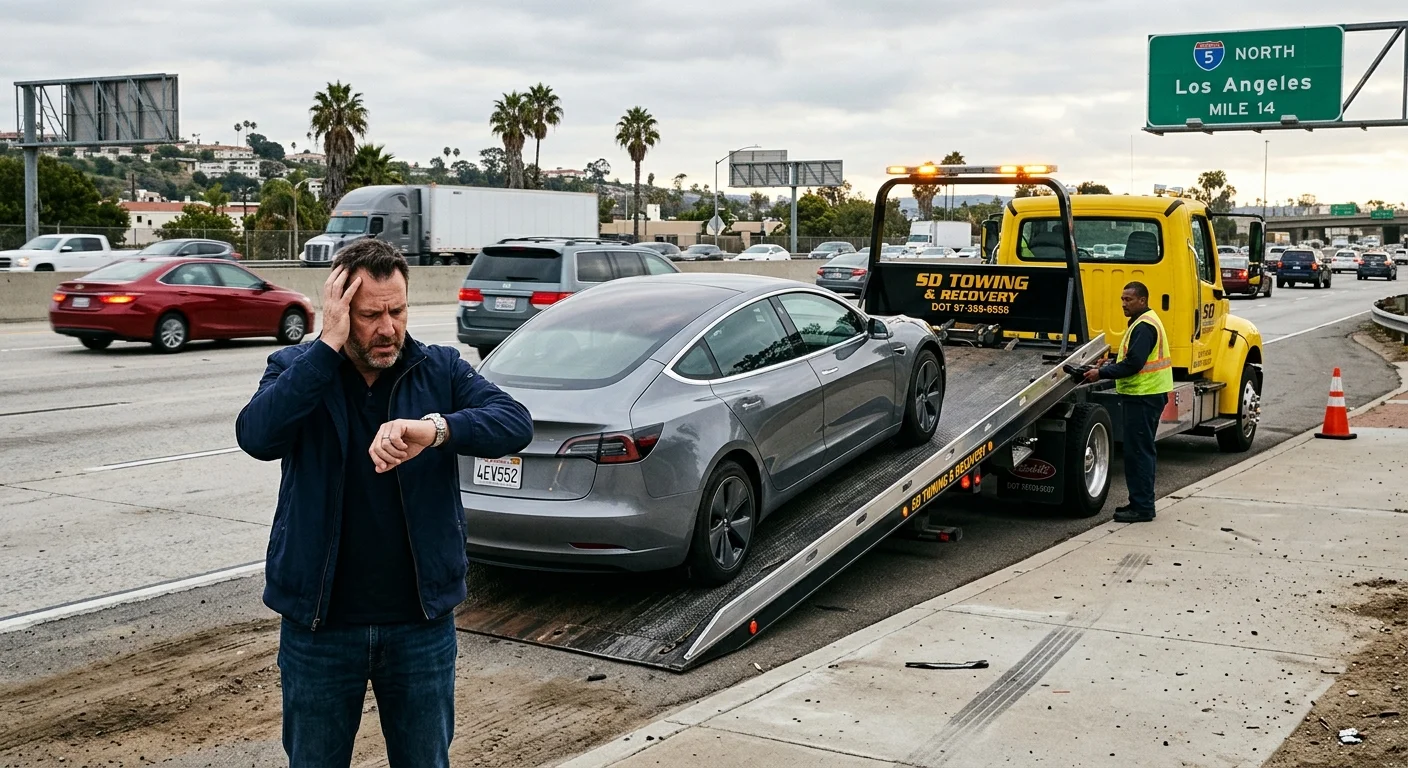
Colorado treats a dead EV like any other stalled car
CRS 42-4-1202 is the disabled-vehicle statute. Outside a business or residential district, you can’t stop on the paved roadway. The exception is a vehicle so disabled it can’t be moved off the travel lanes. Hazards have to stay on, under CRS 42-4-230. A violation is a class B traffic infraction.
There’s no EV carve-out in that statute. No Colorado law addresses a disabled EV or mobile roadside charging. That absence was confirmed against the statutes in September 2026. The EV-specific laws on the books cover HOA charging access and charging-space parking. Your empty pack doesn’t change the legal picture. It only changes what kind of help actually gets you moving.
Stay on the shoulder with the hazards lit. Don’t roll a powerless car into a live lane.
What CDOT will do, and what it will not
CDOT Safety Patrol covers I-25 South from 120th Avenue to Arapahoe Road. It also covers I-70 East from Wadsworth to Airport Boulevard. Portions of US-6, C-470, and I-225 are in the program too. The I-70 Mountain Corridor is covered from Morrison to Vail.
They publish help for flat tires, jump-starts, emergency fuel, minor mechanical issues, debris, and incidents. Front Range weekday hours are 6:00 to 9:30 a.m. and 2:30 to 7:00 p.m. Weekends run 10:00 a.m. to 7:00 p.m. Mountain Corridor hours are 6:00 a.m. to 7:00 p.m. Friday through Sunday, and during significant weather.
Their pages mention nothing about electric vehicles or bringing range to a stranded pack. That’s a real gap in the state’s published guidance. They can jump a 12-volt battery and change a tire. They don’t bring a charge to an empty traction pack.
On E-470, pull to the shoulder and dial *470 for the authority’s own help, or *CSP for State Patrol. No EV-specific charging service is published there either.
COtrip.org and the 511 line are the live sources for I-70 closures and traction-law status. CDOT activates traction rules by signage and on COtrip. A 2WD EV still needs the posted traction device, just like a 2WD gas car.
A tow is not a hook and a ride
When the pack is empty, a lot of drivers default to a tow. That’s the right call after a crash or a mechanical failure. It’s also right when the car won’t accept a charge. For a car that only ran out of miles, a tow is a bigger job.
Most EVs can’t be dragged on two wheels. Wheel-lift trucks leave the drive wheels on the pavement. That can load the motors, the reduction gear, and regen hardware that wasn’t meant to freewheel unpowered. When the 12-volt is also dead, transport mode and the parking brake may not release. A flatbed, with all four wheels off the ground, is the usual safe method.
Tesla has its own published towing procedure when the car has no power. An operator who hasn’t done this work can still hook the car. That doesn’t mean the drivetrain survives the ride. Read how to tow a Tesla with no power before you wave someone in.
The Colorado Public Utilities Commission regulates towing carriers. The Towing Bill of Rights, HB22-1314, covers nonconsensual tows. It requires written notice before most private-property tows. It limits drop fees when a tow is halted on residential property. Carriers have to accept cash and cards. They can’t tow for expired plates alone without a law-enforcement order. That bill is about private lots and consent. It doesn’t set what a consensual highway recovery costs. It also doesn’t tell you whether a charge in place would’ve been enough.
Abandoned-vehicle rules sit in CRS 42-4-1803 to 1805. An officer decides on reasonable grounds that a vehicle is abandoned. The statute doesn’t use a fixed clock. Don’t assume you have a set number of hours on a metro shoulder. Colorado State Patrol handles enforcement, crash response, and dispatch. It also holds abandoned-vehicle removal authority under that statute.
What actually moves the cost to tow an EV
People search “cost to tow an ev” because they want a number. No honest page can give you one. Operators quote before they start, and they bill you directly. Distance, time of day, corridor, and equipment are what move that quote.
A recovery on I-25 through Denver isn’t the same job as I-70 west of Golden. Past Idaho Springs toward the Eisenhower-Johnson Memorial Tunnel, the west portal sits at 11,158 feet. A flatbed climbing that corridor in weather, with traction law possibly active, isn’t a city-street pickup in Glendale or Wheat Ridge.
Time of day matters because traffic and weather stack. A weekday peak on I-25, C-470, or US-36 is slower pavement. A night sit on Peña Boulevard is exposed plains. That’s the 11-plus-mile city-maintained freeway into Denver International. Ground blizzards have closed it before, including the March 2019 bomb cyclone. It’s why two quotes for a tow aren’t comparable.
Special equipment moves the quote too. A flatbed isn’t a wheel-lift. Winching a locked EV onto the bed takes a crew that knows the model. If the 12-volt is dead, the car may not go into tow mode. That’s extra work on the shoulder, not a line item you can guess from a website.
Where the truck is told to take you also changes the bill. A shop, a public stall, or your driveway are three different miles. A stall that’s occupied, down, or on the wrong connector leaves you sitting in someone else’s lot. Then you’re arranging another move. That second move is how a simple tow grows.
How much range you actually need is the question a tow never asks. If the car will still accept a charge, you may only need miles, not a relocation. Operators in this network typically add 10 to 20 miles of range in 15 to 30 minutes of charging time. That’s charging time on site, not an arrival promise.
For a clear split between moving the car and charging it where it sits, read charge in place or tow. The operator you’re connected with quotes you before any work starts. If the quote isn’t right for you, you don’t have to proceed.
Cold, elevation, and why the pack hit zero
January’s normal low around Denver is about 18 degrees. The all-time record is minus 29. The January 2024 arctic blast dropped the city from 47 to minus 19 in about two days.
Recurrent Auto’s winter study of more than 30,000 U.S. EVs found they retain about 78 percent of max range at 32 degrees. At 20 degrees they retain about 70 percent, on average. AAA’s 2026 dynamometer work reported about 39 percent range loss at 20 degrees.
Climbing costs energy, and regen on the way down recovers a large share of that spend. Drivers still ease regen off on icy descents for traction. It does explain why the same trip that worked in July doesn’t work in January.
A car that won’t wake isn’t always an empty pack. The 12-volt is a separate battery. CDOT can jump that, and so can a local operator. A week in a cold lot at Denver International is a classic 12-volt sit, not proof the traction pack is at zero. Sort that before you pay to move the car. Charge, jump, or tow is the decision tree.
When a charge in place beats a flatbed
If the car is intact and will accept a plug, bringing 240-volt Level 2 to it is the smaller job. Native NACS on Teslas, with CCS or J1772 adapters for other brands. The car stays put. There’s no drivetrain load and no second drop at a stall that may not help you.
Mobile EV charging is that on-site boost. Charge Pro DEN is a referral line. It matches you with independent local mobile rescue operators. It doesn’t own trucks, employ technicians, or set prices. The operator quotes you before starting and bills you directly.
What moves a mobile-charge quote is where you are, how much range you need, and time of day. Who sets the price when a mobile charger reaches you walks through that. Compare it with mobile charge or tow for a stranded Denver EV if you’re still deciding.
A tow is still the right call when the car won’t take a charge, or you need a shop, not miles. Don’t force a charge into a car that needs a flatbed. Don’t flatbed a car that only needed a Level 2 lead.
Shoulder steps that keep you legal
Hazards on, and stay out of the travel lane. On I-25 North and US-36 Express Lanes, CDOT built a minimum 8-foot outside shoulder for breakdowns. Move to that right-side shoulder. Don’t sit in an express lane.
On a covered Safety Patrol segment during published hours, you can flag that free help for a 12-volt jump or a tire. It won’t fill the pack. If the traction pack is empty, you still need a charge or a properly equipped tow.
If you’re westbound on I-70 and weather is moving, check COtrip before you commit past Golden.
If you need a local operator
Call (720) 738-6950. We’ll connect you with an independent operator who quotes a charge in place, a 12-volt jump, or a flatbed. You hear the quote before work starts. You pay that operator directly.