A search for an ev rapid charger near me is a reachability problem. Tesla Superchargers sit across Denver, Aurora, and Lakewood. They also sit at Park Meadows in Lone Tree and around the Denver Tech Center. EVgo and Electrify America add DC fast stalls in the same metro. If remaining range can get you into a confirmed stall, drive there. If you’re already on a shoulder, you need a truck with a 240-volt source.
Superchargers are thick in the core
NREL’s 2026 inventory shows Tesla Superchargers in the cities Front Range drivers actually use. Denver has several sites. Park Meadows in Lone Tree shows Superchargers. So do Centennial, Highlands Ranch, Lakewood, Boulder, and Castle Rock. Thornton, Northglenn, Westminster, Arvada, Brighton, and Longmont do too. Idaho Springs and Conifer sit on the west side.
That’s a lot of DC fast hardware. It still doesn’t roll to a stopped car.
A pin in Greenwood Village doesn’t help on Peña Boulevard. A Park Meadows stall doesn’t help on C-470. Rapid charging is for cars that can still drive. A shoulder is a different job.
Confirm the stall, not just the listing
Treat “near me” as a starting list. Spend your last miles only on a stall you’ve checked tonight.
Open the operator’s own app or site first. Compare that with your car’s navigation. An old listing isn’t proof the cable works.
Before you commit remaining range, check:
- The connector matches your car, NACS, CCS, or J1772.
- The network shows the stall as available.
- You can enter the lot or garage when you arrive.
- Your car still predicts enough energy for the full route.
The U.S. Department of Energy lists CCS, CHAdeMO, and J3400 as DC fast connectors. Your EV might not take every plug. An adapter doesn’t make every stall compatible.
Live status is a signal, not a promise. Another driver can take the stall on the way. A unit can show online and still be dead.
If you’re planning a route, save more than one compatible station. Charging apps to check before you’re stranded walks through that prep.
Remaining range is an estimate on a cold night
Denver’s January normal low sits around 18 degrees. Recurrent Auto’s winter study found EVs keep about 78 percent of max range at 32 degrees. They keep about 70 percent at 20 degrees. AAA’s 2026 dynamometer work reported about 39 percent range loss at 20 degrees.
Your dash doesn’t owe you those miles. A route that looked fine at noon can fail after a long dwell. That happens at the Denver Tech Center and at Park Meadows. Count exits, garage ramps, and the last turn into the stall. If that path leaves no buffer, stop hunting a farther pin.
The January 2024 arctic blast dropped Denver from 47 degrees to minus 19. That swing happened in about 48 hours. Range math from a warm afternoon doesn’t survive that.
The route matters more than the pin
Downtown Denver chargers can sit on-street or inside a garage. A pin inside a structure can still be a dead end. The ramp climb can eat the last miles.
Along I-25, check the actual exit, not the bird’s-eye view. North metro through Thornton and Northglenn is one path. US-36 toward Boulder, Louisville, and Superior has its own ramps. CDOT built the I-25 North and US-36 Express Lanes with a wide outside shoulder. It’s at least eight feet. If you stall in those lanes, move to the right.
I-70 west through Wheat Ridge, Golden, and Idaho Springs is a climb. Drivers still ease regen on ice. COtrip.org and the 511 line carry CDOT’s live I-70 closures. Traction law turns on by highway signage.
E-470 is cashless. The E-470 Public Highway Authority runs it. A disabled driver on that loop pulls to the shoulder. You can dial *470 for E-470’s own assistance. That patrol handles flat tires, jump-starts, fluids, and debris. It doesn’t publish an EV charging service.
Peña Boulevard is the only road into Denver International Airport. The city maintains it. A week in a cold DEN lot is often a 12-volt problem. Don’t spend remaining range circling lots for a pin you haven’t confirmed.
CDOT can jump a 12-volt. It won’t charge the pack.
CDOT Safety Patrol is free on covered metro freeway segments. Coverage includes I-25 South from 120th Avenue to Arapahoe Road. It includes I-70 East from Wadsworth to Airport Boulevard. It also covers portions of US-6, C-470, and I-225. The I-70 Mountain Corridor is covered from Morrison to Vail. Weekday Front Range hours are 6:00 to 9:30 a.m. and 2:30 to 7:00 p.m. Weekend hours are 10:00 a.m. to 7:00 p.m. Mountain hours run 6:00 a.m. to 7:00 p.m. Friday through Sunday, and during significant weather.
The patrol lists flat tires, jump-starts, emergency fuel, and minor mechanical help. CDOT’s Safety Patrol pages say nothing about electric vehicles. The “my car broke down” page doesn’t either. They’ll jump a 12-volt battery. They won’t refill a traction pack. That’s why a shoulder still needs a truck.
If the car is truly disabled, stay off the traveled lanes with hazards on. CRS 42-4-1202 allows that when the vehicle couldn’t be moved. A violation is a class B traffic infraction. There’s no Colorado EV carve-out. CRS 42-4-1803 leaves abandoned-vehicle timing to officer discretion. Colorado State Patrol handles crashes and abandoned-vehicle removal. On E-470, *CSP (*277) reaches them.
A dark car isn’t always an empty pack
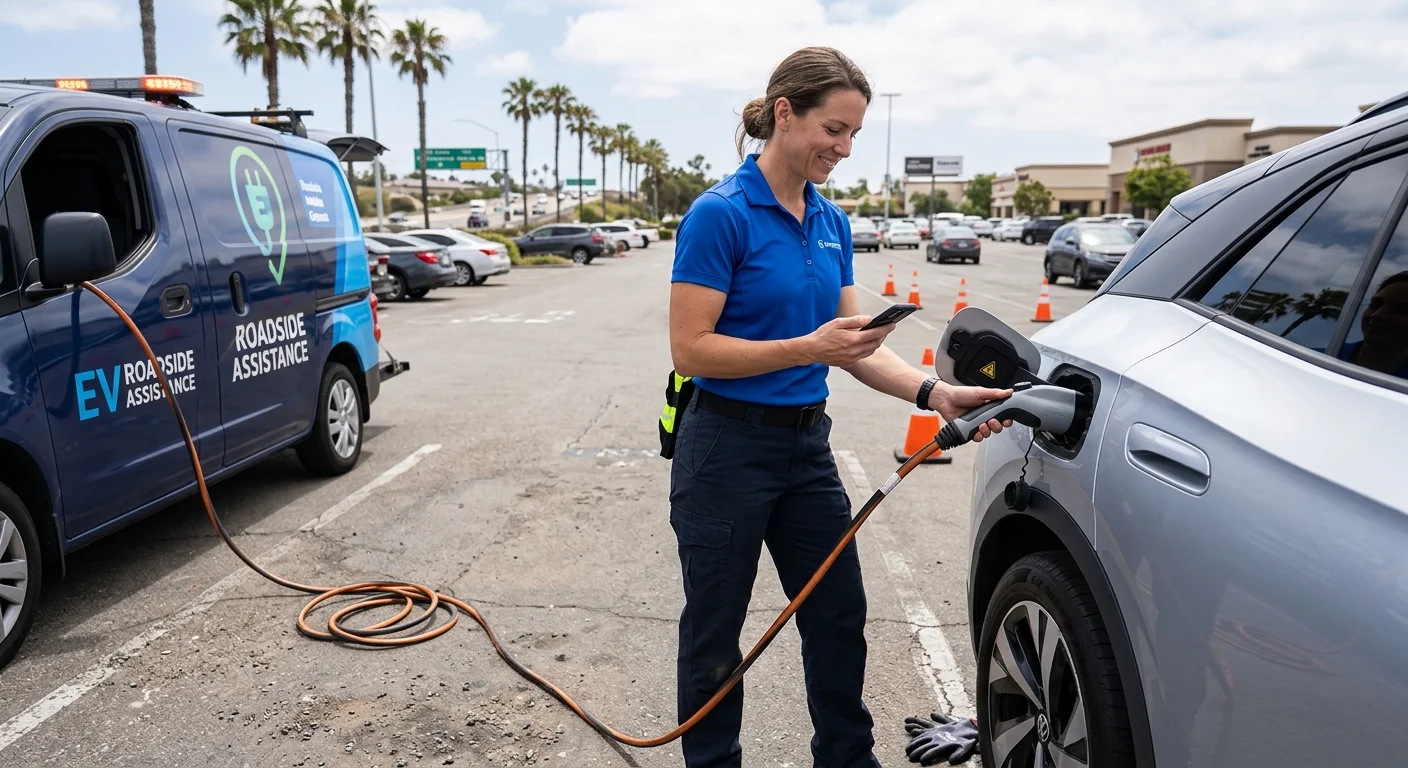
A black screen or locked doors can be a 12-volt failure. A car that won’t shift can be the same thing. That’s a separate battery from the traction pack. Independent operators in this network jump or replace a dead 12-volt on site. They also bring a 240-volt Level 2 source to the car. Teslas get a native NACS plug. Non-Tesla EVs use a CCS or J1772 adapter. Typical charging adds 10 to 20 miles of range. That takes 15 to 30 minutes of charging time. That’s charging time, never an arrival time.
If the 12-volt is dead, a Supercharger stall won’t wake the car. Sort the low-voltage system first. Our guide to which battery matters when you’re stranded walks that split.
If the pack is empty and the car still accepts charge, drive to a public DC stall. That’s the faster fill when you can still roll. If you can’t drive to it, mobile EV charging is the in-place option.
When a roadside Level 2 charge is the right call
Mobile charging fits when the EV is in a safe, legal spot and too low to reach a confirmed stall. The car still has to accept power. The point is enough miles to roll to a Supercharger or an EVgo stall.
Charge Pro DEN is a referral line. We match stranded drivers with independent local mobile rescue operators. We don’t own trucks. We don’t employ technicians. We don’t set prices. The operator quotes you before starting and bills you directly.
Before you ask for a truck, have the year, make, model, and dash message. Add a precise location and a pin when it’s safe. Say whether the car can shift, steer, and unlock.
“Denver” isn’t a location. Say I-25 northbound near the Tech Center. On E-470, say so, because *470 is already in play.
Mobile charging doesn’t fit when the port is damaged. It doesn’t fit when the car refuses power. Don’t diagnose over the phone. The operator decides whether the job matches their equipment.
For the equipment side, read what an EV charging truck brings.
When a flatbed is the honest next step
Transport fits when charging won’t fix the immediate problem. That includes a car that won’t accept power or a port that won’t open. It also fits when the car sits where a charging truck can’t work.
Don’t drive toward a stall because the pin looks close. Use the real route and the car’s own estimate.
If a tow is the path, follow the manufacturer’s loading rules. EVs differ by model. Tell the operator whether the car can enter transport mode. Say whether it can go into neutral and unlock the charge port. Colorado’s Towing Bill of Rights, HB22-1314, governs nonconsensual tows. The PUC regulates towing carriers. Confirm the operator’s plan and price before they hook up. Exact fee figures in that bill weren’t verified here.
Out-of-charge recovery is how we connect that call. We don’t tow. We don’t warranty the work.
If you’re already stopped on I-25 with no usable miles, start with stranded with no charge on I-25. When you can still roll, Supercharger vs EVgo and Electrify America in the metro helps you pick a network.
Call when the stall is no longer reachable
Call when the EV can’t safely reach a confirmed rapid charger. A mobile charge may fit. We’ll connect you with an independent local operator. That operator assesses the scene, quotes the work, and bills you.
Call (720) 738-6950 and we’ll connect you with a local EV rescue operator.