An EV charging truck brings a 240-volt Level 2 source to your stranded EV. It isn’t a Supercharger on wheels. The session adds enough miles to reach a public stall or home. Charge Pro DEN doesn’t own that truck or employ the tech. We’re a referral line for the Denver metro. We connect you with an independent local operator. That operator quotes you before starting, then bills you directly.
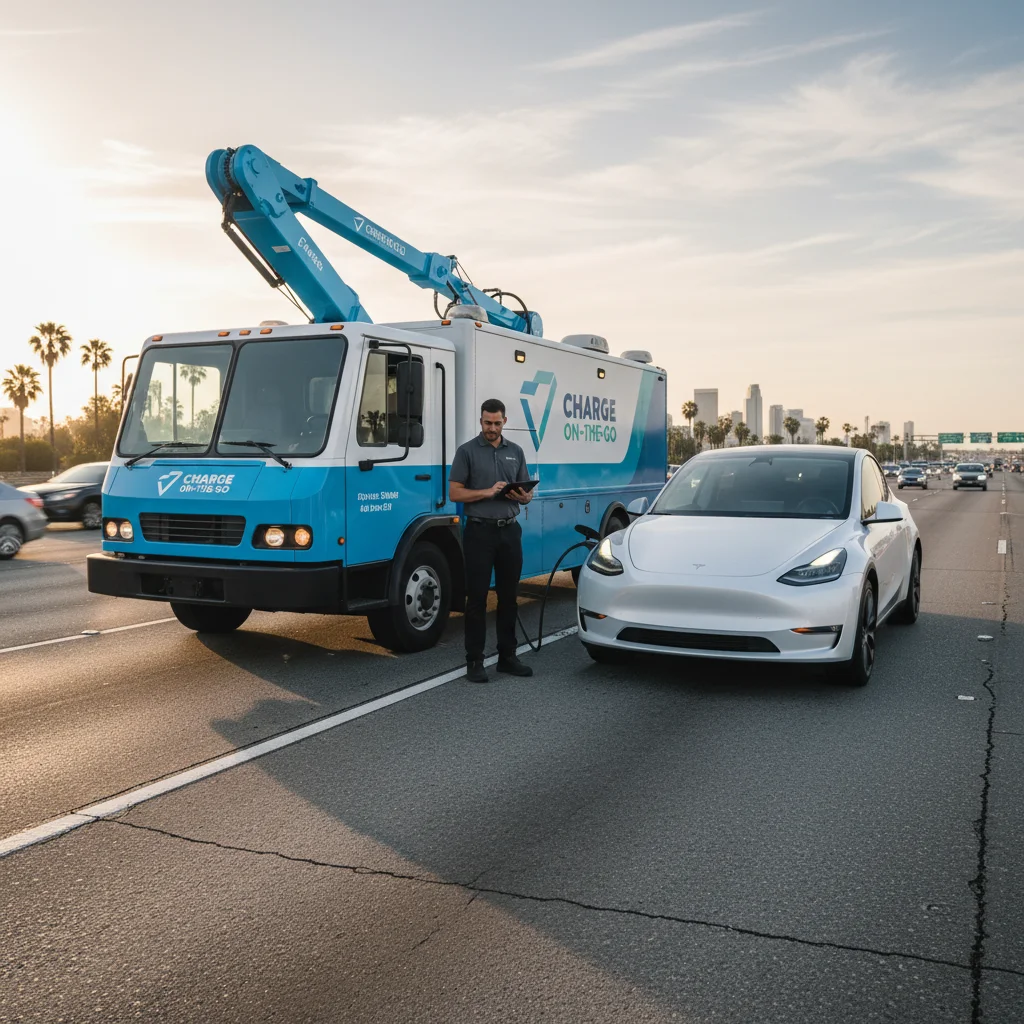
The search ev charging truck means a rescue vehicle that charges the car in place. It doesn’t start with a flatbed. Colorado has no statute that treats a dead EV as a special case. CRS 42-4-1202 applies the same disabled-vehicle rule as any other car. Put the hazards on and stay off the traveled lanes. Wait for the operator on the shoulder.
What the truck actually brings to your bumper
Independent operators in this network bring a 240-volt Level 2 source. They don’t arrive with a public DC fast stall. Native NACS is on the truck for Tesla and newer NACS cars. Non-Tesla EVs connect with a CCS or J1772 adapter. The goal is a usable boost, not a full pack.
A typical session adds about 10 to 20 miles. That’s in 15 to 30 minutes of charging time. Charging time isn’t an arrival time. Nobody here can promise when the truck shows. Weather on Peña Boulevard, backups on I-25, and I-70 holds all change that. The operator talks through the quote before any cable goes in.
Once you accept the quote, the operator plugs in. Stay with the car and keep the hazards on. Don’t stand in a live lane while the cable is connected. When the boost is in, you drive to a stall or home.
That boost is the point of mobile EV charging. You need enough range to roll to a known stall. Tesla Superchargers sit across the metro. A 2026 NREL pull lists sites in Denver, Lakewood, Thornton, Northglenn, Westminster, and Arvada. Brighton, Boulder, Longmont, Lone Tree, Centennial, Highlands Ranch, and Castle Rock show sites too. Idaho Springs has an eight-stall Supercharger on the I-70 west climb. Pick a stall you can actually reach after the boost.
If the pack is truly empty, that’s out of charge recovery. It isn’t a shop appointment.
Plugs for Tesla and every other major EV
NACS is Tesla’s compact plug. Ford, GM, Rivian, and others have moved new models onto it. Operators in this network carry a native NACS lead. CCS1 is still common on Hyundai, Kia, VW, BMW, Chevy, and Porsche cars. J1772 is the North American AC inlet on non-Tesla EVs. CCS adds DC pins under that J1772 face. For non-Tesla rescues, operators use a CCS or J1772 adapter on the Level 2 source.
You don’t need the standard name by heart. Say the year and model when you call. The operator confirms the adapter before they quote. Tesla and every major EV brand are in scope for this network.
Why a Denver stop isn’t a full charge
Denver sits at 5,280 feet at the State Capitol’s west steps. Evergreen is about 7,200 feet. Idaho Springs sits at 7,526 feet. The Eisenhower-Johnson Memorial Tunnel west portal is 11,158 feet. A climb toward the foothills spends energy a flat commute never sees.
January’s normal low here is about 18 degrees. Recurrent Auto’s winter study found EVs keep about 78% of max range at 32 degrees. At 20 degrees, the average is about 70%. AAA’s 2026 dynamometer work reported about 39% range loss at 20 degrees. In January 2024, Denver dropped from 47 to minus 19 in about two days. Cabin heat, a cold pack, and a grade will eat a thin buffer.
Descent can return some of that energy. Regen on Front Range grades is well documented. Drivers still ease regen on ice for traction. The truck doesn’t care which way the road tilts. It only cares that the car will take a Level 2 cable.
Colorado Energy Office counted more than 200,000 registered EVs statewide by October 2025. CADA’s Q2 2026 outlook put metro battery EVs at 12.5% of new registrations. That’s about one in nine new cars here.
Home power isn’t one utility. Xcel Energy covers Denver, Aurora, Lakewood, Golden, Wheat Ridge, and Boulder. CORE Electric Cooperative covers the south-metro Douglas corridor. That includes Centennial, Highlands Ranch, Lone Tree, Parker, Castle Rock, and Castle Pines. United Power covers Brighton and much of the north and northeast. It splits streets with Xcel in Thornton, Northglenn, Westminster, Arvada, Broomfield, and Erie. Longmont Power and Communications is Longmont’s municipal utility. Confirm the account by address before you blame the car.
Pack empty versus a dead 12-volt
Not every dead EV needs an EV charging truck. Many Front Range no-starts are the 12-volt, not the traction pack. The 12-volt wakes computers, locks, and contactors. If it dies, the car looks bricked even with miles left. Operators in this network can jump or replace that 12-volt on site.
A week in a cold lot at Denver International is a classic 12-volt story. Peña Boulevard is the only road in, an 11-plus-mile city-maintained freeway. Charging stall counts in DEN garages couldn’t be confirmed from flydenver.com. Don’t plan around a number that isn’t published. If the car won’t wake after a cold sit, start with the 12-volt.
The same pattern shows up after a long sit at Park Meadows in Lone Tree. It also shows up after a work day at the Denver Tech Center. The pack may be fine and the little battery may not. Ask the operator to check pack versus 12-volt before anyone hooks a tow.
For a pack-empty interstate case, see stranded with no charge on I-25. The hardware is the same idea in what a mobile EV charger actually brings.
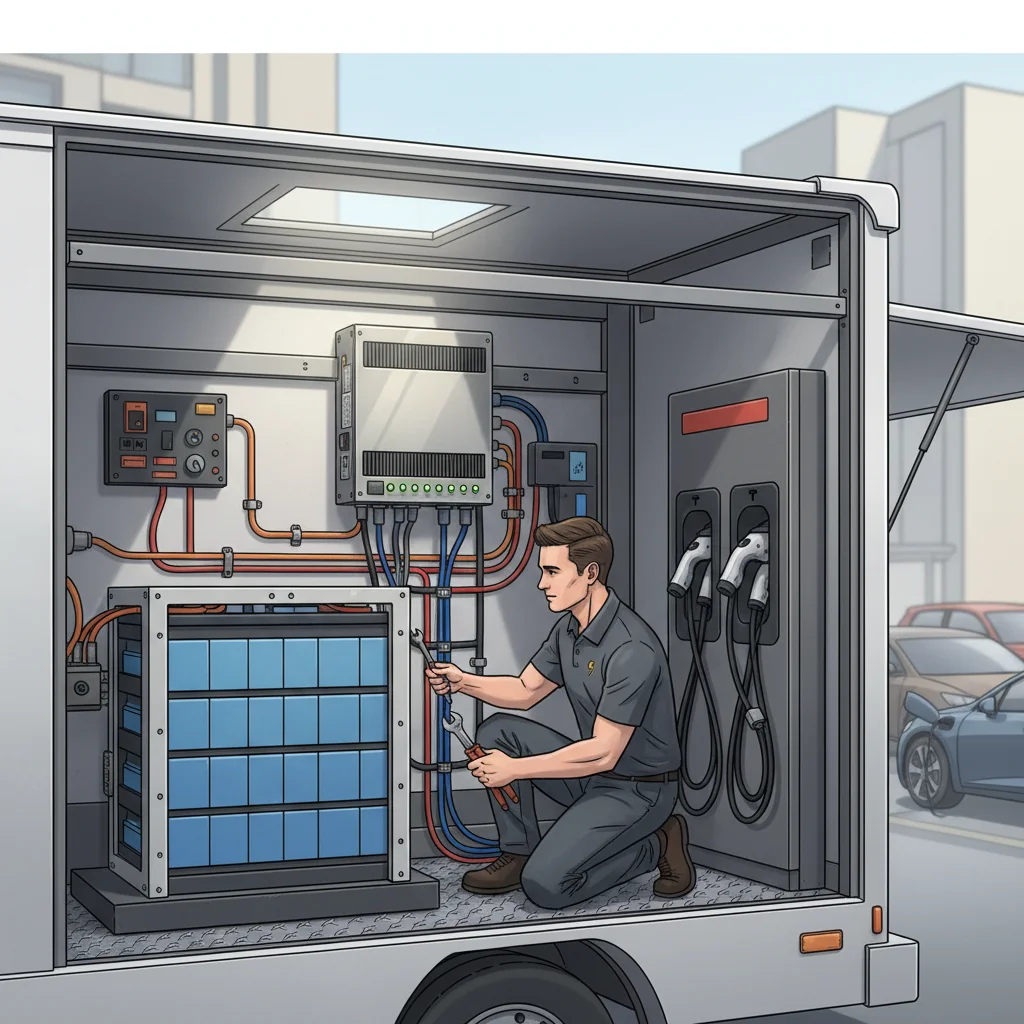
Battery bank or generator: two truck designs
People picture a rolling DC fast charger. Most rescue trucks you’ll meet aren’t that. One design stores energy in a separate onboard battery bank. The operator inverts that power and feeds your car at 240 volts. The other design runs a generator on site. Then it converts that output for the car. Charge Pro DEN can’t confirm which layout each independent operator uses. Ask when they quote. You’ll hear it if a generator is part of the setup.
Neither design is a public Supercharger. Superchargers stay at fixed sites. EVgo and Electrify America add DC fast coverage across the metro. The truck comes to you. Then you drive to a stall if you still need a long charge. You may be weighing a stall versus a truck. See charging levels for a stranded Denver EV.
What CDOT and E-470 can do, and what they cannot
CDOT Safety Patrol is free on covered metro freeway segments. It handles flat tires, jump-starts, emergency fuel, minor mechanical help, debris, and incident support. Published Front Range weekday hours are 6:00 to 9:30 a.m. and 2:30 to 7:00 p.m. Weekends run 10:00 a.m. to 7:00 p.m. Covered pieces include I-25 South from 120th Avenue to Arapahoe Road. They also include I-70 East from Wadsworth to Airport Boulevard. Portions of US-6, C-470, and I-225 are covered too.
CDOT’s Safety Patrol pages, read in September 2026, mention nothing about electric vehicles. They don’t describe a charge to the pack. The patrol can jump a 12-volt. It doesn’t publish an EV charging service. Emergency fuel is for gasoline cars. It won’t refill a traction battery.
E-470 is the eastern-metro cashless toll loop. A disabled driver pulls to the shoulder and dials *470. E-470 lists flat tires, fluid top-offs, jump-starts, phone help, and debris removal. There’s no EV-specific toll discount and no published pack-charge on that list.
I-25 North and US-36 Express Lanes were built with a minimum eight-foot outside shoulder. If you stall there, CDOT’s guidance is the right, outside shoulder. COtrip.org and 511 carry I-70 closures and traction-law status. CDOT can activate the Passenger Vehicle Traction Law. In severe storms it can activate the Passenger Vehicle Chain Law. Watch the signs and COtrip.
The shoulder rule while you wait
Outside a business or residential district, CRS 42-4-1202 limits where you may stop. You may not stop on the paved main-traveled part of a highway. The exception is a vehicle so disabled you couldn’t avoid stopping. You also couldn’t move it off the roadway. Hazard lights are required under CRS 42-4-230. A violation is a class B traffic infraction.
If the car truly couldn’t go farther, wait on the shoulder with hazards on. Don’t stand in a live lane or wander up the fog line. On E-470, *470 is the published roadside number for that authority. Colorado State Patrol handles crashes, enforcement, and abandoned-vehicle removal. If an officer says the car has to move, follow that order. There’s still no Colorado statute that names mobile EV charging.
How a Charge Pro DEN referral works
Call and say where you are, what you drive, and how to reach you. A freeway exit, a cross-street, or a map pin all work. That covers Peña Boulevard toward DEN or a C-470 shoulder. It also covers a Capitol Hill block without a driveway plug. The operator needs a place they can legally stop.
Charge Pro DEN matches you with an independent local operator. We don’t set the price and we don’t quote a window. The operator quotes before starting. You accept or you don’t. If you accept, they bill you directly.
Nobody here can promise a truck staged on I-25, US-36, or I-70. Independent operators move around the metro like any other contractor. For who quotes you, see who sets the price when a mobile charger reaches you. If a tow is the safer move, that’s a different call. Loading many EVs the wrong way can hurt the driveline.
The metro map of referral charging is here. See mobile EV charging near me in the Denver metro. When you’re ready to call, the number is (720) 738-6950. Charge Pro DEN will refer you to an independent operator. That operator quotes before any cable goes on the car.