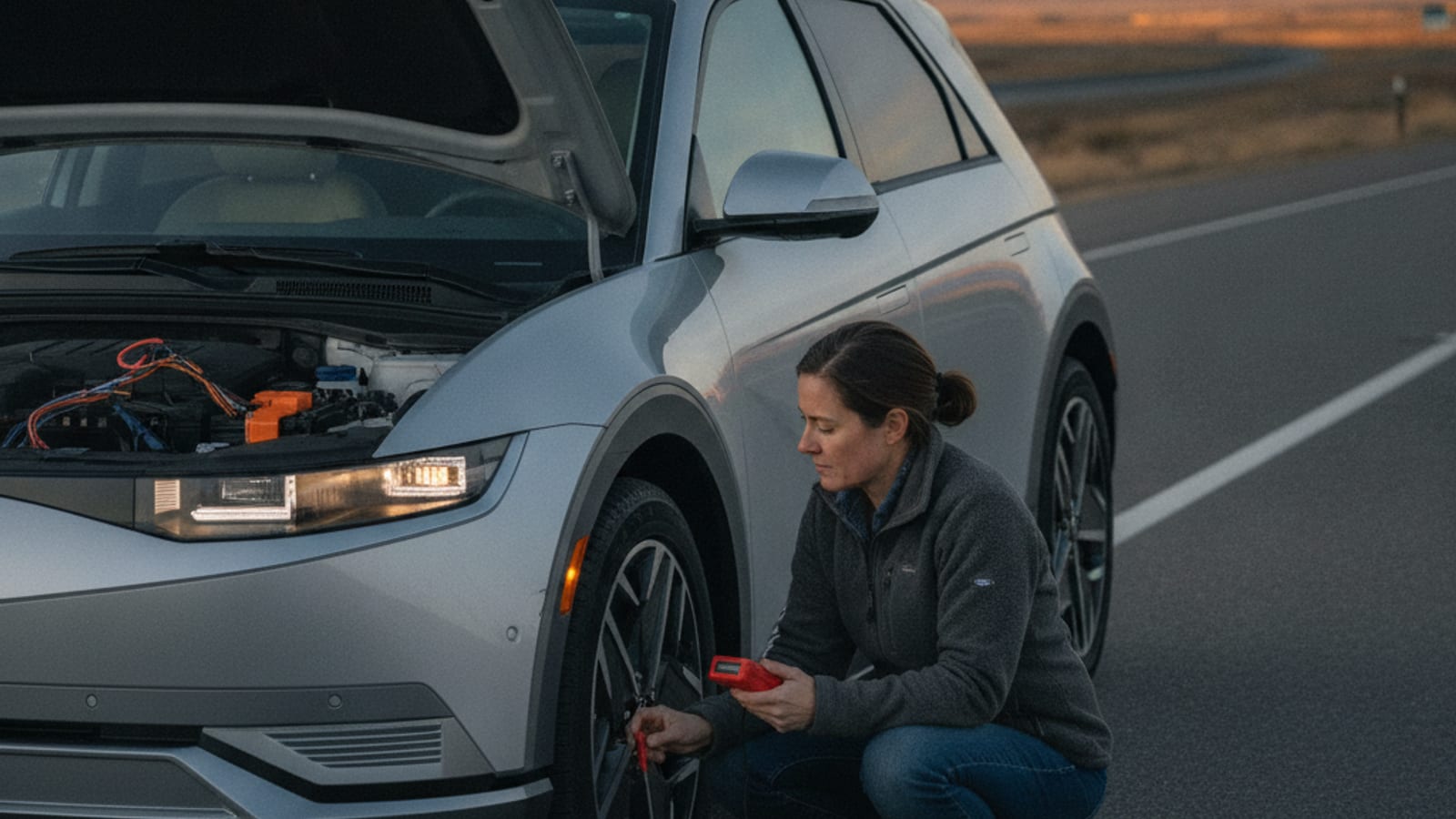
A VW ID.Buzz that will not wake on a Denver morning is almost always the 12-volt, not the traction pack. The big battery under the floor still has range. The small battery that runs the computers and contactors is the one that died in the cold. Charge Pro DEN is a referral line for stranded drivers. An independent operator jumps or replaces the 12-volt on site. Call (720) 738-6950 and we will match you with someone covering your part of the metro. The operator quotes you before starting.
Why the ID.Buzz stops waking up here
Denver sits at 5,280 feet. January nights run near 18 degrees on a normal year, and arctic drops arrive fast on this high plain. Denver swung from 47 to minus 19 in about 48 hours during January 2024. The ID.Buzz has a traction pack under the floor for driving, and a separate 12-volt battery for everything else. The 12-volt runs the computers, the contactors that connect the high-voltage system, the infotainment screen, the door locks, and the wake-up handshake. When the 12-volt dies, the whole car looks dead. None of the dash lights come on. The charge port will not release. The key fob does not respond. The traction pack can still show plenty of range on a phone app, and the car still will not move.
Cold plus a long soak drains that 12-volt faster than drivers expect. The battery management system wakes itself at low temperature to protect the traction pack. Each wake-up draws from the 12-volt. A van parked outside in Denver over a cold week can come back to a 12-volt too weak to close the contactors. A van parked at Denver International for a week of travel in January sees the same drain. A van that sat through a January cold snap on a driveway in Lakewood, Arvada, or Wheat Ridge sees it too.
Every modern EV behaves this way. Tesla, Rivian, Hyundai, Polestar, and Ford all use a small 12-volt battery to wake the car and close the high-voltage contactors. The ID.Buzz follows the same rule. The traction pack can be near full and the car can still refuse to start, because the small battery cannot do its job.
How to tell 12-volt from empty pack
The split matters, because the fix is different.
An empty traction pack shows up on the phone app. State of charge sits near zero. The car usually drove normally to the last mile and then coasted to a stop. The dash lights up to the brake warning and then goes quiet. A 12-volt failure is quieter. The app may still show 60 percent or 80 percent state of charge. The car simply does not respond to the key. Pressing the brake does nothing. The screens stay dark. The charge port will not release.
Recurrent Auto studied more than 30,000 U.S. EVs in winter. At 32 degrees, EVs keep about 78 percent of max range. At 20 degrees, that drops to about 70 percent on average. A morning buffer that looked fine at dusk can look thin at dawn. If the dash read low before the car stopped, treat it as an empty pack. If the dash was healthy last time you parked and the car sat cold, treat it as a 12-volt. The Denver metro is high and dry, and the temperature swing between dusk and dawn is bigger than drivers from lower elevations expect.
The Volkswagen ID.Buzz in particular has its 12-volt under the hood near the firewall on the driver side. Lead-acid and lithium 12-volts have been used across model years. The terminals are the standard jump points. A modern lithium 12-volt still fails in a Denver cold snap, and the wake-up handshake does not care what chemistry the small battery uses.
First checks before you call
You can run a few quick checks before dialing for help. None of them require tools beyond what is in the glove box.
Look for the brake pedal response. Step on the brake and try to wake the car. If the dashboard comes up partially, the 12-volt has some life left. If nothing happens, the 12-volt is probably flat.
Check the key fob battery. A weak fob battery can look identical to a dead 12-volt. Replace the fob battery if it has not been changed in a couple of years and try again. Volkswagen fobs use a CR2032 in most ID.Buzz years. That change alone wakes up some cars.
Try the mechanical key release for the charge port. The ID.Buzz has a manual release cable in the front trunk area. A flat 12-volt can trap the charge cable in the port. Pulling that release lets you remove a charger before you call for help, so the operator who arrives can plug in.
Look at the headlights. A 12-volt that is weak will dim the headlights when you press the brake. A 12-volt that is dead shows nothing. A dim-but-present headlight response is the borderline case where a jump will succeed quickly.
If those checks point at the 12-volt, the next call is the operators we refer. They jump the 12-volt on site, and they carry a replacement if the battery will not hold a charge. They quote before starting and they bill you directly. Call (720) 738-6950 and we will match you with an operator covering your part of the metro.
When the call is actually about an empty pack
Cold eats range faster than the dash shows. A van that pulled into a Park Meadows garage at 30 percent and sat through a long errand in January can come back to a dead pack and a 12-volt that is fine. In that case the fix is a Level 2 charge on site. The operators we refer bring a 240-volt Level 2 source to the bumper. Tesla uses NACS natively. The ID.Buzz uses CCS in North America, so the operator brings a CCS adapter. Fifteen to thirty minutes of charging adds 10 to 20 miles. That is enough to reach a Supercharger or get home to your driveway under your own power.
A few ID.Buzz drivers live on Capitol Hill or in Baker without a home plug. Their van sits on the street overnight, and a cold week can pull the pack lower than they budgeted. That is the urban no-home-plug pattern. More than half of Denver housing predates 1980, and renters in older buildings often depend on public charging. A cold morning no-start in that pattern is a 12-volt failure far more often than an empty pack, but a Level 2 boost handles both cases.
If the van is on the highway shoulder, take a moment for safety. Move to the outside shoulder if traffic permits. Set the hazards. CRS 42-4-1202 lets a truly disabled vehicle sit on the shoulder with hazards on. Stay out of the travel lane. Stay in or near the car with the seatbelt on if that is the safer call. The operator matches your location to the closest local driver and quotes you before starting.
What the operator actually does on site
For a 12-volt problem, the operator brings a portable lithium jump pack and connects it to the 12-volt terminals under the hood. That wakes the car, lets the contactors close, and brings the high-voltage system online. The operator then checks whether the 12-volt will hold a charge. If it does, you drive away. If it does not, the operator can replace the 12-volt on site in most cases, and they quote that before they start.
For an empty pack, the operator brings a 240-volt Level 2 source to the bumper. They plug in a CCS adapter for the ID.Buzz and run charging until you have enough range to reach a fast charger or drive home. The clock on charging starts when charging starts. The operator does not promise an arrival window. They quote before starting and they bill you directly.
For a charge port stuck closed because the 12-volt died, the operator releases the cable first, then handles the 12-volt. A stuck port is a latch problem, not a tow problem.
For a van that will not roll at all, the answer is a flatbed tow. The operators we refer will say so plainly. They do not improvise with a tow when a charge or jump will do the job. The Colorado Towing Bill of Rights (HB22-1314, effective August 10, 2022) sets the rules on a nonconsensual tow from private property, with 24-hour written notice in most situations. The operator will tell you whether your situation falls inside that law.
Where Denver cold does the most damage to a 12-volt
The Denver metro does not have a mountain pass inside the city, but cold still finds the 12-volt.
The DEN parking lots are the worst case. A van left for a week in a DEN garage in January can come back to a 12-volt too weak to wake. The traction pack still shows range on the phone app, and the car still will not respond. The fix is a jump or on-site 12-volt replacement. Read when an EV 12-volt dies in a Denver lot for the full pattern. Aurora drivers who use Peña Boulevard see the same call.
Driveways in Lakewood, Arvada, and Wheat Ridge see the second-most common version. A van parked outside in January soaks the 12-volt overnight. By the second or third cold night, the battery management system has woken often enough to drain the small battery. The first cold morning after that is the no-start.
The foothills are the third case. A van parked at altitude in Evergreen or Kittredge sees colder nights than the city. The SH-74 climb from I-70 also adds grade, and a cold climb is harder on the high-voltage system than a cold start on the flat. The 12-volt is still the most likely failure, but the pack drops faster as well. The operator brings the same kit, but the timeline is tighter because cell coverage thins in the canyons.
The US-36 corridor through Westminster, Broomfield, and Louisville is a fourth case. Express-lane commute traffic with the heater running drains the pack faster than the dash shows. A van that pulled into a FlatIron Crossing lot on 20 percent and sat through the afternoon often comes back to a pack lower than expected and a 12-volt that drained during the wait. The operator brings a Level 2 boost and handles the 12-volt if the pack was not the only failure.
What the ID.Buzz has in common with its VW siblings
The ID.Buzz shares Volkswagen’s MEB platform with the ID.4. The ID.4 has the same 12-volt pattern and the same wake-up handshake. Drivers who own both vans sometimes find the same 12-volt failure mode in cold weather. Read ID.4 12-volt keeps dying in the cold for the sibling model. The lessons carry over directly. A 12-volt that fails twice in a winter usually needs replacement, not another jump. The operators we refer can replace on site, and they quote before starting.
The ID.Buzz also shares the broader EV industry’s 12-volt habits. Tesla, Rivian, Hyundai, and Polestar all rely on a small battery to wake the car. The pattern is the same across brands, which is why the fix is the same across brands. A jump gets the car moving. A replacement battery ends the repeat failures. For the broader category, read can roadside jump an EV 12-volt and Tesla 12-volt dead diagnosis in Denver cold for the cross-brand read.
When a tow is still the right call
A jump works when the 12-volt is the only failure. A tow is the right answer when the car cannot roll, when the high-voltage system shows a fault code on the dash, when the body or suspension is damaged, or when the operator cannot reach the 12-volt terminals safely. CRS 42-4-1202 lets a disabled vehicle sit on the shoulder with hazards on. The Colorado Towing Bill of Rights applies on private property. The operators we refer will say when the right answer is a flatbed and not a jump.
A van that was in a crash before the no-start is a tow, not a charge. A van with a coolant leak on the parking lot is a tow. A van with a fault code on the high-voltage system is a tow. A van that simply will not wake on a cold morning, with no crash history and no dash warning other than silence, is a 12-volt job. The split matters because the cost and the time are different.
How to get help from a Denver metro shoulder
Turn the hazards on and move to the outside shoulder if traffic permits. CRS 42-4-1202 lets a truly disabled vehicle sit on the shoulder with hazards on. Stay in or near the vehicle if that is the safer choice. Do not stand in the travel lane.
Call (720) 738-6950. Charge Pro DEN matches you with an independent operator covering your part of the metro. The operator quotes you before any work starts and bills you directly. There is no membership and no upfront charge from Charge Pro DEN. We refer. The operator does the work.
When the operator arrives, name the vehicle (year and trim of the ID.Buzz), the symptoms (no dash, no key response, headlights dim or out), and the location (driveway, lot, shoulder, garage). For the ID.Buzz, the 12-volt is under the hood near the firewall on the driver side, and the operator will work from those terminals. The fix is a jump plus a charge-hold check, or a same-day 12-volt replacement if the old battery will not hold. The operator handles both, and they tell you which before they start.
Frequently asked questions
Is the ID.Buzz known for 12-volt problems in cold weather?
The ID.Buzz follows the same 12-volt pattern as every other modern EV. The traction pack runs the wheels. The 12-volt runs the wake-up handshake, the contactors, the locks, and the screens. Cold plus a long soak drains the 12-volt. Denver cold snaps amplify that. The fix is a jump or on-site 12-volt replacement, not a flatbed.
How do I tell whether the traction pack is empty or the 12-volt is dead?
Check the phone app first. If state of charge sits near zero, the pack is empty. If state of charge reads 30 percent or more and the car does not respond at all, the 12-volt is the failure. The dash behavior is the second clue. A flat 12-volt leaves the screens dark. An empty pack usually lights the dash down to the brake warning, then goes quiet.
Can the operators we refer jump the ID.Buzz 12-volt on site?
Yes. Operators carry a portable lithium jump pack and connect it to the 12-volt terminals under the hood. The car wakes, the contactors close, and the high-voltage system comes back online. The operator checks whether the 12-volt holds a charge. If not, they replace on site. They quote before starting and they bill you directly.
What if my ID.Buzz is stuck at Denver International?
Call (720) 738-6950 and name the DEN lot (East garage, West garage, the 61st and Peña shuttle lots, or the Canopy lot). A week-long cold soak in a DEN lot commonly kills the 12-volt, not the pack. The operator meets you at the lot, jumps the 12-volt, and checks the hold. If the traction pack is also low, they add a Level 2 boost. The operator quotes you before starting and bills you directly.
Does a 12-volt replacement on site cost the same as a shop?
The operator quotes before any work starts. Charge Pro DEN does not set prices on any job. The independent operator who takes the call sets their own price for the visit, the jump, and any parts. You approve before the work begins. The operator bills you directly when the work is done.