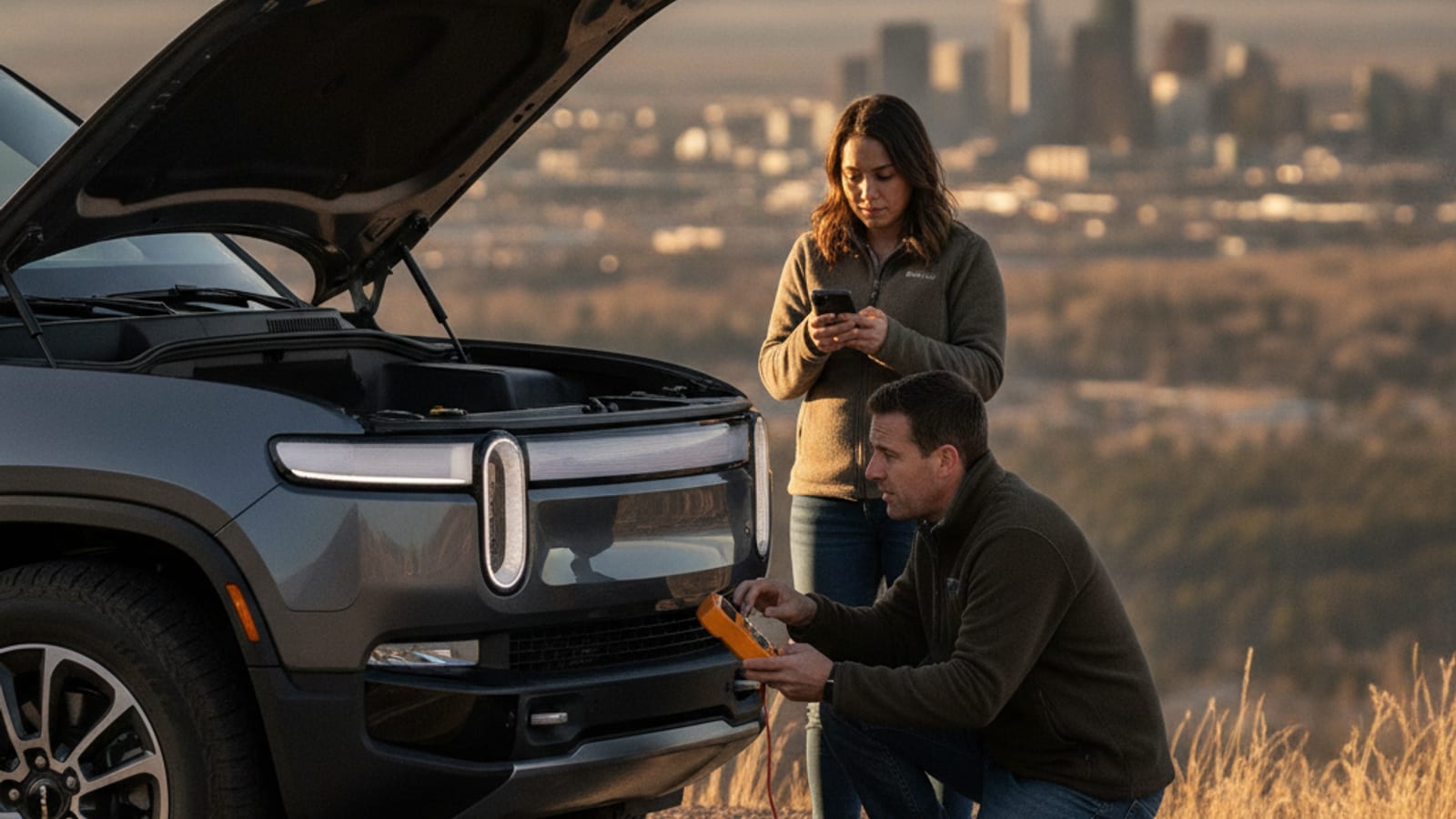
What happens when an EV 12-volt battery dies is the car looks finished, but the traction pack is still full. Doors will not unlock. Windows will not move. The dash stays black. You press the key fob and nothing happens. A cold-soaked week in a Denver airport lot can kill that little battery while the big pack underneath the floor sits at 80 percent and waits. The fix is a jump or an on-site 12-volt swap, not a tow to a charger. If you are standing in a lot right now, call (720) 738-6950. Charge Pro DEN matches you with an independent operator who brings a 12-volt source to the bumper. They quote before any cable goes in.
The 12-volt runs everything you touch
An EV has two batteries. The big one moves the car. The small one runs the computers, the contactors, the lights, the door handles, the infotainment, and the alarm. The high-voltage pack is offline until the 12-volt closes the contactors. When the 12-volt is dead, the whole car looks dead. The pack is still sitting there with hundreds of miles of potential range. It just cannot reach the wheels.
This is the source of most “my Tesla will not wake up” stories on the Front Range. The traction pack can be 70 percent or 90 percent. The 12-volt dropped below the threshold the Battery Management System needs. The BMS will not even try to close the contactors on a weak 12-volt, because doing so on a starving system can brick downstream modules. So the car protects itself by appearing broken.
Why a cold lot in Denver kills it
A January morning in Aurora can hit 10 below. The research notes January normal lows around 18 degrees and an all-time record of minus 29. A car parked at DEN or in a long-stay economy lot sits through that every night for a week. Lead-acid 12-volt batteries lose a big share of their cranking amps as the temperature drops. Lithium low-voltage batteries, used in newer Model 3 and Model Y cars, hold more cold capacity but still sag under a long soak with phantom drain.
Phantom drain is the second half of the story. Even a parked EV is awake in the background. The telematics module pings the network. The security system watches for movement. The BMS monitors cell voltage. Each of those pulls from the 12-volt, not from the traction pack. Over a week in the cold, those small draws add up. The 12-volt drains below its reset threshold and the car goes to sleep it cannot wake from.
A week is the figure that matters here. A weekend trip usually does not drain a healthy 12-volt, even in our cold. A seven-day or ten-day trip, on a battery that was already a little weak, will. Older Teslas with the lead-acid 12-volt in the frunk are the most common case. Newer lithium-low-voltage cars are not immune; they are just slower to fail.
The signs that it is the 12-volt, not the pack
Walk back to the car and try the key fob. If the lights do not flash and the mirrors do not unfold, the car is dark at the 12-volt level. Pull the door handle. Most EVs will not present the handle at all if the 12-volt is gone. Look at the app. If the app shows the car as “asleep” or “offline” and the climate or sentry mode tile is greyed out, the low-voltage bus is dead.
Now check the obvious: did you leave the headlights on, did you leave a reading lamp on, did a recent service disconnect the 12-volt and forget to reconnect it? Those are rare. The usual Denver pattern is a cold-soak week plus a marginal battery. The traction pack’s percentage on the app is irrelevant if the app is also asleep.
For the full split between an empty pack and a dead 12-volt, read Tesla looks dead: empty pack or 12-volt. That post stays on the diagnostic. This one stays on what to do when the 12-volt is the cause.
What you can try before you call anyone
If you have access to a small 12-volt booster pack, the new lithium jump packs sold for gas cars, you can sometimes wake a Tesla by attaching the clamps to the designated 12-volt jump points. Newer Model 3 and Model Y have a dedicated jump terminal under the hood. Model S and Model X have terminals in the frunk. The owner’s manual for your year is the source for the exact location. Do not improvise clamps on random under-hood metal; the wrong contact can fry a module.
If you do not have a booster pack, and the car is in a public lot or a private driveway, do not pry at the door or force the frunk. The 12-volt also powers the mechanical release for the frunk on some models. If the 12-volt is dead, the mechanical release is dead. Operators we refer carry a separate power supply that they can clip to the jump points without needing access to the cabin. They can also replace a 12-volt on site when the old one will not take a charge.
If the car is at DEN or another airport lot, the lot operator may have a procedure for reaching a stranded vehicle. Ask the lot attendant first. Do not break a window. A 12-volt jump costs the operator’s visit fee. A window costs the deductible.
What CDOT Safety Patrol will and will not do
If you broke down on a listed Front Range segment of I-25 South, I-70 East, US-6, C-470, or I-225 during posted hours, CDOT Safety Patrol will respond. Their published menu is flat tires, jump-starts, fuel, debris, and minor mechanical help. A 12-volt jump is on that list. The truck does not carry a Level 2 charger and does not carry high-voltage rescue gear. Published hours for the Front Range metro run 6:00 to 9:30 a.m. and 2:30 to 7:00 p.m. weekdays, with a 10:00 a.m. to 7:00 p.m. weekend window. The Mountain Corridor has separate hours. Outside those windows, CDOT Safety Patrol is off shift and your call goes to Colorado State Patrol for emergencies only.
If you are not on a listed segment, or you are off shift, the next step is an independent mobile operator. CDOT does not publish an EV charging service. The Safety Patrol menu does not mention electric vehicles or traction packs. That’s a real gap in the state’s published guidance.
What an independent operator brings
Charge Pro DEN is a referral line. We do not own trucks. We do not employ technicians. We do not set prices for the visit. We match you with an independent local operator who brings a 12-volt power supply to the bumper. That operator quotes you before any cable goes in. They bill you directly for the work they do.
The 12-volt on a Tesla sits in the frunk under a liner. The operator will pop the frunk using an external power source, identify the jump points, and clip a portable 12-volt supply across them. Once the BMS sees a healthy low-voltage bus, it will close the high-voltage contactors and the car wakes up. The car is now drivable. If the 12-volt was simply drained by a long cold-soak, a short drive and a normal charge session will let it recover. If the 12-volt is at end of life, the operator can swap a replacement on site for the common Tesla low-voltage battery sizes.
For the broader coverage question, including what an in-place mobile Level 2 charge looks like versus a tow, read mobile charge or tow. For the broader 12-volt diagnosis, how to tell if your Tesla’s 12-volt is dead walks the warning signs that come before a no-wake.
The DEN-lot pattern in Aurora and the airport east
The highest-frequency Front Range call is the traveler. They flew out of DEN for a week. They parked in the East or West garage, or in the 61st and Peña economy lot, or in an off-site canopy lot in Watkins or Bennett. They came back to a car that would not wake. The traction pack on the app is irrelevant if the 12-volt cannot wake the car to phone home.
Peña Boulevard is city-maintained, not a state highway, so CDOT Safety Patrol coverage does not extend onto it. Once you clear the airport road and reach I-70 East to Airport Blvd, you are on a covered segment during posted hours. For a DEN-lot case, an independent mobile operator is the right call. They meet you in the lot, jump or replace the 12-volt, and you drive home. No tow. No flatbed. No waiting on a stall.
The same pattern shows up at the Denver Tech Center garages in Greenwood Village and Centennial, where office workers leave an EV all week and come back to a dark car. The Tech Center sits on CORE Electric Cooperative territory, not Xcel, so utility questions there go to CORE rather than to Xcel.
What the cold does to range while you wait
A car that does wake up after the 12-volt is replaced has likely lost some range while parked. Recurrent’s study of more than 30,000 U.S. EVs found EVs retain about 78 percent of max range at 32 degrees and about 70 percent at 20 degrees on average. AAA’s study put the loss at about 39 percent at 20 degrees. Those figures cover driving range, not phantom drain. Phantom drain on a cold 12-volt is the failure mode, and it is a separate problem from the traction pack’s reduced range in winter.
If the car wakes up and the dash shows lower range than when you parked, that is the cold, not a fault. Drive gently for the first ten minutes and let the battery warm. Use a public Level 2 stall or a home Level 1 or Level 2 to top off. Those cold-range figures come from Recurrent’s study of more than 30,000 U.S. EVs and from AAA’s 2026 dynamometer work, both of which the upstream pages update; we cite them rather than republishing them.
Colorado law that protects you on a shoulder
CRS 42-4-1202 governs a disabled vehicle on a highway. You may not stop on the paved main-traveled part of a highway outside a business or residential district, except a vehicle so disabled it is impossible to avoid stopping and to move it off. Hazard lights must be on under CRS 42-4-230. A violation is a class B traffic infraction. The plain read: it is lawful to be stuck on the shoulder with hazards on while you sort a jump.
CRS 42-4-1803 governs abandoned vehicles. Abandonment is on officer discretion, “reasonable grounds to believe,” not on a fixed clock. There is no 24-hour or 72-hour threshold in Colorado statute. A disabled EV is not a special class. The Colorado Public Utilities Commission regulates towing carriers. The Colorado Towing Bill of Rights (HB22-1314, effective Aug 10, 2022) gives you 24-hour written notice before most private-property tows and limits drop fees. We do not publish specific fee caps here because the bill PDF and PUC pages do not render cleanly.
When a tow is the right call
A 12-volt jump does not straighten bent suspension. If the car cannot roll, you need a tow. If a body panel is damaged and a wheel is off the ground, you need a tow. If the high-voltage system has thrown a fault that a Level 2 charge will not clear, you need a tow to a shop that reads EVs.
For a Tesla with a dead 12-volt and a healthy pack, the tow is overkill. A flatbed to a shop will cost the deductible and the lost time. A 12-volt jump at the lot, in the garage, or on the driveway is a fraction of that. The operator we refer brings a 12-volt source and the basic PPE to clip it in. For a non-Tesla EV, CCS or J1772 adapters make the Level 2 charge path work, but a 12-volt jump is the same story; the 12-volt is the same kind of battery on every modern EV.
How to call for a 12-volt jump in the metro
If the car is dark at the 12-volt and the traction pack still holds range, the right call is a 12-volt jump. Call (720) 738-6950. The operator will ask where the car is, what model and year it is, and whether you have access to a booster pack. They quote before they roll. They bring the right 12-volt source for your car and they handle the frunk or the under-hood jump points. They do not promise an arrival time. They do not promise a price. They tell you what they will do, and they tell you what it costs, before they start.
For broader mobile charging that adds range to the traction pack, see mobile EV charging. For the Tesla-specific 12-volt service, see Tesla 12-volt battery jump. These are all referral paths through Charge Pro DEN. We connect you to an independent operator. We do not send a Charge Pro crew.
Frequently asked questions
Why does my Tesla not respond at all in a cold lot?
The traction pack is fine. The 12-volt battery that runs the computers and contactors is dead. Cold plus a week of phantom drain drained it below the threshold the BMS will accept. The car protects itself by staying dark. The fix is a 12-volt jump or an on-site 12-volt replacement.
Will Tesla roadside help with a dead 12-volt?
Tesla roadside is requested through the Tesla app. Tesla may send a contractor who can jump the 12-volt or arrange a flatbed. Read the Tesla app’s coverage text for your VIN and year. We could not verify a fixed arrival window or a specific service tier; confirm in the app before you wait.
Is a 12-volt jump the same as a charge?
No. A jump gives the low-voltage bus enough power to wake the car. A charge adds miles to the traction pack. They are different jobs with different tools. CDOT Safety Patrol and AAA trucks handle jumps on listed segments during posted hours. A mobile EV charge is what an independent operator does when the traction pack is the problem.
Can a 12-volt be replaced on site?
Yes. The operator we refer carries common 12-volt sizes for Tesla and other EVs. A swap takes longer than a jump but stays on site. The traction pack is not involved. You drive away with a fresh low-voltage battery and the pack you parked with.