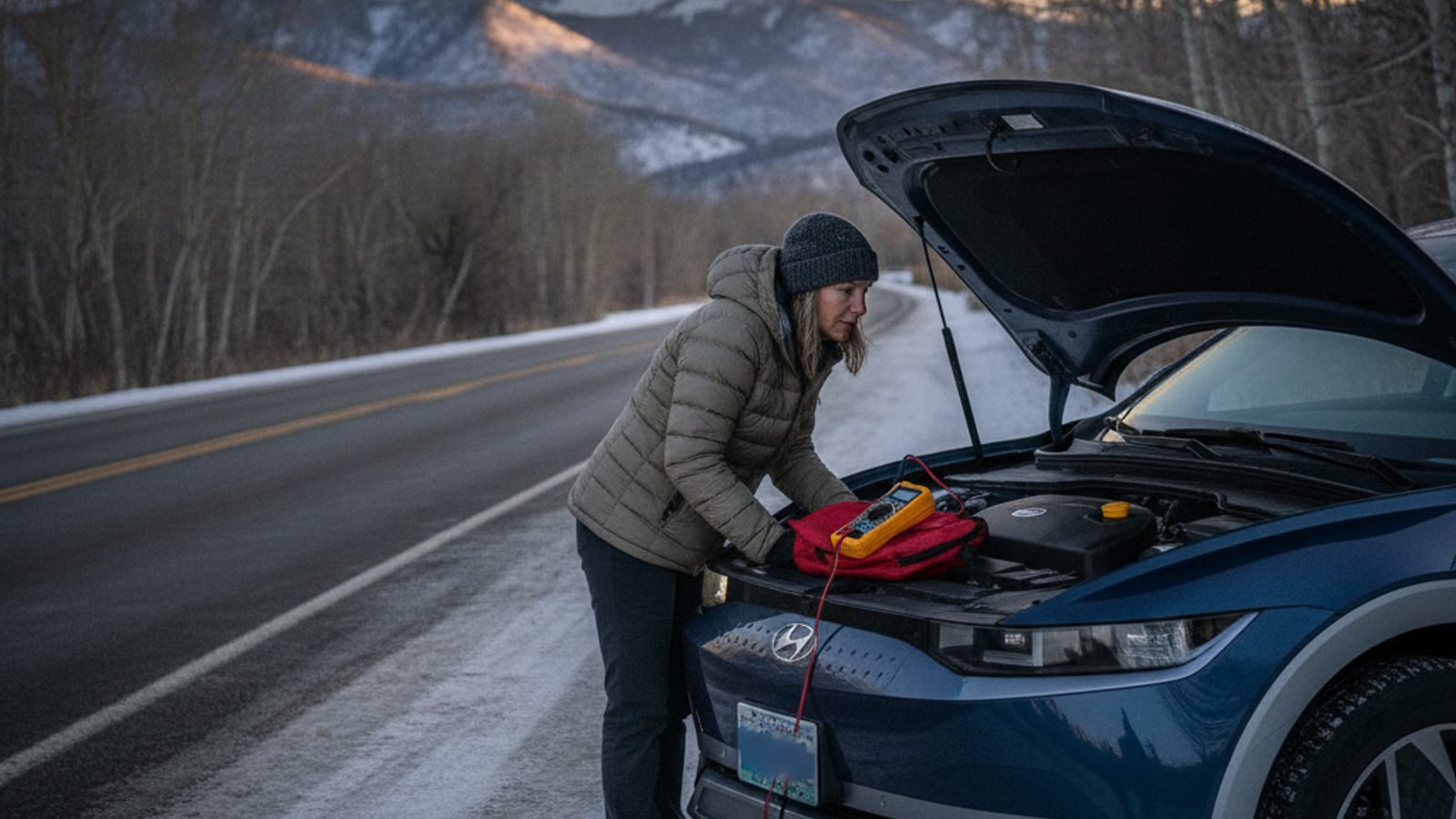
A Volkswagen ID.4 that will not wake after a Denver cold snap is almost always a 12-volt problem, not an empty pack. The traction pack can still hold miles. The 12-volt is the small battery that runs the computers and the contactors. When it dies in the cold, the whole car looks finished. Photograph the screen. Open your model-year manual. If you need help on a shoulder or in a lot, the operators we refer can jump the 12-volt or replace it on site. Call (720) 738-6950 when you need that match.
Why the 12-volt dies here first
Like most modern EVs, the ID.4 carries two batteries. The traction pack drives the wheels. A separate low-voltage battery runs the infotainment screen, the door locks, the body controller, and the contactors that wake the pack. The low-voltage battery on most ID.4 builds is a small lead-acid AGM cell. Lead-acid hates a long cold soak.
A cold soak is not just a chilly day. It is many hours below freezing with the car parked outside. Denver’s January normal low sits near 18 degrees. The January 2024 arctic blast dropped Denver from 47 to minus 19 in about 48 hours. A car that sat through that kind of swing often comes back dark. Parked modules still draw a small current. Cold raises internal resistance. The voltage sags. The contactors will not close. The dash stays black.
The pack itself is fine. That is the useful split. It changes which truck you ask for. A 12-volt jump wakes the computers. The pack still shows the range it had the night before. If the gauge was already at zero, that is a different job.
What the ID.4 is doing when it goes silent
An ID.4 that will not wake can look the same in three cases. The 12-volt is dead and the pack has range. The pack is empty. Or a stored fault has locked the high-voltage system and the cluster is not explaining it. Drivers cannot tell those three apart from the driver’s seat. That is the value of a photograph.
Take a photo of the screen before anyone clamps a cable. Note whether the doors unlock with the fob. Note whether the car still reports range. Note whether the windows roll. Those small clues tell the operator which system died. Sluggish windows or a slow screen have more than one cause. They are observations to hand off, not a self-diagnosis.
If the ID.4 sits in a traffic lane, on a freeway ramp, or anywhere dangerous, call 911 first. Colorado State Patrol handles crashes, enforcement, and abandoned-vehicle calls under CRS 42-4-1803. A silent EV on a shoulder is still a disabled vehicle under CRS 42-4-1202. Hazard lights must be on under CRS 42-4-230. A class B traffic infraction is the published penalty for a violation.
The jump posts belong to your model-year manual
There is no universal ID.4 jump procedure that works for every year. VW has changed the 12-volt chemistry, the remote post location, and the donor rules across model years. The emergency section of your model-year manual is the authority. Use only those terminals. Follow only that polarity. Skip any donor-idle timing that another car calls for.
A few rules that hold across years. Do not treat a gas-car clamp order as an ID.4 rule. Do not use tow-eye leads as jump posts. Those wires serve hood releases and tow hooks on most EVs. They do not feed the 12-volt bus. If your manual tells you to use remote posts instead of the battery case, believe it. If the manual forbids using the ID.4 as a donor for another car, believe that too.
A jump that wakes the car is still temporary if the 12-volt is worn. Replacement, coding, and parts are shop questions or operator questions. They are not a Charge Pro procedure. A roadside jump buys you a drive to a warm garage or a shop. It is not a warranty.
Long cold dwells are the usual cause
The ID.4 pattern that shows up in the Denver metro is not a daily-driver problem. It is a long-dwell problem. A car parked at the airport for a week. A car parked at the Denver Tech Center for a long business trip. A car in a Capitol Hill street-parking spot during a cold snap. A car in an Arvada driveway when the family went skiing. The 12-volt sits under load from the connectivity stack, the security module, and the climate scheduler. None of those are large draws. In the cold, none of them have to be.
Recurrent Auto studied more than 30,000 U.S. EVs in winter. At 32 degrees, EVs kept about 78 percent of max range. At 20 degrees, they kept about 70 percent. Those are range numbers for the traction pack. A 12-volt failure is a different curve. Below about 15 degrees the battery management system wakes more often. That wake cycle costs the low-voltage battery some of its reserve. A weak 12-volt gets weaker. A weak 12-volt in a cold car stops waking the car.
If your ID.4 sat in Denver for a week and now will not unlock, the most likely cause is the 12-volt. If your ID.4 sat in Boulder or Lakewood through a cold snap, the same is true. Cold does not pick a city.
What CDOT Safety Patrol will and will not do
CDOT Safety Patrol runs free on listed metro freeway segments. Front Range hours are 6:00 to 9:30 a.m. weekdays. Afternoon coverage runs 2:30 to 7:00 p.m. those same weekdays. Weekends run 10:00 a.m. to 7:00 p.m. The Mountain Corridor from Morrison to Vail has a separate window. That is 6:00 a.m. to 7:00 p.m. Friday through Sunday. Crews also roll during significant weather on that corridor.
Covered metro stretches include I-25 South from 120th Avenue to Arapahoe Road. They include I-70 East from Wadsworth to Airport Boulevard. Portions of US-6, C-470, and I-225 are on the same list. Patrol trucks list flat tires, jump-starts, emergency fuel, debris removal, and minor mechanical help. CDOT’s Safety Patrol page does not mention electric vehicles. Its my-car-broke-down page does not either. Neither page names EV charging or a pack refill.
A patrol truck can jump a 12-volt on those segments during posted hours. It cannot bring 240 volts to the traction pack. If the gauge was already at zero, the patrol truck is the wrong call. If the car went dark after a freeze, the patrol truck may finish the job.
E-470 is its own road. Pull to the shoulder and dial *470 for the Authority’s free help. That list is jump-starts, flats, fluids, a phone, and debris. Dial *CSP (*277) for Colorado State Patrol. E-470 publishes no EV charge and no pack refill. A jump on E-470 is still a 12-volt jump.
How the operators we refer handle an ID.4
Charge Pro DEN is a referral line. We match stranded EV drivers with independent local operators. We do not own trucks. We do not employ technicians. We do not hold a trade license. We set no prices and publish no hours. We do not promise an arrival time.
You tell us the year, the trim, the warning text, and the last range shown. We pass that to an operator who reviews the job. For an ID.4 that will not wake after a cold dwell, that operator can jump the 12-volt on site. When the cell is worn, the operator can replace it on site with a compatible 12-volt. The operator quotes you before work starts. You contract with that operator, not with us.
If the traction pack is empty rather than the low-voltage system, charging is a different job. Operators we refer bring a 240-volt Level 2 source to the car. CCS cars like the ID.4 use the J1772 portion of the inlet for AC Level 2. A typical roadside boost gives 10 to 20 miles of range in 15 to 30 minutes of charging. That is charging time, not an arrival promise. The operator bills you directly for the work.
For an empty pack, the operator we refer brings 240-volt Level 2 to the car. For a 12-volt that will not wake, see Tesla 12V battery jump service for how the same workflow handles a low-voltage battery. The procedure is not Tesla-only. CCS and J1772 cars go through the same step. For the broader mobile charge, the mobile EV charging service page covers the kit and the workflow.
How to read the alert on the cluster
The screen on an ID.4 is more useful than the absence of one. If the dash wakes at all, it usually names the system that failed. A red 12-volt icon means low-voltage battery. A yellow turtle means reduced propulsion. A red car with a slash means high-voltage system locked. None of those are a code readers should be confused with a self-diagnosis.
Read every word on the screen before you call. Photograph the alert. Send that photo to the operator if you can. The alert tells the operator which battery to suspect. It does not tell you whether the 12-volt is the only problem. Some faults store more than one code.
If the screen will not wake at all, that is the 12-volt job. Say that. Say whether the key fob unlocks the doors. Say whether the hazard lights work. Say whether you hear any clicks under the hood. Those are the questions an operator will ask. Have the answers before you dial.
When the manual wins
This page is not a Volkswagen procedure. We are not the OEM. We are a referral line. For the jump procedure on your specific year and trim, the model-year owner’s manual is the authority. Use only those terminals. Follow only that polarity. Skip any donor-idle timing that another car’s manual calls for.
A few rules that hold across ID.4 model years. The 12-volt is not in the engine bay. It is typically under the hood or behind a panel in the front trunk area. Remote posts are sometimes the only safe place to clamp. Donor vehicles for a 12-volt jump must follow the manual’s voltage and amperage limits. A gas-car jump pack can damage an EV’s 12-volt bus if it exceeds those limits. If your manual forbids a particular donor, follow that line.
A jump that wakes the ID.4 should still be followed by a real charge and a code check at a shop. A weak 12-volt will fail again. A replacement cell should be coded to the car by a qualified shop or operator. The operator we refer can do the on-site jump. The shop handles the coding.
Putting the call together
If the ID.4 will not wake and you need help, have the answers ready. Year and trim. Last range shown on the dash. The exact warning text on the screen. Whether the key fob unlocks the doors. Whether the car sat outside or in a garage. The road or lot you are in. The mile marker if you are on a freeway. Name the city and the cross street.
Those details decide whether the operator brings a 12-volt pack, a 240-volt source, or a flatbed. They decide whether the truck even fits where the car sits. A low-clearance garage in Capitol Hill is a different job than an open shoulder on C-470. The operator quotes before work starts. You confirm the work and the quote before any cable goes in.
For a longer coverage comparison, read AAA, CDOT patrol, or a local mobile charge. That post stays on who covers which script. For the general 12-volt question, see can roadside jump an EV 12-volt. Call (720) 738-6950 when you want a local operator. Treat it as a referral number, not a rolling promise.
Frequently asked questions
Are Volkswagen ID.4 12-volt battery failures common in cold weather?
This page will not grade frequency. Owners do search for ID.4 12-volt problems in cold weather. A silent car with remaining range is a real task. How often it happens on a specific build is a Volkswagen or shop question. What is true here is the mechanism. A long cold soak in the metro drains a small AGM cell that the parked modules keep drawing on. The same mechanism shows up on other EVs in the same conditions.
Why does the Volkswagen ID.4 12-volt battery drain in cold weather?
Parked modules draw from the low-voltage battery. Heat and age matter on some chemistries. None of that is a license to call the battery undersized. Check the manual’s storage and charging notes for your year. If the car sat outside through a cold snap, that is the most likely cause of a no-wake event.
What warning should I look for on the ID.4?
The one on your screen. Photograph it. Do not match it to sample strings from a blog. A red 12-volt icon means low-voltage battery. A yellow turtle means reduced propulsion. A red car with a slash means the high-voltage system is locked. None of those are a self-diagnosis. They are the words to read out before anyone clamps a cable.
Does Charge Pro DEN jump a dead Volkswagen ID.4 in Denver?
We refer you. The operators we refer confirm whether a jump is the right job for that car. Availability and equipment are theirs to state, not ours to promise. The operator quotes you before work starts. You contract with that operator. Call (720) 738-6950 when you want that match.