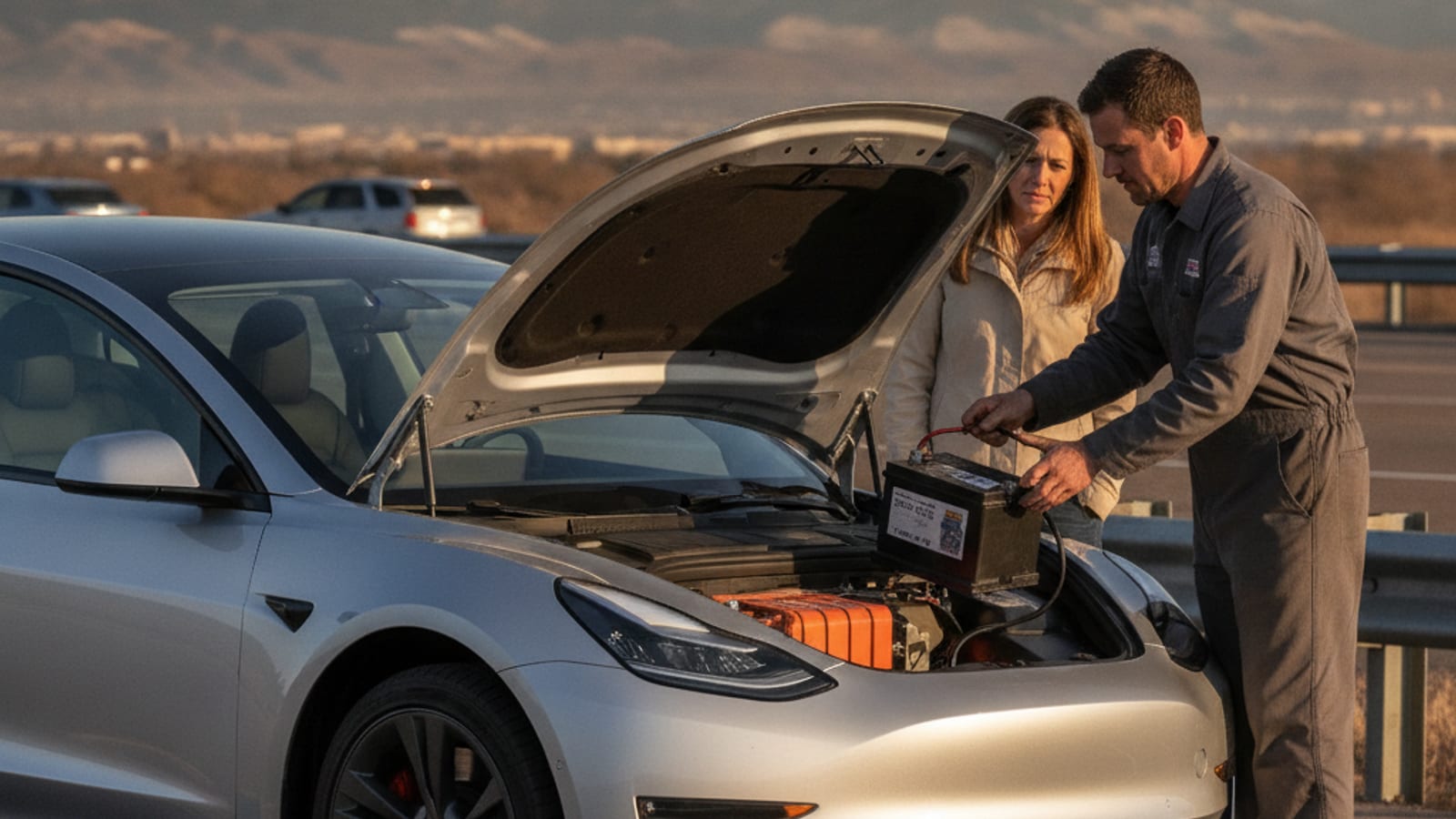
Tesla Model 3 battery replacement is two different jobs in one search. The traction pack under the floor is the expensive one and it sits behind an 8 year warranty. The 12-volt under the hood is the cheap one and it sits behind almost nothing. Drivers mix the two up because a dead 12-volt looks exactly like a dead pack from the driver’s seat. The right first move on a Denver shoulder is to figure out which one died, because the answer changes the bill, the wait, and who pays. Call (720) 738-6950 if you want a referral to an independent local operator who will jump or replace the 12-volt on site, and who will quote you before any cable goes in.
The Model 3 has two battery systems
A Model 3 carries two batteries. The big one is the high-voltage traction pack, a lithium-ion module bolted under the floor. It runs the motors and stores the energy that moves the car. Replacing it is a lift job at Tesla service or a qualified EV shop, not a roadside call.
The small one is the 12-volt. On newer Model 3 cars it is a lithium-ion low-voltage battery that lives under the hood. The 12-volt wakes the car up, runs the computers, throws the contactors that connect the big pack to the motors, opens the charge port, and powers the door locks. When it dies the whole car looks finished. The dash stays dark, the screen does not wake, the doors will not unlock, and the traction pack can still sit at 60 percent and the car still cannot move.
So when a Denver driver searches “Tesla Model 3 battery replacement cost,” the answer depends on which battery failed. A shop replacement of the traction pack is a major repair and there is no public rate card. A roadside jump or on-site 12-volt swap is a different kind of job, and it is what the operators we refer handle every week.
What the pack warranty actually covers
Tesla’s published New Vehicle Limited Warranty names HV Battery and Drive Unit coverage by model. For the Model 3 the table splits by trim.
Model 3 Standard or Standard Range Plus gets 8 years or 100,000 miles, whichever comes first. Model 3 Long Range or Performance gets 8 years or 120,000 miles, whichever comes first. The capture says the warranty covers defects and excessive capacity loss, with a minimum 70 percent battery capacity retention over the coverage window.
The VIN-specific terms in the Tesla app under Specs and Warranty still control for any individual car. Tesla can update those terms, and what is in your app is the document that pays a claim, not what a help article said last year.
Cybertruck sits outside that table. The published PDF does not list Cybertruck coverage. For that vehicle, the Tesla app is the only source of truth, and a Cybertruck driver who wants pack coverage details needs to read it in the app for the VIN.
The pack warranty is built around degradation and defect. It is not a roadside assistance product. It does not promise a tow, a charge at the car, or a loaner. It does not cover a 12-volt battery that died because the car sat in a cold lot for a week, and it does not pay for an empty pack on a Denver shoulder.
What the pack warranty does not cover
The list of out-of-scope items is longer than most drivers expect. The pack warranty does not pay for damage from a collision, from a flood, from using the car as a stationary power source outside the specs, from a track day, or from an aftermarket high-voltage repair that did not go through Tesla. It does not pay for a depleted pack on a shoulder. It does not pay for a 12-volt that died because of a phantom drain in a January parking lot.
That last point is the one that surprises Denver owners. A car parked at Denver International for a week in January can come back with a dead 12-volt and a full traction pack. The pack warranty does not apply, because the traction pack is not the failed part. The 12-volt is a wear item, closer to tires or wiper blades than to the drivetrain. It fails on a schedule, and cold accelerates the schedule.
The 12-volt in a Denver winter
January’s normal low around Denver sits near 18 degrees. The all-time record cold is around minus 29. A Model 3 that sits through one of those stretches, whether at DEN, in a Capitol Hill street spot, or in an apartment garage that does not stay warm, often comes back dark.
Below about 15 degrees the battery management system wakes periodically to keep the traction pack warm. That phantom drain pulls from the small battery too. Leave the car out for a week in a real cold snap, and the 12-volt often will not have enough left to wake the car up.
Newer Model 3 cars use a lithium-ion 12-volt. Lithium is lighter and smaller than the older lead-acid unit. It does not save the chemistry from a cold soak. The cells still sag, and a pack that was fine in November can be dead in February.
A week in a Denver parking structure is not the same as a week outside. The structure holds a few degrees of warmth. The 12-volt usually survives. The outside-air lot, especially in January or February, is the textbook 12-volt case. The pack did not die. The battery that opens the pack’s contactors did.
Out-of-range and what Tesla roadside will do
Tesla has its own roadside path through the Tesla app. The path is for jump-starts, flat tires, lockouts, and tows. Out-of-range assistance may be available for an empty traction pack, but it is not financially covered. A driver who runs a Model 3 to zero on a metro shoulder may end up waiting on a flatbed to a Supercharger rather than a charger coming to them.
For the Model 3 the published roadside procedure lives in the app, not in a printed booklet. Read what your year and VIN get before you call anyone. Tesla roadside sends a contractor, not a Tesla employee. The contractor may only carry jump gear. If the car needs more than a jump, the contractor often tows it to a service center.
That tow can be a long wait in the Denver cold. A mobile operator with a replacement battery on the truck ends the call in one visit. Tesla roadside sends a contractor walks the referral flow in more detail.
How to tell which one died
The two failure modes look similar at the handle. A few tells sort them out without tools.
The screen will not wake, but the 12-volt indicator on the Tesla app may still show the car as connected. The doors may not unlock. The frunk may not release. Hazard lights may or may not work depending on how dead the 12-volt is. None of those symptoms tell you the pack is empty. They tell you the pack cannot wake up.
The pack, on the other hand, may sit at a known percentage in the app before the failure. If the driver left home with 80 percent and the app showed 80 percent ten minutes before the stall, the pack is not the problem. The 12-volt is.
A Model 3 that runs to zero shows a different pattern. The screen warns at low percentages. The car starts to cut climate and limit power. The driver usually feels the car slow down before the car stops. That is a pack problem, not a 12-volt problem.
The quickest roadside test is a jump on the under-hood posts. If the car wakes and stays awake after a minute, the 12-volt was the problem and the pack can carry you home. If the car wakes and dies again within minutes, the 12-volt is not holding a charge and a swap is the real fix. If the car wakes, shows a 12-volt warning on the screen, and the warning does not clear after a drive, the 12-volt is failing and the next cold night will repeat the stall.
Where the Model 3 hides the 12-volt
The Tesla published documents for the Model Y describe a lithium-ion low-voltage battery accessed after the hood is open. The hood unlatches through the screen or the emergency release under the front nose panel. The positive and negative jump terminals sit under that hood and unlatch only. You do not have to climb into the frunk cavity to reach them.
Model Y pages are not a Model 3 procedure. The Model 3 layout is close but not identical. Earlier build Model 3 cars put the 12-volt under the frunk liner behind a plastic trim panel. Newer build Model 3 cars use an under-hood lithium 12-volt similar to the Model Y. The right manual page for your year and trim is the one to follow.
For a walkthrough of access steps by build year, see Where a Model 3 hides the 12-volt and the pack.
What the operators we refer handle on site
Charge Pro DEN is a referral line. We do not own trucks, employ technicians, set prices, or publish hours. We match a stranded driver with an independent local operator in the Denver metro, and that operator quotes the work before any cable goes in.
The typical on-site job for a Model 3 is a 12-volt jump from the under-hood posts. The car wakes, the driver waits a minute, and the car either stays awake or it does not. If it stays awake, the driver drives home. If it does not, the operator carries a small lithium or lead-acid 12-volt sized for the model and can swap the unit on the spot. The operator bills the driver directly for the visit and the part. There is no add-on from Charge Pro DEN for the referral itself.
The operators we refer also handle the empty pack case. They roll a 240 volt Level 2 source with a NACS plug native to Tesla. They add range in place so the driver can reach a stall or a home charger. They quote the visit before they start. For the broader script, see mobile Tesla charging near me and the out-of-charge recovery page.
For the comparison between jumping and swapping, see Tesla 12-volt dead: jump it or replace it on site.
When a shop is the right call
A 12-volt that will not hold a charge still ends at a shop if the on-site operator does not carry the model-specific battery. Some Model 3 years need a programmed replacement that ties the new 12-volt to the car’s modules. That programming can happen at Tesla service or at a qualified independent EV shop with the right scan tool. The operators we refer will tell you on the phone whether their truck handles the swap or whether the car needs a shop.
A traction pack that has lost range below the warranty retention floor, or one that has thrown a critical error, is a shop job from the start. Tesla service in the metro is the obvious path. A qualified independent EV shop is the alternative for out-of-warranty cars. Either way, the car needs a lift, not a roadside call.
For the pack-warranty details on a specific VIN, the Tesla app is the source of truth. For the 12-volt, the manual is the source of truth. For the broader question of whether roadside help or a shop fits the call, see pack warranty vs a dead 12-volt on the road.
How to keep the 12-volt alive through a Denver winter
A few habits cut the chance of a cold-morning stall.
Plug the car in at home whenever possible. Even a 120 volt Level 1 cord keeps the battery management system from doing repeated cold-soak wake cycles on the small battery.
If the car sits outside for a week or more at DEN, ask the parking operator whether a tender or a maintenance charger is an option. The DEN garages and shuttle lots do not all offer it, but a long-stay lot sometimes does.
Drive the car at least once a week in winter, even for a short run. The DC-DC converter recharges the 12-volt while the car is moving, and a weekly drive is enough to keep it above the failure threshold for most owners.
Replace the 12-volt on schedule. A Model 3 that is more than six years old on the original 12-volt is at end of life. The replacement cost is small compared to a tow and a service appointment after a cold-morning stall.
The right first move on a Denver shoulder
If the car is in a travel lane or another dangerous place, call 911 first. Hazards on, stay visible, stay in the car if that is the safer choice.
If the car is safely off the road and the screen will not wake, the next call is the one that ends the wait. The operators we refer handle Model 3 12-volt jumps and on-site swaps every week in the Denver metro. They quote before any cable goes in. Call (720) 738-6950 when you want that match. Treat it as a referral number, not a rolling promise.
Frequently asked questions
Does Tesla warranty cover the 12-volt in a Model 3?
No. The HV Battery and Drive Unit warranty covers the traction pack, not the 12-volt low-voltage battery. The 12-volt is a wear item. The pack warranty also excludes a depleted pack on a shoulder, a 12-volt that died from sitting, and damage from outside causes.
How long is the Model 3 traction pack warranty?
For the Standard or Standard Range Plus it is 8 years or 100,000 miles, whichever comes first, with a minimum 70 percent capacity retention. For the Long Range or Performance it is 8 years or 120,000 miles, whichever comes first, with the same minimum 70 percent retention. The Tesla app Specs and Warranty page for your VIN is the document that controls.
Can a Model 3 12-volt be replaced on the roadside in Denver?
Often, yes. The operators we refer carry small lithium and lead-acid 12-volts sized for the Model 3. They quote the swap before they start. Some model years need a programmed replacement that ties the new battery to the car, and that work moves to a shop with the right scan tool.
Is the Cybertruck pack warranty different?
The published Tesla warranty PDF does not list Cybertruck. For Cybertruck, the Tesla app is the source of truth for pack coverage on the VIN.