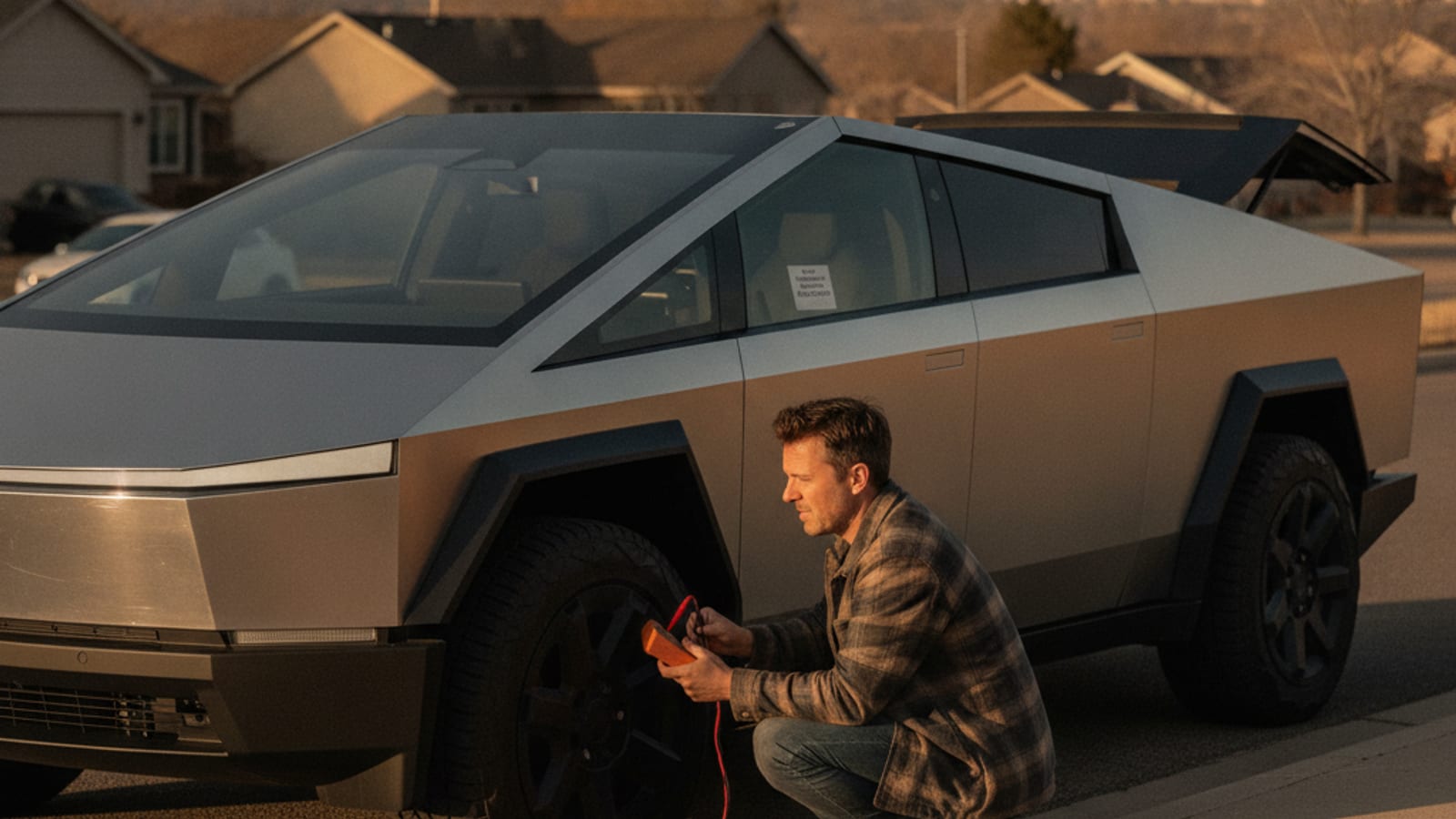
The Tesla battery warranty covers the traction pack, the high-voltage module under the floor that drives the wheels. It does not cover the small 12-volt battery that wakes the car, opens the charge port, and runs the computers. When a Tesla will not wake after a cold night in a Denver lot, the pack warranty is the wrong document to reach for. Call (720) 738-6950 and we will refer an independent local operator who can jump or replace the 12-volt on site. They quote before they start and they bill you directly.
What the pack warranty actually covers
Tesla’s published New Vehicle Limited Warranty lists HV Battery and Drive Unit coverage by model. Model S and Model X get 8 years or 150,000 miles, whichever comes first, with a minimum 70 percent battery capacity retention. Model 3 and Model Y Standard or Standard Range Plus get 8 years or 100,000 miles. Model 3 and Model Y Long Range or Performance get 8 years or 120,000 miles. The capture says the warranty covers defects and excessive capacity loss under those thresholds. The VIN-specific terms in the Tesla app under Specs and Warranty still control for any individual car.
Cybertruck sits outside that table. The published document does not list Cybertruck coverage, and the Tesla app is the source of truth for that vehicle.
The pack warranty is built around degradation and defect. It is not a roadside assistance product. It does not promise a tow, a charge at the car, or a loaner. It does not cover a 12-volt battery that died because the car sat in a cold lot for a week.
What the pack warranty does not cover
The 12-volt battery is a separate component from the high-voltage pack. On current Teslas it is a small lithium-ion low-voltage module that runs the contactors, the computers, the locks, and the wake sequence. The traction pack sits under the floor. The 12-volt sits under the hood or in a service panel. They are wired in series at start-up, and the 12-volt has to wake the contactors before the pack can deliver power to the wheels.
If the 12-volt is dead, the car looks completely finished. The screens stay dark, the doors will not unlock, the charge port will not open. The traction pack may still hold most of its energy. The warranty on the traction pack cannot help, because the failure is in a different component.
A Tesla in a Denver parking structure in January is a textbook setup for this pattern. The car’s thermal management wakes the pack as needed, but the 12-volt sits exposed to cold soak. A long sit, especially with sentry mode or a climate preconditioning schedule, pulls the 12-volt down. By the time the driver returns, the pack may still show 60 percent on the app. The car will not wake.
Why Denver cold is the usual cause
January’s normal low at Denver sits around 18 degrees. The all-time record cold hit minus 29 on Jan 9, 1875, and arctic drops can swing the metro from the 40s into the teens in hours, the way the January 2024 storm moved Denver from 47 to minus 19 in about 48 hours. Lithium-ion chemistry slows in cold. The 12-volt holds less usable energy, the contactors need more voltage to close, and the BMS draws the small battery down to keep the pack healthy.
Recurrent studied more than 30,000 U.S. EVs in winter. At 32 degrees, drivers kept about 78 percent of max range. At 20 degrees, about 70 percent. AAA’s 2026 study showed roughly 39 percent range loss at 20 degrees. Those figures describe the traction pack. The 12-volt follows a different curve, but it follows the same trend, and a marginal 12-volt that sat through a Denver cold week simply will not wake.
A long sit in a DEN economy lot multiplies the pattern. Travellers leave cars for days, cold snaps arrive, sentry mode drains the 12-volt, and the driver returns to a car that will not open. That call shows up across the metro from Aurora and Commerce City more than anywhere.
What the warranty cannot do for you on a shoulder
Tesla roadside is requested through the Tesla app. The app confirms what is covered for the VIN and the year. Out-of-range assistance may be available under the program, but it is not financially covered the way a warranty repair is. Tesla does not promise a Level 2 charge at the car. Tesla does not promise a 12-volt replacement on the shoulder.
If the pack is at fault, Tesla can route the driver to a service center. If the 12-volt is at fault, Tesla’s published roadside path typically covers a jump or a tow to a service center, not a mobile boost and not a 240-volt charge at the car.
What does work in a Denver lot
CDOT Safety Patrol covers listed metro freeway segments. Front Range hours run 6:00 to 9:30 a.m. and 2:30 to 7:00 p.m. on weekdays, 10:00 a.m. to 7:00 p.m. on weekends. Mountain Corridor hours run 6:00 a.m. to 7:00 p.m. Friday through Sunday and during significant weather. The free patrol will jump a 12-volt on those listed segments. CDOT’s own Safety Patrol and breakdown pages do not mention EV charging, which means a jump is the help on offer, not a charge.
Operators we refer handle 12-volt jumps and on-site 12-volt replacements for Tesla. They bring the kit, they quote before the cable goes in, and they bill the driver directly. The same operator can also bring a 240-volt Level 2 source if the pack is empty, with a native NACS plug on the lead for any Tesla. A jump adds minutes to the visit. A Level 2 charge adds about 10 to 20 miles over 15 to 30 minutes once the cable is in. Neither is an arrival time, and we don’t promise one.
For the broader choice between a charge in place and a tow, see mobile EV charging or out-of-charge recovery.
How to read the warranty in plain terms
The pack warranty is a long protection against an expensive failure. It is not a roadside plan, and it is not a rescue tool. The 12-volt battery is a wear item that lives on a different clock. A healthy pack and a dead 12-volt can sit in the same car.
For a Denver driver, the practical translation is this:
- A pack that loses range below the 70 percent retention threshold in the warranty window is Tesla’s problem, and the Tesla app routes the repair.
- A 12-volt that will not wake after a cold soak is a roadside problem, not a warranty problem. The right call is a Tesla 12-volt jump service or a local operator who can swap the battery on site.
- An empty pack on the highway is a mobile EV charging referral or a flatbed, depending on whether the car can roll.
- A pack failure that disables the car entirely is a Tesla service event, not a roadside one. The Tesla roadside rescue call is the start of that path.
Colorado law a stranded driver should know
CRS 42-4-1202 is the disabled-vehicle statute. Outside a business or residential district you may not stop on the paved main-traveled part of a highway, except for a vehicle so disabled it cannot be moved further, with hazard lights on under CRS 42-4-230. A violation is a class B traffic infraction if a driver stops on the main lanes when the car could have rolled to the shoulder.
CRS 42-4-1803 to 1805 cover abandoned vehicles on public property. The statute sets no 24-hour or 72-hour threshold. An officer decides on reasonable grounds to believe the vehicle is abandoned. After a tow, a defined notice and sale clock starts.
Colorado is a one-party-consent state for recording under CRS 18-9-303. A participant may record a call without telling the other party. That is materially different from California, and it is why a recorded-line consent notice does not need all-party disclosure to be lawful here.
No Colorado statute addresses a disabled EV or mobile EV charging. A stranded EV is governed by the same disabled-vehicle statutes as any car. There is no EV carve-out. For more on what roadside crews can and cannot jump, read can roadside jump an EV 12-volt.
What a cold-lot driver should do in order
- Check the Tesla app first. If the car shows pack percentage and responds to a wake command, try the wake command before assuming the 12-volt is dead.
- If the screens stay dark, treat it as a 12-volt failure. The Tesla 12-volt jump service is the right referral.
- If you are on a listed CDOT Safety Patrol segment during posted hours, the free patrol will jump a 12-volt. It will not charge a pack.
- If the pack is genuinely empty, the mobile EV charging referral brings a 240-volt source. The operator quotes first.
- If the car cannot roll, a flatbed to a service center is the right call.
A note on what the warranty does for resale
The pack warranty follows the car, not the owner. It transfers when the car sells, and the time and mileage continue from the original in-service date. A 5-year-old Model Y Long Range still has roughly 3 years of pack coverage left. That is a real resale point, and it is one of the genuine values of the warranty.
The 12-volt is not part of that resale story. A replacement 12-volt is a wear item, like tires. A driver buying a used Tesla should plan to inspect or replace the 12-volt on a normal service interval, not on the warranty clock.
When to call Tesla instead
If the car will wake but shows a pack warning, the Tesla app is the right path. If the car will not wake and you suspect a defect in the traction pack rather than the 12-volt, the Tesla app still routes the call. The Tesla roadside path in the app is the documented first step for any VIN-specific question.
Charge Pro DEN does not replace what Tesla does. We refer a local operator for a 12-volt jump or a Level 2 charge when the situation does not need a service center. Call (720) 738-6950 to talk through the choice. The operator we refer will quote before they start, and they will bill you directly. Treat that number as a referral line, not a rolling promise.
Frequently asked questions
Does the Tesla warranty cover a dead 12-volt?
No. The published warranty covers the HV battery and drive unit. The 12-volt is a separate component that wears on its own clock. A dead 12-volt is a roadside problem, not a warranty repair.
What does the Tesla battery warranty actually cover?
It covers defects and excessive capacity loss in the high-voltage traction battery and drive unit, with model-specific years and miles, and a minimum 70 percent capacity retention. The Tesla app under Specs and Warranty shows the terms for a specific VIN.
Will Tesla send a charger to a stranded car?
Tesla roadside in the app can dispatch help, but a Level 2 charge at the car is not a standard Tesla roadside service. A local operator we refer can bring a 240-volt source to the bumper and quote before they start.
Can a cold Denver night really kill a 12-volt?
Yes. Cold slows lithium chemistry, the BMS draws the 12-volt down for thermal management, and a long sit in a cold lot can leave the small battery flat. The traction pack may still hold plenty of energy. That is the cold-lot 12-volt failure pattern.
What about Cybertruck?
The published New Vehicle Limited Warranty does not cover Cybertruck in the same table. The Tesla app is the source of truth for Cybertruck pack terms.
Does the pack warranty transfer when I sell the car?
Yes. The pack warranty follows the car, not the owner. Time and mileage continue from the original in-service date.