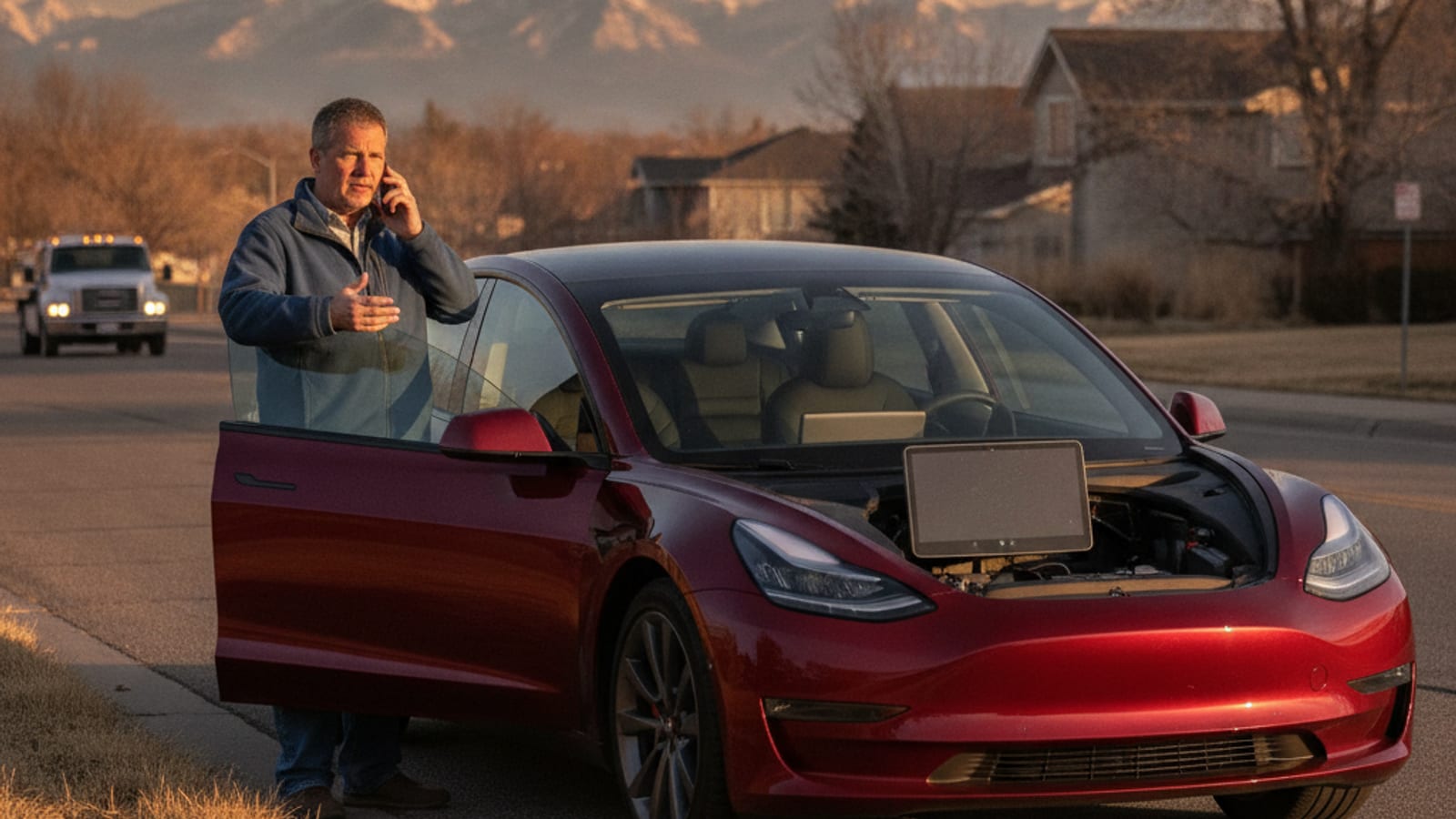
A Tesla that won’t unlock is almost always a flat 12-volt, not a dead traction pack. The handles stay in. The phone-as-key does nothing. The Tesla app can’t see the car. The car looks totally finished, but the big battery under the floor is probably fine. Call (720) 738-6950 and we’ll match you with an independent operator who jumps or replaces a 12-volt on site. You pay them. Charge Pro DEN does not send a truck.
Why the car locks you out
The 12-volt is the small battery that runs the car’s everyday electronics. It powers the door handles and latches. It feeds the touchscreen, the network module, and the key-fob handshake. It closes the contactor that lets the high-voltage pack reach the motors. When the 12-volt is dead, every one of those jobs is paused. The handles can’t present themselves. The screen can’t wake. The pack relay stays open. From outside, it looks like the car has no power at all.
The traction pack is a different system. On a Tesla Model 3 and Model Y it sits under the floor and holds plenty of energy. On a Model S and Model X it sits behind the firewall or under the floor. None of that matters until the 12-volt wakes the car. The pack can’t help a Tesla that won’t unlock.
Cold does this. Denver’s January normal low is about 18 degrees. The all-time record is minus 29 on January 9, 1875. In January 2024, Denver dropped from 47 to minus 19 in about 48 hours. A lead-acid 12-volt loses punch in that kind of soak. Newer lithium 12-volts in Model 3 and Model Y hold a rest charge longer, but they still die after a long cold nap. Older Model S and Model X cars used lead-acid and age out faster.
A Denver winter can kill a 12-volt in three common places:
- A week in a DEN parking lot on Peña Boulevard. Peña is the only road to the airport, city-maintained, an 11-plus-mile run across open plains. Cold and wind stack up. The car sits asleep. The Tesla app may have shown a 12-volt low notice before you flew, or it may not have.
- A long dwell at Park Meadows or the Denver Tech Center. Office towers and mall garages hold cars all day. Cold plus a tired 12-volt plus phantom drain equals a brick.
- Street parking overnight in a Denver neighborhood. More than half of Denver’s housing predates 1980. A lot of those addresses have no driveway plug and no garage. The car sits outside, runs its own thermal management below about 15 degrees, and wakes up lower than it parked.
A frozen 12-volt is the rule, not the exception, in those situations. Read Tesla 12-volt failure in Denver cold for the longer Denver pattern.
What you can try from outside the car
Some Teslas will respond to a mechanical key hidden in the key fob. It releases the door, but it does not start the car. On Model 3 and Model Y, the mechanical key slot sits under the driver’s door handle. Pull the small tab at the bottom of the handle, lift, and the lock cylinder shows. The key fob’s hidden metal key fits. You can get in, but the car still won’t drive.
Phone-as-key needs the 12-volt. If the 12-volt is dead, the Bluetooth and network modules can’t talk. The Tesla app shows the car as offline. You may have tried the app already. That offline state is a 12-volt signal, not a pack signal.
A wall connector can’t help. The car has to close its contactors before it will accept a charge. The 12-volt is what closes them. Plugging in a dark Tesla does nothing until the 12-volt is alive.
This is the moment drivers call a flatbed. Stop and look for the 12-volt jump points instead. Model 3 and Model Y have them under the hood. Model S and Model X have them in the frunk, near the firewall. A standard 12-volt jump pack on those posts will often wake the car. If it wakes and the pack percentage looks normal, you have the answer.
What to do on a Denver metro shoulder
If the car is in a travel lane or another dangerous place, call 911. Don’t stand in traffic trying to jump a battery.
If you made it to the shoulder, hazards on. Colorado law under CRS 42-4-1202 lets a disabled vehicle sit on the shoulder if it genuinely could not be moved further, with hazards on under CRS 42-4-230. You can stay with the car. Stay visible.
CDOT Safety Patrol is free on listed metro freeway segments in published hours. Weekday hours run 6:00 to 9:30 a.m. and 2:30 to 7:00 p.m. Weekend hours run 10:00 a.m. to 7:00 p.m. Mountain Corridor hours run 6:00 a.m. to 7:00 p.m. Friday through Sunday and during significant weather. CDOT’s published menu is tires, jumps, fuel, debris, and minor mechanical help. CDOT’s own pages do not mention EV charging as a service. The Safety Patrol will jump a 12-volt on those segments. It won’t add miles to the traction pack.
E-470 is the eastern metro loop. Pull to the shoulder and dial *470. E-470 publishes jump-starts on its free roadside menu. It does not publish an EV charge. If you want Colorado State Patrol, dial *CSP, which is *277.
If you’re on Peña Boulevard, treat it as a city-maintained road. Don’t assume CDOT’s published metro segments cover Peña. The bomb cyclone of March 2019 closed Peña, I-70, I-25, and all DIA runways at once. Ground blizzards still close it today.
Empty pack or 12-volt: which one you have
A locked-out Tesla with no screen and no door response is the 12-volt pattern. Pack trouble usually still lets the car power on. You see a range drop or a warning, not a silent brick. If your gauge said zero before you parked, the pack may be empty. If the gauge said 50% and the car still won’t wake, the 12-volt is the failure.
If the gauge was already at zero, a mobile Level 2 charge adds about 10 to 20 miles in 15 to 30 minutes of charging time. The clock starts when the cable goes in. It isn’t an arrival window, and we don’t promise one. Read how to tell if your Tesla’s 12-volt is dead for the full 12-volt check.
If the gauge was not at zero, the jump is the first step. The jump is a test, not a repair. Remove the jumper and the 12-volt can fail again. Next is a replacement, on site or at Tesla service. The independent operators we connect you with jump a dead 12-volt on site and replace one when that is the job. They quote before they start, and they bill you directly.
How a local operator helps on a Denver shoulder
Charge Pro DEN is a referral line. We don’t own trucks. We don’t employ technicians. We don’t set prices. We match you with an independent local operator. That operator quotes you before any cable goes in. They bill you directly for the work they do.
The kit is a 240-volt Level 2 source for the pack, or a 12-volt jump pack and a replacement 12-volt on site. Tesla drivers get a native NACS plug on the lead. Other EVs use a CCS or J1772 adapter.
For an empty pack, use mobile EV charging. For a frozen 12-volt that locked you out, use Tesla 12-volt battery jump. For how the 12-volt fails again after a jump, read EV 12-volt dies again after a jump.
If you hold a tow membership, ask whether the truck packs Level 2 charging gear. Many empty-pack calls still move as flatbed tows toward a public stall. A local operator can add range on site instead. The choice depends on whether the 12-volt or the pack is the failure, where you are, and what the weather is doing.
A locked-out Tesla in a DEN lot
This is the hardest version. You’re at the airport. The car is in the East or West garage, or in a shuttle lot. You can’t open the door. The app can’t see it. You’re stuck with luggage and a flight to catch.
Peña Boulevard is the only road in. If the car has to move, a flatbed to a public stall or to Tesla service is the realistic plan. A mobile operator can come to DEN, but the question is whether you need a 12-volt wake-up at the curb or a tow. Read jump-start a Tesla 12-volt on Model 3, Y, S, and X before you order the tow.
The longer-term fix is to keep the 12-volt healthy before a trip. A weak 12-volt shows a low notice in the app. If doors still work and the app is warning you, treat that as a short fuse. Plan a jump or a replacement before your next flight. A Tesla that sits asleep for a week in a cold lot is the test case. Most pass it. Some do not.
Frequently asked questions
Why won’t my Tesla unlock in Denver cold?
A frozen 12-volt is the usual reason. Cold plus a long sit plus a tired battery is enough. The traction pack can still hold plenty of charge. The 12-volt is what runs the door handles, the screen, and the contactor that wakes the pack.
Will the Tesla app unlock a car with a dead 12-volt?
No. Phone-as-key needs the 12-volt to talk to the car. If the 12-volt is dead, the app shows the car offline. That offline state is a 12-volt signal, not a pack signal.
Can CDOT Safety Patrol open a locked Tesla?
CDOT’s published menu covers tires, jumps, fuel, debris, and minor mechanical help. A 12-volt jump is in the toolkit. CDOT’s own pages do not mention EV charging as a service. The Safety Patrol can wake a 12-volt on listed segments in published hours. It cannot unlock a car without power to the handles.
How long can a Tesla sit at DEN before the 12-volt dies?
There is no fixed clock. Cold, age, idle electronics, and a long rest stack the odds. A week in a cold January lot is the hard version. Some cars restart fine. A weak 12-volt fails in that lot. Check the 12-volt before you order a flatbed.
Should I get a tow or call for a 12-volt jump first?
Start with the 12-volt. A jump pack on the front posts often wakes the car. If it wakes with a normal pack percentage, the traction battery was not the failure. If it does not wake, or wakes with a true zero, then a tow or a mobile Level 2 charge is the next step.