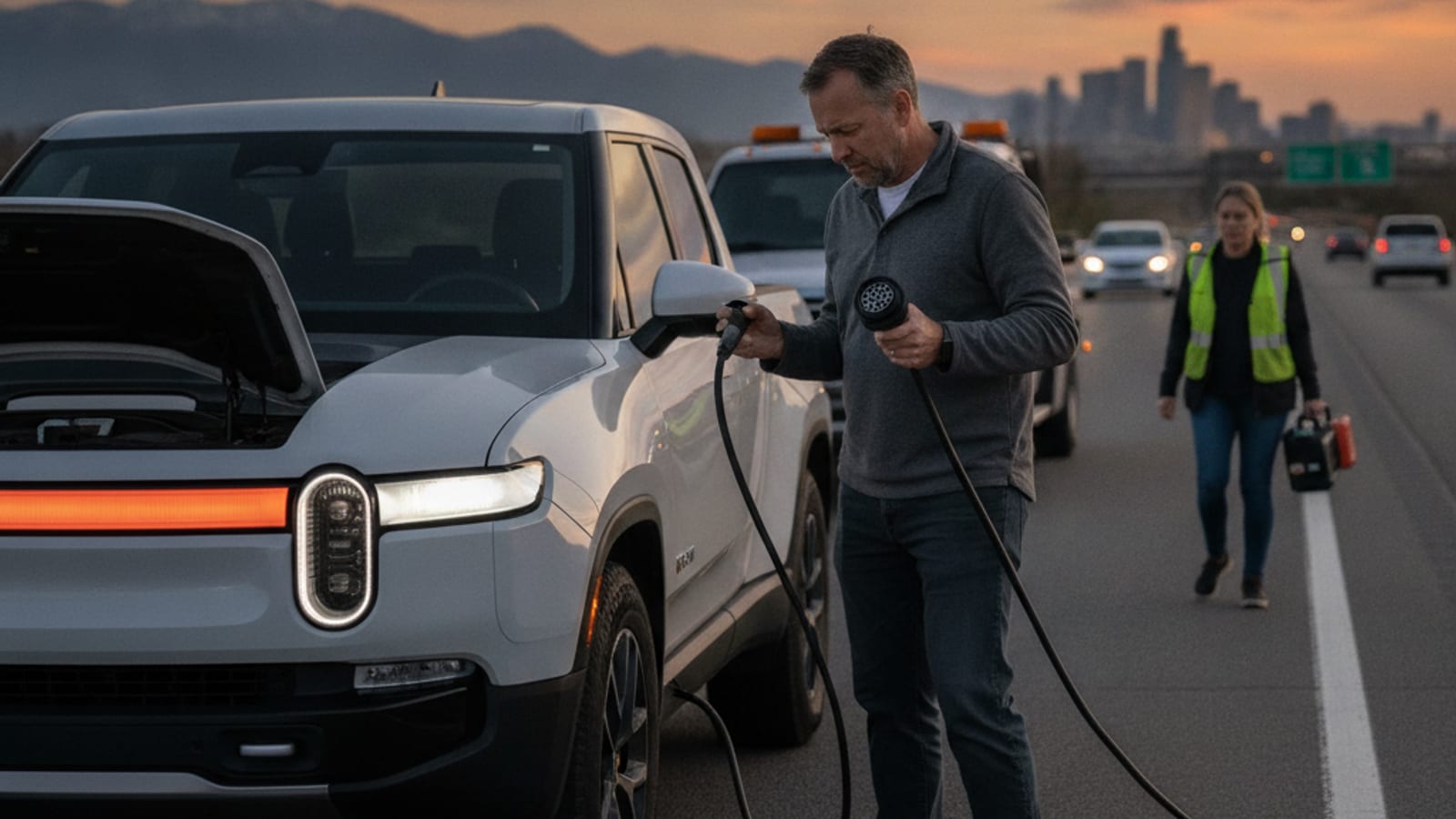
A Rivian on the shoulder needs a 240-volt Level 2 source with the right plug. Most Rivians on the road in 2026 use the CCS inlet, the big combined plug. Newer Rivian model years with NACS need the smaller Tesla-style connector or an approved AC adapter. Charge Pro DEN does not bring a charger. We match you with an independent local operator who carries a 240-volt Level 2 source, a NACS lead, and the right CCS adapter for the truck in front of them. They quote you before any cable goes in. You pay them. If your Rivian is stuck, call (720) 738-6950.
The connector depends on the year
Rivian connector support changes by model year and trim. The current lineup on the road in Denver, Boulder, and the metro splits into two camps.
CCS (Combined Charging System). The older and most common inlet on a Rivian R1T or R1S sold before the NACS switch. It is a big plug with two extra DC pins below a J1772-style AC portion. AC Level 2 uses the round J1772 part. DC fast uses the whole inlet.
NACS (J3400, the Tesla-style plug). Rivian moved to the smaller NACS inlet on newer model years. A NACS Rivian still needs a J1772 AC adapter for many AC Level 2 stalls. Rivian publishes an approved J1772 adapter for compatible 2026 and newer NACS vehicles, AC use only.
The split matters at the curb. If your truck has the CCS inlet, the operator needs a CCS lead or a CCS adapter on a J1772 source. If your truck has the NACS inlet, the operator needs a NACS lead or the approved J1772-to-NACS AC adapter, and never on a DC charger.
Why Level 2 is the roadside answer, not DC fast
A mobile roadside truck carries a 240-volt Level 2 source. That is the AC Level 2 we just named. It is not a DC fast charger. DC fast charging needs industrial power, three-phase service, and a fixed install. A truck does not carry that.
Level 2 at 240 volts adds a real share of range in a real window of time. Typical charging time adds about 10 to 20 miles of range in 15 to 30 minutes of charging. The clock starts when charging starts. It is not an arrival time. Operators we refer handle Tesla and every major EV brand, and a mobile EV charge is the right job when the pack is just low.
For the broader kit a mobile EV charger brings, read what a mobile EV charger actually brings. That post stays on the truck and its gear.
Cold eats more than the meter shows
A Rivian’s rated range is the floor in Denver January. Recurrent Auto studied more than 30,000 U.S. EVs in winter. EVs kept about 78 percent of max range at 32 degrees. At 20 degrees the share dropped to about 70 percent. The AAA study put average cold loss at about 39 percent at 20 degrees. A Rivian with a full pack rated for 300 miles can show closer to 210 on a 20-degree morning.
Below about 15 degrees the battery management system also wakes up to keep the pack warm. That phantom drain shows up after a long sit. A Rivian parked at the curb overnight in January can lose a few percent just sitting there. By the time you head out in the morning, the gauge reads lower than the night before.
Cold plus a grade is the harder math. Climbing out of Idaho Springs at 7,526 feet toward the Eisenhower-Johnson Memorial Tunnel at 11,158 feet, the road gains roughly 3,600 feet in less than an hour of driving. The heater runs against sub-freezing air. The grade eats range. A driver who left the Denver metro at 80 percent can arrive at the tunnel below 30 percent if conditions stack up.
The useful true counterpart: coming back down, regen returns a real share of that climb. A Lucid Air GT used about 3 percent of its battery over a 77-mile descent from Loveland Pass. A Hyundai Ioniq 5 used about 10 percent over a 75-mile descent from the same area. Both credits go to regenerative braking. Drivers dial regen down on icy descents for traction, so the real number varies. The point stands: the climb is the expensive half.
What “stranded” looks like on a Rivian
Three real patterns bring a Rivian to a halt on a Denver metro shoulder.
Empty pack on the climb. You left Golden or Idaho Springs with what looked like enough. The grade plus cold plus the heater finished the margin. The truck drops to zero on the shoulder with hazards on.
Dead 12-volt after a freeze. A Rivian R1T and R1S use a small 12-volt battery to wake up. The traction pack drives the wheels. The 12-volt closes the contactors, runs the infotainment, and keeps the cell modem alive. A cold soak that lasts a week, often at the airport, finishes a marginal 12-volt. The pack may still show range on the app. The truck will not wake. Read Rivian R1T or R1S won’t start in the cold for that pattern in full.
Failed public stall. You pulled into a Supercharger or an EVgo site. The cable would not lock. The session would not start. The pack is fine, but you are out of time and out of patience in a parking lot.
For pattern one and pattern three, an operator with a 240-volt Level 2 source and the right plug is the answer. For pattern two, the operator jumps the 12-volt or replaces it on site.
The CCS versus NACS question at the curb
Operators we refer show up with the gear for both inlets. A typical truck carries a 240-volt Level 2 source, a NACS lead, a J1772 lead, and a CCS adapter. The operator reads the truck and picks the lead or adapter before plugging in.
If your Rivian has a CCS inlet, they use the CCS lead or the CCS adapter on a J1772 source. The J1772 portion of the CCS inlet handles AC Level 2. The two extra DC pins below stay out of the way on AC.
If your Rivian has a NACS inlet, they use a NACS lead on the NACS portion of the plug. For many NACS Rivians on a J1772-only Level 2 source, they need an approved J1772-to-NACS AC adapter. That adapter is AC only. It is not for a DC fast charger, and an operator who tries to use it on DC is doing it wrong.
For the broader question of adapters and ports on every brand, read non-Tesla EV rescue in the Denver metro. That page stays on the adapter problem across CCS, J1772, and NACS at the roadside.
What CDOT patrol and E-470 will not do
CDOT Safety Patrol runs free on listed Front Range freeway segments. Coverage includes portions of I-25, I-70 East, US-6, C-470, and I-225 in the metro. The I-70 Mountain Corridor is covered Morrison to Vail. The patrol will change a tire, jump a 12-volt, and bring emergency fuel. CDOT’s Safety Patrol and the my-car-broke-down page mention nothing about electric vehicles, EV charging, or a charging-specific service. The free state truck will not bring a charge to your Rivian.
E-470 is the eastern toll loop. Pull to the shoulder and dial *470. The authority publishes flat tires, fluid top-offs, jump-starts, phone help, and debris removal. E-470 does not publish an EV charging service. *CSP (*277) reaches State Patrol for crashes, enforcement, and dispatch.
Neither program brings a 240-volt Level 2 source to a stranded EV. That work belongs to an independent mobile operator.
Sit on the shoulder the legal way
CRS 42-4-1202 covers a disabled vehicle on a highway. Outside a business or residential district you may not stop or leave a vehicle on the paved main-traveled part of a highway, except a vehicle so disabled it is impossible to avoid stopping and to move it off the roadway. Hazard lights must be on under CRS 42-4-230.
A Rivian with an empty pack or a dead 12-volt is the kind of disabled vehicle the statute contemplates. Pull as far off the travel lane as you can. Turn the hazards on. Stay in the truck if the shoulder is too narrow to stand on. Call for help from the truck.
On E-470, dial *470 first if you need a jump or a tire. On CDOT-covered freeway segments during published hours, the Safety Patrol handles the same list. None of those trucks bring a charge.
Why Charge Pro DEN is a referral, not a truck
Charge Pro DEN does not own trucks, employ technicians, set prices, publish hours, hold a license, or perform work. We match a stranded driver with an independent local operator. The operator quotes before any cable goes in. They bill the driver directly for the work they do.
Operators we refer handle Tesla and every major EV brand. A stuck charge port is a latch problem, not a tow problem. Ask the operator about the port before anyone hooks a winch. For the choice between a charge in place and a tow to a stall, read mobile charge or tow: which a stranded Denver EV actually needs.
For Rivians, the referral matters because the connector question is real. The operator who shows up reads the inlet, picks the right lead or adapter, and starts the 240-volt Level 2 charge. If the 12-volt is dead instead of the pack, they handle that on site and quote first.
A short list before you call
- A Rivian needs 240-volt Level 2 with the right plug: CCS for older trucks, NACS or an approved J1772 AC adapter for newer NACS trucks.
- Mobile roadside is AC Level 2 only. It is not DC fast. Expect 10 to 20 miles of range in 15 to 30 minutes of charging.
- Cold eats more than the meter shows. Plan for the climb and treat regen on the descent as a real share back.
- A dead 12-volt looks like a dead truck. The pack may still have plenty of range.
- CDOT Safety Patrol and E-470 *470 will jump a 12-volt. Neither brings a charge.
- The traction law can require winter tires or chains on I-70 in storms. Activates by signage, posted on COtrip.
- Charge Pro DEN is a referral. The operator quotes before work. You pay the operator.
Frequently asked questions
Does a Rivian use a Tesla plug?
Older Rivian R1T and R1S trucks use the CCS inlet. Newer Rivians have moved to the NACS inlet, the Tesla-style connector. The connector your specific truck needs depends on its model year. A NACS Rivian also needs an approved J1772 AC adapter for many AC Level 2 stalls, and that adapter is AC only.
Can a Rivian use a regular Level 2 charger?
Yes, for AC Level 2 charging. A CCS Rivian uses the J1772 portion of the inlet. A NACS Rivian uses a NACS lead or an approved J1772-to-NACS AC adapter. The 240-volt Level 2 source a mobile operator carries is the right tool for a roadside charge.
What charger does a Rivian use for DC fast charging?
For DC fast charging, a Rivian uses the CCS inlet on older trucks or the NACS inlet on newer trucks at a Supercharger or an EVgo or Electrify America stall. A mobile roadside truck does not carry DC fast. DC fast needs industrial power and a fixed install.
Can an operator bring a charge to my Rivian on a shoulder?
Yes, an independent operator we refer can bring a 240-volt Level 2 source with a NACS lead, a J1772 lead, and a CCS adapter. The operator reads your inlet and picks the right lead or adapter. They quote you before the cable goes in.
Does CDOT Safety Patrol charge a Rivian?
No. CDOT Safety Patrol provides flat tires, jump-starts, emergency fuel, minor mechanical help, debris removal, and incident support. CDOT’s published guidance does not include EV charging. The same is true for E-470 *470.