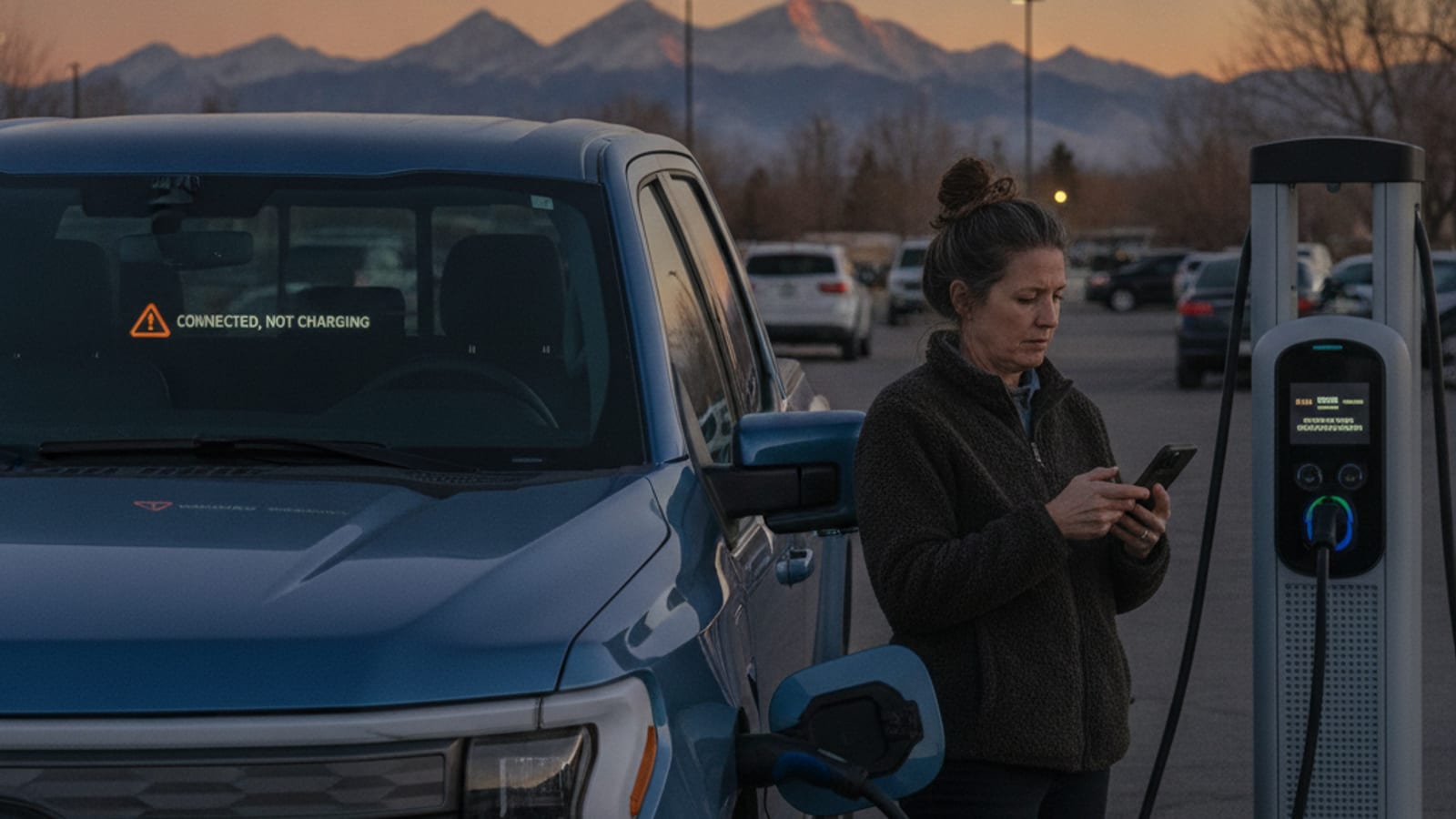
A public charger that says connected but will not charge usually points to one of four things. The handshake between the car and the stall did not finish. Your account or the app did not authorize a session. The cold ate the pack’s ability to take a charge. Or the stall itself is faulty. Most drivers can sort the first two in a few minutes. The cold-pack case is when a mobile Level 2 boost is the right next call. If you are stuck at a metro stall with a cord plugged in and nothing happening, call (720) 738-6950 and the operators we refer will quote you before any cable goes in.
What “connected but not charging” actually means
The car and the stall are talking. The connector is locked into the port and the dashboard reads connected. The session has not started, or it started and stopped. There is no charge flowing into the traction pack. The cable is doing nothing useful and the clock on the parking app, if the stall bills by the minute, may already be running.
This is different from a port that will not latch in the first place. A stuck or frozen port is a hardware problem with its own fix. Read charge port stuck in the cold for the latch and ice case. This post stays on the stall-fault handshake.
The same dashboard message shows up on every connector type. NACS, CCS, and J1772 all run the same handshake. The difference between them is the plug shape and the speed. So the steps below apply across the metro, from a Supercharger in Denver to a ChargePoint in Boulder, an EVgo stall near Centennial, and a ChargePoint pedestal in Lakewood.
Walk the stall before you do anything else
Before you reset anything, look at the stall screen. Most stalls will tell you what they think the problem is.
- Session not started, no error. The cable is locked but the screen reads idle or no session. The handshake finished at the car. It never reached the network side. That is usually a payment or app problem.
- Error code on the stall. Every major network uses a small set of codes. EVgo and Electrify America publish their codes in their apps. ChargePoint shows the code on the screen. Tesla Supercharger stalls show red text or a blank screen on a fault. A photo of the code helps any support chat.
- Stall is dark or frozen. Some stalls in the metro do not have good cold-weather prep. A stall that will not wake up is its own fault, not your problem.
If the stall reads a clear hardware error, stop. Do not try the same stall a second time. Move to a different stall on the same site, or a different network nearby. A bad stall is a bad stall. Trying the same one five times does not change it.
The connector side: reseat, then check the latch
The connector locks itself into the port. If the lock did not seat, the stall never sees a finished handshake. The fix is a clean reseat. Unplug. Wait a few seconds. Plug it back in until you hear the latch click and the dashboard reads connected.
Cold is the usual reason the latch does not finish in the metro. A frozen gasket or a thin layer of frost on the port pins can hold the latch from seating. Wipe the connector tip with a clean dry cloth. Wipe the port face the same way. Do not use water, and do not use any lubricant. The pins do not need help from a chemical. They need the ice out of the way.
If the port reads “connected” on the dashboard and the stall does not respond, the latch side is probably fine. The car is telling you the connector is seated. The stall is the side that did not move past the handshake.
The app side: authorize the session the second time
Most stall faults are not stalls. They are accounts. The app side has a short list of common fails.
- Hold or pending authorization on the card. Some billing apps put a pre-auth hold before the session starts. A pre-auth that does not clear is a no-start. Open the app, kill the hold, and try again.
- Network outage on the operator side. EVgo, Electrify America, and ChargePoint all have occasional regional outages. The stall will accept the cable and read connected. It will not start a session until the network confirms. Check the operator’s status page or X account.
- Wrong vehicle selected in the app. If you have more than one EV on the same account, the app can authorize against a different VIN. Pick the car at the stall. Try again.
- Charger ID mistyped. On ChargePoint pedestals, you type a charger number into the app. A wrong number sends the start command to a different stall. Re-type the ID printed on the front of the pedestal.
A clean way to test the app side is to call the operator’s support line from the stall. The number is on the screen. Ask whether a session is queued for that stall ID. The answer is fast and rules the network out without more tries.
The cold-pack case: why a stall will not push energy in
Below freezing, an EV traction pack warms itself before it will take a fast charge. The battery management system runs heaters and slows the session until the pack is in a safe temperature window. A stalled or very slow session in cold weather is not a stall fault. It is the car protecting the pack.
Recurrent Auto studied more than 30,000 U.S. EVs. At 32 degrees the average EV retains about 78 percent of max range. At 20 degrees that drops to about 70 percent. Heat-pump vehicles hold about 10 points more at 32 degrees than vehicles without a heat pump. The pack being cold is a real and measurable thing, not driver imagination.
A stall that takes 45 minutes to add the range it would normally add in 15 is not broken. It is doing what the pack asked it to do. A stall that simply will not start the session after the cable is in is a different problem. The car is too cold to negotiate, or the operator’s network is.
Denver’s January normal low sits around 18 degrees. In January 2024 Denver dropped from 47 to minus 19 in about 48 hours. That is the exact combination a public stall hates: an extreme cold snap on a car that sat outside overnight. A metro-area driver on a morning like that is the pattern that produces “connected but not charging” messages. For the broader why-does-cold-eat-range angle, charging stopped at random percent in the cold walks through what the dashboard is doing.
If your pack is too cold to take a charge and you cannot wait, a mobile Level 2 boost is the right next call. A 240-volt source still has to negotiate the same handshake, but it runs the car at a slower, gentler rate that the cold pack will accept faster than a cold-soaked DC fast stall will.
A few things that are not the fix
Drivers try these in the moment. None of them are worth a third attempt.
- Cycling the car on and off from inside. A full power cycle does not change the handshake once the cable is locked.
- Trying a different cable on the same stall. Most stalls have their own fixed cable. There is no second cable to try.
- Forcing the connector out by hand. The latch is software-controlled once a session is running. Pulling on it damages the port. The release button or the app’s stop button is the path.
For the stuck-port case, the port has a manual release tab behind a small panel in the trunk. That is for a 12-volt fault, not a session fault. Different problem.
When to stop trying the stall
Three tries is the practical limit. After that, every additional minute at the stall is range you cannot recover and minutes you cannot get back. The decision tree is short.
- The stall gave a clear hardware error on the second try. Move.
- The app will not authorize a session after the third try. Move.
- The session starts but the pack will not accept energy in the cold. Stay, but call for help.
A mobile EV charging referral is the path for the third case. An independent operator brings a 240-volt Level 2 source to the bumper. The connector matches your car: NACS for a Tesla, CCS or J1772 for most other EVs through an adapter. Typical charging time adds about 10 to 20 miles in 15 to 30 minutes of charging. The clock starts when charging starts, not before. The operator quotes you before any cable goes in.
If your stall is a DC fast charger and the car simply will not start the session, a Level 2 boost in place is faster than waiting for a tow to another site. You are not stuck in a travel lane. You are at a parking stall with time to wait.
When it is actually the 12-volt, not the stall
A public stall needs the 12-volt battery to negotiate. The 12-volt runs the car’s computers, the contactors, and the port lock. If the 12-volt is dead, the dashboard reads connected sometimes and does nothing at all other times. A jump fixes the 12-volt. It does not charge the traction pack. Those are two different systems.
A cold-soak no-wake, especially in a DEN airport lot or a west-metro garage, looks like an empty pack on the dash. It is usually a dead 12-volt. The traction pack may still hold plenty of range. Can roadside jump an EV 12-volt walks the split.
If the stall is reading your car but no session will start, even after a clean reseat and a clean app try, the 12-volt is one of the few things left. The operators we refer can jump a 12-volt on site. They quote first.
Where CDOT Safety Patrol fits, and where it does not
CDOT Safety Patrol runs free service on covered metro freeway segments and on the I-70 Mountain Corridor from Morrison to Vail. The menu is tires, jumps, fuel, debris, and minor mechanical help. The Safety Patrol page and CDOT’s my-car-broke-down page mention nothing about EVs. CDOT’s free truck can wake a 12-volt on those listed segments. It does not bring a charge to the pack. For a stalled session at a public stall on a freeway-adjacent site, the Safety Patrol is not the answer.
CRS 42-4-1202 covers a disabled vehicle on a highway. A public-stall parking lot is not a highway shoulder, and the disabled-vehicle statute does not apply. CRS 42-4-1803 sets no fixed hour count for abandonment on officer discretion. There is no Colorado statute that treats a disabled EV as a special class.
What a mobile EV charge actually is
Charge Pro DEN is a referral line. We do not own trucks. We do not employ technicians. We do not set prices. We match you with an independent local operator who quotes you before any cable goes in. They bill you directly for the work they do.
The kit is a 240-volt Level 2 source with the connector your car uses. Typical charging time adds about 10 to 20 miles. That add happens in 15 to 30 minutes of charging. It is not an arrival time and we do not promise one. The miles let you drive under your own power to a public stall that is working. For an empty pack on a metro shoulder, out-of-charge recovery is the closest match in our service list.
A mobile boost does not fix a broken stall. It does fix a stalled session caused by a cold pack, a 12-volt that will not negotiate, or a driver who has burned 30 minutes on a stall that never had a session to start. The operators we refer work through the Denver metro, from Broomfield down to Castle Rock, across to Lakewood, and along the I-70 Mountain Corridor through Idaho Springs.
When a tow is still the right tool
A mobile charge does not straighten bent suspension. If the car cannot roll, you need a tow. If the dash showed low range first and the car genuinely rolled to a stop on a shoulder, a flatbed to a working public stall may save time. The Colorado Towing Bill of Rights (HB22-1314) governs nonconsensual tows. The 24-hour written notice rule is the main driver-side protection.
For a longer view of the charge-versus-tow call from a metro shoulder, read mobile charge or tow: which a stranded Denver EV actually needs. That post stays on the choice. This one stays on the public-stall fault.
How to choose from a metro charging lot
Pull forward into a regular parking space if you can. Stay out of the EV-only stalls if your car is not charging. Use hazards if you are on the edge of a busy lot. Do not block another stall while you work the app.
Try a clean reseat first. Try the app. Try one more reseat. If the stall still will not start a session after three tries, call (720) 738-6950. The operators we refer will quote a mobile boost. If your 12-volt is the issue, they will tell you on the phone. If the cold is the only barrier, a Level 2 in place is the right next call.
Charge Pro DEN matches you to an independent operator who serves the Denver metro. The operator quotes you before they start work. Call (720) 738-6950 when you want that match. Treat it as a referral number, not a rolling promise.
Frequently asked questions
Why does my EV say connected but not charging at a public stall?
Most often the handshake between the car and the stall did not finish, the app did not authorize a session, the pack is too cold to take energy, or the stall itself is faulty. Three reseats and three app tries is the practical limit before you call for help.
Can a cold battery cause connected but not charging?
Yes. Below freezing the traction pack warms itself before it accepts energy, and a very cold pack can stall a session outright. Recurrent Auto found about 78 percent range retained at 32 degrees and about 70 percent at 20 degrees. A cold pack is a real and measurable barrier, not a stall fault.
Will calling Charge Pro DEN fix a broken public charger?
No. We do not own or service chargers. We refer you to an independent operator who brings a 240-volt Level 2 source to your car. The boost adds the range to drive to a working stall.
How long does a mobile charge take?
Typical charging time adds about 10 to 20 miles in 15 to 30 minutes of charging. The clock starts when charging starts, not before. It is not an arrival time, and we do not promise one.
Is the Denver cold really harder on public chargers than the rest of the metro?
The stall technology is the same across the metro. Cold exposure is what changes. A car that sat outside overnight in Denver, Boulder, or Longmont has the same cold-soak risk as one in the foothills. Heated garages in Greenwood Village and Centennial reduce it. The pattern, not the city, is what matters.