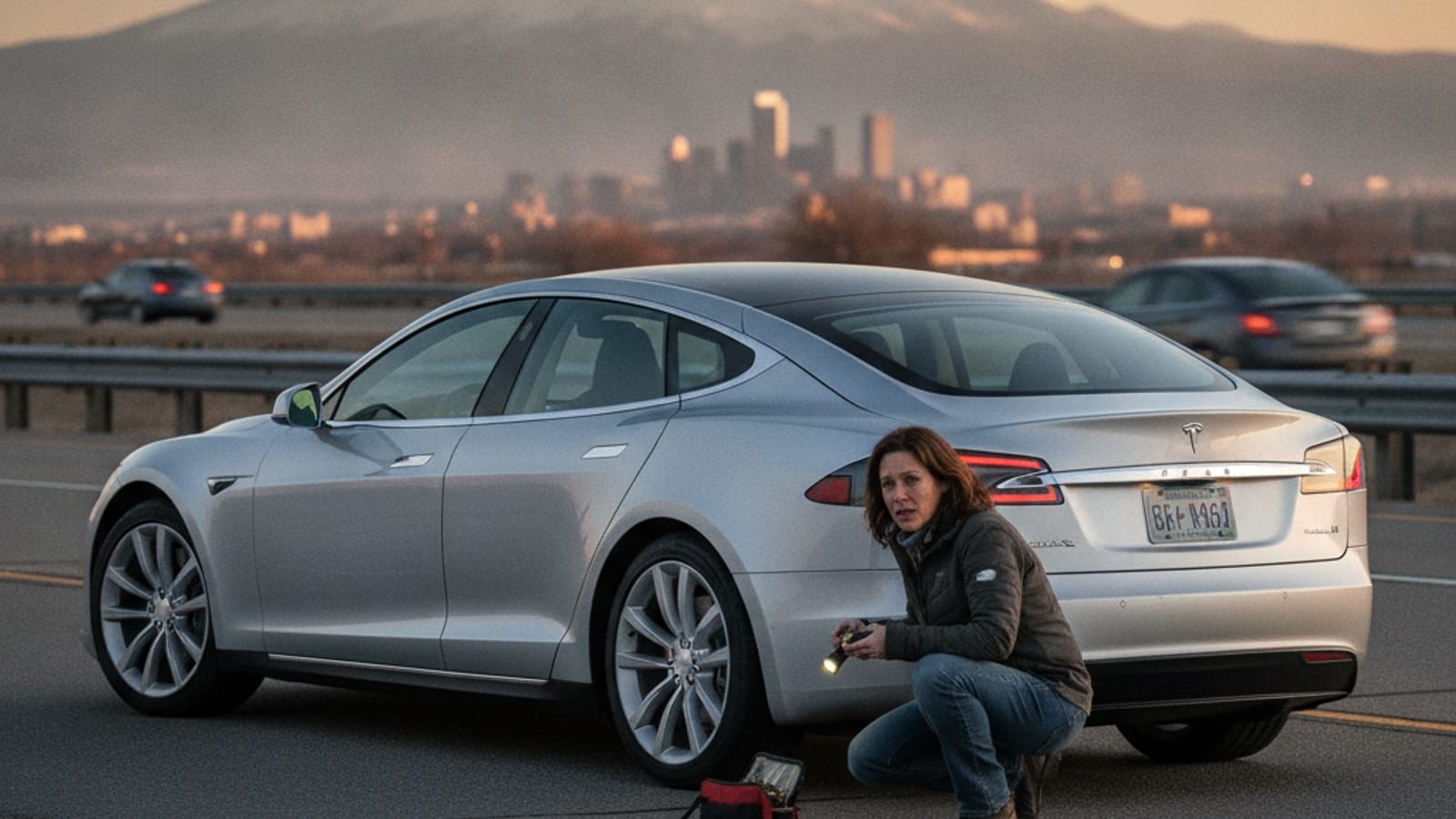
Towing a Tesla Model S with no power usually starts with the 12-volt battery, not the traction pack. A Model S that will not wake, will not unlock, or shows a fully dark dash is more often a dead low-voltage battery than an empty pack. Hazards on, pull to a safe shoulder if you can, then call (720) 738-6950. The operators we refer in the Denver metro jump Model S 12-volt batteries on site, and a jump often fixes what looks like a dead car without arranging a flatbed.
What “no power” usually means on a Model S
A no-power Model S shows up one of a few ways. The key fob does nothing. The door handles do not present. The dash stays dark when you press the brake. The center screen is black. The mobile app says the car is offline. None of those symptoms tell you which battery failed. The traction pack and the 12-volt are two separate systems. The traction pack drives the motors. The 12-volt wakes the computers, runs the contactors, and powers the door locks and the screen.
When the 12-volt is dead, the whole car looks finished. The traction pack can still have plenty of range. When the traction pack is empty, the 12-volt is usually still good. Those are two different roadside jobs. A 12-volt jump wakes the car. A Level 2 charge fills the pack. Picking the right one starts with which symptom you saw first.
If the dash showed low range before the car went dark, treat it as an empty pack. If the car sat through a cold night and now will not wake, the 12-volt is the more likely cause. The Denver metro drops into the teens most January nights. A long cold soak can pull a marginal 12-volt below its working voltage without ever touching the traction pack. Tesla pack empty or 12-volt dead walks that split on other Tesla models and applies the same way.
You can sit on the shoulder while you sort a jump
Colorado law treats a disabled car on the highway shoulder as a lawful stop, with conditions. CRS 42-4-1202 says a driver may not stop or leave a vehicle on the paved main-traveled part of a highway, except a vehicle so disabled it is impossible to avoid stopping and to move it off the roadway. CRS 42-4-230 requires hazard lights on a stopped or disabled vehicle. The plain read is simple. If your Model S died on the shoulder and you cannot safely move it further, hazards on puts you on the right side of the rule.
That matters because a jump usually takes more time than a fuel delivery. An operator needs to reach you, access the 12-volt jump points, hook up, let the car boot, and confirm a stable voltage. You may sit on the shoulder with hazards on while that happens. Stay in the car if that is the safer choice. Stay visible to traffic from behind. Keep your seatbelt on if you stay in the lane of travel.
If the Model S is in a travel lane, on a curve, or anywhere it cannot be reached safely, call 911 first. A roadside operator cannot work in an active travel lane.
Open the hood before you call
The Model S 12-volt battery sits under the front trunk, accessible only after the hood is open. The hood release on a Model S is electric by default, controlled through the center touchscreen. If the screen is dark and the car will not wake, that release will not work. Tesla builds a manual hood release inside the front trunk area for exactly this case. Pull it, then lift the hood.
Once the hood is up, you are looking at the front service panel. The 12-volt terminals live on that panel. Do not hook anything to them yet. The Model S uses a high-voltage system under the same hood. The 12-volt posts and the high-voltage components are clearly marked. Use the 12-volt posts only. Hooking a booster to anything high-voltage can damage the pack, the inverter, or both.
The current Tesla owner’s manuals describe a release path through the hood with separate wires used only to release the hood from the jump posts used after the hood is open. The Model S follows the same logic, but the placement and the cover vary by year and trim. The 12-volt battery itself has been lead-acid on most Model S years and lithium-ion on the 2022 refresh and later. Both types jump the same way at the posts, with the right 12-volt booster pack or jump box. The operators we refer bring one that is rated for an EV low-voltage system, which is the safer choice than a generic auto parts store box.
Try the wake sequence before you call for help
Some Model S no-wake events clear with a wake sequence. With a known-good 12-volt boost box on the jump posts, the operator:
- Presses and holds the brake pedal.
- Taps the brake pedal twice in a row.
- Waits about 30 seconds for the center screen to come up.
- Releases the parking brake through the touchscreen once the screen lights.
If the screen does not light within a minute, the 12-volt is more likely the cause and a longer boost is the next step. If the screen lights but the car shows a red triangle and will not shift, the problem is downstream of the 12-volt and the operator needs to walk the codes.
A cold-soak no-wake in a Denver lot can take more than one wake attempt. The battery management system may need several minutes of stable voltage before it lets the contactors close. Plan on the operator staying with the car until it either boots cleanly or the diagnostic shows a different fault.
When a flatbed is still the right call
A 12-volt jump is the right call for a dead low-voltage battery. A flatbed is the right call when the car cannot roll, when the traction pack is genuinely empty and there is no charging access within reach of a mobile charge, or when the high-voltage system shows a fault.
Towing a Tesla Model S is not generic flatbed work. The owner’s manual lists Instructions for Transporters with vehicle-specific lift points and tow mode steps. Model S tow procedures are not Model 3 or Model Y procedures, and the lift points and dolly placement differ between the older S body and the 2022 refresh. A driver-arranged flatbed needs a driver who knows where to put the dollies, where to set the lift, and how to put the car in transport mode with no working screen.
If the car must be transported, say so when you call. The matched operator decides whether mobile charging is appropriate or transport is required, and arranges the right truck. Charge Pro DEN does not send a crew. We match you with an independent local operator who carries the right gear for a Model S and quotes the work before the cable goes in or the truck hooks up. For the broader Metro-side script, see Tesla roadside rescue in the Denver metro.
What Tesla’s own roadside covers
Tesla roadside help is requested through the Tesla app. The current Tesla support language notes that out-of-range assistance may be available but is not financially covered. Owner cost depends on the terms shown for the request. Confirm coverage for your VIN and model year in the app before you accept the dispatch.
Tesla still sends a contractor, not a Tesla employee. The contractor brings the equipment the job requires. A 12-volt jump is on that list. A Level 2 charge on a metro shoulder is not the standard Tesla roadside response.
If you would rather work with an independent local operator directly, call (720) 738-6950 and Charge Pro DEN refers one. The operator confirms the make, model, model year, displayed charge, and warning text, then quotes you before the work starts. You pay the operator, not Charge Pro DEN.
The cold-soak pattern in the Denver metro
January’s normal low around Denver sits near 18 degrees. Below about 15 degrees, the battery management system wakes periodically to run thermal management on the traction pack. That wake uses the 12-volt. A marginal 12-volt that worked fine in October can be flat by December if the car sits outside and the BMS keeps waking it.
The Recurrent winter study tracked thousands of U.S. EVs. At 32 degrees, EVs kept about 78 percent of maximum range. At 20 degrees, about 70 percent. The cold does not just lower range. It pulls more current from the 12-volt to keep the pack warm. A Model S that sat outside for a week in a downtown garage or at a DEN-area long-term lot can come back with a dead 12-volt and a full pack. The cure is a jump, not a tow. For the broader Metro EV no-start picture, read Tesla locked out and the battery looks dead. That post covers the same 12-volt split on other models.
Empty pack is a different job
If the dash showed low range before the car went dark, an operator can bring a 240-volt Level 2 source to the car. Tesla drivers get a native NACS plug on the lead. Charging time adds about 10 to 20 miles of range in roughly 15 to 30 minutes of charging. That is enough to reach a public stall under your own power. The clock starts when charging starts. It is not an arrival promise, and the operator quotes you before the cable goes in.
For the broader empty-pack flow, read mobile EV charging in the Denver metro. That page covers the Level 2 boost for any EV, with CCS or J1772 adapters for non-Tesla cars. For a focused 12-volt jump, see Tesla 12-volt battery jump in the Denver metro.
A safe shoulder is the right place to wait
Pull as far off the travel lane as the car will roll. Turn the hazards on. Stay in the car if that is the safer choice. Stay visible to traffic from behind. Do not stand in the lane to flag help down. Keep your phone charged for the call. If you cannot move off the lane and traffic is still flowing, call 911 first.
On I-25 through the metro, the I-25 North Express Lane was built with a minimum 8-foot outside shoulder for breakdowns, so a Model S that makes it across the gore usually has somewhere to stop. On E-470, dial *470 for the toll authority’s own roadside. The authority lists jump-starts and flats but does not publish an EV charge. CDOT Safety Patrol covers segments of I-25 South, I-70 East, US-6, C-470, and I-225, and the patrol trucks will jump a 12-volt on those listed segments during their published hours. CDOT does not publish an EV charging service, so an empty pack is still a local-operator call. Can roadside jump an EV 12-volt walks that split across clubs, CDOT, and local operators.
Frequently asked questions
Can a Tesla Model S be towed with no power at all?
A Model S without working 12-volt power still needs vehicle-specific transport. The owner’s manual Instructions for Transporters describe lift points and tow mode steps that vary by year and trim. A driver-arranged flatbed needs a driver who knows those steps. The matched operator confirms whether the job is a 12-volt jump, a mobile charge, or transport.
Is the Model S 12-volt under the hood?
Yes. The Model S 12-volt battery is under the front trunk, accessible after the hood is open. The hood release is electric by default and runs through the center screen. When the car has no power, the manual release inside the front trunk area opens the hood. Jump points sit on the front service panel and are clearly marked. Do not connect anything to the high-voltage components.
Can roadside jump a Tesla Model S 12-volt?
Yes. CDOT Safety Patrol will jump a 12-volt on listed metro freeway segments. Independent mobile operators we refer also jump a Model S 12-volt on site. CDOT’s published menu covers tires, jumps, fuel, debris, and minor mechanical help. It does not mention EV charging. A jump wakes a dark 12-volt. It does not refill an empty traction pack.
What about a Tesla app roadside request?
Tesla roadside help is requested through the Tesla app. Out-of-range assistance may be available but is not financially covered. Confirm what your request shows in the app before you accept. If you would rather call a local operator directly, dial (720) 738-6950.
How long can a Model S sit before the 12-volt dies?
Below about 15 degrees, the battery management system wakes to run thermal management on the traction pack, and that wake draws from the 12-volt. A Model S parked outside in Denver in January can drain a marginal 12-volt in a few days. A week of cold soak is a common trigger. Treat any Model S that will not wake after a multi-day cold sit as a 12-volt problem until a voltmeter says otherwise.