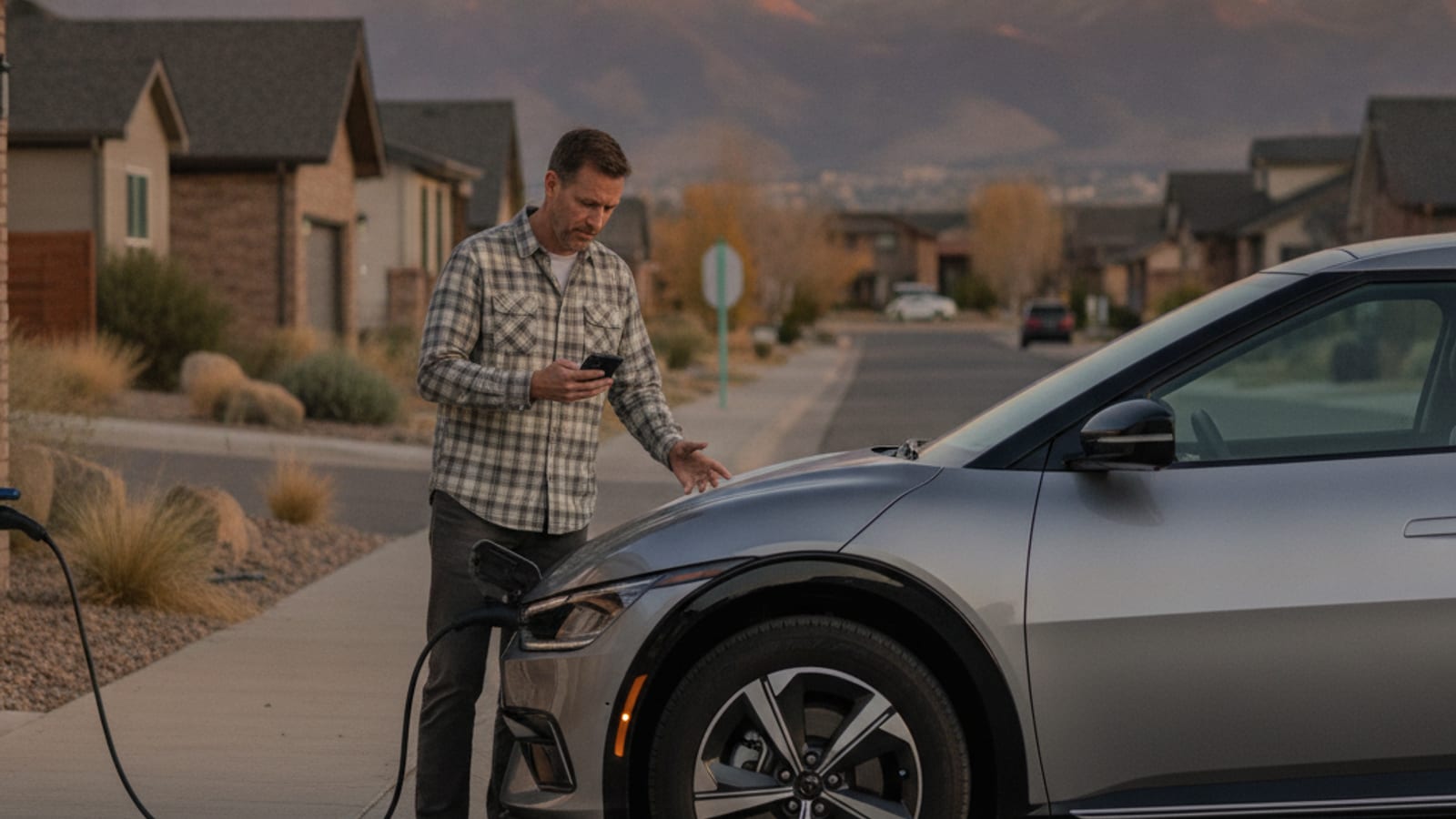
A Kia EV6 that won’t charge in the Denver metro usually traces to one of three things: a public CCS stall that never starts a session, a cold pack that throttles the rate, or a connector that the car thinks is locked. Run those checks first, then call (720) 738-6950 if you’re still stuck. Charge Pro DEN refers independent local operators who bring a 240-volt Level 2 source to the car.
What “won’t charge” usually means on an EV6
The phrase covers several different problems. The dash shows an error like “Check electric vehicle system.” The connector clicks but no session begins at a public stall. The connector seats and starts, then stops at 3 percent. The car beeps and releases the lock as soon as you press the button. Each one has a likely cause. The first move is to figure out which.
In a January cold snap, the EV6 charges its battery management system from the traction pack until the cells warm up. You see range drop fast in those first few minutes of driving. That is not the same as “won’t charge.” It is the pack telling you it is cold. The session itself still starts; the rate is what is throttled. Recurrent Auto’s winter study of more than 30,000 EVs found about 78 percent of range held at 32 degrees and about 70 percent at 20 degrees. Colorado sits well below those numbers on most January nights.
A January 2024 arctic blast took Denver from 47 to minus 19 in about 48 hours. Many EV6s in the metro saw a 20 to 30 percent range drop overnight. If your car sat outside that week and now reads low, the cells are fine. The pack just spent the night warming itself.
Start with the connector and the port
Public CCS stalls at places like the Lakewood sites take a few extra steps over a Tesla Supercharger. The EV6 uses the J1772 portion for AC Level 2 and adds two lower pins for DC fast charging under CCS1. The plug is bulky. It has to seat all the way.
Three checks before you do anything else.
- Push the connector straight in until you hear the lock click. A partial seat looks seated but the car never sees a closed circuit.
- Look at the small white light on the EV6 charge port. A solid green means ready. A slow blink means a handshake is in progress. A red blink means the port saw a fault. Wait ten seconds and try again.
- Open the Kia Access app or the dash screen and confirm the scheduled climate or charging window is not blocking the session. A departure timer set for 6 a.m. holds the car in a low-power state until then.
If the port light stays red after two tries, the port itself may be the problem. For a frozen or stuck port, read charge port stuck in the cold for the release sequence.
The 12-volt can lock out the whole car
The EV6 still runs a 12-volt battery for computers, contactors, and the charge lock. That battery dies in a cold soak the same way it dies in any modern EV. A week in a cold DEN lot, or a long airport-parking dwell, will kill a marginal 12-volt. The traction pack may still show 60 percent. The car looks dead because the contactors cannot close.
The clues are subtle. The dash does not light. The doors unlock with the physical key fob but the car will not ready. The charge port light is dark or red.
Can roadside jump an EV 12-volt walks that split. If the EV6 sat dark through a freeze, the 12-volt is the first thing to check, not the pack.
A failed public stall is not a failed car
EVgo and Electrify America sites across the metro add DC fast coverage. Tesla Superchargers are dense here too, including sites in Denver, Boulder, Highlands Ranch, Castle Rock, and Lakewood. The car not starting a session is most often a stall problem, not a car problem.
A few things to try at a cold public stall.
- Switch stalls. One module may be in fault while its neighbor is fine.
- Check the screen on the stall for a session error code. Write it down before you call the network.
- Open the EVgo, Electrify America, or Tesla app and confirm payment is good. A declined card reads as a no-start at the stall.
- Try again in five minutes. A cold stall sometimes needs that long to wake its own electronics.
- Pull up to a different network entirely. The EV6’s CCS handshake fails on a small share of older EVgo modules, even when the stall looks healthy.
If the stall itself is the issue and you have a few miles, drive to the next site. If you have less than 10 miles and the temperature is below freezing, that is when a mobile EV charging referral earns its keep. An operator brings a 240-volt Level 2 source to the car. You add 10 to 20 miles in 15 to 30 minutes of charging and drive to a working stall under your own power.
Cold-pack throttling and what it looks like
Cold cells do not accept a charge at full speed. The EV6 has a thermal preconditioning system that warms the pack on the way to a fast charger. If you skip that, the car charges at a fraction of the rated speed. You sit at a stall, the rate climbs slowly, and a 20-minute stop becomes an hour.
The fix is in the navigation. Set the fast charger as a destination in the EV6’s built-in nav. The car starts preconditioning the pack before you arrive. If you use Apple CarPlay or Android Auto for nav, the preconditioning never starts. Use the Kia system for any fast-charge run in the cold.
For background on what cold does to a pack, read EV battery care in a Denver winter.
When it really is the car
A handful of EV6 faults are not stall or weather. A “Check electric vehicle system” message, a charge that stops at a fixed percent, or a port that won’t release the connector are warning signs of a vehicle-side issue. The owner’s manual has a fault tree by year and pin.
A few patterns worth naming. A 2022 EV6 recall covered ICCU (integrated charging control unit) failures that disable both AC and DC charging. If your EV6 is in that build range and the dash shows the ICCU warning, a dealer visit is the path, not a mobile boost. A connector that will not release after a session ends is a separate lock problem and is covered in charge port stuck in the cold.
For other non-Tesla EVs in the same situation, non-Tesla EV rescue in the Denver metro describes the broader referral.
A simple order to follow on a cold shoulder
If you pulled off on a metro shoulder with a pack near zero and the EV6 will not charge at the nearest stall, do these in order.
- Hazards on. Pull as far off the travel lane as you can.
- Confirm the car is in Park and the pack is actually under 10 percent. The dash will tell you.
- Try one more stall at the same site. A cold EVgo module is the most common public-stall miss here.
- If you are at a Tesla Supercharger and your EV6 has a CCS adapter, check that the adapter is fully seated and locked.
- If neither works, call for a mobile boost. An independent operator we refer brings a 240-volt Level 2 source and adds the miles you need to reach the next stall.
CRS 42-4-1202 lets a driver stay on the shoulder with hazards on when the vehicle could not be moved further. CDOT Safety Patrol can jump a 12-volt on listed segments but its published menu does not mention EV charging at all.
How Charge Pro DEN fits
Charge Pro DEN is a referral line. We do not own trucks and we do not employ technicians. We do not set prices for a visit and we do not promise an arrival time. We match you with an independent operator who quotes you before any cable goes in. You pay the operator directly for the work.
The kit is a 240-volt Level 2 source with NACS, CCS, or J1772 adapters. Typical charging time adds about 10 to 20 miles in 15 to 30 minutes of charging. That is charging time, not arrival time. It is enough range to drive to a working stall, a home charger, or your next stop.
For a deeper dive on how this works across non-Tesla brands, read non-Tesla EV rescue in the Denver metro.
Call (720) 738-6950 when you want the match. Treat it as a referral number, not a rolling promise. We serve the Denver metro from the plains to the foothills, and the operator quotes before the work starts.
Frequently asked questions
Is it the EV6 or the stall?
Most public-stall “won’t charge” reports in Denver turn out to be a stall fault, not a car fault. Switch stalls, switch networks, and check the stall screen for an error code. The EV6’s CCS handshake fails on a small share of older EVgo modules. If two stalls at one site fail and the next site’s stalls work, the first site is the problem.
Can an EV6 charge at a Tesla Supercharger?
A factory EV6 with the J1772/CCS1 inlet needs a NACS-to-CCS adapter to use a Tesla Supercharger. Kia began selling a NACS adapter for the EV6 in 2024 and 2025 model years. Confirm your build year and the adapter type before you plan a Supercharger stop in the cold.
Will preconditioning the pack fix a “won’t charge” error?
If the pack is cold enough to throttle the rate, yes, preconditioning brings the cells up before you arrive and the session starts at a normal rate. If the port shows a fault code, preconditioning does nothing. Run the connector and stall checks first.
What if the EV6 sits at zero all night in a Denver cold snap?
Below about 15 degrees the battery management system wakes to run thermal management. A night at zero does not damage the cells. The range drop you see in the morning is phantom drain and warming, not lost capacity. Charge as soon as you can. The 12-volt is the real risk over a long cold dwell, not the traction pack.