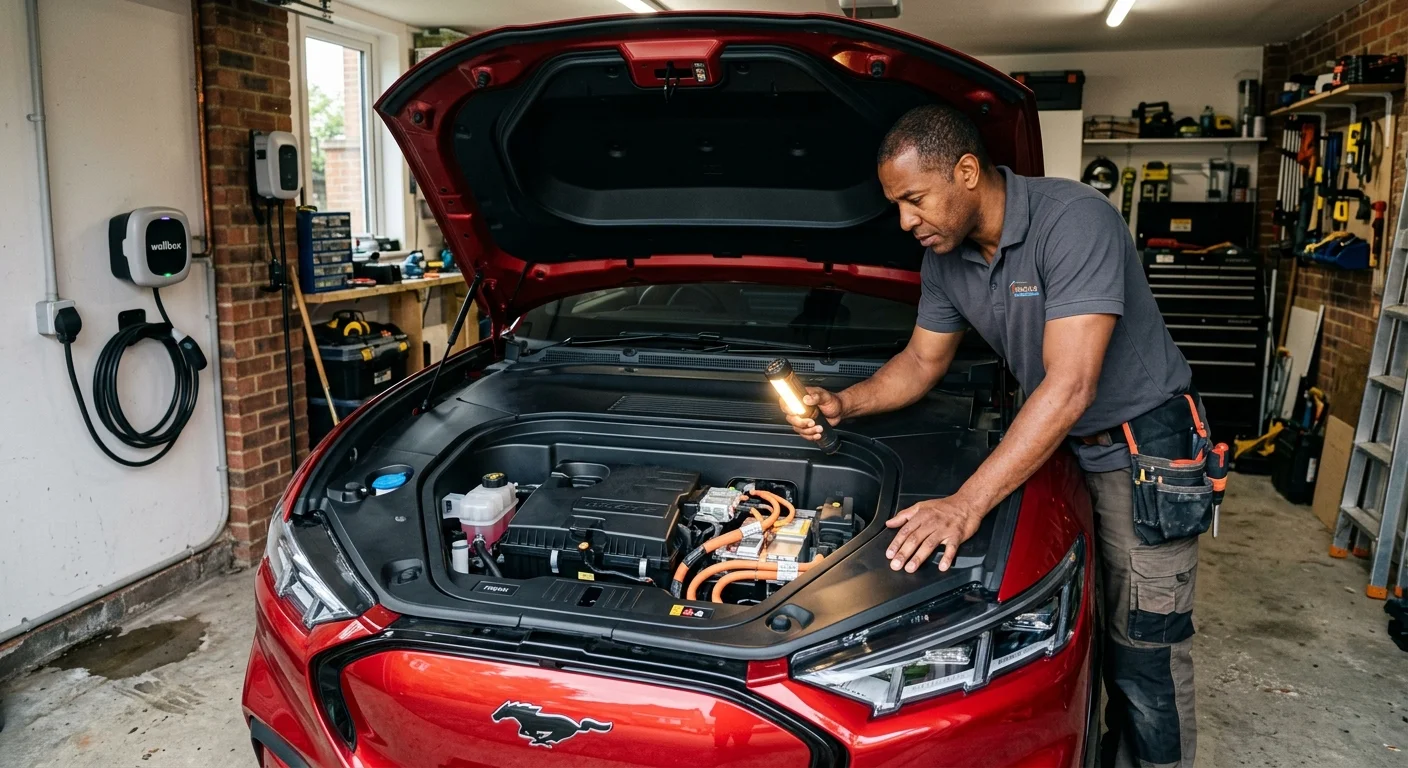
Your Ford Mustang Mach-E sat on a Denver street overnight. It looks dead at dawn. The screen stays black. The fob does nothing. Check the 12-volt first. That cold soak is a 12-volt no-start, not a bricked pack.
Why a Front Range cold soak hits the 12-volt
Denver’s January normal low is around 18 degrees. That figure comes from NWS Boulder climate normals. It’s a typical night, not a freak freeze. A curb near downtown leaves the Mach-E sitting cold. So does a long dwell at the Denver Tech Center. A week in a DEN lot does the same. The 12-volt still runs computers, locks, and contactors. Those contactors wake the high-voltage pack. Cold slows that small battery. A long sit drains it even when the pack still holds energy.
The January 2024 arctic blast made the pattern obvious. Denver fell from 47 degrees to minus 19 in about 48 hours. A Mach-E left outside through that swing may refuse to ready. Recurrent Auto found EVs keep about 70 percent of range at 20 degrees. Those are miles problems. A black screen is a wake problem.
Elevation changes the soak. Denver’s official mark is 5,280 feet at the State Capitol. Evergreen sits around 7,200 feet. A core-city street and a foothills lot aren’t the same overnight. The 12-volt still fails the same way.
Blank screen versus a pack that won’t pull
Owners often treat a silent Mach-E as an empty traction battery. Those failures don’t look alike. Read which EV battery matters on the roadside before you call a flatbed.
A dead 12-volt leaves the car asleep. No cluster. No interior lights that hold. The fob may not unlock. You might get a single click, or nothing. The high-voltage pack can still sit at a usable charge. The contactors never close, so the car never wakes that morning.
A low pack usually lets the car wake. You get a display. You may see a low-charge warning or reduced power. You can sit in Ready and still be unable to go far. That’s a miles problem. It isn’t a brick-looking silent crossover.
If last night’s plug seemed to fail, pause before you blame the utility. Denver proper is Xcel Energy territory. Highlands Ranch, Parker, Castle Rock, and Castle Pines sit on CORE Electric Cooperative. Thornton, Brighton, and parts of Westminster split with United Power. Longmont has its own municipal utility. A dead 12-volt can look like a failed charge. That’s true on any of those systems. Confirm the small battery before you fight an app.
What the messages usually mean
Start with a dark cabin. No message at all is the classic 12-volt death. The computers never get enough voltage to draw a warning.
If you do get text, treat it as a 12-volt clue first. “System Off to Save Battery” is the car protecting a weak 12-volt. A countdown to shut down is the same story. “Key Fob Not Detected” can be a dying coin cell in the fob. It can also be a 12-volt too weak to hear the fob. Swap the fob battery if you have a spare. Then treat the 12-volt as the next suspect.
“Stop Safely Now” is different. That one usually points at a high-voltage or safety fault. It isn’t a simple cold soak. Don’t keep trying to drive on it. “Service Vehicle Soon” is a later shop visit. It doesn’t, by itself, explain a car that won’t wake.
Ford’s wording can vary by year and software. Your owner’s manual is the authority for your VIN. The pattern still holds on a Front Range morning. Silence, or a save-battery warning, is the 12-volt until you prove otherwise.
Street parking, work garages, and a week at DEN
Central Denver still has a lot of overnight street parking. Capitol Hill is the clear example. No driveway. No plug. The Mach-E sits in 18-degree air. If that’s your block, read Capitol Hill with no driveway plug. It’s the same morning on a different badge.
A work dwell in Greenwood Village is a shorter drain. Hours in a cold Tech Center garage still tick down the 12-volt. Park Meadows in Lone Tree can do it after a long shop. A week in a DEN lot is the extreme. Peña Boulevard is city-maintained, and it’s the only road in. The car sits on open plains. Charger counts at DEN parking could not be confirmed from the airport’s own pages. A long, cold sit still kills the 12-volt while the pack waits.
South-metro houses on CORE may have a garage. So may a United Power street in Brighton. It doesn’t make the 12-volt immortal. A Lightning on the same driveway sees the same split. Lightning 12-volt no-start is the truck version of this page.
Find the 12-volt before you assume the pack
Ford put the Mach-E’s 12-volt under the hood, in the frunk. It isn’t under a rear seat. Open the frunk with the fob if the fob still talks to the car. If the 12-volt is already gone, that release may not work. Then you’ve got a lockout and a silent car together.
Under a passenger-side cover in the frunk you should see a conventional 12-volt. It looks like a small starter battery because that’s still its job. Ford also gives you jump posts in that bay. Look for a positive post under a red cap and a nearby chassis ground. Use those posts. Stay off the orange high-voltage cables. Those belong to a different system.
A multimeter beats a guess. Set it to DC volts. Red lead on positive, black on negative. A resting 12-volt near 12.6 volts is in decent shape. Under 12 volts, and especially down near 11.5, that battery is discharged or failing. Voltage can’t promise a healthy battery. It can stop you from towing a pack that was never the problem.
Wake the 12-volt. Leave the pack alone.
You’re only jumping the 12-volt. Jumper cables don’t fill the traction battery. How to jump an EV 12-volt in this cold is the safety order. The Mach-E uses Ford’s posts, not a Tesla frunk layout.
Use a jump pack made for 12-volt automotive use, or a second vehicle. Keep both vehicles off until the clamps are set. Red clamp to the Mach-E’s positive jump post. Black clamp to the marked ground, not a random painted bolt. Then connect the donor, red then black. If you use another car, start that one. Let it idle a few minutes. If you use a pack, power it as the label says.
Try to wake the Mach-E. If the cluster comes back, the 12-volt was the gate. Disconnect in reverse: donor black, donor red, then Mach-E black, then Mach-E red. Keep the Mach-E awake. Drive it, or plug it in. The onboard converter can refill the 12-volt from the pack. Ford’s manual is the last word on how long to keep it on. If it dies again after a short sit, the 12-volt is likely worn out. When the 12-volt dies again after a jump covers that next step.
Skip a jump if you smell sulfur. Skip it if you see a swollen case. Skip it if you can’t find the marked posts. High-voltage work isn’t a curb experiment. A silent car plus “Stop Safely Now” is also a stop.
If this happens on a metro shoulder
CRS 42-4-1202 is the disabled-vehicle rule. Outside a business or residential district, stay off the travel lane. A car that can’t move may stop on the shoulder. Keep the hazards on, per CRS 42-4-230. A violation is a class B traffic infraction. Put the hazards on.
CDOT Safety Patrol will jump a 12-volt and change a tire on covered freeway segments. Coverage includes I-25 South from 120th Avenue to Arapahoe Road. It includes I-70 East from Wadsworth to Airport Boulevard. Portions of US-6, C-470, and I-225 are covered too. Weekday hours are 6:00 to 9:30 a.m. Afternoon coverage is 2:30 to 7:00 p.m. Weekends run 10:00 a.m. to 7:00 p.m. CDOT’s published pages mention nothing about charging a stranded EV. Patrol can jump. It doesn’t bring a Level 2 source to a Mach-E.
On E-470, the authority publishes free roadside help. Pull to the shoulder and dial *470 for a jump or a tire. Dial *CSP for State Patrol. There’s no EV-specific charge in that program either. Colorado has no separate disabled-EV statute. Your Mach-E is treated like any other disabled car.
When the pack really is empty
Sometimes the 12-volt is fine and the pack is empty. You woke the car, but it won’t go far. The operators we send bring a 240-volt Level 2 source to the car. They use a CCS or J1772 adapter on a Mach-E. That charge typically adds 10 to 20 miles. That’s 15 to 30 minutes on the plug. It isn’t an arrival time.
Non-Tesla EV rescue is the page for that job. Charge Pro DEN doesn’t own trucks and doesn’t do the work. We connect you with independent local operators who quote before they start.
Who to call from the curb
If you’re not set up to jump a 12-volt in traffic, stop there. The pros we send can jump or replace a dead 12-volt on site. They can charge the pack if that’s the real failure. Call (720) 738-6950 and we’ll match you with a local operator. Confirm the quote before any work starts.