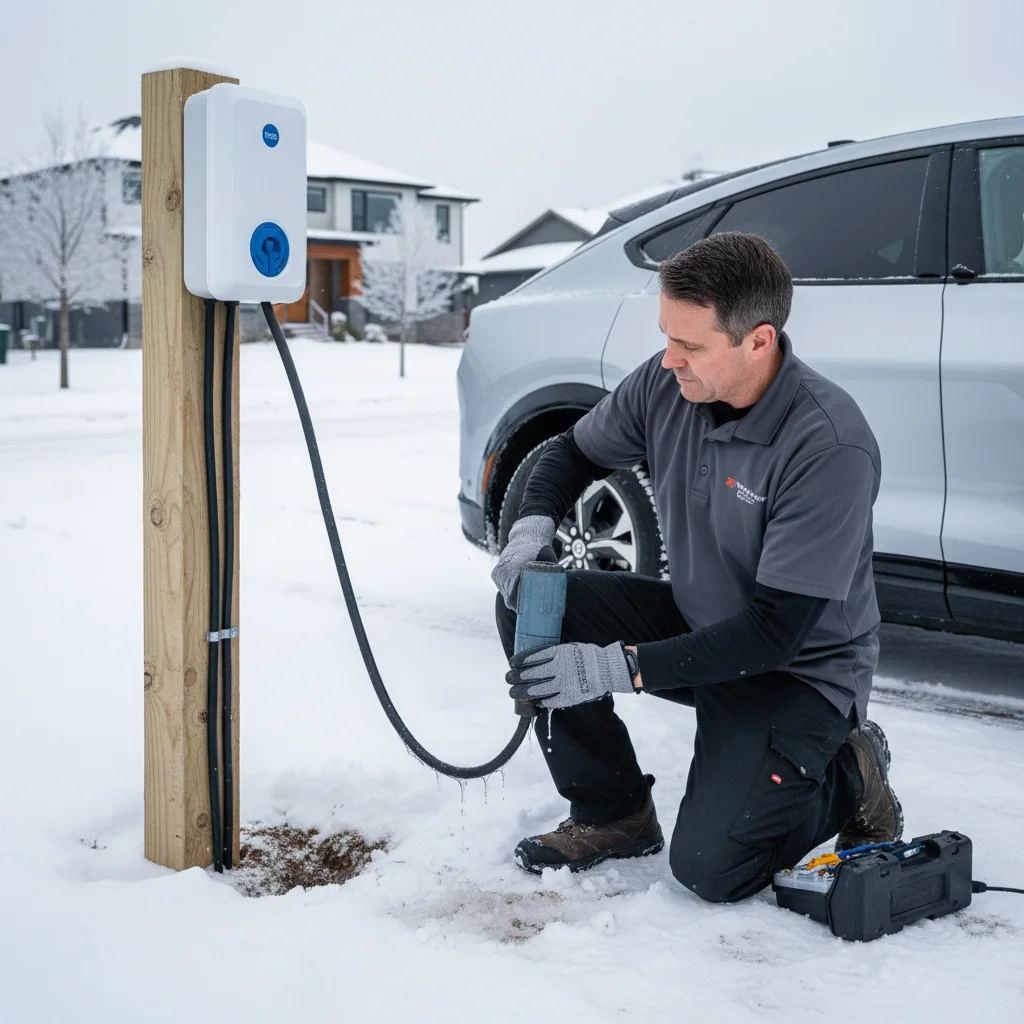
A Front Range January morning sits near 18 degrees. You walk out to a Mach-E that finished charging overnight. The CCS handle won’t come off. The latch that locked the cable at dusk can ice in place by dawn. This page covers what to try and what not to force. A local operator is the better call when those paths fail.
Why a Mach-E latch ices overnight here
Denver’s official elevation is 5,280 feet. Nights drop fast after a mild afternoon. January’s normal low sits around 18 degrees. That figure comes from NWS Boulder climate normals. Melt from the evening plug-in can freeze in the port by morning. That ice binds the electronic latch and the charge door hinge. The car may still show a full traction pack. The handle still won’t budge.
This isn’t a humidity story. It’s overnight freeze after a plug-in. A Lakewood driveway sees it. So does a garage stall at the Denver Tech Center. Evergreen sits near 7,200 feet. It wakes colder than the city floor. A Golden driveway before the canyon can wake the same way. So can a Wheat Ridge street before I-70 climbs toward the foothills. The January 2024 arctic blast hit hard. Denver fell from 47 degrees to minus 19 in about 48 hours. A latch that felt fine at dusk can seize in that swing.
Melted snow inside the port makes it worse. If slush sat in the inlet overnight, it can refreeze around the lock. Dry the port when you can. Our note on snow melt in an EV charge port covers that habit.
The Mach-E uses a motorized charge door and an electronic connector lock. Both draw from the 12-volt system, not the high-voltage pack. A weak 12-volt after a cold soak can starve the solenoid. That’s why a full Mach-E can hold a cable hostage.
Start with the car and the station, not the handle
Don’t yank the CCS connector. A locked handle can crack. Bent pins become a dealer job. Ford’s app and the station software often still control the lock. Ice can be part of the story and those commands still matter.
Open FordPass and look for the charge-port unlock. End the session on the vehicle screen too. If you’re on a public cabinet, end it there as well. Electrify America and EVgo both run DC fast sites across the metro. Some cabinets keep their own software lock after the car reports complete. The station may still think you’re in a session. Use the screen or the network app to close it. The cabinet usually prints a support number. Give them the station ID on the label and ask for a remote unlock. A wait time for that unlock isn’t a figure we can confirm. Stay with the car until the handle actually frees.
If you charged at home, confirm the wall unit closed the session. Xcel Energy serves Denver, Lakewood, and much of the core metro. CORE Electric Cooperative serves the south-metro Douglas corridor. United Power covers much of the north and northeast. A wall unit that never closed the session can still hold the connector.
Wipe visible frost with a dry cloth if you can reach it safely. Don’t pry the door. Don’t pour hot water into the electronics. Ford’s owner’s manual is the authority for any heat or tool it allows. If the manual isn’t in the car, check FordPass. Use Ford’s site before you improvise.
The emergency release is in the underhood storage
Ford documents a charge-cord emergency release in the underhood storage, the frunk. It’s a brightly colored pull strap, yellow on many years. The strap works by cable and bypasses the solenoid. That’s why it still helps on a weak 12-volt.
Open the frunk from FordPass or the in-cabin hood release. If the 12-volt is dead, those commands may do nothing. The car may need a 12-volt jump before the bin will open. Confirm the jump-post polarity and ground in your owner’s manual. Don’t guess from a forum photo. A reverse hookup can damage body electronics. Once the frunk is up, look in the bin for the colored strap Ford describes. Give it one steady pull. You want a click at the port, not a snap in the cable. Then go back to the handle. Press its release button and ease the connector out.
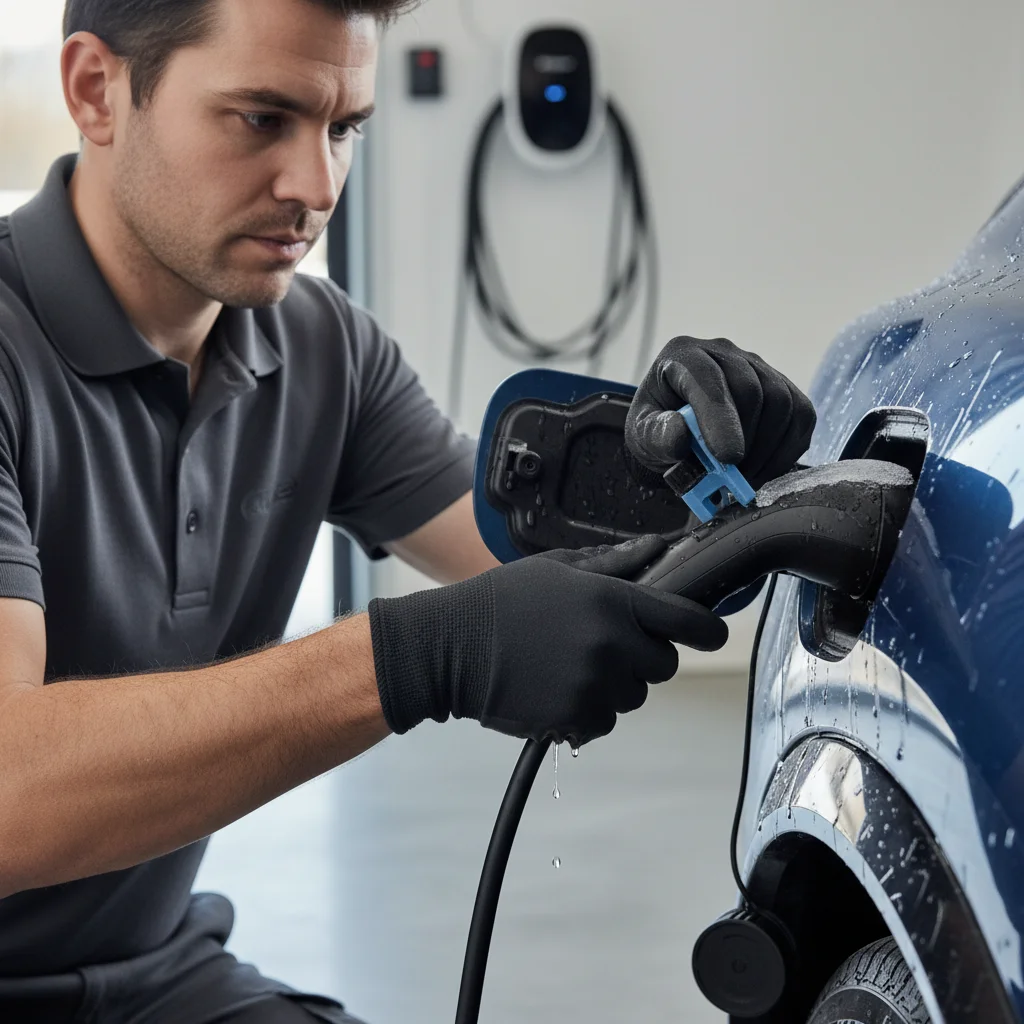
If the strap has firm resistance, the cable is intact. A click at the port is a good sign. You were fighting an electrical lock, ice, or both. If the strap goes slack and the handle still won’t move, stop. A loose strap can mean a disconnected cable or a damaged hook inside the port. That isn’t a parking-lot repair. Forcing it can wreck the inlet.
The same 12-volt that starved the latch can also keep the car from waking. If the Mach-E won’t ready after the cable comes off, start with the 12-volt. Our Mach-E won’t start note sits next to this one. So does the cold 12-volt jump guide.
Electrical lock, ice, or a broken hook
An electrical failure looks like this. The port light blinks. FordPass shows a charge error. The handle won’t move. The strap still has weight when you pull it. Ice can mimic that, because the hook can’t travel even when the solenoid tries. Clearing ice and pulling the strap often frees it. The root issue may still be a tired 12-volt. If this keeps happening after cold nights, have the 12-volt tested.
A mechanical failure is less common and harder. The hook inside the port is bent, or the release cable has come off. The strap feels empty. The connector stays planted. Don’t keep yanking. Don’t twist the CCS housing. That inlet is a dealer-level assembly.
A third case is the cabinet, not the car. You already pulled the strap. The Mach-E shows the session ended. The handle is still locked in the station’s grip. That’s the EVSE holding its own lock. Go back to the network screen or the number on the cabinet. Don’t treat that as a Ford latch you can overpower.
For stuck ports on other EVs, see EV charge port stuck in the cold. The Mach-E’s underhood strap is the Ford-specific piece. Ice on a January morning is the Front Range piece.
If you’re on a shoulder instead of a driveway
A frozen latch at home is annoying. A frozen latch on I-25, I-70, or C-470 is a disabled vehicle. CRS 42-4-1202 covers a disabled vehicle on the shoulder. You may remain off the paved travel lanes when the car truly can’t move. Keep hazard lights on. A violation is a class B traffic infraction. If you’re in an I-25 North or US-36 Express Lane, move right. CDOT built those lanes with a minimum 8-foot outside shoulder.
CDOT Safety Patrol covers some metro freeway segments. That includes parts of I-25 South, I-70 East, US-6, C-470, and I-225. On the I-70 mountain side it runs Morrison to Vail. Published Front Range hours are 6:00 to 9:30 a.m. and 2:30 to 7:00 p.m. weekdays. Weekends run 10:00 a.m. to 7:00 p.m. Patrol can jump a 12-volt, change a tire, and handle debris. CDOT’s Safety Patrol page and its breakdown page say nothing about electric vehicles. They don’t mention charge handles or a mobile charge. They won’t bring a Level 2 source. On E-470, pull to the shoulder and dial *470. That program publishes jump-starts and tire help, not EV charging.
Colorado has no separate statute for a disabled EV. The same shoulder rules apply as any other car. COtrip.org and the 511 line are CDOT’s live source. Use them for I-70 closures and traction-law postings. Traction law activates by signage and COtrip. A fixed seasonal date for that law isn’t confirmed in the sources used here.
When to call a local operator
Most frozen Mach-E cables free with the app, the station unlock, or the underhood strap. Call for on-site help when those paths are blocked. The frunk won’t open. The 12-volt is dead. The strap is slack or missing. The CCS housing is damaged. You’re on a public cabinet and the network won’t release the handle. You also need miles to leave. The pack is too low to move once the cable is free.
Charge Pro DEN is a referral line. It matches stranded EV drivers with independent local mobile rescue operators. It doesn’t hold a trade license, own trucks, or send its own technicians. The operator quotes you before any work starts and bills you directly. The pros we connect you with are licensed and insured. They can jump or replace a dead 12-volt on site. They can bring a 240-volt Level 2 source to the car. Non-Tesla EVs use a CCS or J1772 adapter. That typically adds 10 to 20 miles of range. Plan on 15 to 30 minutes of charging time. That window is charging time, not a promise of when someone arrives. We serve the Denver metro. That includes Denver, Lakewood, Aurora, and the south-metro CORE towns.
If you drive a CCS Mach-E, use the non-Tesla EV rescue page. The non-Tesla rescue note for the Denver metro explains who helps a CCS car.
Call (720) 738-6950 and we’ll connect you with a local operator. Confirm the current steps in your Ford owner’s manual before you pull any strap. Confirm the station’s own unlock path before you force a handle. A check of those two sources is safer than a guess.