A Ford Lightning charge in Denver cold runs longer than Ford’s mild-weather numbers. Ford lists about 41 minutes from 15 to 80 percent on DC fast for Extended Range. Home Level 2 on the Charge Station Pro is listed around 8 to 10 hours empty to full. Those clocks assume a pack that’s already warm. A Front Range January low around 18 degrees isn’t that test.
Cold is what stretches the session
Denver’s official elevation is 5,280 feet at the State Capitol’s west steps. January’s normal low sits around 18 degrees. The all-time record is minus 29, on January 9, 1875. In January 2024 the city fell from 47 to minus 19 in about 48 hours. Your Lightning’s pack lives in that swing, not in a lab.
Cold cuts range and charging speed together. Recurrent Auto studied more than 30,000 U.S. EVs in winter. Packs keep about 78 percent of max range at 32 degrees. At 20 degrees they keep about 70 percent. AAA’s 2026 dynamometer study reported about 39 percent range loss at 20 degrees. Those studies aren’t Lightning-only. They still explain why a Denver stop outruns a brochure.
Cabin heat and battery warmup both draw energy. A cold pack also accepts current more slowly until it warms. Those two effects stack on a north-metro overnight sit. Plug in when you park. Waiting until morning in an unheated garage wastes the easiest warmup you have. Daily habits that help are in our guide to EV battery care through a Denver winter.
Elevation adds a second tax. Evergreen sits near 7,200 feet. Idaho Springs sits at 7,526 feet. Georgetown sits at 8,530 feet. The Eisenhower-Johnson Memorial Tunnel west portal is 11,158 feet. A climb in the cold spends energy before you ever plug in. Descent regen can return a large share of that climb, often cited around two thirds in published tests. Drivers still ease regen on ice for traction. Recovered energy doesn’t help if you stalled on the way up.
Two battery packs, two different clocks
Ford sells the Lightning with Standard Range and Extended Range packs. Standard Range is about 98 kWh total, with about 89.5 kWh usable. Extended Range is about 131 kWh total, with about 120 kWh usable. The bigger pack takes more hours to fill at home. On DC fast charging it also accepts a higher peak rate. The two packs don’t scale in a simple way.
How long it takes to charge a Ford Lightning depends on four things. Your pack. The charger. Your starting percent. The pack temperature. Leave one out and you’re quoting someone else’s weather.
Overnight charging in a Denver garage
A 120-volt household outlet can feed a Lightning. It won’t cover this truck on a work-night schedule. Level 1 is a backup when 240-volt is down. A fill from empty can run into multiple days on pack size alone. Cold makes that even less useful.
Most owners charge at home on Level 2. Ford’s Charge Station Pro, up to 80 amps on a dedicated circuit, is the published home figure. Extended Range is listed around 8 to 10 hours empty to full. Standard Range is listed around 6 to 8 hours. A lower-amp 240-volt wallbox takes longer. Ford doesn’t publish one time for every home unit. Check the amps your electrician actually landed.
Overnight math still assumes the pack isn’t fighting a deep freeze. After a night near 18 degrees, the truck may spend early minutes warming the battery. Watch the first cold-snap session. Plan from that, not a coastal spec.
The utility behind the outlet isn’t the same across the metro. Xcel Energy covers the core metro and Boulder County cities, plus Idaho Springs, Georgetown, and Empire. CORE Electric Cooperative covers Centennial, Highlands Ranch, Lone Tree, Parker, Castle Rock, Castle Pines, and nearby Douglas County communities. United Power serves Brighton and Commerce City. It also splits streets with Xcel in Thornton, Northglenn, Westminster, Arvada, Broomfield, and Erie. Confirm the utility by address before you chase a home rate or a wiring program.
CORE’s residential COREV Charge program is at capacity and closed to new applications. Xcel publishes EV Accelerate At Home, EV Home Wiring Rebate, and Optimize Your Charge. Rebate dollar amounts weren’t verified here. Charge Pro DEN doesn’t install chargers and doesn’t hold a contractor license.
What a DC fast stop looks like here
Ford lists about 41 minutes from 15 to 80 percent for Extended Range on a peak-rate stall. Standard Range is listed around 44 minutes. Both figures assume a mild starting pack temperature and a charger that isn’t throttled. A Denver January morning isn’t that lab.
The curve isn’t flat. The Lightning takes power fastest in the middle of a session. It tapers as it nears full, like most EVs. The last 20 percent can eat as much clock as the rest of the stop. Aim for 80 percent on a trip, then go. Sitting to 100 percent in the cold is a long wait for little extra range.
Tesla Superchargers sit across Denver, Lakewood, Boulder, Thornton, Northglenn, Westminster, Arvada, Brighton, Longmont, and Castle Rock. Highlands Ranch and Castle Rock each show 16-stall sites in the current inventory. Idaho Springs shows 8 stalls on I-70 west. EVgo and Electrify America add CCS coverage around the metro. The Lightning uses CCS unless a site offers a plug the truck can take. Confirm the connector in the app before you spend the last miles.
Pack temperature is the local wildcard. A truck that sat in plains wind in Commerce City takes a slower first slice. So does a truck left overnight in a DEN lot off Peña Boulevard. Peña is an 11-plus-mile city-maintained freeway across open plains. A week in a cold DEN lot can kill the 12-volt even if the pack isn’t empty. Those are different problems.
A cabinet running below rated output also caps you. Busy public stalls do this. The truck can only take what the station feeds. Starting already high in the pack means less energy added even if the percent climbs fast.
Load, hills, and why the clock moves
Towing or a loaded bed means fewer miles on arrival, and a pack that’s warmer or colder than a light commute. That shifts the charge curve on a truck this heavy.
Plugging in on the flats in Golden or Wheat Ridge buys margin before a canyon climb. Waiting until the pack is already low in the foothills makes the session longer. You also have fewer backup options in play. That’s a planning habit, not a measured gap.
CDOT Safety Patrol covers parts of I-25 South, I-70 East, US-6, C-470, and I-225 in published hours. It’ll jump a 12-volt and change a tire. CDOT’s published pages don’t mention EV charging. The free state program won’t fill a traction pack. On E-470, *470 reaches that road’s own assistance for jumps and flats. It isn’t a mobile EV charge.
CRS 42-4-1202 lets a disabled truck stay on the shoulder when it can’t move, with hazards on. Colorado doesn’t carve out a stranded EV in statute.
When the truck won’t charge at all
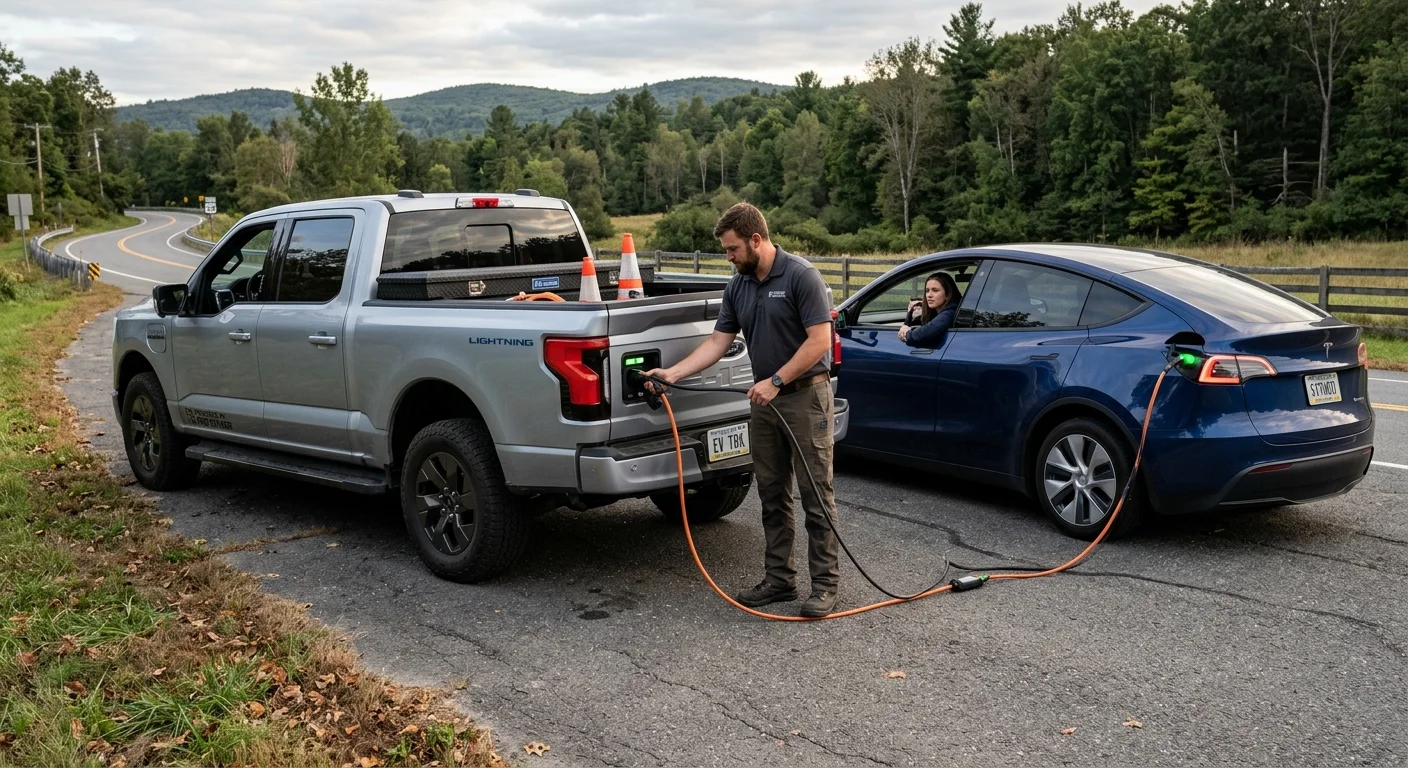
A Lightning that accepts no current isn’t a slow-session problem. A truck that won’t ready after a cold night is often the 12-volt battery, not the big pack. Start with a Ford F-150 Lightning that won’t start before you call a flatbed. Asking whether this truck can feed another EV from Pro Power Onboard is a different question. We cover it in whether an F-150 Lightning can charge another EV roadside.
Out of miles before you reach a stall
A public timer doesn’t help if you can’t reach the stall. Charge Pro DEN is a referral line. We match stranded drivers with independent local mobile rescue operators. We don’t own trucks. We don’t employ technicians. We don’t set prices. The operator quotes you before work starts and bills you directly. Through mobile EV charging, operators bring a 240-volt Level 2 source to the truck. They use native NACS, or a CCS or J1772 adapter, including for the Lightning. Typical on-site charging time is 15 to 30 minutes for about 10 to 20 miles of range. That’s charging time, never an arrival time. Non-Tesla EV rescue is the same referral when the Lightning is the one that needs help. We serve the Denver metro, including Denver. See charging levels for a stranded Denver EV for what each level adds on a shoulder.
If you need that referral, call (720) 738-6950.
Frequently asked questions
How long does a Ford Lightning take to charge at home in the cold?
Ford lists about 6 to 8 hours for Standard Range and 8 to 10 hours for Extended Range on the Charge Station Pro. Cold adds warmup time. A 120-volt outlet isn’t a daily plan.
How long is a DC fast charge when the pack is cold?
Ford lists about 41 minutes from 15 to 80 percent for Extended Range and about 44 for Standard Range in mild temperature. A Denver January start runs longer.
Does the Extended Range pack charge faster than Standard Range?
On DC fast charging the larger pack accepts a higher peak rate, so the 15-to-80 percent times stay close. At home, filling the bigger pack still takes more hours.