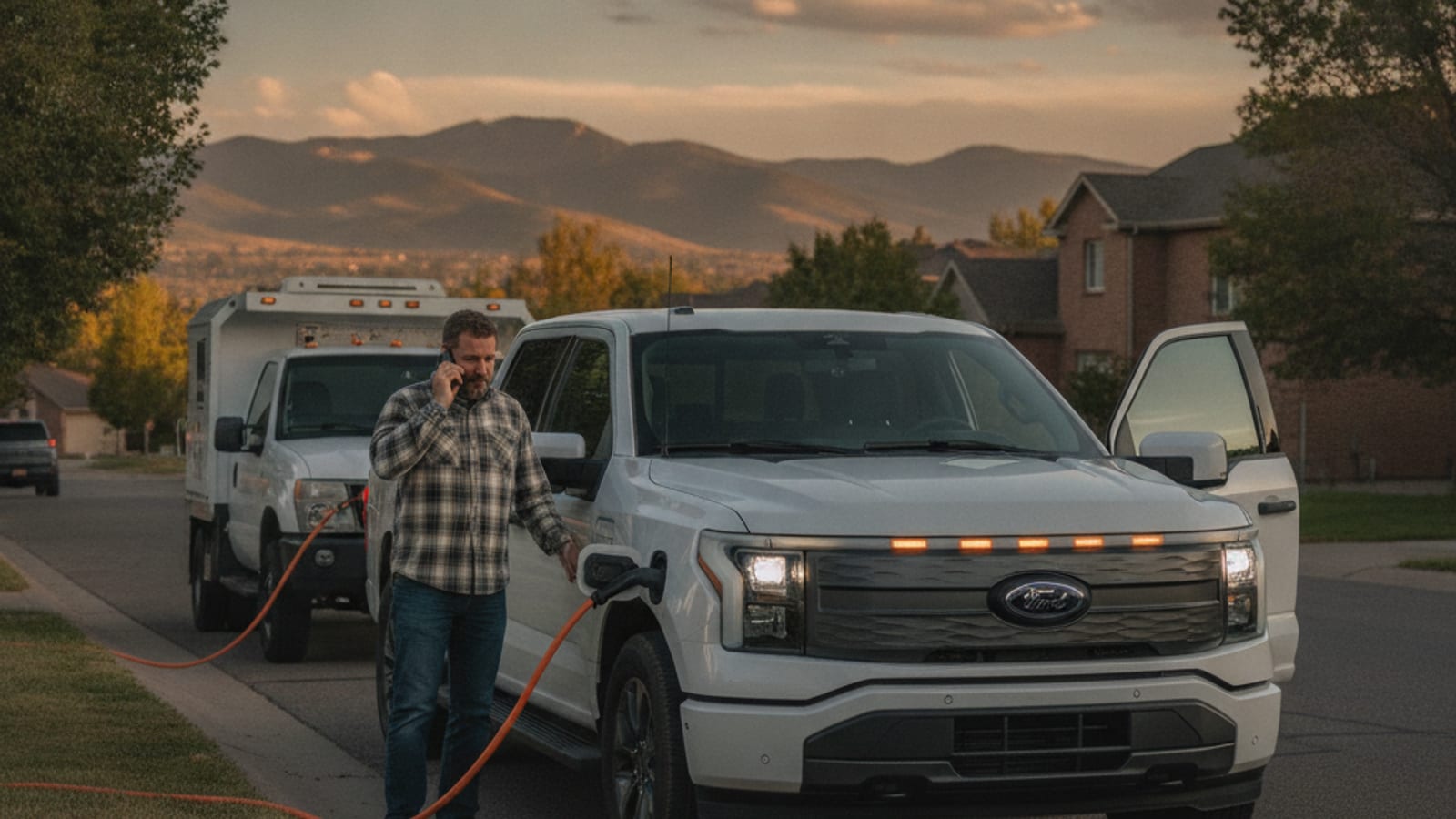
Mobile EV charging in Longmont comes down to two questions. Is there a public charger within a few miles, or do you need a Level 2 boost brought to you. If the pack is at zero, a tow to the nearest stall is one path. A mobile Level 2 charge at the car is another. Both work. The right call depends on where the car sits and what the cold has done to the battery overnight. If you are stuck in a parking lot on Main Street or on a shoulder off the Diagonal right now, call (720) 738-6950 and we will match you with an independent local operator. The operator quotes you before the cable goes in.
Longmont Power and Communications is city-run
Longmont is the one place in the metro where the electric utility is not Xcel Energy and not a co-op. Longmont Power and Communications is the city’s own municipal utility. The City bills your house and the City answers your charger questions. That distinction matters because Longmont residents sometimes call Xcel by reflex. Xcel does not serve Longmont for electricity. The municipal utility runs the public Level 2 chargers the City owns, and the LPC EV Charger Rebate is the home program to ask about. Rebate amounts shift, so confirm with the City rather than a third-party article.
If you are reading this from a Longmont driveway wondering whether your home charger rebate went to the right place, that is the answer. The City is the right place. Xcel is not.
Why the pack can read zero here in winter
Longmont sits on the St. Vrain at the northern edge of the metro. The ground is high plains, fully exposed. January nights in this part of Boulder County often run near 18 degrees. At 20 degrees an EV keeps roughly 70 percent of its warm-weather range, per Recurrent Auto’s study of more than 30,000 U.S. EVs. That means a car that would comfortably reach Fort Collins in October can read low before reaching Broomfield in February. The heater is the biggest single drain on a cold morning, and Longmont drivers tend to live within an hour of the city, so a heater on full plus a hard headwind off the plains can take 30 percent of the indicated range before the first stoplight.
Recurrent also found EVs retain about 78 percent of max range at 32 degrees, with heat-pump vehicles holding about 10 points more. The lesson is not to panic at a low number. The lesson is to count on less than the gauge suggests when the temperature is below freezing.
The two stall patterns Longmont sees most
The first pattern is the local short trip. A driver leaves home in Old Town with enough range to get to work, run one errand, and come home. The car sits outside through the day in cold. The owner returns to a pack that dropped more than expected, or to a 12-volt battery that died overnight and will not wake the car. The pack itself still has charge. The car just looks dead because the small 12-volt battery that runs the computers, the contactors, and the door locks is gone. A 12-volt jump gets most of those cars moving without a tow.
The second pattern is the highway miss. A driver commutes on the Diagonal toward Boulder, or on US-287 north toward Fort Collins, or runs east toward I-25 on SH-66. The pack is low, the heater is on, the drive is longer than the dash predicted, and the car slows on the shoulder. This is the empty-pack case. The fix is a Level 2 charge at the car, or a tow to the nearest stall. A mobile operator can bring the Level 2 charge to your shoulder, lot, or driveway.
What the operator actually brings
Charge Pro DEN is a referral line. We do not own trucks and we do not employ technicians. We match you with an independent local operator who serves the Boulder Corridor. The operator brings a 240-volt Level 2 source on a mobile lead. Tesla drivers get a native NACS plug. Other EVs use a CCS or J1772 adapter. Typical charging time is 15 to 30 minutes and adds about 10 to 20 miles of range. The clock starts when charging starts, not before. It is not an arrival time and we do not promise one.
The operator bills you directly for the work they do. For an empty pack, the right service is out-of-charge recovery. For a dead 12-volt battery that will not wake the car, the right service is Tesla 12-volt battery jump for Teslas or mobile EV charging for non-Tesla vehicles. Both come back to the same dispatch number.
Public charging inside Longmont
Longmont has City-owned Level 2 chargers at civic locations, plus private network sites at retail corridors. The exact stall count and pricing move, so check your charging app before you drive across town. The Ken Pratt Boulevard corridor, the Main Street district near Roosevelt Park, and the area around the St. Vrain Greenway trailheads are common dwell points where a low charge turns into a walk home.
If the car is in a travel lane or a dangerous spot, call 911 first. A mobile operator comes to safe parking. Do not stand in traffic to swap a plug.
What to do on the shoulder of the Diagonal or US-287
The Diagonal (SH-119) between Boulder and Longmont, and US-287 through town, both have paved shoulders. If you stall, get as far right as you can. Set your hazards. Stay in the car if that is the safer choice. CRS 42-4-1202 allows a vehicle so disabled it cannot be moved to sit on the shoulder with hazards on. That is the lawful thing to do here. Violation is a class B traffic infraction, and a stranded EV that genuinely cannot move is the textbook exception.
CDOT Safety Patrol covers portions of the metro freeways, but its coverage map names I-25, I-70, US-6, C-470, and I-225. SH-119 and US-287 are state highways but are not on the published Safety Patrol segment list for the metro. CDOT’s Safety Patrol and breakdown pages mention nothing about EV charging on any segment. So the free state truck, when it comes, will jump a 12-volt. It will not bring a Level 2 charge to your EV. For a charge on the shoulder, the operator referral is the path.
Cold-soak, phantom drain, and the 12-volt problem
Below about 15 degrees the battery management system wakes to run thermal management. That uses pack energy even when the car is parked. Owners call it phantom drain. The traction pack may still show plenty of energy when the owner returns. The 12-volt is a separate, smaller battery. It runs the computers and the locks. A cold week in an unheated lot can kill it while the pack still reads full.
A 12-volt jump is fast. A battery that will not hold a charge needs on-site replacement, which the operator can do for many common models. If the dash showed low range first, treat the call as an empty pack. If the car sat dark through a freeze and would not wake, start with the 12-volt. Can roadside jump an EV 12V walks the split.
What to tell the dispatcher
When you call (720) 738-6950, the dispatcher will want a few basics. Your cross street or landmark, the make and model, what the dash is doing, and whether you can move the car out of traffic. For Longmont, common landmarks include the St. Vrain Greenway, Roosevelt Park, Union Reservoir, the Longmont Museum, and the Ken Pratt corridor. The dispatcher matches the closest operator who serves the Boulder Corridor and shares your vehicle’s plug standard.
When a tow is still the right call
A roadside charge does not straighten bent suspension. If the car cannot roll, you need a tow. The Colorado Towing Bill of Rights (HB22-1314) governs nonconsensual tows, including a 24-hour written notice rule for most private-property tows. If you sit on a public shoulder and AAA or a club truck comes for a flatbed, that is a consensual tow and the normal fee rules apply. The PUC regulates towing carriers in the state. We never name a specific tow operator on this site, and we never set a tow price.
If the car must reach a specific shop, a charge may delay the hook. Use your judgment.
How a Longmont driver should think about the call
If you can safely reach a stall and your charging app shows it is online, drive to it. A native stall is faster than any mobile Level 2 charge will be. If the nearest stall is more than a few miles away, or you are off the main roads in a lot, or the stall has been flagged as unreliable, a mobile Level 2 charge at the car is the cleaner path.
For Longmont, that means a dispatcher call to (720) 738-6950, a quote from the operator before the cable goes in, and a charge that puts 10 to 20 miles of range in the pack so you can drive under your own power to a stall or home. Mobile EV charging near me in the Denver metro covers the broader near-me pattern. Your EV died on Capitol Hill with no driveway plug covers the apartment-and-street-parking version of the same call.
Frequently asked questions
Does Longmont Power and Communications run the public chargers in town?
The City of Longmont owns Longmont Power and Communications and runs the LPC EV Charger Rebate program for home chargers. The City also operates public Level 2 charging at civic sites around Longmont. For an exact stall count and current pricing, check the City site and your charging app before you drive.
What if I call Xcel about my home charger rebate in Longmont?
Xcel does not serve Longmont for electricity. Longmont Power and Communications is your utility. Take rebate and public-charging questions to the City rather than Xcel. That is the single most common local mistake on this corridor.
Can a mobile operator come to the shoulder of the Diagonal?
Yes. The Diagonal (SH-119) between Longmont and Boulder is normal service area. Get right, set hazards, stay clear of traffic, then call. The operator quotes you before starting and bills you directly. Typical charging time is 15 to 30 minutes and adds 10 to 20 miles of range, enough to reach a stall in town or roll home to Fox Hill or Prospect.
My Tesla will not wake in an Old Town driveway. Is that an empty pack?
Almost always it is the 12-volt, not the empty pack. Longmont winters regularly drop below 20 degrees, and a cold-soaked 12-volt dies while the traction pack still shows range. A jump gets most cars moving without a tow. A 12-volt that will not hold a charge needs on-site replacement, which the operator can do for common Tesla models. The operator will tell you which is which on the phone.