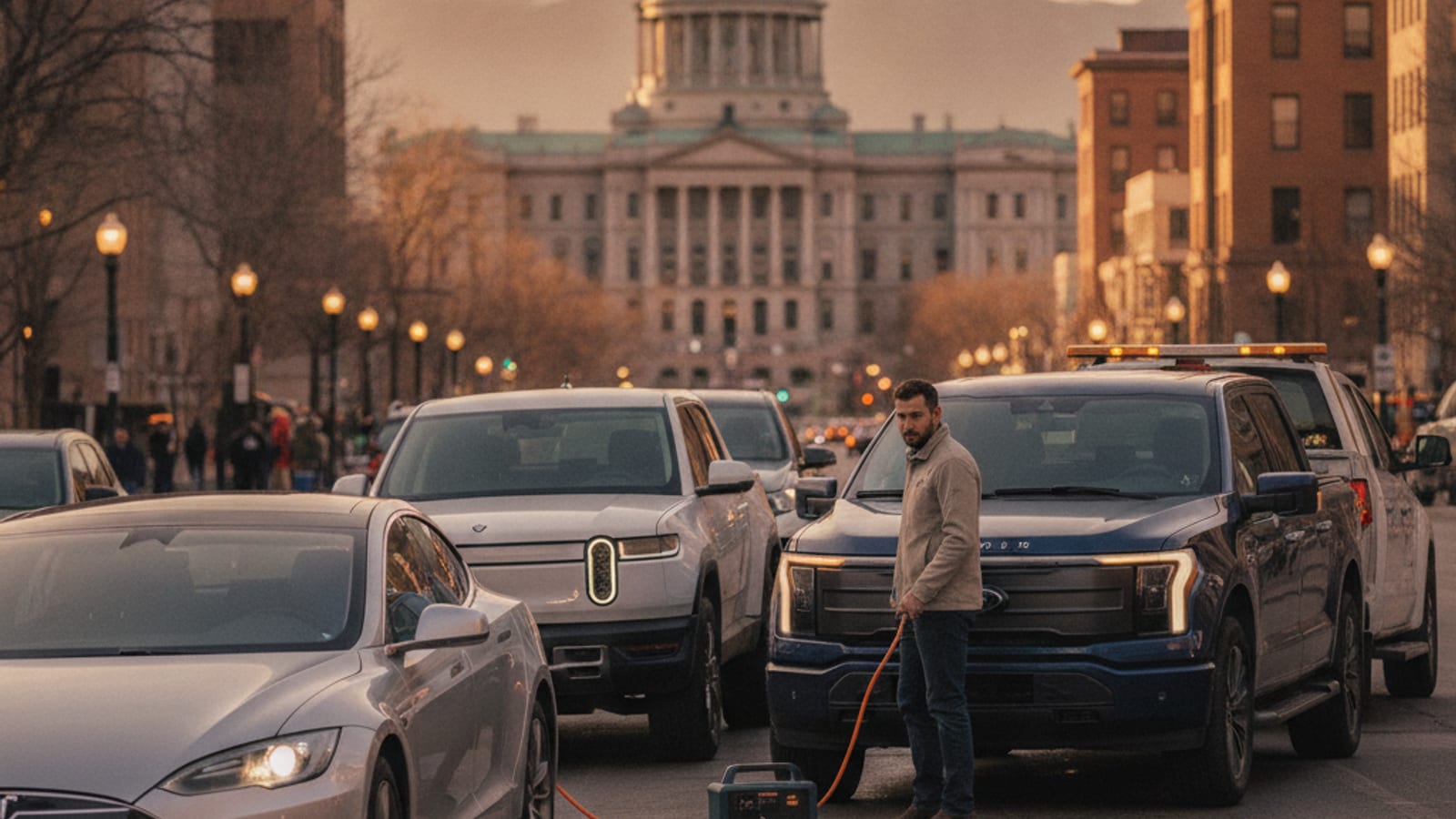
Mobile EV charging downtown Denver for a Capitol Hill driver without a driveway plug comes down to who can roll a 240V source to your curb. The Denver core was built before home EV charging was a thing. More than half of the city’s housing predates 1980, and most of those older buildings and street-parking blocks never planned for a charger at the door. A cold night on the curb eats margin a garage would have held. Charge Pro DEN matches you with an independent local operator. That operator quotes you before any cable goes in. Call (720) 738-6950 when you want that match.
Capitol Hill was built before the plug
The neighborhood runs from the State Capitol east to Cheesman Park. Old brick apartment buildings, small multifamily rentals, and single-family bungalows without garages are the rule here. Street parking is the only parking for most residents. A 240V home charger is a luxury, not a default. Even many of the newer condo conversions on East Colfax and around the Cap Hill nightlife blocks share curbside spots rather than dedicated charging stalls.
The same pattern stretches into Five Points, Baker, the northern edge of Wash Park, and Broadway’s older rental blocks. It’s a metro-wide urban reality concentrated in the core. Over half of Denver’s housing predates 1980, and the share climbs higher inside the oldest neighborhoods. Panel capacity for a home Level 2 install is also a real limit in some of those older buildings, even when the lease or HOA allows it.
The practical result. A Capitol Hill EV driver lives on public charging and on whatever the office garage, the Cheesman Park lot, or the Colfax corridor stalls can offer. A cold soak on the street pulls more out of the pack than the trip meter predicts. Morning range is lower than the range you parked with.
Why the cold eats your range here
Denver sits on the high plains at 5,280 feet. January nights run around 18 degrees on a normal year. Arctic drops arrive fast: the city went from 47 to minus 19 in about 48 hours during January 2024. Cold does two things to a parked EV at once.
First, the traction pack loses efficiency in the cold. Recurrent Auto studied more than 30,000 U.S. EVs. At 32 degrees, the average EV kept about 78 percent of its maximum range. At 20 degrees, that share fell to about 70 percent. AAA has measured closer to a 39 percent loss at 20 degrees in separate testing. The exact number depends on the car, but the direction is the same.
Second, the battery management system runs its own thermal management while the car sits. Below roughly 15 degrees, modules wake up to keep the pack in a safe band. That phantom drain shows up on a cold morning as a pack that is lower than the pack you left at bedtime. Street-parked cars cold-soak harder than cars tucked in a garage.
Recurrent also notes that heat-pump vehicles hold about 10 percentage points more range at 32 degrees than vehicles without a heat pump. That’s a real, measurable difference on a Capitol Hill morning.
Where Capitol Hill drivers actually charge
Public charging around the core runs in three flavors, and none of them replace a home plug on the worst morning.
Street-corner Level 2 posts sit on key blocks. The City of Denver runs a network through its charging program. Those posts pull 240V and add meaningful range during a long shop, a meeting, or a meal on East Colfax.
Retail and grocery parking lots around the core carry ChargePoint, EVgo, and Electrify America stalls. These come and go. A stall that worked last Tuesday may be iced over or occupied now. The same site may have one stall down for a month.
Office and apartment-amenity chargers run a mixed bag. Some require a fob or an app account. Some shut off at 10 p.m. Some have a two-hour cap that doesn’t fit a workday dwell. A cold weekend morning isn’t a useful time to count on them.
For all of those, the same problem shows up. A low morning pack needs a way to add 10 to 20 miles to reach the next stall or to make it home. That’s the mobile EV charging case.
What a mobile charge actually looks like on your block
Charge Pro DEN is a referral line for stranded drivers. We don’t own trucks. We don’t employ technicians. We don’t set prices for the visit. We match you with an independent local operator. That operator quotes you before any cable goes in. They bill you directly for the work they do.
The kit is a 240V Level 2 source. Tesla drivers get a native NACS plug on the lead. Other EVs use a CCS or J1772 adapter. Typical charging time adds about 10 to 20 miles. That add happens in 15 to 30 minutes of charging once the cable is in. The clock starts when charging starts, not before. It’s not an arrival time, and we don’t promise one.
Capitol Hill blocks are tight. Curb space is the entire game. Tell the dispatcher where the car sits and what side of the street. Operators work with that, the same way they work with any narrow Denver block. For an empty pack at zero, use out-of-charge recovery. For a deeper comparison of in-place charge versus a tow, read charge in place or tow.
The 12-volt problem after a street-park night
A street-parked Tesla or other EV that won’t wake in the morning is a 12-volt story more often than it is a traction-pack story. The traction pack may still hold plenty of energy. The 12-volt runs computers, contactors, and door locks. A cold soak weakens it. When it dies, the whole car looks finished.
CDOT Safety Patrol covers certain metro freeway segments, not residential streets. Capitol Hill streets don’t qualify. CDOT’s published menu is tires, jumps, fuel, debris, and minor mechanical help on listed freeways. CDOT doesn’t publish an EV charging service. The 12-volt jump is the closest thing on the published list, and even that is only on the covered segments.
Operators we refer can jump a 12-volt on site. They can replace one on site when that’s the job. They carry the gear. The dash showed low range first, treat it as an empty pack. The car sat dark through a freeze, start with the 12-volt. For the full split, read can roadside jump an EV 12V.
Xcel runs the electricity here
Capitol Hill is Xcel Energy territory. So are the surrounding Denver core neighborhoods. The 2024-2026 Xcel EV program names include EV Accelerate At Home, EV Home Wiring Rebate, Optimize Your Charge, Charging Perks, RE-TOU, Residential EV Rebate, and PCAN. Those are the program names. Dollar figures aren’t published on this page.
Home-charging questions go to your utility. If you rent, the question goes to your landlord first, then to the utility about panel capacity. A Capitol Hill driver in an older building is unlikely to have a 240V plug at the door. The realistic options are public charging, workplace charging, and a mobile boost when those don’t add up.
What a Capitol Hill rescue costs you
No published dollar figure here. The operator quotes you before work starts. You pay them. Charge Pro DEN doesn’t set the price, doesn’t take a cut, and doesn’t add a fee. The model is a referral match, not a service contract.
What the operator brings is a 240V Level 2 source. What it adds in a 15 to 30 minute window is roughly 10 to 20 miles of range. That’s the only time figure that matters. The clock starts when charging starts. It’s not an arrival promise. It’s not a “minutes away” claim. Operators we refer work the Capitol Hill, Five Points, and Baker blocks regularly, so dispatchers know the parking patterns.
If the car is in a travel lane, a live traffic lane, or another dangerous place, call 911 first. Don’t wait on a referral number with the car sitting in a travel lane. Once the car is safely out of lanes and visible, call Charge Pro DEN.
When a tow is still the right tool
A roadside charge doesn’t straighten bent suspension. If the car can’t roll, you need a tow. AAA and other clubs exist for that work. If the car must reach a specific shop, a charge may delay the hook.
CRS 42-4-1202 covers a disabled vehicle on a highway. You may not stop on the paved main-traveled part of a highway. The exception is a vehicle so disabled it can’t be moved off. Hazard lights must be on under CRS 42-4-230. That statute covers highway shoulders, not residential streets. Capitol Hill is a residential street case, so the same hazard-lights-on rule still applies, but the disabled-vehicle statute isn’t what governs it.
CRS 42-4-1803 sets no fixed hour count for abandonment. No Colorado statute treats a disabled EV as a special class. The Colorado Public Utilities Commission regulates towing carriers.
How to plan for the next Capitol Hill morning
A few patterns help a no-driveway EV driver through a Denver winter.
Treat the public network as your backup, not your plan. A week of looking at the same stalls tells you which ones actually work in the cold. Some freeze. Some get parked in by non-EVs. Some break. Keep that list in your head.
Pre-condition the car while it’s still plugged in at a public stall or office. That uses grid power for cabin heat, not pack range. Most EVs let you schedule a departure time in the app. Use it.
Watch the low-battery warning as the moment to act. Range drops faster below about 20 percent, and the cold makes that fall steeper. If the warning lights up near the Colfax and Broadway junction, treat it as the start of a rescue, not the end of a day.
Charge Pro DEN is the referral line for the Denver metro. We match you with an independent operator who quotes you before starting work. They bring a 240V Level 2 source to wherever the car sits, including Capitol Hill’s tight curb spaces. Call (720) 738-6950 when you want that match. Treat it as a referral number, not a rolling promise.
Frequently asked questions
Can I charge an EV on a Capitol Hill street at home?
Most Capitol Hill residents don’t have a private driveway or a dedicated 240V plug. Public charging on the surrounding blocks is the realistic home alternative, and a mobile Level 2 boost is the way to bridge a low morning when the public stalls don’t add up. Over half of Denver’s housing predates 1980, so panel and parking limits are real in the older stock.
How much range can a mobile charge add to my car here?
Operators bring a 240V Level 2 source. Typical charging time adds about 10 to 20 miles of range in 15 to 30 minutes of charging once the cable is in. That figure is a range added, not an arrival time. The clock starts when charging starts.
Does CDOT Safety Patrol charge street-parked EVs in Capitol Hill?
CDOT Safety Patrol covers listed metro freeway segments, not residential streets. CDOT’s published menu doesn’t include EV charging. The 12-volt jump is the closest thing on the published list, and even that is only on the covered freeway segments.
Is it cheaper to call for a mobile charge or get a tow to a public stall?
A mobile Level 2 boost adds range at the curb in minutes. A flatbed tow moves the car to a public stall, where you wait on that stall to add the same range. Both are real options. The mobile charge avoids the second wait. The operator quotes you before work starts. Charge Pro DEN doesn’t publish a price.
Who do I call about a home charger in a Capitol Hill apartment?
Capitol Hill is Xcel Energy territory. Home-charging questions go to your utility. If you rent, start with the landlord about panel capacity and any lease restriction, then call Xcel about the program names. A Capitol Hill renter in older stock often finds that a public-network plan plus a mobile boost is more realistic than a hardwired install.