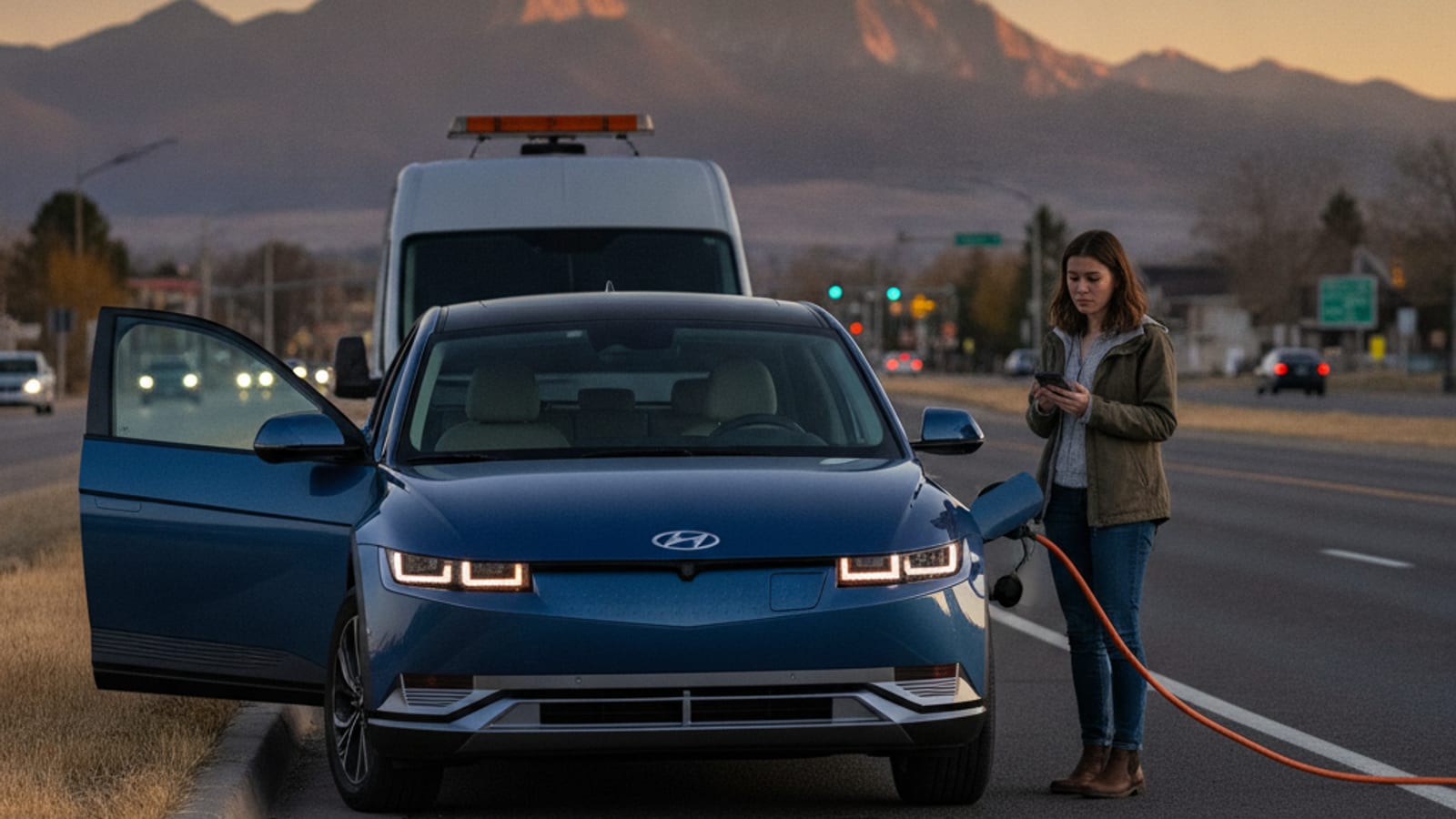
Mobile EV charging in Broomfield comes down to one fast choice when the gauge is dropping. If the car will not wake after a cold night, you need a 12-volt jump, not a pack charge. If the pack is at zero on US-36 or the Northwest Parkway, you need a Level 2 boost so you can drive off under your own power. Charge Pro DEN is a referral line. Call (720) 738-6950 and an independent local operator meets you on the shoulder, in a parking lot, or at your driveway. The operator quotes you before any cable goes in.
Broomfield is its own city and county
Broomfield is not part of Adams, Boulder, Jefferson, or Weld County. It is a city-and-county, carved out of all four in 2001 and operating as a single unit. The practical effect for a stranded EV driver: a Broomfield address can route to several different agencies depending on who you ask, and the electric utility is the most confusing of those splits.
Most of the city sits on a high-plains shelf at roughly 5,400 feet, with rolling ground on the way up toward Louisville and the Boulder foothills. Population is about 75,000 in the city limits and growing. The ZIPs that map to Broomfield are 80020, 80021, 80023, 80026, 80234, and 80516. When you call for help, the ZIP plus the cross street gets the operator to you faster than a vague “Broomfield” ever will.
The city’s pre-1980 housing share is about 21.7 percent. That single number shapes the call mix. A newer Anthem or Wildgrass subdivision driver almost always charges at home on a 240-volt plug. A driver in an older part of town may not. The dominant Broomfield pattern is the road-specific stranding rather than the no-home-plug pattern, and that is worth knowing before you decide what to do.
The Xcel versus United Power split
Broomfield is one of the metro’s split-utility cities. Xcel Energy holds the franchise through 2027 and serves most addresses. United Power serves portions and is in franchise talks to expand. Confirm by address before you call either utility about a home charger question. The same caution applies to anyone asking “who do I call about a home charger?” The honest answer is to confirm by address, not by city name.
For a roadside stranding this split matters less. A mobile EV charge does not depend on your home utility. An independent operator brings a 240-volt Level 2 source to the bumper with a native NACS plug or a CCS or J1772 adapter. The operator bills you directly for the work. Charge Pro DEN does not set the price and does not bill you.
What the utility split does affect is the home-charger decision after the rescue. If your address is Xcel, you can look at Xcel’s EV program names: EV Accelerate At Home, EV Home Wiring Rebate, Optimize Your Charge, Charging Perks, the RE-TOU time-of-use rate, the Residential EV Rebate, and PCAN. If your address is United Power, the programs are different: United EV, the EV Make-Ready Wiring Rebate, the EV Home Charge Panel Upgrade Rebate, and the RTD1 time-of-use rate. Dollar figures were not verified for this page. Use program names, not dollar figures. The point of the utility split is to know which set of program names applies to your address.
Why most Broomfield strandings are road-specific
Broomfield drivers charge at home far more often than drivers in older parts of the metro. So when the car fails, it usually fails on a road, not at the residence. The three Broomfield-area corridors that eat range and break cars are US-36, the Northwest Parkway, and the I-25 north edge.
US-36 is the Boulder Turnpike, with express lanes in both directions. The commute crawls in stationary traffic with the heater on and a cold-soak buffer drained. The I-25 North and US-36 Express Lanes were built with a minimum 8-foot outside shoulder for breakdowns, plus added courtesy-patrol presence. A driver who breaks down moves to the right, outside shoulder.
The Northwest Parkway is a separate toll road extending the loop northwest from US-36 to I-25 and E-470. Its roadside-assistance number and hours were not verified for this page. The published thing to know is that it is a toll road with limited shoulder in stretches, so a stalled EV here is more exposed than a stall on US-36. Treat any shoulder stop on the Northwest Parkway as a hazard-lights-on, stay-buckled situation until help arrives.
The Interlocken business park and FlatIron Crossing mall draw long dwells. A car left for a long weekday in cold weather can come back with a marginal 12-volt battery that will not wake the pack. That is a jump, not a charge.
The shoulder law when you are stuck
CRS 42-4-1202 covers a disabled vehicle on a highway. Outside a business or residential district, you may not stop or leave a vehicle on the paved main-traveled part of a highway. The exception is a vehicle so disabled it is impossible to move it off the roadway, with hazard lights on under CRS 42-4-230. A violation is a class B traffic infraction.
The plain read for a Broomfield driver: it is lawful to be stuck on the shoulder if the car genuinely could not move further, with hazards on. Stay buckled if staying in the car is the safer choice. Stay visible. CRS 42-4-1803 sets no fixed hour count for abandonment on public property. No Colorado statute treats a disabled EV as a special class. You are governed by the same disabled-vehicle statutes as any other car.
CDOT Safety Patrol covers portions of I-25 South (120th Ave to Arapahoe Rd) and portions of US-6, C-470, and I-225. The Broomfield edge of I-25 north does not show up on the published metro Safety Patrol list. The patrol covers tires, jumps, fuel, debris, and minor mechanical help, and does not mention electric vehicles in its published menu. It will jump a 12-volt. It will not bring a charge to a stranded pack.
On US-36, the express-lane corridor has added courtesy-patrol presence and an 8-foot outside shoulder. If you stall in the express lane, move right to the outside shoulder first, then call.
A mobile EV charge is a different kind of job
Charge Pro DEN is a referral line for stranded drivers. We do not own trucks, we do not employ technicians, and we do not set prices for the visit. We match you with an independent local operator. The operator confirms the equipment, the access, the price, and the timing before any work starts. You pay the operator directly for the work they do.
The kit is a 240-volt Level 2 source. Tesla drivers get a native NACS plug on the lead. Other EVs use a CCS or J1772 adapter. Typical charging time adds about 10 to 20 miles of range in 15 to 30 minutes of charging. The clock starts when charging starts, not before. It is not an arrival time and we do not promise one. Those miles let you drive under your own power to a stall, a home charger, or a shop, instead of waiting on a flatbed.
Operators we refer handle Tesla and every major EV brand. A Broomfield driver in Anthem, Interlocken, Wildgrass, or the Broadlands who runs low on US-36 can take a boost and roll to the nearest charger rather than wait on a tow. For an empty pack, use out-of-charge recovery. For the broader mobile-charge choice, see mobile EV charging.
Jump versus pack
The two failure modes look the same from the driver’s seat but need different tools. An empty traction pack needs Level 2 charging. A dead 12-volt battery needs a jump or an on-site 12-volt replacement. The 12-volt runs the computers, contactors, and door locks. When it dies, the whole car looks finished even though the traction pack still holds energy.
January’s normal low around the Broomfield area sits in the high teens. A long sit in a cold lot can kill the 12-volt overnight. The traction pack may still be fine. If the dash showed low range first, treat it as an empty pack. If the car sat dark through a freeze and will not wake, start with the 12-volt.
Recurrent Auto studied more than 30,000 U.S. EVs in winter. At 32 degrees, EVs kept about 78 percent of max range. At 20 degrees, about 70 percent. Cold is why a morning buffer can vanish on US-36 west of Broomfield on a frozen commute. It is not a reason to guess the next charger.
Operators we refer can jump a 12-volt on site or replace one on site when that is the job. For the deeper walk-through of the split, see can roadside jump an EV 12-volt.
How to choose from a Broomfield shoulder
Turn your hazards on and stay visible to traffic. Stay in the car if that is the safer choice. If you are on a published CDOT Safety Patrol segment and within posted hours, that free jump is for a dark 12-volt. Skip it when the pack was already at zero. On US-36, the 8-foot outside shoulder is the place to be. On the Northwest Parkway, treat the shoulder stop as more exposed and call for help rather than walking.
If the car is otherwise fine and the pack is empty, call for range. A mobile EV charging referral adds that range in place. The operator quotes you before they start. Call (720) 738-6950 when you want that match. Treat it as a referral number, not a rolling promise.
For the broader Broomfield-area rescue picture, read EV roadside assistance in Broomfield and EV roadside on the US-36 Boulder Turnpike. For a long Broomfield commute day that started at home, the home-charging utility question lives at Tesla home charging: which utility in Denver.
Frequently asked questions
Do I need a charge or a jump in Broomfield?
If the dash showed low range first, treat it as an empty pack and ask for a Level 2 boost. If the car sat dark through a cold night and will not wake, the 12-volt is the usual suspect and a jump or on-site 12-volt replacement is the right job. The two failures look the same from the driver’s seat but need different tools.
Is Broomfield Xcel or United Power?
Broomfield is a split-utility city. Xcel Energy holds the franchise through 2027 and serves most addresses. United Power serves portions and is in franchise talks. Confirm by address before you call either utility about a home charger question. A roadside stranding does not depend on your home utility at all.
Can CDOT Safety Patrol bring a charge?
CDOT Safety Patrol covers published metro freeway segments for tires, jumps, fuel, debris, and minor mechanical help. The Broomfield edge of I-25 north does not show up on the published metro list. CDOT’s published menu mentions nothing about EV charging. A jump is covered. A pack charge is not.
Where is the safe shoulder on US-36 through Broomfield?
The I-25 North and US-36 Express Lanes were built with a minimum 8-foot outside shoulder for breakdowns, plus added courtesy-patrol presence. A driver who breaks down moves to the right, outside shoulder before calling. Hazards on under CRS 42-4-230. It is lawful to be stuck on the shoulder if the car could not be moved further.