The US-36 climb into Louisville is where a thin battery becomes a stop. You were fine leaving Boulder. Cabin heat was on. Traffic stacked on the turnpike. The estimate fell while you sat. Now the car is on McCaslin Boulevard. Or it’s sitting in a Colorado Tech Center stall. It won’t cover the last stretch home.
That’s the Louisville version of an empty EV. Most households here charge in the garage. The stranding is usually the commute, not a missing wall plug. That’s EV roadside assistance Louisville drivers actually need. Charge Pro DEN is a referral line. We match you with an independent local operator. That operator brings a 240-volt Level 2 source to the car. The operator quotes you before any work starts. They bill you directly.
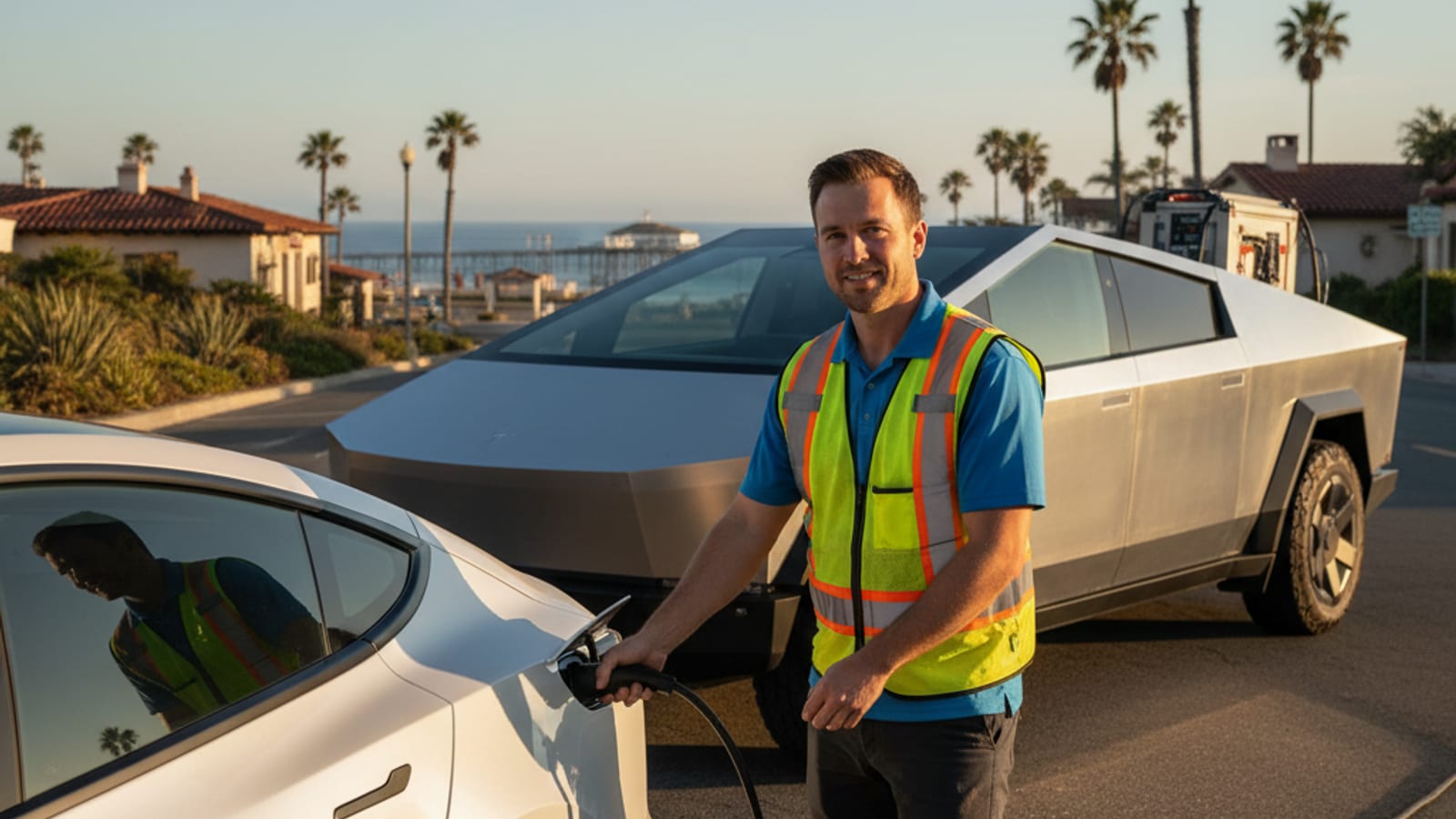
Louisville strandings start on the road, not in the driveway
Louisville sits in Boulder County on the high plains. It’s right at the mouth of the foothills. About 21,000 people live here. It’s a high-EV town with strong household incomes. After the Marshall Fire on December 30, 2021, the south edge of town had to rebuild. That fire was Colorado’s most destructive on record. It burned into Louisville. Much of the new housing came back well insulated. Modern electrical service was part of the rebuild. Home chargers went in with a lot of those houses.
That rebuild changed the mix of calls. A dead car in Old Town or Coal Creek Ranch is less often a missing wall plug. It’s more often the last miles on US-36. Or it’s a long sit at an office on McCaslin. Louisville EV charging still starts at home for most drivers. Xcel Energy serves the city. If you’re on Xcel, know the program names. EV Accelerate At Home is one. The EV Home Wiring Rebate is another. Optimize Your Charge, Charging Perks, and the RE-TOU time-of-use rate are the others drivers ask about. Check current terms with Xcel. Don’t assume a neighbor’s offer still applies.
About one in five homes here was built before 1980. Those older pockets sit near Downtown Louisville on Main Street and in parts of the North End. A roadside visit doesn’t upgrade a garage panel. It gets the car off the street. Steel Ranch and Centennial Valley feel close to everything on a map. They still sit on the far side of a commute. If the display is already in the buffer, that last neighborhood street is the one you miss.
The Boulder corridor is the map that matters
Louisville isn’t a downtown Denver problem. It’s a corridor town. US-36 is the spine between Boulder and the metro. SH-42, also called Empire Road, cuts across the local grid. McCaslin Boulevard is the office, retail, and errand street. South Boulder Road runs you toward Lafayette. Dillon Road ties the north edge toward Erie and the Broomfield side.
A typical weekday writes the same story. Morning, you drop onto US-36 toward Boulder or Denver. Evening, you climb back. Cabin heat in January costs range. So does a crawl. Recurrent Auto studied more than 30,000 U.S. EVs in winter. Packs kept about 78 percent of max range at 32 degrees. They kept about 70 percent at 20 degrees. Heat-pump cars held about 10 points more at 32 degrees. AAA’s 2026 dynamometer work pointed to steeper loss at 20 degrees, around 39 percent range. Your 4 p.m. estimate isn’t the 6 p.m. car in a queue.
If you work at the Colorado Tech Center, the long sit is the trap. The pack was fine when you parked. Hours later you may have a 12-volt that won’t wake the car. Or you simply leave with less than the climb home wants. The same pattern shows up after a Coal Creek Trail walk. It shows up at the Louisville Recreation Center lot. It shows up after dinner on Main Street in historic Downtown Louisville.
Neighbors share the same roads. Superior sits on the same turnpike. Lafayette is the next town when you’re short on South Boulder Road. For that next town, see EV roadside assistance in Lafayette: a charge when you’re short on the corridor. Broomfield is the hinge with I-25. Boulder is the campus and office pull. Erie sits north of the same pattern. A stop in Louisville is often the last easy place to add miles before you commit. For the turnpike itself, read Stalled on US-36: what to do when your EV won’t make the hill. If the stall is closer to campus, see EV roadside assistance in Boulder when a Tesla dies on US-36.
Pack empty, 12-volt dead, or a tow
An EV that won’t go isn’t one problem. Treat it as three different jobs.
If the traction pack is at zero, a gas can won’t help. The car needs energy in the high-voltage battery. A traditional club call often starts with a flatbed. Many EVs need that flatbed so the drivetrain isn’t damaged. You still arrive with an empty pack. Out-of-charge recovery is the other path. An operator brings a 240-volt Level 2 source to where you sit.
If the car is dark, locked, or won’t wake, look at the 12-volt first. Teslas and most other EVs still use a small 12-volt battery. It runs computers, locks, and the contactors that connect the main pack. A full pack won’t save you if that little battery is dead. Cold overnight parking is a classic Front Range trigger. January normal lows around Denver sit near 18 degrees. The January 2024 arctic blast dropped Denver from 47 to minus 19 in about two days. A Louisville driveway breathes that same air. Operators in the network can jump or replace a dead 12-volt on site. They handle Tesla and other major brands. That isn’t the same job as adding range. For the Tesla-specific path, see Tesla 12-volt battery jump.
If you’re on the paved travel lane, the law matches any disabled car. CRS 42-4-1202 says you may not stop on the main-traveled part of a highway outside a business or residential district. The exception is a vehicle so disabled you can’t avoid stopping and can’t move it off the roadway. Hazards go on under CRS 42-4-230. A violation is a class B traffic infraction. No Colorado statute carves out a dead EV. You’re under the same rules as a gas car.
Towing is sometimes the right call. A crash, a bent wheel, or a car you can’t legally leave may need a carrier. The Colorado Towing Bill of Rights, HB22-1314, covers nonconsensual tows, notice, and payment rules. The Public Utilities Commission regulates towing carriers. This page won’t guess at fees. If you can stay put and the only problem is energy, charge in place is the cleaner first move.
What a mobile Level 2 stop actually does
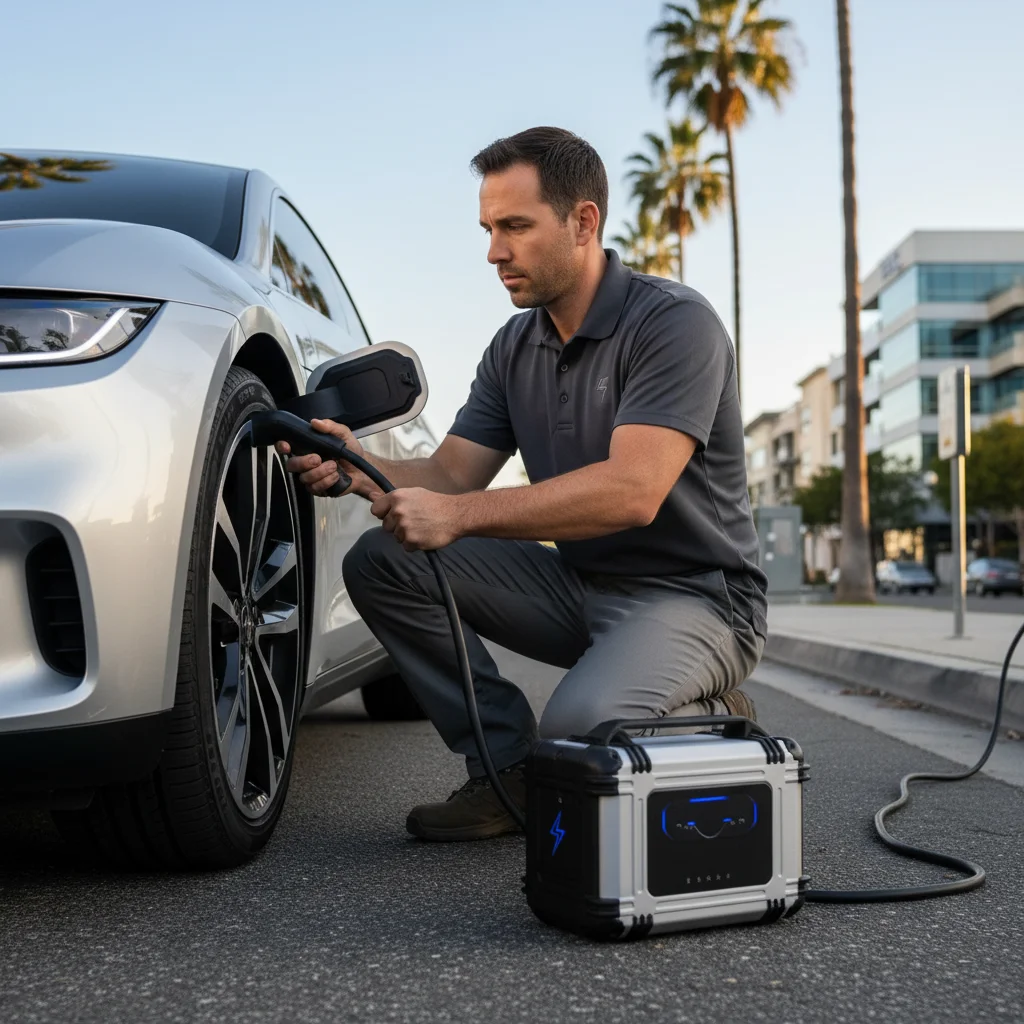
The operator we connect you with brings a 240-volt Level 2 source to the car. Teslas take a native NACS plug. Other EVs use a CCS or J1772 adapter. That covers Tesla and every major EV brand the network handles.
You don’t need a full pack on the shoulder. Operators typically add 10 to 20 miles of range in 15 to 30 minutes of charging. That’s charging time. It isn’t a promise about when someone arrives. It’s enough to reach a public stall you already had in mind. Or it’s enough to reach the garage in Old Town, Coal Creek Ranch, or the rebuild streets on the south edge.
Mobile EV charging is that visit. The operator looks at the car. They quote you before starting. They bill you directly. Charge Pro DEN doesn’t own trucks. We don’t set the price. We don’t perform the work. We match you.
A household Level 1 outlet is a different tool. On a cold night it may not keep up with the pack’s own thermal load. Roadside Level 2 is closer to a home wall charger in power. It comes to McCaslin, Main Street, Empire Road, or a legal US-36 shoulder.
Public DC fast charging still exists in the metro. Tesla Superchargers are dense across the region. Boulder has two Supercharger sites. That doesn’t help if you can’t roll to one. A dead 12-volt that won’t unlock the charge port is a different failure. A car already sitting in a Tech Center lot is a location problem, not a map problem. If the car can still move, pull into a legal stall while you still can.
CDOT can help. It won’t charge the pack.
CDOT Safety Patrol is free on covered freeway segments. It handles flat tires, jump-starts, emergency fuel, minor mechanical help, debris, and incident support. Front Range hours are 6:00 to 9:30 a.m. and 2:30 to 7:00 p.m. on weekdays. Weekends run 10:00 a.m. to 7:00 p.m. The I-70 Mountain Corridor has its own published window. Confirm current coverage on CDOT’s Safety Patrol page.
Here’s the part EV drivers miss. Those Safety Patrol pages mention nothing about electric vehicles. They don’t offer a charge for a stranded pack. A patrol can jump a 12-volt. Emergency fuel is a gas-car tool. Your empty traction battery isn’t in the published list.
US-36 Express Lanes were built with a minimum 8-foot outside shoulder for breakdowns. If you break down in those lanes, move to the right, outside shoulder. The idea that there’s no shoulder isn’t the published layout. COtrip.org and the 511 line are the live sources for closures. Traction law is by signage and COtrip, not by a date you memorized.
Colorado State Patrol handles crashes, enforcement, and abandoned-vehicle dispatch. If you’re in a travel lane, that’s a safety problem first. Get out of the live lanes if the car can still roll.
Cold, climb, and the miles you thought you had
Louisville’s climate is high plains, not a mountain town. You still feel Front Range winter. Cabin heat is a pack load. A slow US-36 merge is a pack load. Elevation between the Denver core and Boulder is a real step. Louisville sits on the flats at the foothills’ mouth. The car still spends energy heading west and north into Boulder. Regen on the way back can return a large share of a climb. Descent analyses often put that recovery around two-thirds. Drivers still cut regen on ice for traction. Don’t budget a January commute on a July number.
Colorado crossed 200,000 registered EVs by October 2025, per the Colorado Energy Office. The Denver metro remains the highest-EV-share region in the state. New-sale share isn’t the 2025 credit spike. Battery-electric vehicles were 12.5 percent of new Denver-metro registrations year-to-date through June 2026. That’s about one in nine. You’ll still see plenty of Teslas and other EVs on McCaslin.
Range math on this corridor is local. A Coal Creek Trail stall after a weekend walk is a long sit. The Recreation Center lot is the same. Downtown Main Street is too. Any of those can leave a 12-volt weak. Any of those can leave a pack lower than the US-36 merge wants. The Marshall Fire rebuild streets are newer. The commute is the same hill.
Home charging on Xcel doesn’t cover a turnpike stall
Most Louisville drivers charge at home. That’s the point of a high-adoption city with a lot of post-fire rebuilds. Xcel’s RE-TOU rate is built around that garage session. Optimize Your Charge and Charging Perks are too. None of that helps when the car is already on Empire Road with a red display.
A forgotten plug still happens. So does a trip you didn’t plan at the Tech Center. So does a second run to Superior after the evening charge was supposed to be the last move. The garage charger is the right tool tonight. It’s the wrong tool at 6:15 p.m. on McCaslin.
If your street is in Louisville, Xcel is the electric utility. Don’t call CORE. Don’t call United Power. Those names belong to other parts of the metro. Confirm the bill if you live near a Broomfield or Erie border, where neighboring cities can split territory. Louisville itself is on Xcel.
What to do when the car stops here
Pull out of the travel lane if the car can still roll. Turn the hazards on. If you’re in a US-36 Express Lane, take the outside shoulder. Stay with the vehicle if traffic is close.
Read the display honestly. Zero on the traction pack isn’t the same as a car that won’t unlock. A silent cabin with a locked charge port is often the 12-volt. A car that still drives but won’t make Coal Creek Ranch is an energy problem.
Don’t keep creeping on a few predicted tenths. You can stall in a worse place. CRS 42-4-1202 already wants you off the main-traveled pavement when you can move.
Then pick the job. A 12-volt jump is the dark-car path. A Level 2 visit is the empty-pack path. A tow is the damaged-car or illegal-stop path. Many traditional roadside plans still default to a tow when the pack is empty. Ask whether they will charge the car or only haul it. Wait in a legal place. An operator still has to reach you. The quote happens on site, before the cable goes in.
How a Charge Pro DEN referral works
You give a location a driver can find. A McCaslin cross street works. So does a Tech Center building, Main Street in Old Town, a US-36 marker, or a neighborhood name like Steel Ranch. You give the make and model. Tesla, Rivian, Hyundai, Ford, Chevy, and the rest of the major EV list are all in play. Plugs are NACS, CCS, or J1772.
We match you with an independent local operator. That person quotes the job. They bring the 240-volt source. They add enough range to reach a charger you can use, or the garage. They bill you. We don’t take over the car. If the 12-volt is the failure, they can jump or replace it on site when that’s the right fix. If the car needs a shop, they can say so. A referral isn’t a repair shop and isn’t a tow company.
Habits that cut Louisville corridor calls
Plug in at home even after a short day. The US-36 evening is where buffers die. Check the estimate against cabin heat and a slow merge. Don’t check it against a summer highway number. If you work at the Colorado Tech Center, glance at the car before the lot empties. A 12-volt that’s already unhappy won’t improve in a January lot. If you’re heading to Boulder, leave Louisville with more than the map’s minimum. The climb and the campus loop both spend miles. If you already know you’re short, stop in a legal stall while the car can still move. A Level 2 visit in a lot is simpler than a shoulder on the turnpike. Keep COtrip in the phone for closures.
Frequently asked questions
Does CDOT bring a charge if I stall on US-36
No. Safety Patrol can jump a 12-volt, change a tire, and handle fuel for gas cars on covered segments, during published hours. Its own pages don’t offer EV charging. An empty pack needs a mobile Level 2 visit or a way to roll to a public stall.
How much range does a roadside charge add
Operators typically add about 10 to 20 miles in 15 to 30 minutes of charging. That’s time on the cable, not travel time to you. The point is enough miles to reach home or a charger, not a full pack on McCaslin.
What if the car won’t unlock in a Louisville lot
Treat that as a 12-volt problem until proven otherwise. A full traction pack can still sit behind a dead 12-volt. The operator can jump or replace that battery on site for Tesla and other major brands. Don’t start with a pack charge if the car can’t wake.
When you’re already stuck
Louisville’s EV story is home charging plus a commuting hill. The Marshall Fire rebuild put more wall connectors in garages. It didn’t flatten US-36. When the car dies on McCaslin or US-36, you want a charge or a 12-volt fix in place. A default flatbed is the last resort, not the first.
Call (720) 738-6950 to get matched with a local operator. Give a clear pin. Say whether the car is dark or just out of miles. The operator quotes before they start.