A Tesla that dies on US-36 into Boulder usually needs help in place. That’s a charge or a 12-volt jump, not a tow first. Boulder is one of Colorado’s highest-EV cities. The Boulder Turnpike climb over Davidson Mesa spends range. That spend hits on the commute home from Denver.
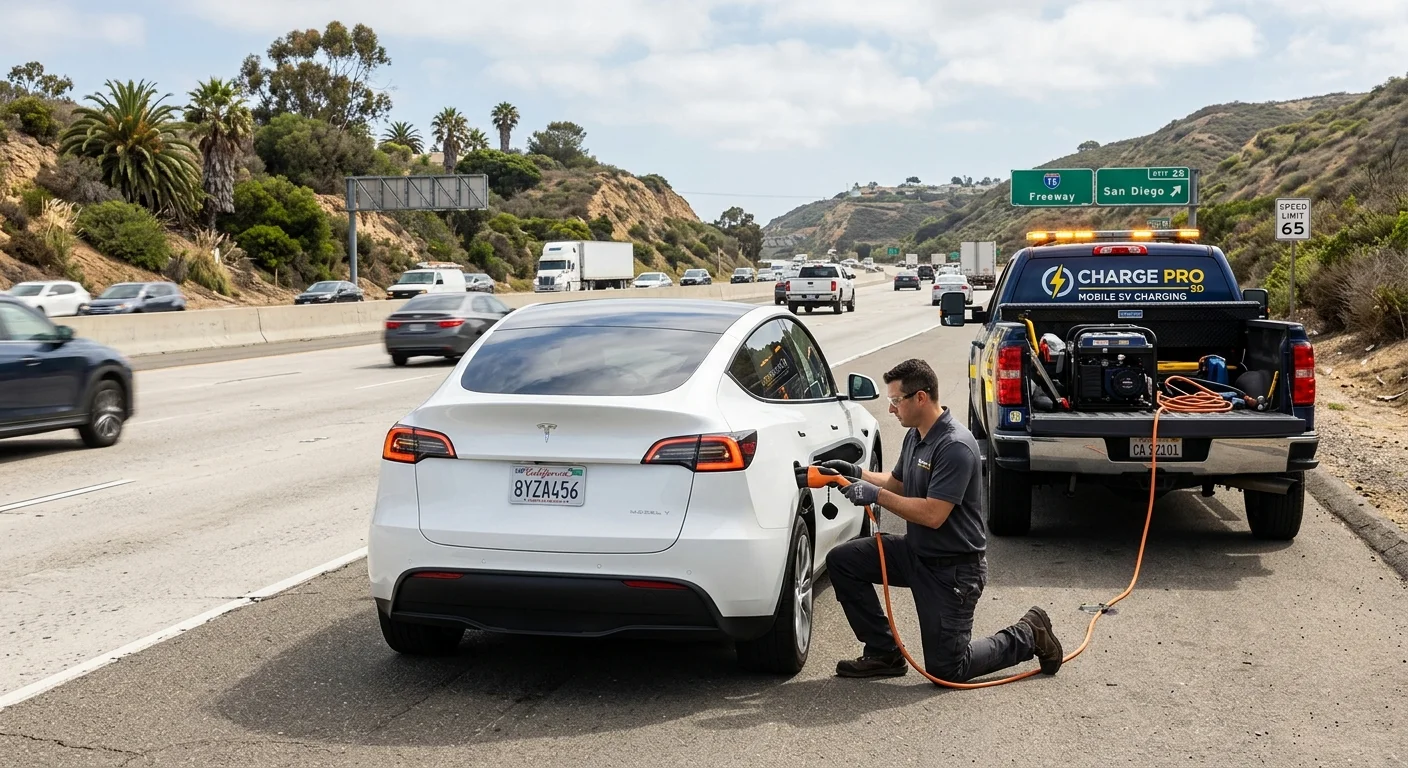
If you’re stuck, open the Boulder EV charging page for the local pattern. For a Tesla that won’t wake, start with Tesla roadside rescue. Charge Pro DEN is a referral line that matches stranded drivers with independent local operators. It owns no trucks, employs no technicians, sets no prices, and publishes no hours.
Why this stall is a Boulder Turnpike problem
US-36 is the Boulder Turnpike, and Denver workers come home over Davidson Mesa. That hill is a genuine range cost on the way back. Boulder sits around 5,430 feet at the foot of the Flatirons. Downslope Chinook winds and hard cold snaps both roll through. Canyon-mouth wind events are part of winter here.
A January 2024 arctic blast hit the Front Range in two days. Denver fell from 47 degrees to minus 19 in about 48 hours. Boulder sat in the same air mass. Recurrent Auto studied more than 30,000 U.S. EVs in winter. Cars kept about 78% of max range at 32 degrees. At 20 degrees the average was about 70%. AAA’s 2026 dynamometer study reported about 39% range loss at 20 degrees. Your trip planner can’t mint extra miles on that climb.
Going toward Denver, the mesa can give some energy back. Regen on a descent is a documented effect, and analyses put recovery around two-thirds of the climb. Drivers still cut regen on ice for traction. Coming home up the mesa is the expensive direction. SH-93 south on Broadway toward Golden spends miles too. Canyon Boulevard up Boulder Canyon does the same. SH-119, the Diagonal, runs toward Longmont and Niwot. The current inventory lists two Tesla Supercharger sites in Boulder. This page won’t guess how far you are from one.
Shoulder steps for the Turnpike itself live in stalled on US-36.
Empty pack or dead 12-volt
A Tesla can look fully dead in two different ways. The traction pack can sit at zero. The small 12-volt battery can also be dead. They’re not the same job, and the fix isn’t the same truck. The pack moves the car, while the 12-volt wakes locks, screens, and contactors. If that 12-volt is down, the car may not unlock. It may refuse a charge, and it may show no screen at all.
Campus parking around the University of Colorado Boulder produces a lot of sit-and-die calls. Students and renters often have no home plug. Cars sit on University Hill, in Whittier, and around Folsom Field. Trailhead dwells do the same work at Chautauqua Park. Cars sit there in sun or cold for hours. Pearl Street errands add more sitting. A long sit in Front Range cold is a classic 12-volt killer.
Older Boulder housing is the other half of the pattern. About 54.3% of Boulder’s housing predates 1980. Panel capacity is a real limit in Table Mesa, Martin Acres, and Newlands. Home charging is common in the wealthier pockets, and it’s not universal. Gunbarrel and some newer edges skew toward driveway charging.
If the dash is dark, treat it as a 12-volt job first. If the doors won’t wake, do the same. The operators we connect you with can jump or replace a dead 12-volt on site. See Tesla 12-volt battery jump. If the car is awake and the range is actually zero, that’s a pack problem. Then you want a mobile EV charge, not a jump.
Tesla’s own roadside on this corridor
Tesla roadside lives in the app, and you can phone it. On many new cars it’s included for a limited term. Confirm that term in the app, and don’t treat this page as Tesla’s contract. Tesla often sends a contractor, not a Tesla employee. For an empty pack, the common outcome is a tow toward a Tesla Service Center. Tesla roadside will often jump a 12-volt. It doesn’t bring a Level 2 charge to the shoulder as a standard product. The coverage split is in Tesla roadside: jump versus a charge.
That tow is sometimes the right call. A damaged tire or a crash still needs a flatbed. An empty pack on Davidson Mesa often doesn’t. Sitting on the Turnpike for a long haul to a service center wastes the day. Tesla roadside is still worth the call when your term covers a jump. It’s weaker when you only need miles. Ask them, in the moment, what they’re actually sending.
What AAA sends to a Boulder Tesla
AAA will jump a 12-volt, and AAA will tow. That’s the core of a typical membership. Membership rules are theirs, so ask AAA what your tier includes when you call. A general contractor may not carry a 240-volt source. They may not have a native NACS plug. They may not carry CCS or J1772 adapters. If the Tesla only needs miles, a tow toward a Supercharger is what you often get.
Compare that path in when your EV dies, does AAA bring a charge. Don’t assume the truck that shows up can charge, and ask before you wait. If they’re sending a jump pack, that helps a 12-volt. It does nothing for a pack at zero. AAA remains useful for a flat, a lockout, or a conventional tow. It’s a weak match for an out-of-charge Tesla on US-36.
A mobile Level 2 charge in place
A local mobile rescue is built around the car staying put. Charge Pro DEN doesn’t perform the work, and independent operators do. The operator quotes you before starting, and they bill you directly. They bring a 240-volt Level 2 source to the car. Teslas take a native NACS plug, while other EVs use a CCS or J1772 adapter. Typical charging time adds about 10 to 20 miles of range in 15 to 30 minutes. That’s charging time, never an arrival time. They also jump or replace a dead 12-volt on site. They handle Tesla and every major EV brand.
Nobody on this page can promise when a truck shows up. US-36 traffic stacks in both peaks, and express-lane backups are real. Ask whoever you call for their current estimate. Charge Pro DEN publishes no arrival time, no hours, and no fee schedule. The operator on the phone is the person who quotes. The pros we connect you with are licensed and insured. The brand holds no trade license and owns no equipment.
CDOT, the shoulder, and Colorado law
CDOT Safety Patrol is free on the segments it actually covers. Published Front Range coverage includes I-25 South from 120th Avenue to Arapahoe Road. It includes I-70 East from Wadsworth to Airport Boulevard. It includes portions of US-6, C-470, and I-225. The I-70 mountain corridor is covered from Morrison to Vail. US-36 isn’t on that published list. Don’t wait on the Turnpike for a truck that was never assigned to it.
Where Safety Patrol does run, the published menu is flats, jump-starts, emergency fuel, and minor mechanical help. Debris removal and incident support are on that list too. Front Range hours are 6:00 to 9:30 a.m. and 2:30 to 7:00 p.m. on weekdays. Weekends are 10:00 a.m. to 7:00 p.m. CDOT’s own pages say nothing about electric vehicles or a charging-specific service. They’ll jump a 12-volt, and they won’t bring a charge to a stranded EV.
The US-36 Express Lanes are run by CDOT’s Colorado Transportation Investment Office. They were built with a minimum 8-foot outside shoulder. CDOT’s project FAQ also notes added courtesy-patrol presence. If you break down in those lanes, move to the right outside shoulder. Don’t sit in a travel lane. There’s no EV express-lane exemption in 2026. Colorado’s clean-vehicle lane program ended May 31, 2020. The federal Clean Air Vehicle decal expired September 30, 2025. A Tesla in those lanes pays like every other car. COtrip.org and the 511 line are CDOT’s live source for closures.
Colorado has no statute that treats a disabled EV as a special case. A stranded Tesla follows the same disabled-vehicle rules as any car. CRS 42-4-1202 is the shoulder statute. Outside a business or residential district you may not stop on the paved main-traveled way. The exception is a vehicle so disabled it can’t be moved off the roadway. Hazards must be on, under CRS 42-4-230. A violation’s a class B traffic infraction. Abandoned-vehicle rules under CRS 42-4-1803 to 1805 use officer discretion. The statute sets no 24-hour or 72-hour clock. Don’t assume you have a set number of hours.
Campus, Chautauqua, and the older Boulder grid
Xcel Energy serves Boulder under the 20-year franchise voters approved in 2020. That vote ended the city’s municipalization effort. Xcel publishes EV programs under names you can look up on its site. Dollar amounts aren’t confirmed here, so check Xcel for the current offer. Don’t import a Longmont rebate story into Boulder. Longmont Power and Communications is that city’s own municipal utility.
A driveway charger in North Boulder doesn’t bank miles for Davidson Mesa. People leave Denver with a thin buffer, and the climb takes it. The same pattern shows up after a long dwell at Chautauqua. It shows up after a night near campus, and after a freeze in Gunbarrel. Colorado crossed 200,000 registered EVs by October 2025, per the Colorado Energy Office. The Denver metro remains the highest-EV-share region in the state. Battery-electric vehicles were 12.5% of new Denver-metro registrations year-to-date through June 2026. That’s about one in eight, not one in three. Boulder still concentrates a lot of those cars.
Louisville, Superior, and the rest of the climb
Louisville and Superior sit on the same Turnpike. Both rebuilt after the December 2021 Marshall Fire. That housing skews new, and home charging is common there. Their strandings tend to be commute strandings on US-36 and McCaslin Boulevard. Lafayette’s spine is US-287, with US-36 to the southwest. Erie splits Xcel and United Power by address. If you live on that line, confirm the utility before you blame the car. Niwot sits on the Diagonal between Boulder and Longmont. None of those neighbors replaces Boulder-specific help on the hill.
If the car can take a charge where it sits, that’s the EV-specific fix. If it can’t, you need a flatbed. An EV with no power shouldn’t roll on its drive wheels.
How to call without treating it like a dispatch desk
Put the hazards on and move to the outside shoulder if you can. Stay out of the express-lane travel lanes, and don’t walk the Turnpike. Call from inside the car if it’s safe. Then decide which dead you have before you talk. If the car is awake and the range is zero, you need miles. If the car is dark, start with the 12-volt. Tell the operator which one you think it is, and they’ll still check.
Don’t flag a random gas-car jumper onto the traction pack. The 12-volt has a specific procedure, and Teslas hide that battery. The jump points aren’t a conventional pair of posts under the hood.
Charge Pro DEN serves the Denver metro, including Boulder. The brand connects you with local pros. Call (720) 738-6950 when you want that match. It’s a referral number, not a promise that a truck is around the corner. Describe the car, the side of US-36, and whether the screens are alive. If you’re in Table Mesa or on University Hill, say so. If you’re already over the mesa toward Louisville, say that too. The operator needs a pin, not a vibe.
You can still call Tesla roadside, and you can still call AAA. Use them when a tow or a 12-volt jump is all you need. Use a mobile charge when the pack is empty. That’s the move when the car can take power where it sits. That’s the Boulder-specific fork, and the Turnpike climb created it.