Your Chevy Equinox EV won’t start after a long Tech Center garage sit. It’s almost always the 12-volt battery. It’s not the Ultium pack that drives the wheels. The small 12-volt under the hood has to wake every computer first. Until it does, the car stays dark and the fob stays quiet.
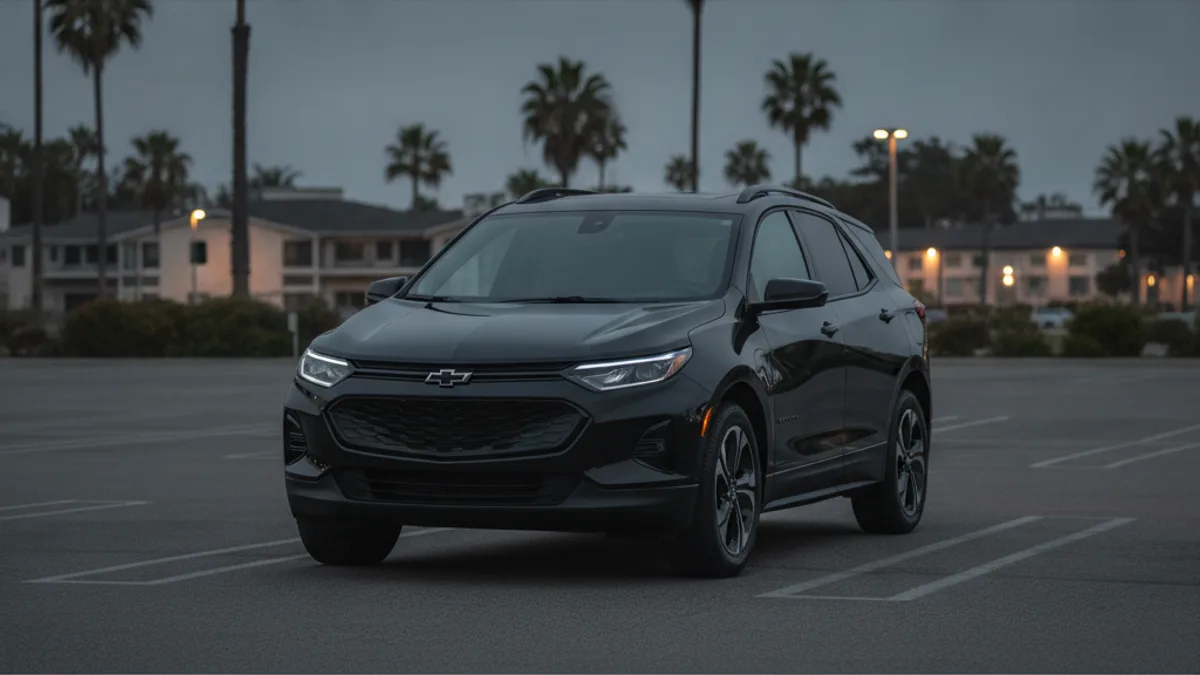
That’s the classic Equinox no-start after a workday soak. The car locked fine that morning. Now nothing answers, not even Neutral. Run the 12-volt checks below before you request a flatbed.
Two batteries, two very different failures
The Equinox EV runs on GM’s Ultium architecture. It has two power systems that do different jobs. The high-voltage pack turns the motors. A separate 12-volt AGM battery boots the computers. Those computers must come up before the pack can connect. A strong range reading from this morning doesn’t save you tonight. If the 12-volt is dead, the car won’t power on. It won’t shift. It won’t talk to the key fob.
Think of the pack as the fuel. Think of the 12-volt as the ignition. Lose the ignition and the fuel just sits there.
Some Equinox EVs go dark with no dash warning. Others show a low-voltage message while they still drive. If you caught that message in time, go to a dealer. If you missed it, treat the car as a 12-volt problem first.
A car that still wakes but won’t take a charge is a different job. Follow the Chevy Equinox EV public charging checks for that path.
Why a Tech Center garage sit flattens the 12-volt
The Denver Tech Center sits in Greenwood Village and runs into Centennial. Office days there run long. Cars sit in concrete garages from the morning standup to the evening I-25 crawl. The 12-volt keeps feeding modules while the car looks off. Alarms, telematics, and keyless systems still sip current. Hours of that sip, plus cold air in the structure, will flatten a weak AGM.
Named DC fast sites sit along that south-metro corridor. The Park Meadows Supercharger in Lone Tree has 10 stalls. Centennial has a 12-stall Supercharger. Highlands Ranch has 16. Those sites help an empty pack. They do nothing for a car that won’t wake. The same dark-car pattern shows up after a long Tech Center dwell. We covered that garage sit here: dead EV after work at the Tech Center.
Greenwood Village electric service is Xcel Energy. Centennial is CORE Electric Cooperative territory. Confirm the utility by address if you later talk home charging. Don’t assume every Tech Center driver is on Xcel. That split doesn’t change the 12-volt jump. It only changes who bills a wallbox later.
Cold and elevation wear the small battery first
Denver’s official elevation is 5,280 feet at the State Capitol step. Winter nights here aren’t a light chill. The National Weather Service normal January low sits around 18 degrees. The January 2024 arctic blast dropped Denver from 47 to minus 19 in two days. Lead-acid and AGM 12-volt batteries lose strength as they get colder. A battery that woke the car in October can fail in January.
The traction pack feels winter too. That’s a range story, not a dark-dash story. Recurrent Auto found EVs keep about 78 percent of range at 32 degrees. At 20 degrees the average held about 70 percent. AAA’s 2026 dynamometer work reported about 39 percent range loss at 20 degrees. Those figures describe miles you can drive. They don’t describe a silent cabin. A pack at 60 percent can sit behind a dead 12-volt.
Short hops on I-25 don’t help the 12-volt much. The DC-DC converter recharges that small battery from the pack while you drive. Errands that never get a long, warm run leave the 12-volt undercharged. Stack that with a garage soak and Tuesday won’t start.
Colorado crossed 200,000 registered EVs by October 2025, per the Colorado Energy Office. Battery-electric vehicles were 12.5 percent of new Denver-metro registrations year-to-date through June 2026. You’ll see Equinox EVs in those garages. Volume isn’t the diagnosis. The 12-volt is.
A week in a cold lot at Denver International can do the same thing. Start with the 12-volt when you come back, not the pack.
Tell an empty pack from a car that won’t wake
Sort the failure before you request help. An Equinox EV that’s only low on range usually still powers on. You get a low-battery warning. You can still shift. You just won’t go far. A dead 12-volt gives you nothing. No chime. No screens. No fob reply. No Ready.
If the car still talks and range is gone, you need pack energy. A mobile operator can bring a 240-volt Level 2 source to the car. That typically adds 10 to 20 miles in 15 to 30 minutes of charging. That clock is charging time. It’s not a promise of when someone arrives. For a dark car, start with the 12-volt instead.
Get in through the liftgate, not the front door
This is the Equinox EV detail that surprises people. When the 12-volt is dead, the fob can’t unlock the car. The fob still hides a mechanical key blade. On this model the blade is for the liftgate, not the driver’s door.
Press the release on the fob and pull the blade free. Walk to the rear of the car. Use the blade in the liftgate’s mechanical lock. Once the liftgate opens, climb through to the cabin. Pull the interior hood release. Then you can reach the 12-volt under the front hood.
Most EVs put that override in a front door. Standing at the driver’s handle with the blade will waste your time. Go to the back first.
If the blade won’t turn, stop. Don’t pry the liftgate. Don’t force a latch in a dark garage. Request non-Tesla EV rescue and let the operator work the entry.
Where the 12-volt sits, and how to jump it
The 12-volt AGM battery is under the front hood. After the hood is up, you’ll see the marked 12-volt terminals. A metal cage or bracket sits over the battery. The cage is often held with four 10mm nuts. It can block a clean grab on the negative post. You don’t need to pull the cage for a normal jump.
Clamp the positive jumper lead to the positive terminal. Clamp the negative lead to a bare-metal chassis ground. Don’t put the negative clamp on the battery’s own negative post. That ground-to-chassis habit is the safe EV pattern. For a fuller walk-through across brands, see how to jump an EV 12-volt.
A small portable jump pack can wake the car. A weak jump pack may need a staged connection. Keep the car’s own positive lead out of the circuit at first. Once Ready comes up, leave the car in a powered state. The DC-DC converter then feeds the 12-volt from the high-voltage pack while you drive.
Don’t jump from the Ultium pack itself. Don’t clamp onto orange high-voltage cables. Those cables aren’t a 12-volt source. If you’re unsure which post is which, stop. Wait for a tech who works EVs.
Try a ten-minute reboot before you replace anything
Sometimes the car feels glitchy, not just dead. Screens hang. Modules lock up after a software update. A jump isn’t always the first move.
Disconnect the 12-volt negative terminal. Wait about ten minutes. That lets modules power down and reboot. Reconnect, then try to start. This can clear a no-power state without a new battery. If the car still sits dark, jump it next.
A failed or interrupted software update can leave the car unresponsive. Dealers sometimes replace the 12-volt and reprogram the vehicle to stop a quiet drain. That’s shop work. It’s not a parking-garage guess.
When a jump works, then dies again
If it starts then dies again in a day or two, stop stacking jumps. A repeat death after a clean jump points past the battery. The usual suspects are a DC-DC converter fault or a software drain. Those need a dealer scan. Our note on a 12-volt that dies again after a jump covers that loop.
The Equinox EV shares Ultium bones with the Chevy Blazer EV. The Blazer has the same 12-volt no-start pattern in this climate. If you’re comparing GM crossovers, see the Blazer EV 12-volt no-start.
If you died on I-25, not in the garage
A Tech Center garage is the classic sit. Some Equinox EVs also go dark on the drive home. If you’re on a freeway shoulder, Colorado treats you like any disabled vehicle. There’s no EV-specific breakdown statute. CRS 42-4-1202 lets you stay on the shoulder when the car can’t move. Keep the hazards on. A violation is a class B traffic infraction.
CDOT Safety Patrol can help on covered metro segments. I-25 South coverage includes 120th Avenue to Arapahoe Road. That stretch is the Tech Center approach. Patrol trucks handle jump-starts, flat tires, and minor mechanical help. The help is free on those segments during published hours. Weekday Front Range hours are 6:00 to 9:30 a.m. and 2:30 to 7:00 p.m. Weekend hours are 10:00 a.m. to 7:00 p.m. CDOT’s own pages don’t mention EV charging. The patrol can jump a 12-volt. It doesn’t bring a charge to an empty pack.
Abandoned-vehicle rules sit in CRS 42-4-1803 to 1805. The statute sets no fixed clock. An officer uses reasonable grounds, not a number you can count down. If a private garage is circling a tow, HB22-1314 governs many nonconsensual tows. Confirm the current notice rules with the lot or the Colorado Public Utilities Commission. Don’t rely on a blog for a fee or a deadline.
For I-70 closures and traction-law postings, use COtrip.org or 511. CDOT activates traction law by signage. Don’t memorize a season window from an article.
E-470 is a cashless eastern loop with its own free roadside help. Dial *470 from the shoulder for a jump or a tire. That patrol also doesn’t publish an EV charge service.
Work the checks in this order
Use this order. Don’t skip to a tow.
- Decide if the car is dark or just low on range.
- If it’s dark, pull the key blade from the fob.
- Open the liftgate lock, then the hood from inside.
- Try the ten-minute negative-terminal reboot if the car feels glitchy.
- Jump at the positive terminal and a chassis ground.
- If Ready returns, drive enough for the DC-DC to feed the 12-volt.
- Get the 12-volt tested when you can reach a shop.
- If it dies again, go to a Chevy dealer. Don’t keep jumping it.
- If you can’t get in, or the jump fails, request a mobile operator.
A tow may still be right. A dead Equinox EV that won’t go to Neutral is hard to roll. Ask how the carrier will load an EV before they hook it. The Colorado Public Utilities Commission regulates towing carriers.
When to stop and request a local operator
Stop if the liftgate blade won’t turn. Stop if the hood won’t release. Stop if a clean jump leaves the car dark. Working blind under a hood in a dark Tech Center garage invites damage. The same is true on an I-25 shoulder at night.
Charge Pro DEN is a referral line for the Denver metro. It doesn’t own trucks. It doesn’t employ technicians. It holds no trade license. It matches you with independent local mobile operators. The pros we connect you with are licensed and insured. Those operators handle Tesla and every major EV brand, including the Equinox EV. They can jump or replace a 12-volt on site. They can also bring a 240-volt Level 2 source for a GM charge port. They bring a CCS or J1772 adapter for non-Tesla EVs. The operator quotes you before they start. They bill you directly.
If you want that match, call (720) 738-6950. Tell the dispatcher you have a Chevy Equinox EV that won’t wake. Say whether the fob is dead. Say whether you’re in a garage or on a shoulder. The operator who takes the job confirms the rest with you.
Frequently asked questions
Why won’t my Chevy Equinox EV start?
The usual cause is a dead or weak 12-volt, not the Ultium pack. The 12-volt has to wake the computers before the high-voltage system can engage. A dead 12-volt leaves the car dark even with range left in the pack. Some cars warn first. Others go silent with no message.
How do I get into a locked Equinox EV?
Use the mechanical key blade hidden in the fob. Go to the liftgate at the back, not the front door. Turn the blade in the liftgate lock to get in. From there you can reach the interior hood release and the 12-volt.
Can I jump the Equinox EV 12-volt?
Yes. Connect to the positive terminal under the hood. Ground the negative clamp to bare, unpainted metal. Don’t use the battery’s own negative post. Once it wakes, the DC-DC converter recharges the 12-volt as you drive. If the car feels glitchy, try the ten-minute negative-terminal reboot first.