Your Chevy Equinox EV won’t charge at a public stall for a simple reason. The stall never opened a session, or the car refused it. If that metro stall is dead, a mobile Level 2 charge still moves you.
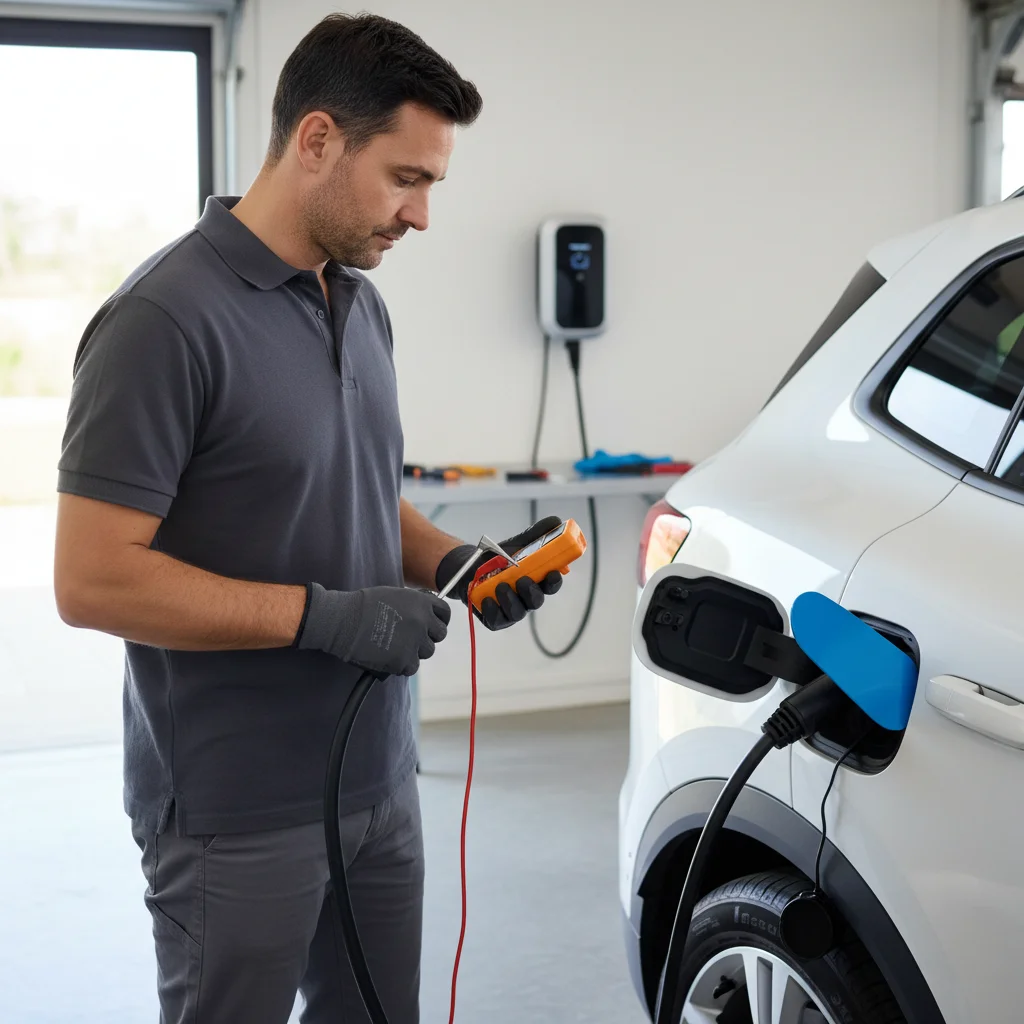
Start with the stall, not the pack
The traction pack can still hold miles when the plug does nothing. Public stalls fail for reasons that have nothing to do with GM. A connected screen still isn’t a live session. Start at the stall before you blame the Equinox EV. Walk the cable, the stall screen, and a second stall on site.
Work the connected-but-dead stall next. Public charger says connected but will not charge
What a dead session looks like on this car
You seat the handle and the Equinox EV cluster never commits. The port light never settles into a steady state. The myChevrolet app sits on charging not started. Or the session starts, then dies in under a minute.
GM’s Ultium system watches the handshake before it closes the high-voltage path. Pilot signal, inlet temperature, and contactor status all have to land. When one check fails, the car locks out the session. That can look like hardware when it’s only a refused handshake.
The Equinox EV shares that Ultium platform with the Blazer EV. Stall refusals and 12-volt charging blocks show up on both.
Try a second stall, then a second network
One dead pedestal isn’t the whole charging site. If another stall on the same island is free, move. Handshake mismatches happen between a charger brand and an Ultium car. The neighbor stall is a faster test than a dealer ticket.
Your Equinox EV isn’t a Tesla, so confirm the plug first. The stall needs CCS or NACS listed for GM before you wait on it. EVgo operates 24 sites across Colorado. Electrify America adds DC fast coverage across the metro. Tesla Superchargers sit at Park Meadows in Lone Tree, plus Highlands Ranch, Castle Rock, Lakewood, and Idaho Springs. Confirm in the app whether that post will take an Equinox EV. If the app doesn’t list GM, move on.
Pull a charging app before you pick a single post. Charging apps to check before you’re stranded on a metro freeway
If you’re already on the shoulder
Get onto the outside shoulder on I-25, I-70, I-225, or C-470. Put the hazard lights on and stay put. Colorado’s disabled-vehicle rule is CRS 42-4-1202. You may sit on the shoulder when the car can’t be moved off the pavement. Keep the hazards on under CRS 42-4-230.
CDOT Safety Patrol can jump a 12-volt or change a tire on covered freeway segments. It doesn’t bring a charge to an EV. CDOT’s breakdown pages say nothing about electric vehicles or mobile charging. Front Range hours are 6:00 to 9:30 a.m. and 2:30 to 7:00 p.m. on weekdays. Weekend hours run from 10:00 a.m. to 7:00 p.m. Coverage includes I-25 South from 120th Ave to Arapahoe Rd. It also includes I-70 East from Wadsworth to Airport Blvd. Portions of US-6, C-470, and I-225 are covered too.
The I-70 Mountain Corridor patrol runs Morrison to Vail, with its own published hours. COtrip.org and the 511 line carry live I-70 closures and traction-law status. Traction law activates by signage and COtrip.
On E-470, pull to the shoulder and dial *470. E-470’s patrol handles flats, jump-starts, fluids, and debris. It isn’t an EV charging truck.
I-25 North and US-36 Express Lanes have a minimum 8-foot outside shoulder. Move to that right-side shoulder if you stall in those lanes. Colorado doesn’t have a separate statute for a disabled EV. The same shoulder rules apply as any other car.
Power-cycle the Equinox EV if the stall looks fine
If two stalls fail the same way, look at the car. Unplug the handle all the way from the inlet. Lock with the key fob, not the door button. Give the modules a few minutes to sleep. Unlock, open the driver’s door, and let the cluster finish waking. Stay off the brake until the screens come up. Get out, lock again, and wait a couple of minutes. Then try a different stall if one is open.
That cycle clears a stuck software state on many Ultium cars. It isn’t a hardware repair. A Chevrolet dealer can check for a charging update if the car is behind.
Check the port before you blame the software
The Equinox EV charge door is motor-driven. A weak 12-volt can stop that door from opening or releasing the handle. Look in the inlet with a flashlight first. Packed snow and road grit sit in Front Range ports all winter. Denver’s January normal low sits around 18 degrees. Melt that refreezes in the latch will fool a session. Dry the inlet before you plug in again.
EV charge port won’t release: free a stuck cable in the cold
If the connector won’t click, don’t force it. If it latched and the session died fast, let the inlet rest before a retry. A frozen latch after a storm is the usual Front Range version of this. January 2024 dropped Denver from 47 degrees to minus 19 in about two days. A port that worked in the afternoon can refuse the same stall the next morning. Recheck ice in the latch before you assume the pedestal died.
A weak 12-volt can block charging with miles still on the dash
This is the trap that strands Equinox EV owners. The 12-volt runs the modules that talk to the stall. It also powers the relay that ties the pack to the inlet. A full traction pack does nothing if that 12-volt is dead.
Dim cluster lights and a short fob range are the early tells. A charge door that ignores the button fits the same pattern. A car that sat a week in a DEN lot can wake this way. Denver International is reached only by Peña Boulevard. That road is an 11-plus-mile city-maintained freeway across open plains. Stall counts in the airport garages aren’t confirmed here. A 12-volt can still die in a cold lot while the pack holds charge.
Pop the hood and use the labeled 12-volt jump points. CDOT patrol can jump a 12-volt on the covered freeway hours. They still won’t charge the pack.
Chevy Equinox EV won’t start: the 12-volt checks to run first
If the stall is dead, a mobile Level 2 charge still moves you
You don’t need a flatbed just to reach the next working post. Charge Pro DEN is a referral line. We match stranded Equinox EV drivers with independent local mobile rescue operators. The brand doesn’t own trucks, and it doesn’t set the price. The operator quotes you before any work starts, then bills you directly. The pros we connect you with are licensed and insured.
Those operators bring a 240-volt Level 2 source to the car. They carry a native NACS plug, plus CCS or J1772 adapters for non-Tesla EVs. That covers the Equinox EV in front of them. Typical on-site charging adds about 10 to 20 miles of range. That’s 15 to 30 minutes of charging time, never an arrival time. They can also jump or replace a dead 12-volt on site.
What a mobile EV charger actually brings to a stranded car
When a roadside Level 2 charger is the right call
Where this happens along the Front Range
After a long sit at Park Meadows in Lone Tree, the garage stall can refuse the car. Try a second pedestal before you assume you need a tow. The Denver Tech Center in Greenwood Village has the same after-work pattern. Cold soaks the 12-volt while you sit in meetings. Then the public stall in the garage never handshakes.
North along I-25 toward Thornton, Northglenn, and Westminster, United Power and Xcel split streets. That split matters for a home charger bill. It doesn’t revive a dead public stall. Confirm your utility by address if the overnight plug at home is the real miss. Broomfield is its own city and county, carved out in 2001. Brighton is on United Power for electricity. Longmont billing goes to Longmont Power and Communications, not Xcel.
South of the city, CORE Electric Cooperative serves Highlands Ranch, Lone Tree, Parker, Castle Rock, and Castle Pines. Don’t call Xcel from those driveways. CORE’s residential COREV Charge program is at capacity and closed to new applications. A public stall that won’t start is still a stall problem.
West toward Lakewood, Wheat Ridge, and Golden, the lots sit colder than the core. Golden sits around 5,675 feet. Denver’s marker is 5,280 feet on the west steps of the Colorado State Capitol. Recurrent Auto’s winter study found EVs keep about 78 percent of max range at 32 degrees, on average. At 20 degrees that average sits near 70 percent. Plan the stall stop with that cut in mind. Don’t sit on a dead post hoping the miles come back.
On I-70 west, the Idaho Springs Supercharger is a named site on the Denver side of the Eisenhower-Johnson Memorial Tunnel. Confirm whether that post will accept an Equinox EV. If it won’t start, a mobile Level 2 charge adds miles in place. Red Rocks Amphitheatre in Morrison is another cold sit after a show.
Overnight Level 1 at home is a different miss. The car can look fine at 10 p.m. and still wake short. That’s a house-circuit or 12-volt story, not a public-stall story. Match the utility to the street before you blame Ultium for a quiet overnight cutoff.
If the stall still won’t start after those checks, call Charge Pro DEN at (720) 738-6950. Tell the coordinator what the cluster and the port light are doing. They match you with an independent operator. That operator quotes before work starts.
Why does a Chevy Equinox EV refuse a public stall?
The cluster message usually means the car declined the session. It doesn’t mean the pack is empty. A dead pedestal, a handshake mismatch, a frozen latch, or a weak 12-volt can all look the same. Move to a second stall, then power-cycle the car. If two networks fail the same way, treat it as the car or the 12-volt.
Can a dead 12-volt stop an Equinox EV from charging?
Yes, a dead 12-volt can stop charging cold. The 12-volt powers the modules that open the charge door and talk to the stall. It also closes the relay to the pack. If that battery is dead, the Equinox EV can’t accept a charge even with range on the dash. Jump it at the labeled underhood points. An operator can jump or replace it on site. CDOT Safety Patrol can jump a 12-volt on covered freeway hours. It still won’t charge the pack.
If the public stall is down, can a mobile charge still help?
Yes, a mobile Level 2 source charges the car where it sits. The operators we match you with typically add about 10 to 20 miles of range. That takes 15 to 30 minutes of charging, never an arrival time. It’s enough to leave a dead stall and reach a working post.