The lights cut out on a Castle Pines ridge night. You type battery backup into the search bar. On this Douglas County hill, that phrase usually means the house. CORE Electric Cooperative runs the wires here, not Xcel Energy. Sometimes it means the EV in the garage that won’t ready. Those are different problems, and they go to different people.
Castle Pines sits on CORE, not Xcel
Most metro chatter about home charging names Xcel Energy. That utility covers Denver, Aurora, and much of the core. It doesn’t serve Castle Pines. CORE Electric Cooperative owns this south-metro Douglas County corridor. The same co-op serves Castle Rock, Lone Tree, Parker, Highlands Ranch, and Centennial. A Greenwood Village neighbor on Xcel is on a different map.
CORE’s own EV pages name three programs. COREV Connect still accepts enrollments for members who connect an EV or charger. COREV Charge is CORE’s residential charging program. CORE states it’s at capacity and closed to new applications. COREV Community Charge is the member program at CORE public chargers. This page doesn’t publish credit amounts or member rates. Those figures move. Read the live terms on core.coop before you enroll.
If you still have an Xcel rebate name in a browser tab, close it. Castle Pines billing and EV programs run through CORE. Who bills a home plug can differ street by street. Read who bills a Tesla charge in the Denver metro.
Three searches hiding under one phrase
Battery backup Castle Pines can mean a wall unit that keeps circuits alive. It can mean solar storage that holds daytime power for evening loads. It can also mean a car that won’t move. The housing stock here is almost all new. Only 3.7 percent of homes were built before 1980. Driveways in Castle Pines Village and The Canyons often already have a plug. Castle Pines North and Lagae Ranch look the same. That plug doesn’t help if the co-op feed is down. It also doesn’t help if the car is empty on I-25.
People here commute north toward the Denver Tech Center. They also run south over the ridge toward Castle Rock. Castle Pines Parkway, Monarch Boulevard, and Happy Canyon Road feed those trips. The ground sits near 6,300 feet and climbs toward the Palmer Divide. Cold and elevation both tax range. Recurrent Auto found EVs keep about 78 percent of range at 32 degrees. At 20 degrees that average falls to about 70 percent. An AAA dynamometer study reported about 39 percent range loss at 20 degrees. A January 2024 arctic blast dropped Denver from 47 to minus 19. That swing happened in about two days. A car that sat through that night can look dead. More than one battery may have failed.
Home storage is a licensed electrical job
A home battery is a fixed install on the panel. It stores power from solar, from the grid, or from both. When CORE’s feed drops, it can carry lights and a fridge. Brand names you’ll hear include Tesla Powerwall, Enphase, and Generac. Sizing, permits, and interconnection are the installer’s work, not ours.
Charge Pro DEN doesn’t install home batteries. We don’t pull permits in Douglas County. We don’t work on CORE member panels. We don’t quote solar-plus-storage. That work belongs to a licensed electrician or a solar shop. Confirm the current Colorado electrical license before anyone opens the panel. A statewide lookup URL wasn’t verified for this page. Start with the state’s professional licensing search, then ask CORE about interconnection.
Highlands Ranch sits on the same co-op. The same house-versus-car split shows up there. Read home battery backup or a mobile EV charge in Highlands Ranch.
When the house is dark and the car is in the garage
An outage on this ridge can leave a Level 2 charger quiet. The wall unit needs grid power, or storage wired to feed it. Many home batteries are sized for lights and a fridge. They’re often not sized for a long EV charge. Ask the installer which circuits the battery actually covers. Don’t assume the garage charger is on that list.
Colorado law does speak to HOA charging access. CRS 38-33.3-106.8 covers charging-access rights in HOA communities. It doesn’t size your battery. It doesn’t keep CORE’s lines up. Castle Pines Village and other HOA pockets may have their own architectural rules. Confirm those with the association. Don’t treat a blog as the covenant.
If the car still has range, call an electrician for the house. If the car won’t ready, keep reading. Those aren’t the same call.
Empty on I-25 is a different kind of backup
The other search is the car itself. You came off I-25 at Castle Pines Parkway. The estimated miles were wrong after a cold run toward the Tech Center. Or you sat at the Castle Pines golf courses, then the car wouldn’t wake. Or a Daniels Park stop ran longer than the display liked. Ridgeline Open Space is a fine walk. It’s a poor place to discover you’re at zero.
Named public DC sites sit on this south spine. The inventory lists a 10-stall Tesla Supercharger at Lone Tree’s Park Meadows. There’s also a 16-stall site in Castle Rock. This page doesn’t guess a distance from your driveway to either one. Open a charging app and read the live status. If you can’t reach a stall, you need a charge at the bumper.
Charge Pro DEN is a referral line. We match stranded EV drivers with independent local mobile rescue operators. We don’t own trucks. We don’t employ technicians. We don’t set the price. The operator quotes you before starting and bills you directly. Distance, time of day, and miles needed all move the quote. Nobody here promises an arrival window.
Castle Pines roadside steps live in luxury EV stranded in Castle Pines. For the hardware, see mobile EV charging.
A 12-volt death is not an empty pack
Plenty of dead-EV calls on this ridge are the small battery. The 12-volt runs computers, latches, and the ready sequence. The big pack can still hold miles. Cold-soak after travel is a common Castle Pines pattern. The car sat in the garage after a trip. In the morning it won’t unlock. That’s often a 12-volt job, a jump or an on-site replacement. It’s not a pack fill.
CDOT Safety Patrol will jump a 12-volt and change a tire on published freeway segments. Its pages mention nothing about charging an EV. The published I-25 South patrol segment runs from 120th Avenue to Arapahoe Road. That listed stretch sits north of this ridge. Confirm with CDOT whether a patrol truck covers your mile. Don’t wait on a charge that program doesn’t offer.
If you’re on the shoulder, CRS 42-4-1202 is the disabled-vehicle rule. Outside a business or residential district, stay off the travel lanes. You may stay only if the car truly can’t move. Hazards go on under CRS 42-4-230. There’s no Colorado statute that carves out a disabled EV. The same shoulder rules apply. Colorado State Patrol handles crashes and abandoned-vehicle calls under CRS 42-4-1803. That statute uses officer discretion, not a posted hour count.
What the operator brings to the bumper
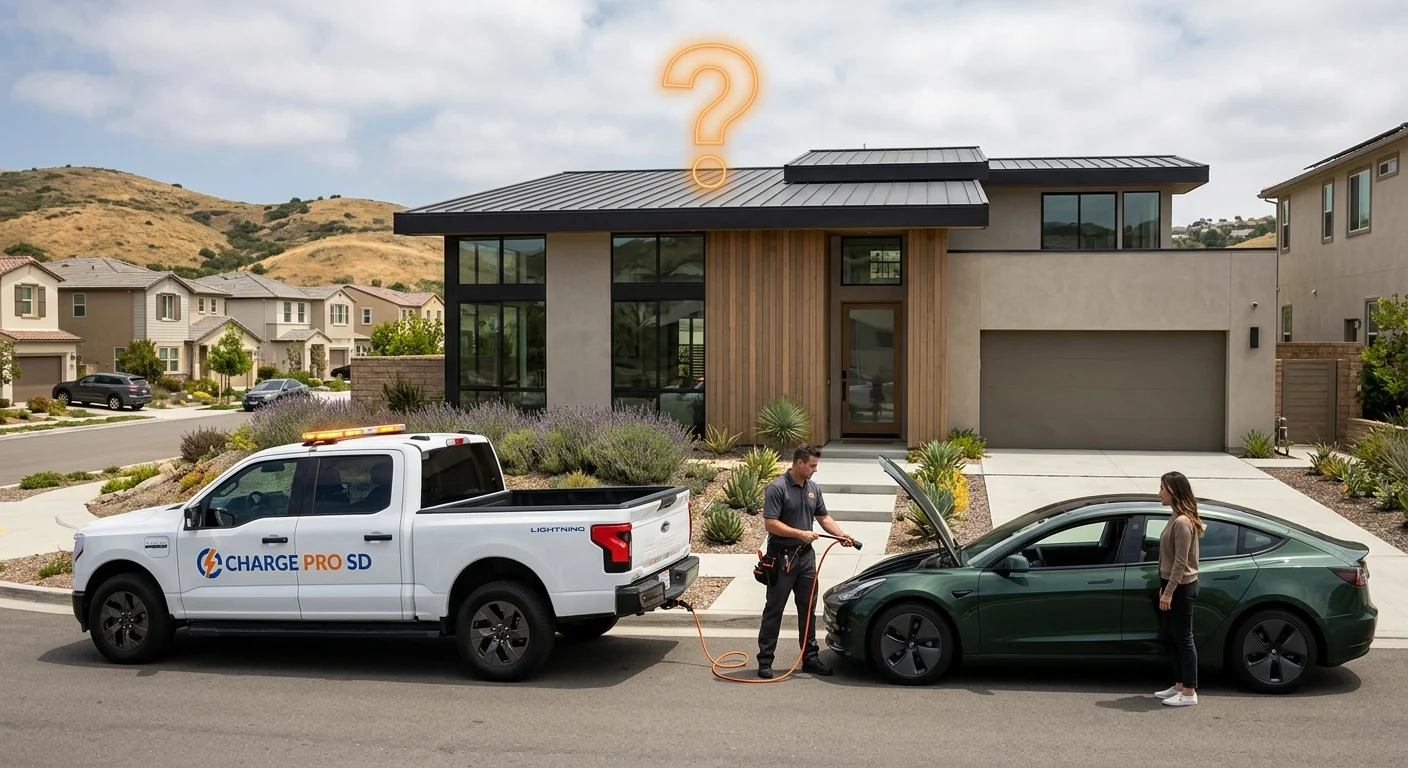
The pros we send bring a 240-volt Level 2 source to the car. Tesla drivers get a native NACS plug. Non-Tesla EVs use a CCS or J1772 adapter. Typical charging adds 10 to 20 miles in 15 to 30 minutes. That’s charging time, never an arrival time. They can also jump or replace a dead 12-volt on site. They handle Tesla and every major EV brand.
A flatbed is a last resort when the car can’t take a charge. Towing a disabled EV has its own steps. Read what towing a dead EV in Colorado actually involves. Most I-25 shoulder stops here want a charge in place. A wrecker isn’t the first tool.
Wall charger versus a roadside boost is a separate read. Read home 240-volt charging versus a roadside charge in Denver.
Pick the call by what actually failed
Lights out, fridge warming, and the EV still shows range: call an electrician. Ask CORE about the outage and about interconnection if you want storage. Don’t call a mobile EV operator to power a house.
Car silent in the garage after a cold soak: check the 12-volt first. If doors won’t unlatch and the screen is dark, start there. A home charger won’t wake a 12-volt that has dropped out.
Car awake and pack at zero is a mobile-charge job. That includes Castle Pines Parkway and the I-25 shoulder. The operator quotes before any cable goes in. You pay that operator, not Charge Pro DEN.
The city hub for this ridge is EV charging in Castle Pines.
When the car is the problem, call (720) 738-6950. We connect you with a local operator. We don’t promise when they arrive. We don’t perform the work. They quote you first, then they charge the car or jump the 12-volt.