EV roadside assistance in Castle Pines isn’t a hunt for a driveway plug. Most houses here already charge overnight on a 240-volt circuit. The luxury EV that won’t move is usually empty on I-25. Or it’s a 12-volt that failed after a cold soak. A mobile charge or an on-site jump is the first useful call. A flatbed is the backup, not the opening move.
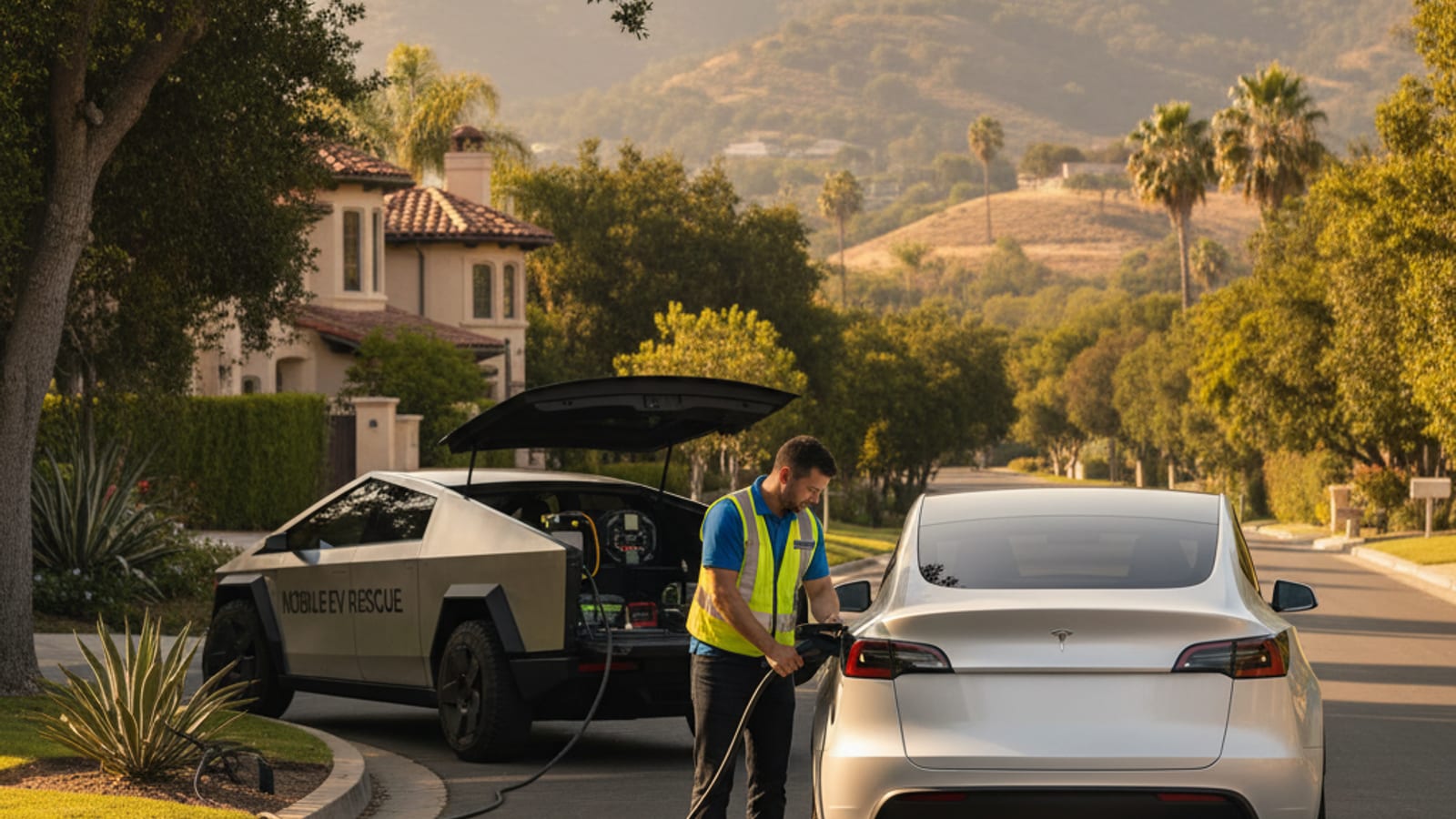
Home charging is the baseline on this I-25 ridge
Castle Pines sits in Douglas County on the interstate spine. It occupies the high ground between Lone Tree and Castle Rock. Elevation is about 6,300 feet, and the land still climbs toward the Palmer Divide. The Census 2024 population estimate is 15,162. ACS puts the five-year count at 12,573. Land area is about 9.6 square miles. Only 3.7 percent of the housing stock predates 1980. That last figure is the charging story. New construction put wall connectors in the garage. CORE Electric Cooperative serves the city, not Xcel.
You aren’t fighting street parking for a public stall. You aren’t begging an HOA for a plug in most of these tracts. You’re fighting the commute and the cold. Castle Pines Village, The Canyons, Castle Pines North, and Lagae Ranch are built around that home-charge habit. ZIP codes 80108 and 80134 cover the city. If the wall unit went dark in a storm, that’s a house problem. We already wrote that split in Castle Pines lost power: home battery, CORE, or a charge to the car. This page is for the car that left, or that won’t wake at all.
CORE runs this city, so skip the Xcel script
Don’t call Xcel from a Castle Pines driveway. CORE owns the south-metro Douglas corridor, including Highlands Ranch, Lone Tree, Parker, Castle Rock, Centennial, and this ridge. CORE publishes COREV Connect for members who enroll an EV or a charger. It also publishes COREV Charge, and that residential program is at capacity and closed to new applications. COREV Community Charge is the member rate at CORE’s public chargers. Confirm enrollment and status on CORE’s own EV pages. Charge Pro DEN doesn’t set utility rates, and we don’t install home equipment. We match you with a mobile operator when the car is already stuck.
Named roads, golf, and open space on the ridge
Castle Pines Parkway, Monarch Boulevard, and Happy Canyon Road are the local spines. I-25 is the road that empties a pack. Northbound you’re aimed at the Denver Tech Center in Greenwood Village and Centennial. Southbound you climb toward Castle Rock and the Palmer Divide. Park Meadows in Lone Tree is the shopping landmark just north of town. The Castle Pines golf course and the Country Club golf course sit in the trees. Daniels Park holds bison and an overlook nearby. Ridgeline Open Space is the trail system residents already use. None of that changes winter physics. Cold at 6,300 feet plus a freeway grade eats the buffer you thought you had.
Two failures, not a dozen, strand luxury EVs here
A Lucid Air, a Porsche Taycan, a Mercedes EQS, a Rivian, or a Tesla fails the same two ways on this ridge. The traction pack hits a number the car won’t leave the shoulder with. Or the small 12-volt battery won’t wake the computers. Those are different jobs. Mixing them up is how you get a tow you didn’t need. EV roadside assistance in Castle Pines starts by sorting which one you have.
Empty pack on I-25, after a garage that did its job
You left with what looked like enough range. Cabin heat, a ridge headwind, and stop-and-go into the Tech Center spent it. Recurrent Auto studied more than 30,000 U.S. EVs in winter. They found about 78 percent of max range at 32 degrees, and about 70 percent at 20 degrees. Heat-pump cars held about 10 points more at 32 degrees. AAA’s 2026 dynamometer work put range loss near 39 percent at 20 degrees, with about 35.6 percent efficiency loss. Castle Pines sits higher than downtown Denver’s 5,280-foot Capitol step. January 2024 dropped Denver from 47 degrees to minus 19 in about two days. A ridge garage doesn’t dodge that kind of blast.
If you’re already on the shoulder, stay out of the travel lanes. CRS 42-4-1202 lets a disabled vehicle sit on the shoulder when it can’t be moved further. Hazard lights are required under CRS 42-4-230. A violation is a class B traffic infraction. Colorado has no separate statute for a dead EV. The same disabled-vehicle rules apply, with no EV carve-out in the breakdown code. CDOT Safety Patrol will jump a 12-volt and change a tire on the segments it publishes. Its pages say nothing about bringing a charge. Published I-25 South patrol coverage runs from 120th Avenue to Arapahoe Road. Castle Pines sits south of that listed Arapahoe Road end, on the ridge toward Castle Rock. Don’t wait on a patrol that may not be assigned to your mile marker. For the broader interstate playbook, see stranded with no charge on I-25.
Named Superchargers you can plan around include Park Meadows in Lone Tree, listed with 10 stalls. Castle Rock is listed with 16. Highlands Ranch is listed with 16. Centennial is listed with 12. We’re not guessing remaining miles from your pin to any of them. If you can’t reach one, that’s when mobile EV charging is the useful call. The operator brings a 240-volt Level 2 source to the car. Native NACS for Tesla, and a CCS or J1772 adapter for everyone else. Typical add is 10 to 20 miles of range in 15 to 30 minutes of charging. That window is plug time, not a travel estimate.
Northbound empty is a Tech Center and Park Meadows problem. Southbound empty is a Palmer Divide problem. The climb toward Castle Rock spends energy you won’t get back until a later descent. Regen can return a large share on a long downhill, though drivers still cut regen on ice for traction. Don’t treat a southbound I-25 night as a mild-weather test loop.
A 12-volt that won’t wake the car after travel or a soak
You charged at home. The traction pack isn’t empty. The screens are dark, and handles may not release. That’s the 12-volt, the small battery that boots computers, lights, and contactors. Cold-soak after travel is the Castle Pines version. You flew, parked, came back, and the car is a brick in the garage. Or it sat in Castle Pines Village through a Front Range night and won’t ready at dawn.
A jump or an on-site 12-volt replacement is the fix, not a pack tow. Tesla owners hit this enough that we keep a dedicated Tesla 12-volt battery jump page. Lucid, Rivian, Porsche, Mercedes, BMW, Cadillac, and the rest still have that low-voltage system. The operator who reaches you can jump it, and they can replace it on site when that’s the diagnosis. Don’t assume the high-voltage pack failed because the cabin is quiet. If the Tesla app or the other brand’s app still shows miles, and the car is dead, think 12-volt first. If the display was counting down to zero on I-25, think pack. If you’re unsure, say both on the call. If the 12-volt is aged, it can die again after the next cold night, so replacement on site is often the lasting fix.
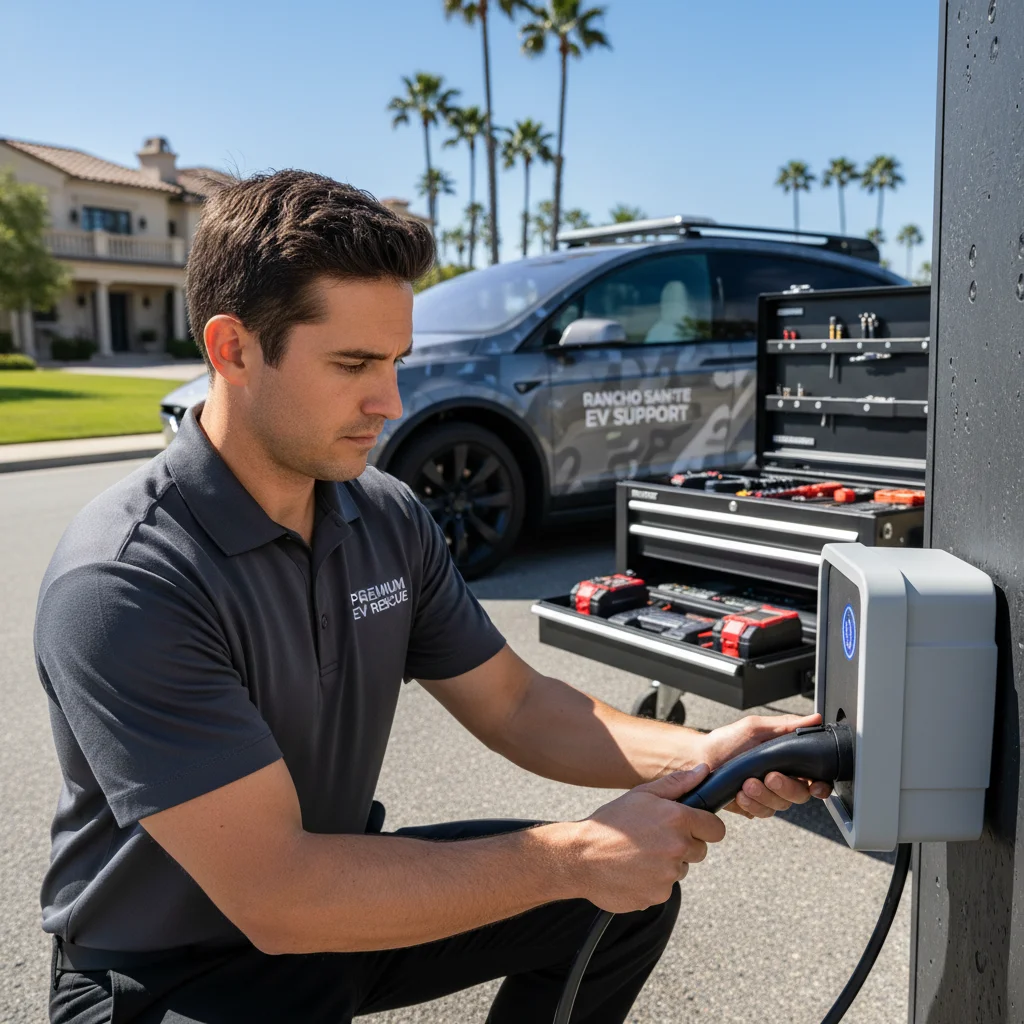
A flatbed is the wrong first move from this driveway
A tow has a place. A bent suspension, a crash, or a car that can’t take a charge still needs a bed. An intact luxury EV that’s empty or dark usually doesn’t. Wrong towing can hurt motors, the pack, or the parking pawl. Many EVs need a flatbed if they must move unpowered. The cleaner path is to put energy into the car where it sits. That’s the point of charge in place versus a tow.
Colorado’s Towing Bill of Rights, HB22-1314, governs nonconsensual tows. It’s about private lots and notice, not your I-25 shoulder. Abandoned-vehicle rules under CRS 42-4-1803 through 1805 don’t run on a published hour clock. An officer decides on reasonable grounds. Don’t invent a wait window. Move the car when you can, or get it charged so you can.
National auto clubs and insurer roadside plans are built around gas cans and jump packs. Many won’t deliver a charge. Tesla roadside, AAA, and insurer add-ons each cover different slices, so read those policies on their own pages before you assume a charger is coming. Charge Pro DEN is a referral line. We don’t run a fleet, and we don’t own a yard. We connect you with independent local operators. Those operators do the work and bill you directly. The pros we connect you with are licensed and insured. The brand isn’t a contractor.
What the operator actually brings, and what moves the quote
The operator quotes you before any cable goes in. What moves that quote is distance to your pin, time of day, and how much range you need to get off the ridge. A Happy Canyon Road driveway is a different dispatch than an I-25 shoulder. A 12-volt jump is a different job than a Level 2 session. Nobody at Charge Pro DEN sets that quote. Confirm it with the operator on the call, before work starts.
Equipment is straightforward: a 240-volt Level 2 source, a native NACS plug, and CCS and J1772 adapters for non-Tesla EVs. Typical sessions add 10 to 20 miles in 15 to 30 minutes of charging. Stay in the car with hazards on if you’re on I-25. If you’re in a neighborhood, stay with the vehicle so the operator can find the gate and the house. They’re there to put enough energy in the car to roll, or to wake a 12-volt so you can drive home or to a stall. If the car still won’t take a charge, that’s when a flatbed earns its keep.
Tesla and every other luxury badge on these streets
Castle Pines Village and Lagae Ranch mix badges. Tesla is common, and so are Rivian trucks, Lucid sedans, the Porsche Taycan, Mercedes EQS and EQE, BMW i models, and Cadillac Lyriq. EV roadside assistance through this network isn’t Tesla-only. Plug type is the hardware split: NACS on one side, CCS or J1772 on the other. The 12-volt job doesn’t care which nameplate is on the hatch. If a tow becomes necessary, say the model, ask for a flatbed, and ask them not to roll drive wheels on the pavement.
What CDOT, COtrip, and a patrol truck can actually do
If you’re on a covered freeway segment during published hours, CDOT Safety Patrol can help with a flat, a 12-volt jump, debris, and incident support. Front Range hours are 6:00 to 9:30 a.m. and 2:30 to 7:00 p.m. on weekdays, and 10:00 a.m. to 7:00 p.m. on weekends. Mountain Corridor hours are a different schedule, and they don’t apply on this I-25 ridge. The patrol pages don’t list EV charging. A jump that wakes a 12-volt is inside their published list. A Level 2 charge to an empty pack isn’t.
COtrip.org and the 511 line are for closures and traction-law status. CDOT activates traction rules by signage and posts them on COtrip. We’re not going to invent a seasonal date range. If storms sit on the Palmer Divide, check COtrip before you commit to I-25 south. Passenger vehicle traction law can require AWD or winter tires with enough tread, and two-wheel-drive cars may need chains or an approved device. Chain law is a stricter step in severe storms. Exact fine amounts belong on CDOT’s own traction-law page, not in this article.
Colorado State Patrol handles crashes, enforcement, and abandoned-vehicle authority, and none of those agencies dispatch a mobile EV charger. No Colorado statute addresses roadside EV charging, so a stranded EV is treated like any other disabled car. E-470 is the eastern toll loop, and it publishes *470 for its own roadside help. Castle Pines sits on I-25, west of that loop. Don’t dial *470 from Castle Pines Parkway and expect an E-470 truck.
Cold, elevation, and the buffer that looked fine at home
Denver’s January normal low sits around 18 degrees. All-time record cold is minus 29, from January 9, 1875. Average annual snowfall in Denver is in the low-to-mid 50s of inches. Castle Pines is higher and more exposed on the ridge. Cabin heat isn’t free. Preconditioning from the wall helps if you’re still plugged in. It doesn’t help once you’ve unplugged and sat through a workday at the Tech Center.
The first miles north on I-25 toward Greenwood Village can spend a morning buffer. Regen on a later descent can give some of that back. Treat regen as real, and still don’t plan a ridge commute on a mild-weather sticker. Watch indicated miles on I-25 the way you’d watch a fuel gauge in a blizzard. Luxury doesn’t cancel elevation.
Colorado crossed 200,000 registered EVs by October 2025, per the Colorado Energy Office. The Denver metro still leads the state in EV share. Battery-electric vehicles were about 12.5 percent of new Denver-metro registrations year-to-date through June 2026, down from 23.7 percent a year earlier. Statewide BEV registrations fell 55.3 percent in the first half of 2026 after the federal credit expired on September 30, 2025. The honest metro picture is about one in eight new cars, not a flood. It’s still enough luxury EVs on this ridge that a dead one is a normal weekday.
Neighbors, gates, and how a referral call works
Lone Tree, Castle Rock, Highlands Ranch, and Parker wrap this city. A stall on the Castle Pines side of the line is still a Castle Pines pin. A stall a mile north may be Lone Tree. Tell the operator the city, the nearest named road, and whether you’re on I-25 or behind a gate. Castle Pines Village and parts of The Canyons aren’t a simple highway pull-off. Stay reachable by phone. Describe the gate, and name the golf course or the open-space trailhead if that helps them find you. Don’t send a gate code in a text you can’t later control. Meet them, or have the HOA process ready.
Charge Pro DEN serves the Denver metro, including this Douglas County ridge. The Castle Pines city page is the local hub. We match stranded drivers with independent mobile rescue operators. We hold no trade license. We employ no technicians. We don’t promise a clock. The operator on the other end quotes the work, does the work, and bills you.
If the wall charger is the actual failure, that’s an electrician and CORE, not a roadside truck. If the car is fine and the pack is empty on the freeway, that’s a mobile charge. If the car is dark with a pack that still showed miles, that’s the 12-volt. Sort that before anyone hooks a winch. A roadside Level 2 session is for enough miles to roll, not for a full pack. Get home to the wall unit, or to a DC fast stall if you still have the range to reach one of the named Superchargers.
What you should have ready when you call
Say the city: Castle Pines. Say the road: I-25, Castle Pines Parkway, Monarch Boulevard, Happy Canyon Road, or a neighborhood name. Say Tesla or not, and the model if you know it. Say whether the screens are on. Say the indicated miles, or that the display is black. Say whether you’re on the shoulder with hazards. That’s enough for an operator to know if this is a Level 2 stop or a 12-volt stop. Don’t pull a quote from a blog and treat it as your bill. Distance, time of day, and needed range change what you’ll hear. The person who shows up with the equipment sets it, and they set it before they start.
Frequently asked questions
What should I do if my luxury EV hits zero on I-25 by Castle Pines?
Hazards on, stay off the travel lanes, and stay with the car if it’s safe. Colorado’s disabled-vehicle rule is CRS 42-4-1202. You may remain on the shoulder when the car can’t be moved, with lights on. CDOT Safety Patrol doesn’t publish an EV charge. Call for a mobile Level 2 charge if you can’t reach a named Supercharger under your own miles. Charge Pro DEN is the referral line that matches you with an operator. The operator quotes you before plugging in.
Why would a Castle Pines EV refuse to start after charging at home?
Home charging fills the traction pack. It doesn’t always keep a weak 12-volt alive through a cold soak. If the screens are dead and the pack still had miles yesterday, ask for a 12-volt jump or replacement. Skip the flatbed as the first call. That pattern is common after travel days and Front Range nights on this ridge.
Can the operators help a Rivian, Lucid, or Porsche, not only a Tesla?
Yes. Operators bring NACS plus CCS and J1772 adapters. Tesla, Rivian, Lucid, Porsche, Mercedes, and the rest of the luxury set on this ridge are in scope. The job is still a charge or a 12-volt service. Tell them the badge and whether the car will wake.
When you need that match in Castle Pines or anywhere in the Denver metro, call Charge Pro DEN at (720) 738-6950. It’s a referral call. The operator who takes the job quotes the work, then bills you directly.