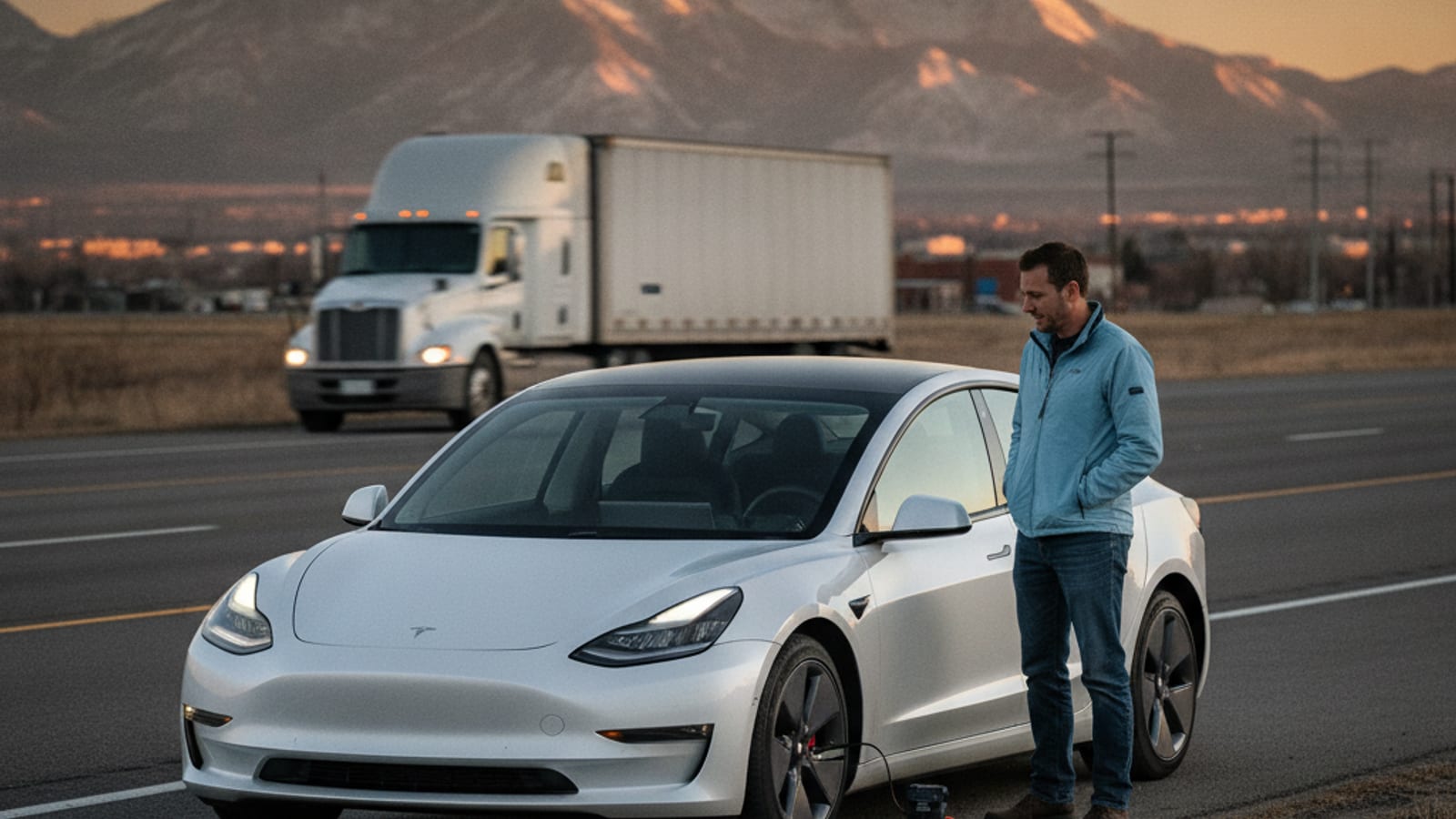
Tesla does not publish a per-model roadside fee menu for the Denver metro. Model 3, Y, S, and X all go through the same Tesla app request path. Out-of-range help may be arranged and is not financially covered. The contractor Tesla sends is independent of Tesla and sets its own price. A local operator in the Denver metro brings 240-volt Level 2 to the car and quotes you before the cable goes in. Call (720) 738-6950 for the referral match.
One app, four model names
Tesla’s published roadside page asks owners to request help in the Tesla app. Model 3, Y, S, and X do not each get a Tesla-stamped price list. They share one request flow, one set of covered categories, and one out-of-warranty treatment. The driver sees a coverage screen in the app. The actual contractor and the actual number come from whoever Tesla dispatches, not from a Tesla-owned truck.
That matters in Denver because the dispatch from any Tesla RSA request usually points at a regional towing or roadside contractor. Sometimes a single contractor covers the whole metro. Sometimes two or three rotate. The contractor’s invoice is not a Tesla menu. It is their own rate sheet, their own trip charges, and their own decision on what equipment rolls.
What Tesla’s own page covers (and what it doesn’t)
Tesla’s captured support language describes a path, not a price list. The categories that show up in coverage screens are the same across Model 3, Y, S, and X:
- Lockout help, when the phone key or key card cannot get in
- A flat tire, where the published path has long been a tow to a tire shop or a loaner wheel
- A 12-volt jump or replacement, with a service call cost on top of any new battery
- Towing, when a warranty defect leaves the car undriveable, billed after the first few miles on a meter basis that varies by contractor
- Out-of-charge help, which Tesla’s page says may be available and is not financially covered
Tesla does not promise a mobile Level 2 charge on the shoulder. Out-of-charge help, when it happens, is usually a flatbed toward a Supercharger or a service center. Drivers who want the car charged where it sits need a separate call.
Why there is no “Model 3 price” and “Model X price”
Tesla does not publish a verified per-model roadside fee for any of the four models in 2026. Public screenshots are not a rate sheet. Forum quotes are not a rate sheet. The fee, if anyone bills you, comes from the contractor who shows up. A contractor may charge differently for a Model S than a Model 3 because the wheel and tire sizes differ, because the tow sling setup takes longer, or because the contractor’s own dispatch rules put S and X on a different truck. None of that is a Tesla policy. It is one contractor’s practice.
The same logic holds for the 12-volt system. Tesla’s current Model Y jump procedure describes a lithium-ion low-voltage battery. Older Model S and Model X vehicles still ship with lead-acid 12-volt batteries. The contractor’s jump gear and the battery part itself differ. None of that is published as a Tesla menu either.
Read Tesla roadside, CDOT, or local boost for the call order on a Denver metro shoulder, and Tesla roadside, in plain terms for the policy in 2026.
The contractor, not a Tesla van
Every Tesla RSA dispatch in Colorado routes through a contracted towing or roadside vendor. The contractor owns the truck, owns the lift, owns the invoice, and answers the phone. Tesla does not pay for the dispatch. The contractor’s invoice is what you pay out of warranty, after the contractor hands you a receipt.
This is the same in Boulder County as in Douglas County, and the same on I-25 as on US-36. Tesla’s coverage screen decides whether the call counts as warranty or as owner-pay. The contractor decides how much to bill once they roll. There is no per-model Tesla fee because Tesla does not run the trucks.
Where the metro’s free state option fits
CDOT Safety Patrol covers parts of I-25 South, I-70 East, US-6, C-470, and I-225 during published hours. The Mountain Corridor runs Morrison to Vail Friday through Sunday and during significant weather. Safety Patrol jumps a 12-volt on a covered shoulder. It changes a flat. It does not put energy into a traction pack. CDOT’s own pages do not mention EV charging.
That means for a Tesla in the Denver metro, the cost picture splits into three buckets:
- Inside warranty, on a covered freeway, during patrol hours: Safety Patrol is the free path for a 12-volt or a tire. Out-of-charge help still goes through Tesla’s app.
- Inside warranty, anywhere else, or out of warranty on a covered segment: Tesla RSA dispatches a contractor. You pay the contractor after the coverage screen signs off.
- Out of warranty, no contractor bill in sight, and the pack is the problem: a local operator is the third call. The operator brings a 240-volt Level 2 source, quotes you first, and bills you directly.
What a local operator brings to a Tesla on a shoulder
Charge Pro DEN is a referral line for stranded EV drivers in the Denver metro. We do not own trucks. We do not employ technicians. We do not set prices. We match you with an independent local operator. That operator quotes you before any cable goes in and bills you directly for the work.
The kit is a 240-volt Level 2 source. Tesla drivers get a native NACS plug on the lead. Other EVs use a CCS or J1772 adapter. Typical charging time adds about 10 to 20 miles of range. That happens in 15 to 30 minutes of charging time once the cable is in. The clock starts when charging starts. It is not an arrival time. The operators we refer handle Tesla and every major EV brand.
For the broader choice between a charge in place and a flatbed tow, read Mobile EV charging. For a 12-volt call where you already know the small battery is the problem, see Tesla 12-volt jump. For the path that puts range back in the pack and lets you drive away, see Out-of-charge recovery.
What each Tesla model actually changes at the shoulder
Model 3, Model Y, Model S, and Model X all use the Tesla app to request help. Beyond that, the differences that matter at the shoulder are vehicle-specific, not Tesla-policy-specific.
A Model Y with no hood power is a real case. Tesla’s published Model Y jump procedure says the wires behind the tow-eye cover only unlatch the hood. They do not charge the low-voltage battery. A contractor who does not know that can waste time on the wrong cover. Tesla’s app prompt, when read carefully, names the right access point for that year.
A Model 3 with a lithium 12-volt battery (newer builds) holds voltage differently than a Model S with a lead-acid 12-volt. The contractor’s jump gear and time on site differ. None of that is in a Tesla menu.
A Model X with a falcon-wing door that will not latch is a separate question from a charge or a jump. Tesla’s app screens that request under a different category, and the contractor response varies by model and year. Confirm the screen label in the app before you tap it.
For a per-model 12-volt read on cold-soak no-wake, Tesla 12-volt dead after Denver cold walks through the symptoms.
When the contractor bill is the only bill
If the call is a warranty-covered defect and Tesla’s coverage screen signs off, the contractor is paid by Tesla’s roadside program. The driver sees a confirmation, not an invoice. That covers a tow to a service center for a covered defect, a covered flat, or a covered 12-volt failure inside the warranty window.
If the coverage screen declines, the contractor hands the driver a quote and a credit-card reader. Tesla’s app shows a price estimate on some screens, but the contractor’s own rate sheet governs. Out-of-charge help almost always lands on the driver-pay side.
CRS 42-4-1202 is the Colorado shoulder rule. It is lawful to be stuck on the shoulder if the car could not be moved further, with hazards on under CRS 42-4-230. The contractor arrival, the Tesla RSA truck, and the local operator all need that shoulder access to do the work. A violation is a class B traffic infraction.
How to read the coverage screen
Open the Tesla app before you need it. Confirm your car shows on the home screen. Tap the roadside section. Read which categories are covered for your VIN and year. Note the warranty end date. Then close the app and save the screen for the day you actually need it.
The coverage screen is the only document that decides whether Tesla pays the contractor or you do. Forum screenshots, owner’s-club posts, and dealership stories are not a coverage screen. Read the screen your car actually shows.
If the screen says out-of-charge help may be arranged and is not financially covered, plan a second number for a Level 2 source. That second number is (720) 738-6950. The operators we refer quote you before they start, and they bring the 240-volt source that Tesla does not promise on the shoulder.
What this means for a Denver metro stall
A Tesla that will not ready on the shoulder of I-25 near the Tech Center, or on US-36 west of Broomfield, or on C-470 near Ken Caryl, is in the same contractor network. The cost is not a Tesla menu. It is whatever the contractor bills after the coverage screen signs off.
Cold makes the same stall more likely. Recurrent Auto’s winter range study of more than 30,000 U.S. EVs found cars keep about 70% of max range at 20 degrees, on average. Denver’s January normal low sits near 18 degrees. The January 2024 arctic blast dropped the city from 47 to minus 19 in about 48 hours. A marginal 12-volt dies in that cold. The traction pack may still hold plenty of range. That is a jump, not an out-of-charge tow.
If the pack is at zero and you want to drive away under your own power, call (720) 738-6950. Charge Pro DEN will connect you with an independent operator in the Denver metro. The operator quotes first. Typical charging adds 10 to 20 miles in 15 to 30 minutes of charging time. That figure is charging time. It is not an arrival time.
Frequently asked questions
Does Tesla roadside cost the same for every model?
No. Tesla’s published support page does not list a per-model fee menu. Model 3, Y, S, and X share one request path. The actual bill, if anyone bills you, comes from the contractor Tesla dispatches. A contractor may charge differently by model because the equipment or the time on site differs. None of that is a Tesla policy.
What does Tesla roadside include during the warranty window?
Inside the Basic Vehicle Limited Warranty (typically four years or 50,000 miles), Tesla commonly covers lockout help, a flat tire, a 12-volt jump or replacement, and a tow for a warranty-covered defect. Out-of-charge help may be available and is not financially covered. Confirm the coverage screen for your VIN and year.
Will Tesla send a charger to a dead Tesla in the metro?
Tesla’s captured page does not promise a mobile Level 2 charger on the shoulder. Out-of-charge help, when arranged, is usually a flatbed to a Supercharger or service center. A local operator is the path that brings a 240-volt Level 2 source to the car in place. The operators we refer quote before they start and bill you directly.
Where do Tesla roadside contractors tow a metro Tesla?
Named Tesla Superchargers in the metro include sites in Denver, Lakewood, Thornton, Northglenn, Westminster, Arvada, Brighton, Longmont, Boulder, Lone Tree/Park Meadows, Centennial, Highlands Ranch, and Castle Rock. On I-70 west, Idaho Springs is the last Supercharger before the Eisenhower-Johnson Memorial Tunnel from the Denver side. Georgetown shows no Supercharger in the current inventory. The contractor chooses the destination based on the screen, the time, and the contractor’s own routing rules.