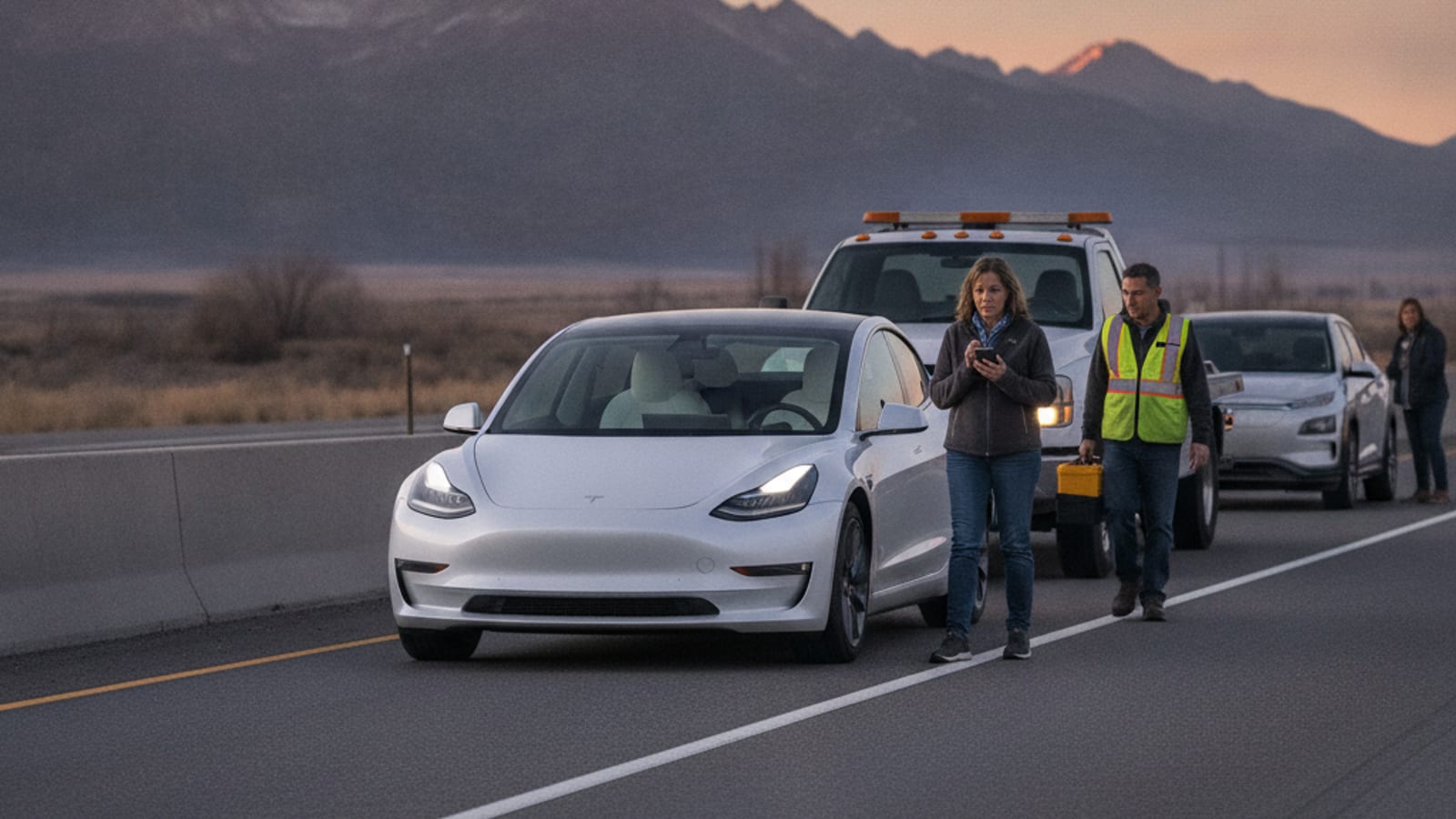
Tesla roadside assistance policy in 2026, in plain terms, does one job. It dispatches a contractor who will jump your 12-volt or tow you to the nearest charger. The policy does not bring a 240-volt Level 2 mobile charge to a stranded car on a metro shoulder. That gap is what an empty pack on I-70, a dead car after a cold DEN lot, a Tesla at zero in Lakewood all live in. For a stranded driver in the Denver metro, (720) 738-6950 connects you to an independent local operator who quotes before any cable goes in.
What the policy is, in plain terms
Tesla roadside assistance, usually called Tesla RSA, is a service bundled with a new Tesla for a set window after delivery. After that window, RSA may continue under an extended service agreement, depending on the model year and the plan a driver purchased. Confirm your status in the Tesla app before you wait on a truck.
For most calls, Tesla dispatches a contractor rather than a Tesla employee. The truck that arrives carries the brand of a third-party operator, not a Tesla logo. That detail matters in the metro. The contractor’s job list comes from Tesla’s script, not from the operator’s own menu. The script is narrower than most drivers assume.
The 2026 policy language around out-of-charge calls is plain on this. Out-of-range assistance may be available, but it is not financially covered. The translation is plain. If your pack ran down on the I-70 climb or on a long US-36 commute, RSA may decline to send a charger, may offer a tow instead, or may dispatch help you pay for out of pocket. The app is where you read that detail for the specific VIN and year.
What the script typically covers
The script RSA runs through a contractor covers a familiar roadside list. A 12-volt jump when the car will not wake. A tow to the nearest charger or service center, your choice, within the published towing radius. Lockout help when a Tesla will not present the handles. A flat tire change in some cases. Incident support if the car is damaged but movable. These are the calls a driver expects to see offered in the app.
A 12-volt jump is the RSA call that fits the metro’s most common no-wake pattern. A Tesla parked at Park Meadows in Lone Tree through a weekend. An EV that sat through a work shift at the Denver Tech Center in Greenwood Village. A cold-soak week in a DEN lot in January. The traction pack can hold plenty of range while the 12-volt, the small battery that runs the computers, contactors and door locks, dies first. RSA sends a jump for that.
A tow covers the move. If the car cannot roll under its own power, RSA arranges a flatbed to a Tesla service center or a Supercharger site. The tow sits inside the included window for most newer cars.
What the policy stops covering
Tesla’s own 2026 program language around out-of-charge calls is the gap that hits Denver drivers hardest. Out-of-range assistance may be available, but it is not financially covered. The translation is plain. If the pack ran down on the climb toward the Eisenhower-Johnson Memorial Tunnel or on a long US-36 commute, RSA may decline to send a charger, may offer a tow instead, or may dispatch help the driver pays for out of pocket.
A Level 2 charge on the shoulder is a different job. RSA contractors typically do not arrive with a 240-volt mobile source. The contract with Tesla does not ask them to. The included job is to move the car to a place that can charge it, not to add range where the car sits. If you were hoping for a top-up at the spot, that is the gap a local operator fills.
Mountain corridor work is the next layer. Idaho Springs sits at 7,526 feet and is the last Tesla Supercharger before I-70 climbs roughly 3,600 vertical feet to the Eisenhower-Johnson Memorial Tunnel at 11,158 feet. Georgetown, in between, shows no Supercharger in the current inventory. A driver who misjudged the climb past Idaho Springs in a storm is past the point RSA can help with a charge. A contractor tow off the corridor is a longer job than a metro tow.
CDOT Safety Patrol is free, will not bring a charge
CDOT Safety Patrol runs a free program on listed Front Range freeway segments. I-25 South from 120th Avenue to Arapahoe Road. I-70 East from Wadsworth to Airport Boulevard. Portions of US-6, C-470, and I-225. Plus the I-70 Mountain Corridor from Morrison to Vail. The published menu is flat tires, jumps, fuel, debris, and minor mechanical help. The Safety Patrol page does not mention electric vehicles. CDOT’s own breakdown page is silent on EV charging. So a free state truck can wake a 12-volt on a covered segment. It will not charge the traction pack.
Hours on CDOT’s site are limited. Front Range weekday windows are 6:00 to 9:30 a.m., with a second afternoon window 2:30 to 7:00 p.m. Weekend windows run 10:00 a.m. to 7:00 p.m. Mountain Corridor hours run 6:00 a.m. to 7:00 p.m. Friday through Sunday and during significant weather. A driver who stalls at 11 p.m. on a weekday is past the published shift.
E-470 is its own thing. The eastern toll loop is all-electronic and cashless. Dial *470 for E-470’s own roadside service (flat tires, fluid top-offs, jump-starts, phone help, debris removal) or *CSP, which is *277, for Colorado State Patrol. E-470 does not publish an EV charging service either.
Why an empty pack on the metro is a local charge, not a Tesla tow
This is the practical version of the question. An empty pack on I-70 west of Golden is rarely a Tesla roadside case. The car needs a 240-volt Level 2 source with a NACS plug at the bumper. That is a different job than a tow to a Supercharger. The local operator who shows up is the operator you hired directly, not a Tesla contractor.
The same is true on the eastern plains. I-70 and Peña Boulevard run out into exposed country east of Watkins and Bennett, and a low charge heading toward the airport is its own category of call. RSA does not publish a service that follows you down the plains with a generator. Local mobile operators do. So does the out-of-charge recovery referral pattern.
For drivers in Lakewood heading out on a cold morning, in Aurora climbing back from the airport, in Evergreen coming down SH-74 in the dark, the same rule applies. The car is below the tow threshold. The pack is below the drive threshold. The mobile charge is the right tool.
How to confirm what your Tesla will cover in 2026
Open the Tesla app and read what it offers for your VIN and year. The app is where Tesla publishes the included window and any extended service agreement. The contractor script is the same regardless. A 12-volt jump, a tow within the published radius, a lockout assist, a flat tire change in some cases. Anything that asks the contractor to bring a 240-volt source to the car is outside the script. Out-of-range help may be dispatched, but the published policy says it is not financially covered.
If the car is in a travel lane or another dangerous place, the right number is 911. A disabled car on a Colorado shoulder is permitted under CRS 42-4-1202 when the car could not be moved further and hazards are on. Colorado is a one-party-consent state for recording under CRS 18-9-303, which is materially different from California’s all-party rule. That detail matters when a driver calls an OEM roadside line and wants to record the dispatch.
For a longer coverage comparison, read Tesla, AAA, and a local mobile rescue. That post stays on who covers which script. This one stays on the 2026 policy itself.
What an independent operator actually brings
Charge Pro DEN is a referral line for stranded drivers. We don’t own trucks. We don’t employ technicians. We don’t set prices. We match you with an independent local operator. That operator quotes you before any cable goes in. They bill you directly for the work they do.
The kit is a 240-volt Level 2 source. Tesla drivers get a native NACS plug on the lead. Other EVs use a CCS or J1772 adapter. Typical charging time adds about 10 to 20 miles. That add happens in 15 to 30 minutes of charging. The clock starts when charging starts, not before. It’s not an arrival time, and we don’t promise one.
Those miles let you drive under your own power. You’re not waiting on a public stall from a flatbed. For an empty pack, use out-of-charge recovery. For the broader choice, read charge in place or tow.
Operators we refer handle Tesla and every major EV brand. A stuck charge port is a latch problem, not a tow problem. Ask the operator about the port before anyone hooks a winch.
How to choose from a metro shoulder
Turn your hazards on and stay visible to traffic. Stay in the car if that’s the safer choice. On a listed CDOT Safety Patrol segment, check the clock. During published hours, that free jump is for a dark 12-volt. Skip it when the pack was already at zero.
On E-470, try *470 for the same jump-and-tire list. If you hold AAA, ask about a flatbed. Ask whether anyone on the truck carries EV charging equipment. Write the answers down before you hang up.
If the car is otherwise fine and the pack is empty, call for range. A mobile EV charging referral adds range in place. We serve the Denver metro from the plains to the foothills. The operator quotes you before they start work. Call (720) 738-6950 when you want that match. Treat it as a referral number, not a rolling promise.
Frequently asked questions
Does Tesla roadside policy in 2026 cover a charge?
Tesla’s published 2026 policy language around out-of-charge calls is clear. Out-of-range assistance may be available, but it is not financially covered. A 12-volt jump and a tow sit inside the included window for most newer cars. A 240-volt Level 2 charge on the shoulder does not.
Does CDOT Safety Patrol charge a Tesla?
No. The CDOT Safety Patrol page does not mention electric vehicles. CDOT’s own breakdown page is silent on EV charging. The free state truck can jump a 12-volt on a covered segment. It will not charge the traction pack.
Can you call Tesla and still call for a mobile charge?
Yes. Tesla’s roadside line dispatches a contractor for the script jobs. A mobile charge is a separate service. Charge Pro DEN matches you to an independent local operator who quotes before any cable goes in. There’s no membership with Charge Pro DEN.