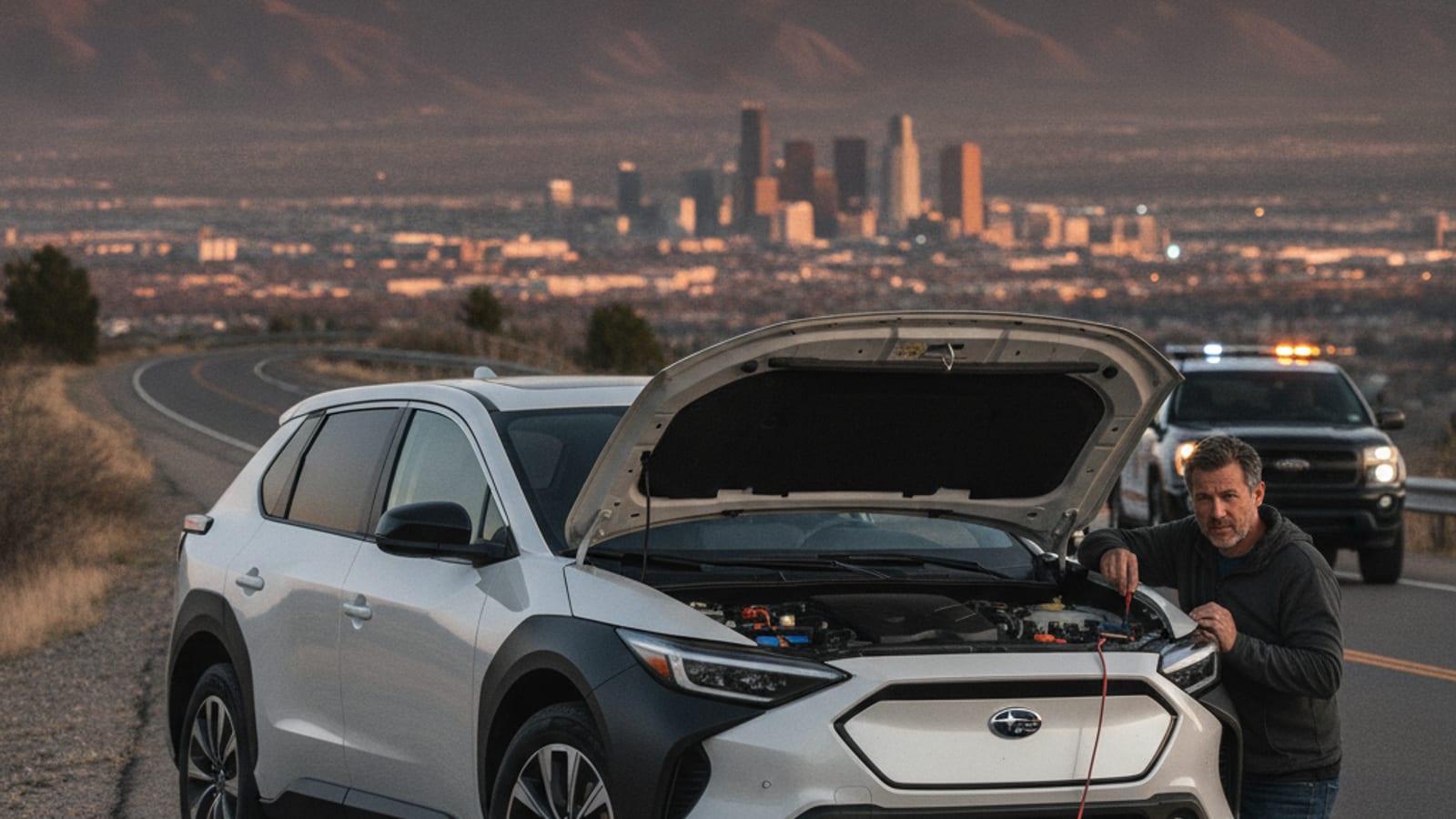
A Subaru Solterra that won’t start in Denver cold usually has a dead 12-volt, not an empty pack. The traction battery often still holds plenty of range. The 12-volt wakes the contactors, the dash, the doors. When it dies after a Front Range freeze, the whole car looks finished. Call (720) 738-6950 and Charge Pro DEN matches you with an independent local operator. The operator quotes you before any cable goes in. They bill you directly for the work they do.
The 12-volt runs the dash, not the wheels
The Solterra is a battery electric vehicle, but it still carries a 12-volt battery. That small battery powers the computers, the contactors that close to connect the traction pack, the door locks, the infotainment screen, the lights. When you press the brake and push the start button, the 12-volt has to wake up first. If it is dead, nothing happens. No click, no ready light, no error on the screen.
The traction pack underneath still holds a charge. The car just cannot talk to it. This is the same pattern on most modern EVs, from a Tesla Model Y to a Hyundai Ioniq 5 to a Ford Mustang Mach-E. The 12-volt is a wear item that the cold eats first.
The Solterra is a non-Tesla. It uses a CCS connector for DC fast and Level 2. The 12-volt itself is a normal automotive-style battery that an operator can jump or replace on site.
What a Front Range freeze does to it
Denver’s January normal low sits around 18 degrees. Sub-zero nights are routine through December, January, and February. The January 2024 arctic blast dropped Denver from 47 to minus 19 in about 48 hours. A Solterra parked outside at DIA, on a Capitol Hill street, or in a Highlands Ranch driveway will see those temperatures for hours on end.
A lead-acid 12-volt loses a large share of its cranking capacity below freezing. Cold slows the chemistry. A battery that started the season marginal may not survive a real cold snap. Add phantom drain, the small current the car draws to run its own battery management and security systems while parked, and you can lose several percent of the 12-volt’s charge over a long sit. A week in a cold DEN lot, a week at a ski condo, a long business trip in winter, all of those are common ways to find a Solterra that will not wake.
Recurrent Auto studied more than 30,000 U.S. EVs in winter. At 32 degrees, EVs kept about 78 percent of max range on average. Cold is why a morning buffer can vanish on I-70 west of Golden. It is also why the 12-volt fails before the pack. The two systems are separate, and the small one is the wear item.
Quick checks before you call
A few things you can try while you still have phone battery.
Open the Subaru or third-party app for the car. If the app shows the pack is at, say, 60 percent, but the car will not respond, that is a 12-volt symptom. The pack is fine. The car is locked out.
Look at the door handles. On a Solterra with a dead 12-volt, the handles will not present. The key fob will not unlock. The cabin lights will not come on. None of the usual electronic welcome happens.
Try the key fob mechanical backup. The Solterra has a hidden mechanical key blade inside the fob. Use it to open the driver’s door. The alarm may sound. That confirms the 12-volt is dead, not a fob or app issue.
If the car is in a travel lane or another dangerous place, call 911 first. A cold-soak no-start on a shoulder is not a 911 problem. A no-start blocking a lane is.
If the app shows the pack is at zero or near zero, the car is not a 12-volt case. It is an empty pack. Call for mobile EV charging instead.
Where to wait while you call
CRS 42-4-1202 covers a disabled vehicle on a highway. Outside a business or residential district, you may not stop on the paved main-traveled part of a highway. The exception is a vehicle so disabled it cannot be moved further, with hazard lights on. CRS 42-4-230 sets the hazard-lighting requirement. Read can roadside jump an EV 12-volt for the same Colorado shoulder law on a different car.
If you are on a listed CDOT Safety Patrol segment, check the clock. Front Range metro hours run 6:00 to 9:30 a.m. and 2:30 to 7:00 p.m. on weekdays, 10:00 a.m. to 7:00 p.m. on weekends. CDOT Safety Patrol will jump a 12-volt on those listed segments. It does not bring a charge to the traction pack. If the gauge was already at zero, skip this call. If the car went dark after a freeze, a jump may finish it.
On E-470, dial star 470 for the authority’s own roadside help. That program lists flat tires, fluid top-offs, jump-starts, phone help, and debris removal. E-470 does not publish an EV charging service either.
What the operator we refer does
Charge Pro DEN is a referral line for stranded EV drivers in the Denver metro. We do not own trucks, and we do not employ technicians. We do not set prices for the visit. We match you with an independent local operator who works on EVs in the field. The operator quotes you before any cable goes in. They bill you directly for the work they do.
For a dead 12-volt, the operator brings a portable jump pack and uses the Solterra’s under-hood jump points. Subaru publishes the location in the owner’s manual. The operator connects, waits for the contactors to close, then tests the system. If the 12-volt is too far gone to hold a charge, they can replace it on site with a fresh 12-volt matched to the Solterra’s spec. They quote you before the swap.
A 12-volt that took a real cold-soak kill often takes another one within weeks. If your Solterra is on a 12-volt more than four years old, the operator we refer may suggest replacing it on the spot rather than jumping and hoping. The pack is fine. The small battery is the wear item.
For an empty-pack case on the same drive, the operator brings a 240-volt Level 2 source with a CCS adapter. Typical charging time adds 10 to 20 miles of range in 15 to 30 minutes. The clock starts when charging starts, not before. It is not an arrival time, and we do not promise one.
Empty pack or dead 12-volt
The split matters. If the dashboard showed low range before the car died, treat it as an empty pack. You need range, not a jump. Call for mobile EV charging or, for a non-Tesla, non-Tesla EV rescue with a CCS adapter. The operator brings 240-volt Level 2 to the bumper.
If the car sat dark through a freeze and the pack shows plenty of energy in the app, start with the 12-volt. A Solterra that wakes after a jump and shows 60 percent is a 12-volt problem, full stop. Drive it home or to a shop and replace the small battery on your own schedule.
A Solterra that sat through a week at DEN in January is almost certainly a 12-volt case. The pack held charge in the cold. The 12-volt drained from phantom draw plus cold chemistry. Treat it as such. Read the Tesla version of the same choice for the comparison on a different EV.
When a tow is still the right tool
A roadside jump does not straighten bent suspension. If the car cannot roll, you need a tow. A Solterra with a dead 12-volt can usually roll in neutral once the parking brake releases manually. A Solterra that cannot roll at all is a flatbed job.
AAA and other clubs exist for that work. If the car must reach a specific shop, a jump may delay the hook. Tell the operator we refer whether the car will roll before they arrive. It saves everyone time.
No Colorado statute treats a disabled EV as a special class. The same disabled-vehicle statutes govern a Solterra as any other car. Colorado State Patrol handles abandoned-vehicle removal under CRS 42-4-1803, which sets no fixed hour clock for abandonment.
How to choose from a Denver shoulder
Turn your hazards on and stay visible to traffic. Stay in the car if that is the safer choice. Move off the travel lane if the car will roll. Check the Subaru app to confirm the pack still has energy. That tells you whether to wait on a 12-volt jump or to ask for range.
For a 12-volt jump on a non-Tesla EV in the Denver metro, call (720) 738-6950. Charge Pro DEN matches you with an independent local operator. The operator quotes you before they start work. The call costs nothing and the operator bills you directly. We serve the Denver metro from the plains to the foothills. Treat the number as a referral line, not a rolling promise.
If the car is on a listed CDOT Safety Patrol segment during published hours and the pack is fine, that free jump may finish the job. If the pack is at zero, call for a mobile EV charging referral instead. We serve Denver, Aurora, Lakewood, Highlands Ranch, and the rest of the 50 cities and communities in the metro.
Frequently asked questions
Where is the Solterra 12-volt jump point?
Subaru publishes the under-hood jump point location in the owner’s manual. On most model years it sits under a plastic cover near the front of the engine bay. The independent operator we refer will know where to look and how to connect without tripping a fault code.
Can a Solterra be jump-started like a regular car?
The procedure is similar but the connection points are different. A modern EV 12-volt should be jumped at the dedicated posts, not by clamping directly to the battery in a way that sparks near sensitive electronics. The operator we refer carries a jump pack and the right leads for the job.
Will jumping the 12-volt hurt the traction pack?
No. The 12-volt is electrically separate from the traction pack. The jump only powers the 12-volt bus. The traction pack stays isolated. The car wakes up, the contactors close, and the pack takes over.
Is it cheaper to jump the 12-volt or replace it on the spot?
A jump gets you moving now. A 12-volt that took a real cold-soak kill often takes another one within weeks. If your Solterra is on a 12-volt more than four years old, replacing it on site costs less than a second call. The operator we refer quotes both options before starting work.
How do I tell the operator my car is a Solterra and not a Tesla?
Tell them the make and model, and that you have a CCS port. Solterras in the U.S. use CCS for DC fast and Level 2. The operator brings the right adapter and the right 12-volt procedure. We serve every major EV brand in the Denver metro.