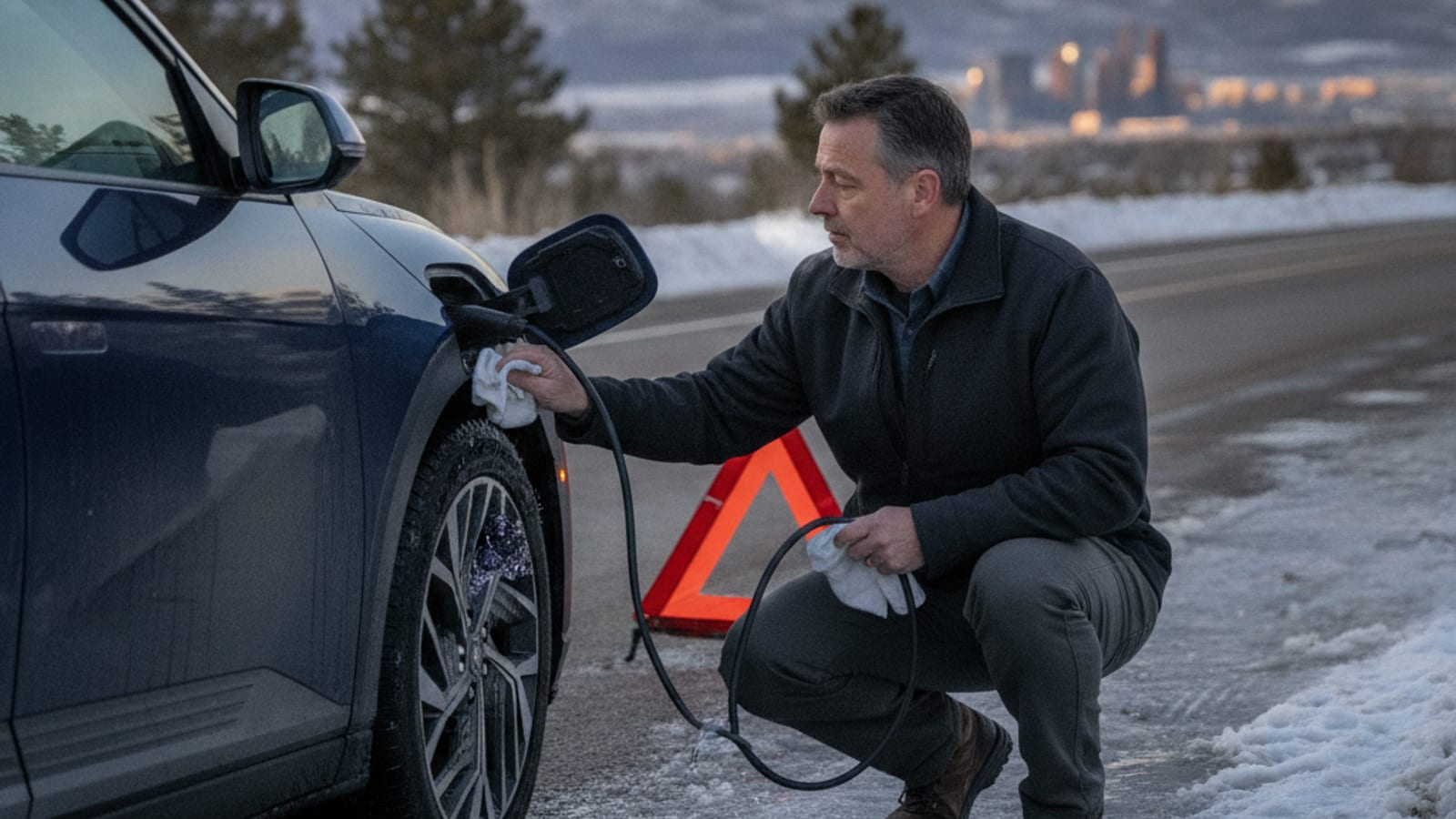
A Denver storm leaves meltwater sitting in your charge port long after the snow stops. The pack still shows range. You walk out to a clean car and a wet inlet. Plugging in while that water is in there can stop a charge session before it starts, or freeze the latch overnight. Dry the port first. Then plug in. If a charge session fails anyway, call (720) 738-6950 and we will connect you with an independent operator in the Denver metro.
How melt gets into the port after a storm
Snow around the metro runs in the low to mid 50s of inches a year. Storm runoff runs along the body panels, settles in the door handles, and pools at the charge inlet. The flap keeps weather off the pins, but it does not seal water out of the housing. After a long storm, melt can sit in the well behind the door for hours.
Cold morning plus a wet housing is a recipe for trouble. Denver’s January normal low sits near 18 degrees. That standing water refreezes at dawn. The same water can also short a charge handshake the first time you plug in.
Denver sits at 5,280 feet at the State Capitol step. Higher places refreeze faster. Idaho Springs sits at 7,526 feet on I-70, and the Supercharger there lists eight stalls. A driver rolling down from the mountain after a storm is the classic wet-port arrival.
If you parked outside in Lakewood or Arvada during the storm, expect meltwater in the port. If you parked inside a heated garage, expect a dry port. A home wall connector indoors stays dry. A public stall in the rain is the wet case.
Why a wet port can stop a charge
Most modern inlets are weather sealed for rain, not for standing water. The car checks for ground, pilot signal, and a clean handshake before it closes the contactor. A puddle at the bottom of the housing confuses that check.
The car may refuse to charge at all. The dashboard may show “charge port error” or “check inlet.” On a Tesla, the charge icon can flash yellow and never turn green. On a CCS car, the stall may time out before the handshake finishes. On a J1772 with J3400 adapter, the same pattern shows up as a stalled session.
Connector types you will see in Denver
J1772 is the round five-pin AC connector used on most non-Tesla EVs for Level 2 charging. J3400 is the Tesla NACS plug, smaller, the same shape every Tesla uses. A CCS inlet is J1772 on the top half with two large DC pins below, used for DC fast charging. Tesla drivers with the J3400 plug use a CCS adapter at non-Tesla fast stalls. Connector compatibility still depends on your exact vehicle and equipment.
Melt in any of these housings creates the same problem: a handshake that never closes, or a latch that freezes after the cold returns.
Dry the port before you plug in
A dry cloth and patience beat any tool here. Do not flood the port. Do not use an open flame. Do not poke the pins.
A simple dry routine
Open the charge door. Wipe the outer lip with a clean dry cloth. Tilt the cloth into the well at the bottom of the housing. Soak up any standing water. Repeat until the cloth comes up clean. Wait two minutes for residual moisture to evaporate. Plug in.
A microfiber towel works better than a paper towel. Paper can leave lint on the pilot pins. A shop towel is fine in a pinch.
If the housing is icy, warm the car first. Run the cabin heat for ten minutes with the charge door open. The heat soaks into the inlet and softens the ice. Then dry and plug in.
Do not use a hair dryer on high heat near plastic trim. A hair dryer on low held a foot away is okay. Most owners manuals warn against high heat at the inlet anyway.
Skip these common shortcuts
Compressed air can drive moisture deeper into the housing. Skip it. A leaf blower is worse. A wet wipe leaves residue on the pins. Skip that too.
Pouring warm water into a frozen port looks like it helps, but it adds water that refreezes at night. That is how you trade a wet port for a frozen latch. Charge port won’t release after a Front Range freeze covers the latch case once it freezes.
If the connector pins look corroded or pitted, the port needs a shop, not a towel. Stop charging on that inlet and book a service appointment.
When the car still will not charge after you dry it
A dry port and a failed handshake is a different problem. The most common cause is a weak 12-volt, not water. The 12-volt runs the contactor and the lock solenoid. A cold-soaked 12-volt fails to close the loop even when the port is clean.
If the dash is dim, the app is offline, or the door handles will not present, suspect the 12-volt first. CDOT Safety Patrol will jump a 12-volt on listed freeway segments in published hours. Front Range weekday windows are 6:00 to 9:30 a.m. and 2:30 to 7:00 p.m. Weekends run 10:00 a.m. to 7:00 p.m. Their pages say nothing about charging an EV. A jump is the missing power for the contactor, not a charge for the pack.
E-470 publishes its own roadside help at *470. They cover flat tires, jump-starts, fluid top-offs, phone help, and debris removal. They do not publish an EV charging service.
For a deeper walk on the 12-volt side, read how to jump an EV 12-volt in Denver cold. That post covers Tesla, Hyundai, Kia, and the rest in plain language.
After a public stall fails you
A wet port is a tow-not-needed case most of the time. The pack still has range. You just lost a charging option.
Park the car in a dry spot for an hour if you can. A heated garage works. A covered parking structure works. Sun and wind can dry a port in summer but not in a Denver January. If you must charge now, a friend with a garage and a wall connector is your best bet.
If the pack is also low and you need range soon, a mobile Level 2 boost is the in-place answer. Operators we connect you with bring a 240-volt source to the car. They add roughly 10 to 20 miles of range in 15 to 30 minutes of charging. The clock starts when the cable goes in, not before. They quote before they start and bill you directly for the work.
For the broader choice between charging in place and towing, read mobile EV charging in the Denver metro. That page covers the trade. For a pack that hit zero on the road, out of charge recovery is the specific service.
The cold-soak case in a DEN parking lot
A week in a cold DEN parking lot is its own scenario. The airport sits east of Aurora on Peña Boulevard, an 11 plus mile city-maintained freeway from I-70. Peña is not a state highway. It is the only road into the airport. CDOT Safety Patrol covers I-70 east to Airport Boulevard. Confirm coverage on COtrip if you plan to pull over east of there.
A car that sits outside at DEN through a January storm comes back with meltwater in the port and a likely dead 12-volt battery. The traction pack may still show range. The small 12-volt battery powers the contactor, the lock, and the dash. Without it, the car looks finished.
The fix is a 12-volt jump first, then a normal charge once the contactor closes. Operators we connect you with jump or replace a dead 12-volt on site. They handle Tesla and every major EV brand. They quote before any cable goes in.
Recurrent Auto studied more than 30,000 U.S. EVs in winter. At 32 degrees, EVs kept about 78 percent of max range. Cold is why a morning buffer can vanish on I-70 west of Golden. It is not a reason to guess the next charger.
What road spray adds to the wet port
Storm runoff is not clean water. It carries deicing salts, brake dust, and grit. After a long slushy drive, that film settles on the housing and on the connector pins.
Wipe the port and the connector end the same way. A clean connector seats against a clean inlet. Skip any grease or spray. The locking pin is the only moving part, and it does not need lubricant.
A coat of dielectric grease on the connector pins is a common myth. It can block the pilot signal and stop the handshake. The ports are sealed at the factory and need no added lubricant.
When a wet port is a sign of something worse
A wet floor under the charge port after a dry day is a body seal issue, not a weather issue. Water that gets in without a storm points to a failed gasket around the charge door or the housing.
Check the floor of the trunk where the charge cable stores. A wet cable bag or wet carpet means water is reaching places it should not. Book a service appointment for the body seal. Do not charge on a port that is taking on water during a wash either. The same path that lets water in lets grit in.
A Tesla charge port door has a small drain channel. If that channel fills with ice or debris, meltwater backs up into the housing. Clear the channel with a plastic pick, not a metal screwdriver that can scratch the pins.
What to do if the latch freezes overnight
You dried the port and plugged in. By morning, the connector is stuck. The water you missed refroze around the locking lip.
Stop pulling. A seized solenoid that you yank out becomes a shop job. Use that year’s manual release. Tesla Model 3 and Model Y hide it in the trunk on the passenger inner wall. Hyundai Ioniq 5, Kia EV6, and EV9 put a button in the rear cargo area. Ford put the release on the port housing itself.
The full procedure is in charge port stuck after a Front Range freeze. That post groups the manual releases by where they live and names the year ranges to check.
If you cannot reach the manual release because the car is fully dark, the 12-volt is dead. Charge Pro DEN is a referral line. We do not own trucks or perform the work. The operators we connect you with jump or replace a dead 12-volt on site. They quote before any cable goes in. You pay them directly for the work they do.
A short Denver checklist for after a storm
Park under cover if you can. A covered space at home, a parking structure downtown, or a friend with a garage keeps the port dry. Open the charge door and wipe the well with a dry cloth before the next plug-in. Wait two minutes after wiping. Plug in. If the handshake fails, suspect a weak 12-volt before you suspect the port.
If you cannot get to a charger and the pack is low, call (720) 738-6950. We will connect you with an independent mobile operator in the Denver metro. They quote before any cable goes in. They do not speak for Tesla, Ford, Hyundai, or CDOT.
Treat the number as a referral line, not a rolling promise. Operators we connect you with serve the metro from the plains to the foothills. Castle Rock, Parker, and Highlands Ranch sit on CORE Electric Cooperative, not Xcel. Longmont sits on Longmont Power and Communications. Utility territory matters for your home wall connector. It does not change the wet port.
Frequently asked questions
Can I charge my EV with snow melt still in the port?
You can try. Most ports will refuse a handshake with standing water in the housing. Dry the port with a clean cloth, wait two minutes, and try again. If the charge still fails, suspect a weak 12-volt battery rather than more water.
Will water in the port damage the car?
Short-term standing water in the inlet lip does not damage the car. The port is sealed for normal rain. The risk is a failed handshake that leaves you stranded, or a frozen latch if the water refreezes overnight. Wipe the housing dry before the next plug-in to avoid both.
Does CDOT Safety Patrol help with a wet port?
CDOT Safety Patrol covers flat tires, jump-starts, fuel, debris, and minor mechanical help on listed freeway segments. Their pages do not mention charging an EV or drying a port. They will not bring a Level 2 source to the car. For a wet port that will not charge, the work is drying and a 12-volt check. An independent mobile operator in the Denver metro is the party that brings 240 volts to the car.