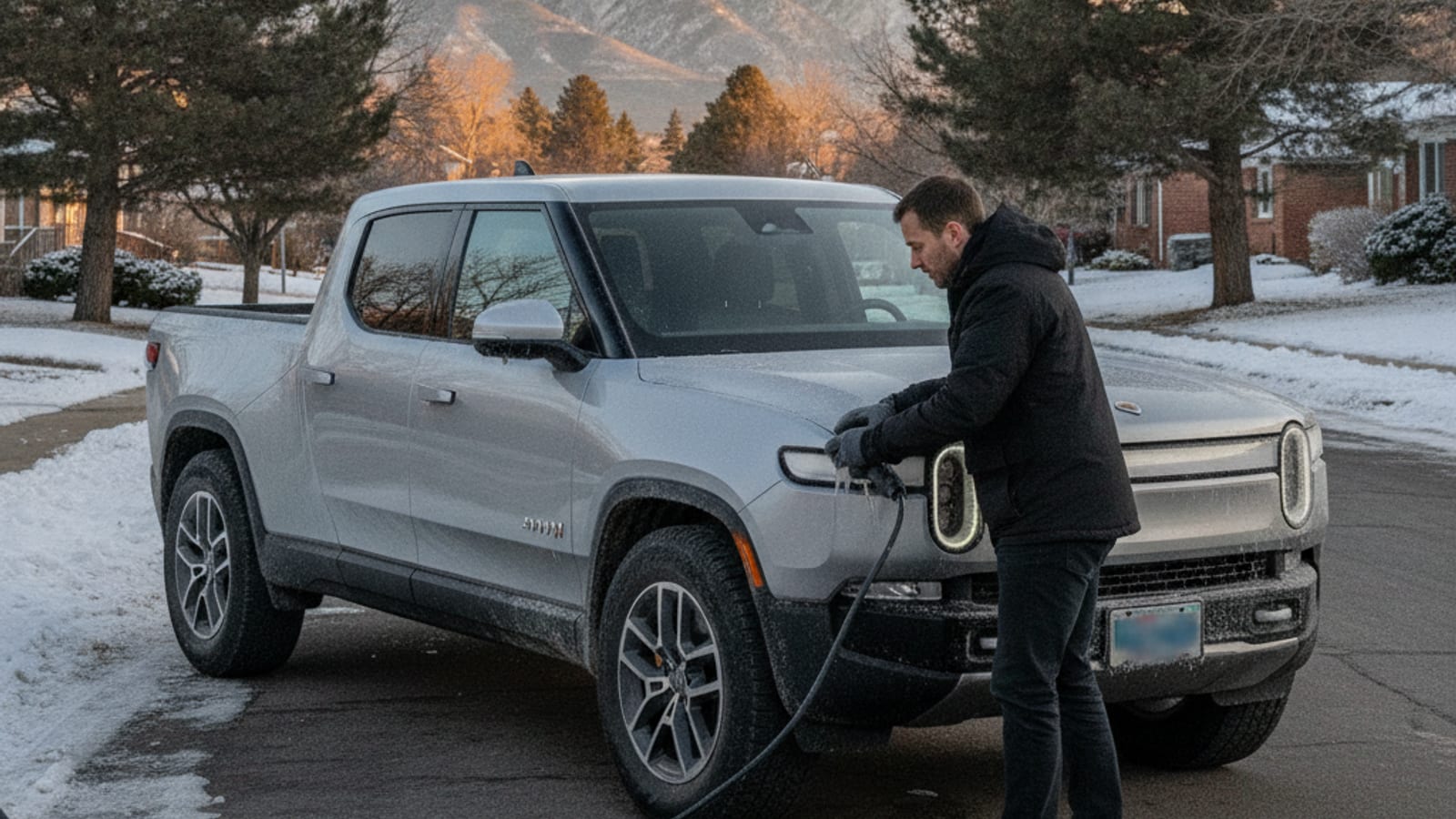
A Rivian charge port stuck in a Front Range freeze is usually ice holding the latch, not a broken truck. You press the button on the connector and the cable stays put. The traction pack still has range. The 12-volt still answers. The lock is welded. Try the in-app unlock, then the manual release your Rivian owner’s guide describes for that VIN. If neither frees the cable, or if the truck is sitting on a shoulder instead of a driveway, call (720) 738-6950 and the operators we refer can take it from there.
Why a Rivian cable freezes here
Denver sits at 5,280 feet. The sun drops fast in winter and the air dries behind it. January’s normal low sits around 18 degrees. That figure comes from NWS Boulder climate normals. Snow and frost arrive on a Rivian that sat outside overnight at a Supercharger, a public garage, or a driveway. You plug in during the afternoon when the body is warm. Melt runs down into the port housing around the locking pin. Dawn arrives below freezing and that melt becomes a thin ice sleeve.
A Rivian charge port uses an electronic lock. The solenoid holds the pin in the connector’s latch until the car ends the session and releases the actuator. Ice inside the latch makes that pin bind. Pressing the button on the handle sends a release signal, but the actuator cannot pull the pin back through the ice. The cable looks locked. Sometimes the app confirms the session is over and the lock is still engaged. The Rivian is fine. The cable is stuck in the truck.
The same thing happens on an Ioniq 5, a Mustang Mach-E, and most other EVs with electronic charge-port locks. Rivians see it more often here because so many Front Range owners are on Superchargers and home wall boxes, so the cable is plugged in through a cold night more often.
What not to do with a frozen cable
The instinct is to pull the connector harder. Don’t. A forced pull can tear the locking pin out of the latch, bend the inlet pins inside the port, or damage the cable head. The repair is then an inlet replacement or a cable replacement, not a stuck-handle fix. Rivian’s own guidance is to stop pulling once the handle resists and to clear the lock instead.
Stop the session first. A session that the truck thinks is still active will not let the lock release under any signal. End the session in the Rivian app, on the center screen, or on the station’s screen if the stall is a public charger. After the session is ended, wait ten or fifteen seconds for the actuator to fully retract.
A weak 12-volt can also keep the solenoid shut. A Rivian whose 12-volt is tired after a long cold dwell may report the lock as engaged when the actuator cannot actually pull hard enough to release. If the truck is dark or the screens are sluggish, the 12-volt is part of the problem. More on that below.
Try the in-app unlock first
Open the Rivian app on your phone. Go to the charging screen. Tap “Stop charging” or “Unlock cable.” The car sends the same release signal twice and the dashboard shows the cable as unlocked. If the app says unlocked and the handle still resists, the actuator is working but the ice is still binding the pin.
A second tap on the unlock button in the app after a thirty-second pause can also work. The actuator cycles once, the ice can crack, and the next cycle pushes through. A driver who hears a soft click on the second try is back to a normal unplug.
The Rivian center screen also has a manual unlock under the charging menu on most model years. The exact path changes by software version. Rivian’s own owner’s app and in-vehicle guide for that VIN is the source of truth, not this page.
The manual release path
If the app will not free the cable, Rivian builds a manual release into the charge port area. The location and method depend on model year and whether the truck has the original charge port or the NACS port that arrived with 2026 model year vehicles. Owners should check Rivian’s current owner’s manual for that VIN before prying anything.
The general pattern is the same across recent R1T and R1S trucks. Open the charge port door. Inside the port housing there is a small manual release tab or pull cord that moves the latch pin by hand. Pulling the tab with a steady hand frees the cable without a tool in most cases. The tab is small and easy to miss, and it sits on the lower or side edge of the port well.
If the cable still will not come out, do not pry the port door wider or wedge the connector. The release tab is meant to move the pin, not the door. Forcing the door can crack the housing and turn a stuck handle into a service visit.
A Rivian whose 12-volt is too weak to even open the charge port door is a different problem. The door motor needs a small amount of power. If the truck is dark and the door will not open, jump the 12-volt first, then try the manual release. Most Rivian 12-volt jump posts sit under the hood, but the exact location is in the manual for that VIN, not in this article.
When the public station is the hardware
A stuck cable at a Tesla Supercharger, an EVgo stall, or an Electrify America site is not entirely your hardware. The stall owns the cable, the session, and the remote release. The number on the cabinet is the first professional contact.
Call the network on the cabinet. The number runs 24 hours. Ask the network operator to end the session or release the connector remotely. Most networks can drop the lock from their side without a technician on site. A forced pull before that call can damage a stall that the network is responsible for, and the driver is responsible for that damage.
The Rivian app and the network app will both reflect a remote release within a minute or two. Try the handle again after the network confirms the unlock. If the cable still resists, the binding is physical and you still want the manual release tab, but the network knows the cable is no longer under power.
When the Rivian is on a shoulder, not a driveway
A frozen port on a home wall box is one thing. The same freeze on a Rivian parked on the shoulder of US-36, I-70, or C-470 is something else. The truck is no longer in a place to wait for a thaw. The operators we refer handle that case. Call (720) 738-6950 and the call gets routed to an independent local operator who can confirm whether the truck needs a manual release on site, a 12-volt jump to free the door motor, or a tow if the cable is truly damaged.
CRS 42-4-1202 covers a disabled vehicle on a highway. Outside a business or residential district you may not stop or leave a vehicle on the paved main-traveled part of a highway, except a vehicle so disabled it is impossible to move it off the roadway. Hazard lights must be on under CRS 42-4-230. The pull-off shoulder is the lawful place to wait. Stay in or near the truck with hazards flashing until the operator arrives.
What the operator will and will not do
Charge Pro DEN is a referral line. It owns no trucks and employs no technicians. The operators we refer are independent local pros who quote the job before any work starts and bill the driver directly. For a Rivian, ask for non-Tesla EV rescue so the operator brings the right adapters for the CCS port or NACS port your truck uses.
The operator can confirm whether the issue is a frozen latch, a tired 12-volt, or a damaged inlet. The first two are jobs an operator handles on site. A damaged inlet is a tow, not a roadside fix. The operator can also add a mobile EV charge if the truck drove to the shoulder on fumes while the driver worked the port. That charge runs 240 volts Level 2 and adds about 10 to 20 miles in 15 to 30 minutes, so the truck can drive under its own power to a warm garage or to a Rivian service center.
A stuck port itself is rarely a charge job. The fix is the manual release, a thaw, or a tow. The operator quotes the scope and price. The driver decides whether to proceed.
For a brand-agnostic walkthrough of the manual release on other EVs, the EV charge port won’t release guide covers the same physics across brands. The Hyundai version of this same problem is in the Ioniq 5 charge port stuck post, and the same pattern shows up on the Ford side in the Mustang Mach-E frozen port guide.
When a tow is the right tool
A Rivian whose 12-volt is dead, whose port door will not open, and whose manual release tab is buried under a damaged housing is a flatbed job. The operators we refer will tell a driver that honestly. Rivian’s own roadside path, if the account includes it, is the manufacturer channel and worth verifying in the Rivian app. For the broader roadside picture, see the Denver EV roadside assistance guide for the metro’s actual call order.
A frozen port that releases cleanly after a thaw or a manual pull does not need a tow. A port that binds even with the manual tab pulled is a different story. The operator can confirm on site whether the lock is the problem or the inlet is.
A short checklist for a frozen Rivian port
End the session in the Rivian app or on the center screen. Wait ten seconds. Try the handle. If it does not move, tap unlock again in the app after a thirty-second pause. If the handle still resists, open the charge port door and look for the manual release tab inside the housing. Pull the tab steadily. If the port door will not open, the 12-volt is the problem and the truck needs a jump before anything else works.
If the stall is a public charger, call the number on the cabinet and ask for a remote release. If the truck is on a shoulder, turn on the hazards and call (720) 738-6950 for an operator referral. If the cable looks damaged, do not pull harder. Stop and let the operator or a tow handle it.
Frequently asked questions
Is a frozen Rivian port covered by Rivian roadside?
Rivian roadside is a manufacturer program. Verify the current coverage in the Rivian app for the specific VIN. A frozen port on a shoulder may be covered, may not be, and the answer changes by account and region. A local operator referral is the fallback when the Rivian program cannot reach the truck in time or will not send a charge-capable truck.
Can a Rivian R1T or R1S charge port freeze shut without warning?
Yes. The first sign is a connector that will not release after a cold-soak plug-in. The Rivian app often still says the session is over and the lock is the issue. The truck itself is usually fine. The fix is the manual release, not a service visit.
Will pulling harder ever work?
No. The lock pin binds in the ice. A hard pull damages the inlet, the connector, or both. The release is the manual tab inside the port housing, not muscle.
What if the Rivian is dead and the door will not open?
The 12-volt is most likely flat. A jump from an independent operator gets the door motor powered so the manual release can be reached. That jump is a separate job from the port release. The same operator can do both.