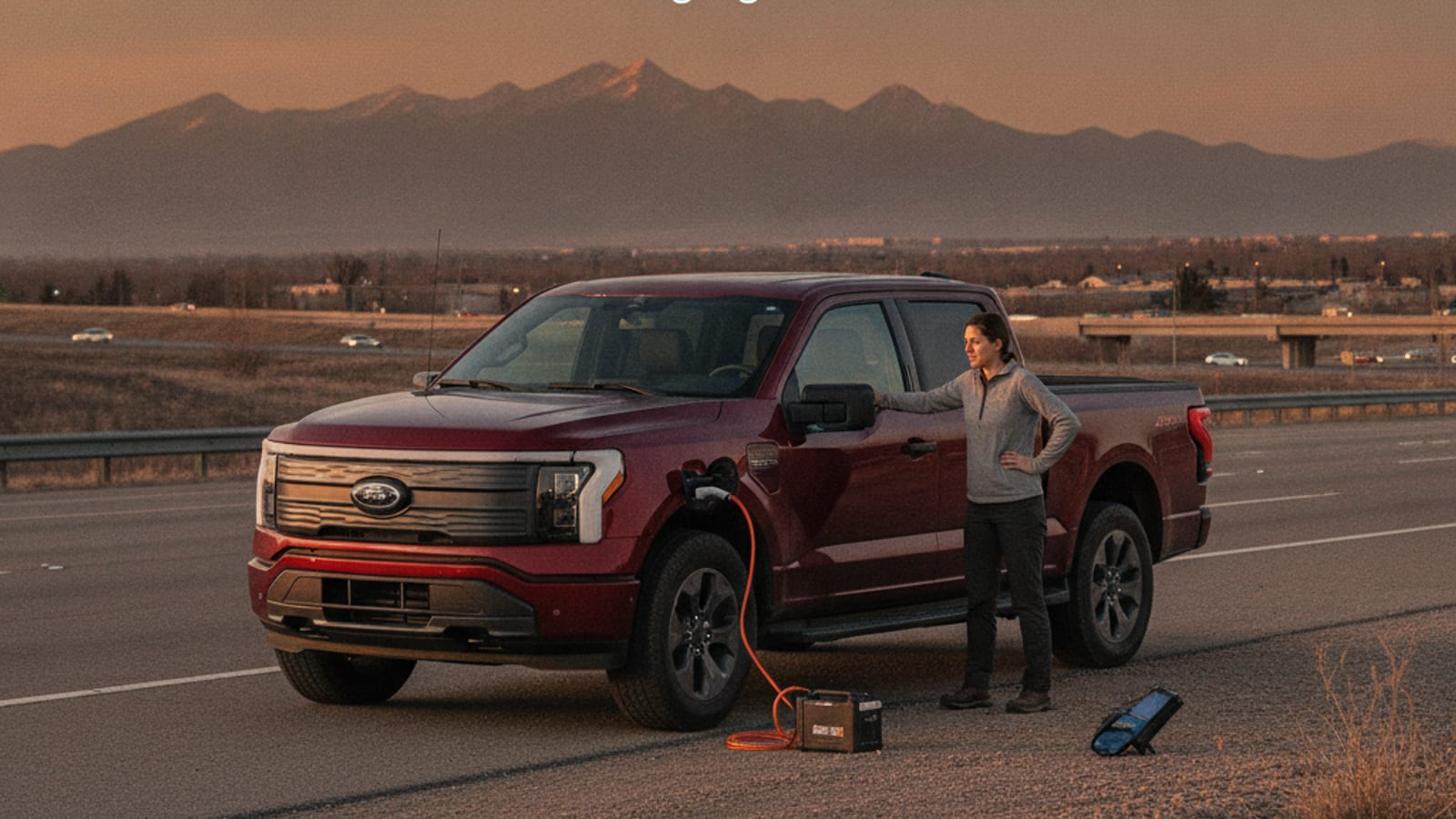
Mobile EV charging on I-25 through the north metro starts with one move: get off the travel lane. Hazards on, wheel to the right, and stop on the outside shoulder. Then call (720) 738-6950 and we match you with an independent operator who brings a 240-volt Level 2 source or a 12-volt jump to your bumper. Charge Pro DEN is a referral line, not a fleet. The operator quotes you before any cable goes in. You pay them directly for the work they do.
Why the outside shoulder on I-25 North
I-25 through Thornton, Westminster, Northglenn, Federal Heights, Commerce City, Brighton, and Broomfield is a wide, well-shouldered highway. CDOT built the I-25 North Express Lanes with a minimum 8-foot outside shoulder for breakdowns. There is also added courtesy-patrol presence on those segments. The point of those design choices is the move that saves your car and your life: pull to the right, all the way off the travel lane, and stop. Do that before anything else.
CRS 42-4-1202 makes it lawful to be stopped on the shoulder if the car could not be moved further, with hazards on under CRS 42-4-230. That same law forbids stopping on the paved main-traveled part of a highway outside a business or residential district. A violation is a class B traffic infraction. The shoulder is where you belong, and on the I-25 North corridor there is room to belong there.
US-36, the Boulder Turnpike that runs through Westminster and Broomfield on its way to Boulder, was built with the same outside-shoulder standard. A low charge on that corridor is the same shape: hazards on, outside shoulder, then the call.
What CDOT Safety Patrol actually does on I-25
CDOT Safety Patrol is the state’s free roadside program, run by CDOT’s Division of Maintenance and Operations. Read the published coverage list carefully. The Denver-metro Safety Patrol covers I-25 South from 120th Avenue to Arapahoe Road. It also covers I-70 East from Wadsworth to Airport Boulevard, plus portions of US-6, C-470, and I-225. The I-70 Mountain Corridor runs from Morrison to Vail.
I-25 North from the Denver city limits up to Fort Collins is not on that published coverage list. Neither is US-36. The patrol truck you see flashing yellow on I-25 South is not the same program as a free truck on the north side of the metro. Confirm the segment before you wait.
The Safety Patrol’s published menu is flat tires, jump-starts, emergency fuel, minor mechanical help, debris removal, and incident support. CDOT’s Safety Patrol page and CDOT’s “my car broke down” page mention nothing about electric vehicles, EV charging, or a charging-specific service. That silence in state guidance is the gap a mobile charge fills. The free truck can wake a 12-volt battery on a covered segment. It cannot add miles to a traction pack at zero.
Hours are limited and published on CDOT’s site. Front Range weekday windows run 6:00 to 9:30 a.m. and 2:30 to 7:00 p.m. Weekend hours run 10:00 a.m. to 7:00 p.m. Outside those hours the patrol is off shift and a different truck answers.
A dead pack versus a dead 12-volt on I-25
January’s normal low around Denver sits near 18 degrees. A cold overnight in a north-metro lot can kill the 12-volt battery. The traction pack may still hold plenty of range. The 12-volt runs the computers, the contactors, and the door locks. When it dies, the whole car looks finished.
A car that was low on range before it stopped is one problem. A car that was at a reasonable charge and now will not wake is another. The dash before the stall usually tells you which one you have. CDOT Safety Patrol, where it covers, will try a jump on a covered segment. Operators we refer jump a 12-volt on site. They replace one on site when that is the job. If the gauge was already at zero, skip the jump call and go straight to a mobile EV charging referral. If the car went dark after a freeze, start with the 12-volt.
Recurrent Auto studied more than 30,000 U.S. EVs in winter. At 32 degrees, EVs kept about 78 percent of max range. At 20 degrees, that figure dropped to about 70 percent. Best models held 88 percent. Worst held 69 percent. Heat-pump vehicles did about 10 points better than resistive-heat vehicles at 32 degrees. Cold is why a morning buffer can vanish on the north-metro run. It is not a reason to guess your way to the next charger.
E-470 north loop is its own patrol
If you broke down on E-470 at the north end of the loop, you are on a different system. E-470 is the eastern-metro cashless toll loop, all-electronic with ExpressToll transponder plus license-plate billing. Pull to the shoulder and dial *470. E-470’s published roadside assistance covers flat tires, fluid top-offs, jump-starts, phone help, and debris removal. State Patrol is *CSP, which is *277. E-470 does not publish an EV charging service.
E-470’s free roadside help overlaps with CDOT Safety Patrol on the 12-volt jump. It overlaps with what the operators we refer do for a 12-volt on site. None of them bring a Level 2 charge to a stalled EV on the E-470 shoulder.
What a mobile EV charge actually looks like on I-25
Charge Pro DEN is a referral line for stranded drivers. We don’t own trucks and we don’t employ technicians. We match you with an independent local operator. That operator quotes you before any cable goes in. They bill you directly for the work they do.
The kit is a 240-volt Level 2 source. Tesla drivers get a native NACS plug on the lead. Other EVs use a CCS or J1772 adapter. Typical charging time adds about 10 to 20 miles of range in 15 to 30 minutes of charging. The clock starts when charging starts, not before. That is not an arrival time and we don’t promise one.
Those miles let you drive under your own power to the next stall, your home charger, or a shop. You are not waiting on a flatbed to a public stall. For an empty pack, use out-of-charge recovery. For the broader choice between in-place charge and a tow, read charge in place or tow.
Operators we refer handle Tesla and every major EV brand on the corridor. A stuck charge port after a cold night is a latch problem, not a tow problem. Ask the operator about the port before anyone hooks a winch.
The utility question on the north metro
Drivers from Thornton, Westminster, Northglenn, and Broomfield hit the same question when they want to install a home charger. United Power and Xcel Energy split the north metro street by street. Inside those city limits, a driver genuinely may not know which utility serves them. Brighton sits on United Power for electricity. Commerce City sits on United Power. Confirm your utility by address before you call about a home Level 2 install. Use program names and “check your utility.” No rebate dollar figures are verified for this site.
When a tow is the right tool on I-25
A roadside charge does not straighten bent suspension. If the car cannot roll, you need a tow. AAA and other clubs exist for that work. If the car must reach a specific shop, a charge may delay the hook.
CRS 42-4-1803 to 1805 cover abandoned vehicles on public property. The statute sets no fixed 24-hour or 72-hour clock. A vehicle is abandoned on officer discretion, on reasonable grounds to believe, not on a timer. After a tow, the published timelines are reporting within 10 working days, a 30-day claim window, and sale not less than 30 nor more than 60 days after notice. The Colorado Public Utilities Commission regulates towing carriers. The Colorado Towing Bill of Rights (HB22-1314) requires 24-hour written notice before most private-property tows. No Colorado statute treats a disabled EV as a special class. A stranded EV is governed by the same disabled-vehicle statutes as any car.
How to choose from an I-25 shoulder
Turn your hazards on first. Stay in the car if that is the safer choice. Pull to the outside shoulder on the right side. Get out of the travel lane before anything else.
Once you are stopped, read the dash. If range was already low before the stall, treat it as an empty pack. If the car was at a reasonable charge and now will not wake, treat it as a 12-volt problem. For a confirmed 12-volt on a covered CDOT segment during published hours, the free Safety Patrol jump is an option. For everything else, the call is the same.
Call (720) 738-6950 and we match you with an independent operator who quotes you before work starts. We serve the Denver metro from the plains to the foothills. The operator bills you directly for the work they do. Treat the number as a referral number, not a rolling promise.
For a longer coverage comparison that stays on Tesla and AAA, read Tesla, AAA, and a local mobile rescue. For the split between a 12-volt fix and a pack charge, Tesla 12-volt dead: jump or replace walks the same decision on a metro shoulder.
Frequently asked questions
Does CDOT Safety Patrol cover I-25 North?
CDOT Safety Patrol’s published Denver-metro coverage list names I-25 South from 120th Avenue to Arapahoe Road. It does not name I-25 North or US-36. Confirm the segment you are on before you wait for a free patrol truck.
Will CDOT or AAA charge my EV on the I-25 shoulder?
CDOT Safety Patrol and CDOT’s “my car broke down” page mention nothing about electric vehicles, EV charging, or a charging-specific service. AAA still makes sense for flats, lockouts, and wrecks. Many dead-pack calls still end as a flatbed tow. An independent mobile operator is the party that brings a Level 2 source to the car.
What should I do first when my EV dies on I-25?
Hazards on, wheel to the right, stop on the outside shoulder. Read the dash to see whether range was already low or whether the car simply will not wake. Then call (720) 738-6950 for a referral to an independent operator who quotes you before any cable goes in.
Can a mobile operator jump a 12-volt on the I-25 shoulder?
Yes. Operators we refer jump a 12-volt on site and replace one on site when that is the job. The same operator also brings a 240-volt Level 2 source for an empty traction pack. They quote you before any work starts.