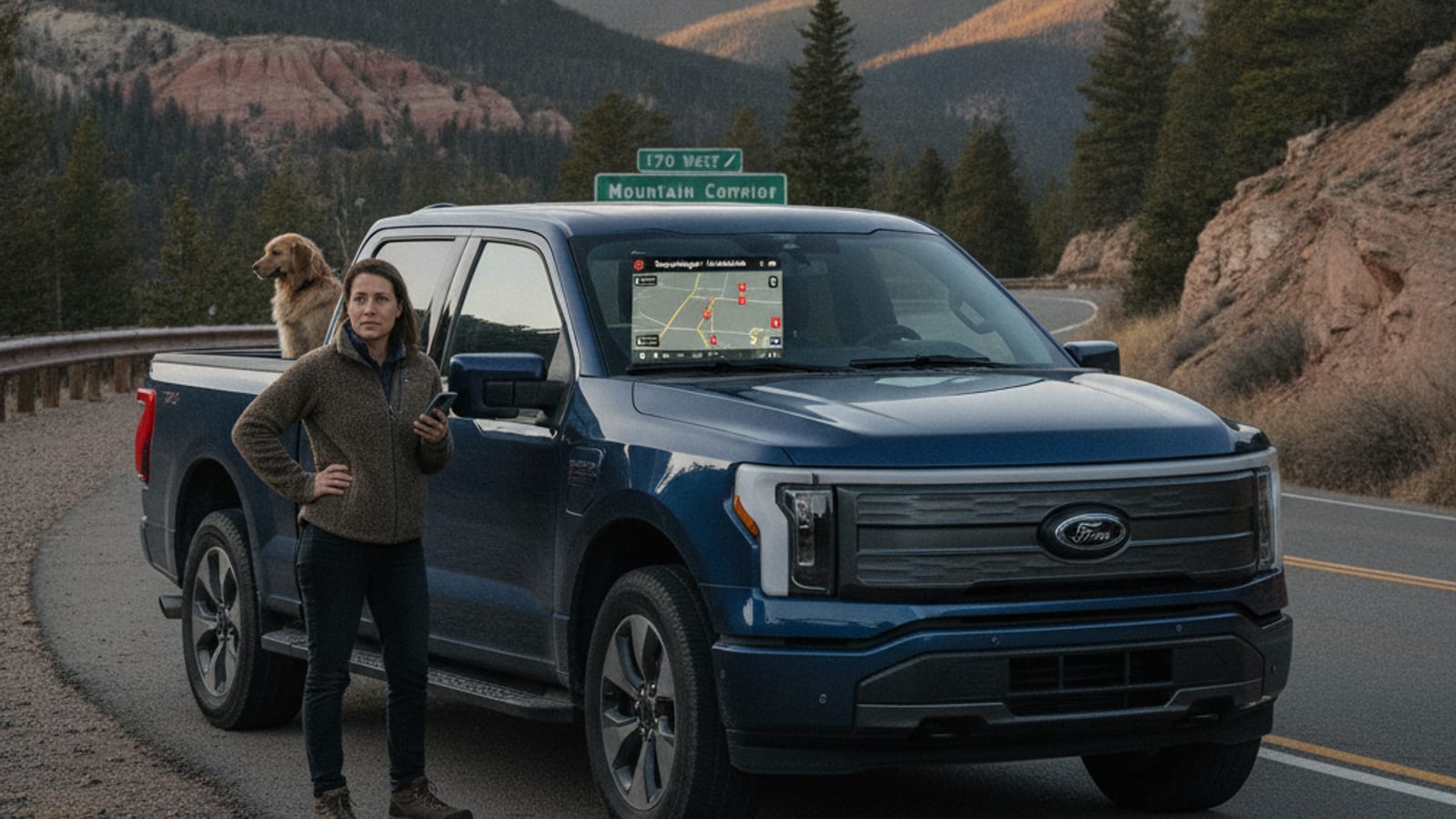
Eight Tesla Supercharger stalls sit in Idaho Springs at 7,526 feet in Clear Creek Canyon. From the Denver side, that is the last confirmed fast charging before I-70 climbs roughly 3,600 vertical feet to the Eisenhower-Johnson Memorial Tunnel at 11,158 feet. If those stalls look full or offline in your app, your climb to the tunnel just changed. If the car is in a travel lane or another dangerous place, call 911. Then call (720) 738-6950 and the operators we refer can bring a Level 2 source to your bumper, no matter which side of the canyon you are on.
Why Idaho Springs matters more than its size
Idaho Springs is a small mining town of about 1,700 people, a historic main street on Miner Street, and a Supercharger site with eight stalls on the I-70 corridor. The town sits at 7,526 feet in Clear Creek Canyon, where the canyon walls close in and the road tilts up. From here, the next fast charging on the I-70 corridor is over the tunnel at Silverthorne and Frisco, after roughly an hour of mountain driving through Georgetown and the tunnel bore. Georgetown, in between, has no Supercharger in the current inventory. That makes the Idaho Springs site the only confirmed fast charging option between the metro and the Eisenhower-Johnson Memorial Tunnel, the highest point on the U.S. Interstate system.
For a driver who left Denver with a comfortable margin, watched the gauge drop on Floyd Hill, and pulled into Idaho Springs hoping to top off, a full or offline stall is a real problem. The town has limited backup. Cell coverage thins in the canyon. The next climb out is the steepest sustained grade on the corridor. Treat the site as one stop, not a network.
What “down or full” actually means in the app
Tesla’s in-app status refreshes on its own schedule, and a stall showing offline can come back without warning. A full stall can free up in minutes when someone finishes charging and drives away. The first move is to confirm the report with your eyes, then with the car.
- Open the Tesla app and tap the charger pin. Read the live stall count and the reported status. If the app still says eight stalls available, the issue may be the site, not the stalls.
- Walk the lot. Count cars already plugged in. Count cars waiting. Eight stalls is a small pool, and a holiday ski weekend can fill the site faster than the app shows.
- Look for a status screen on the stall itself. Tesla posts a per-stall error code on the side display when a stall is genuinely offline. An error code means the stall is down, not just busy.
- Try a different stall if the first one fails to handshake. A single bad stall is not a failed site.
If every stall is genuinely offline, the site itself is down. Move to the next section before you drive anywhere.
If those eight stalls are all gone, here is the safe plan
The right next move depends on how much range you have, the weather, and how far up the canyon you have already climbed. There is no universal answer, and there is no shame in stopping early.
- You have plenty of range to clear the tunnel and reach Silverthorne. A driver who arrived at Idaho Springs with a generous buffer can wait at the site for a stall to open, walk Miner Street for coffee, and check the app every few minutes. Ski traffic is the main cause of full stalls. Patience is the answer.
- You have enough to backtrack downhill. A driver who arrived tight on range can turn around, drop back down US-6 through Clear Creek Canyon to Golden, and charge there. Golden is the last flat, well-charged ground before the canyon, and it has its own stalls. The round trip costs less range than a failed attempt up the grade.
- You have enough to reach the next Supercharger on the far side. A driver who is committed to the climb and has read the gauge carefully can continue over the tunnel to the Silverthorne or Frisco sites. Watch the weather and the traction law status on COtrip before you commit.
- You are already low and the site is full or down. Do not gamble the climb. Pull over, turn on the hazards, and call for help. A Level 2 source brought to your bumper can add 10 to 20 miles in 15 to 30 minutes of charging, and that is enough to clear the canyon and reach the next site. The clock starts when charging starts, not before.
Idaho Springs is also the mouth of US-6 down Clear Creek Canyon and SH-103 up toward Mount Blue Sky. A driver coming down from Echo Lake or the byway can find the same stall situation on a summer weekend. The same plan applies. Wait, backtrack, commit, or call.
CDOT Safety Patrol on the mountain corridor
CDOT Safety Patrol runs along the I-70 Mountain Corridor from Morrison to Vail. The published hours are 6:00 a.m. to 7:00 p.m., Friday through Sunday, and during significant weather. The service is free. The menu is tires, jumps, fuel, debris, and minor mechanical help. CDOT’s published pages do not mention electric vehicles. That silence matters here. The free patrol will jump a 12-volt battery on the corridor. It will not bring a charge to a stranded EV.
A dead traction pack is a different problem from a dead 12-volt. If the car is dark and will not wake, the 12-volt may be the issue, and Safety Patrol can help during posted hours. If the gauge is at zero and the car is otherwise alive, Safety Patrol is the wrong call. The operators we refer are the path that brings a 240-volt source to the car on the corridor. Read Tesla, CDOT, or a local boost for the full coverage comparison.
The Georgetown gap you cannot close
Georgetown sits at 8,530 feet between Idaho Springs and the tunnel, a preserved Victorian town on I-70. The current charging inventory shows no Supercharger in Georgetown, and no measured gap distance was confirmed for this page. Treat it as a confirmed gap, not a comfortable one. A driver who leaves Idaho Springs with a marginal pack and stalls past Georgetown has no published fast charging between there and Silverthorne. The Mountain Express Lane runs roughly 12 miles between the Veterans Memorial Tunnels near Idaho Springs and Empire Junction, and that lane changes the traffic picture but not the charging picture.
The honest plan is to leave Idaho Springs with enough range to clear both Georgetown and the tunnel in one stretch. If the in-car estimate at the top of Floyd Hill shows you will arrive in Silverthorne below 10 percent, the safe move is to stop and wait for a stall, or to call for a boost in town rather than gamble the gap.
What you get back on the descent
The Eisenhower Tunnel climbs about 3,600 vertical feet from Idaho Springs to the west portal. That climb is the headline. The useful counterpart is the descent. Regenerative braking returns a large share of that energy when you come back down. A Lucid Air GT used about 3 percent of its battery over a 77-mile descent from Loveland Pass, and a Hyundai Ioniq 5 about 10 percent over a 75-mile descent. Those are real corridor numbers, not lab figures.
Drivers dial regen down on icy descents for traction, so the return depends on conditions. The honest read: you will not regain every mile you spent climbing, but you will regain a meaningful share on the way back to town. Plan for the climb as one-way energy, and treat the descent as a partial refund. Don’t skip the top-off in Idaho Springs on the way up because regen will save you on the way down.
Cold eats the same margin all over again
Cold reduces range before the grade does. Recurrent’s study of more than 30,000 U.S. EVs found EVs retain about 78 percent of max range at 32 degrees and about 70 percent at 20 degrees. AAA’s 2026 dynamometer study found about 39 percent loss at 20 degrees. A driver who leaves Denver at 70 degrees and arrives in Idaho Springs at 18 degrees has already lost a share of the buffer the trip meter expected, and then the grade takes more.
The safe pattern in winter is to leave with more range than you think you need, top off at Idaho Springs on the way up, and watch the in-car estimate at the top of Floyd Hill before committing to the tunnel. If the estimate shows you arriving in Silverthorne tight, do not chase the next stall over Georgetown. Wait in Idaho Springs or call for help.
What a mobile EV charge looks like here
Charge Pro DEN is a referral line for stranded drivers. We don’t own trucks, and we don’t employ technicians. We don’t set prices for the visit. We match you with an independent local operator. That operator quotes you before any cable goes in. They bill you directly for the work they do.
The kit is a 240-volt Level 2 source. Tesla drivers get a native NACS plug on the lead. Other EVs use a CCS or J1772 adapter. Typical charging time adds about 10 to 20 miles. That add happens in 15 to 30 minutes of charging. The clock starts when charging starts, not before. It’s not an arrival time, and we don’t promise one.
An operator can meet you in the Idaho Springs site lot, in town, or at a safe pull-off on US-6 or SH-103. The boost is enough to clear the canyon and reach Golden, or to climb to Silverthorne and Frisco. For the broader referral explainer, read mobile EV charging in the Denver metro. For the broader stranding pattern in town, read EV roadside assistance in Idaho Springs.
If you are stuck mid-climb
CRS 42-4-1202 covers a disabled vehicle on a highway. You may not stop on the paved main-traveled part of a highway. The exception is a vehicle so disabled it is impossible to avoid stopping and to move it off the roadway. Hazard lights must be on under CRS 42-4-230. A stalled EV at the top of Floyd Hill with hazards on is the lawful shoulder position.
Stay in the car if that is the safer choice. Pull as far off the travel lane as you can. Watch your mirrors. If you must exit, exit on the uphill side and stay visible. Call for help before you walk. The operators we refer will tell you what they need over the phone, including the closest safe meeting point they can reach. For the broader shoulder routine on I-70, read out of charge on I-70.
The Colorado Towing Bill of Rights (HB22-1314) governs nonconsensual tows, and CDOT can impose the Passenger Vehicle Traction Law during storms. The traction law activates by signage and posts to COtrip. Don’t guess the law’s status; check COtrip before you commit to a climb in a storm.
How to plan the climb before you leave
A few habits make the difference between a smooth run and a shoulder call.
- Read the in-car estimate at the bottom of Floyd Hill and again at the top. The grade takes more than the trip meter predicts.
- Check the Tesla app for the Idaho Springs stall count before you arrive. A reported full site is the cue to consider stopping in Golden instead.
- Check COtrip for I-70 closures and traction-law activation before you commit to the canyon in winter.
- Pack a warm layer and water. Idaho Springs sits at 7,526 feet and the canyon holds cold.
- Carry the universal line in your phone. (720) 738-6950 routes to the operators we refer, who quote before any cable goes in.
The I-70 Mountain Corridor is the flagship climb on the site because the corridor is the flagship stranding. Idaho Springs is the hinge. The Supercharger there is the last confirmed fast charge before the tunnel, and a stalled pack at 7,526 feet in a winter storm is a different event from a stalled pack at the Belleview Avenue exit.
Frequently asked questions
How many Supercharger stalls are in Idaho Springs?
The current inventory shows eight Tesla Supercharger stalls at the Idaho Springs site. The site is the last confirmed fast charging before the Eisenhower-Johnson Memorial Tunnel from the Denver side. Georgetown, in between Idaho Springs and the tunnel, has no Supercharger in the current inventory.
What if every Supercharger stall in Idaho Springs is full or down?
The first move is to confirm the status in the Tesla app and walk the lot to count cars. If every stall is genuinely offline, the options are to wait for a stall to free, to backtrack down US-6 to Golden, to commit to the climb with enough range to clear Georgetown and the tunnel, or to call (720) 738-6950 for a mobile Level 2 boost in town.
Does CDOT Safety Patrol bring a charge to a stranded EV on I-70?
No. CDOT Safety Patrol runs along the I-70 Mountain Corridor from Morrison to Vail during posted hours. The published service is tires, jumps, fuel, debris, and minor mechanical help. CDOT’s pages do not mention electric vehicles. The patrol will jump a 12-volt battery; it will not charge a traction pack.
Will regen on the descent refill the pack I spent climbing?
Regen returns a meaningful share of the energy spent climbing. A Lucid Air GT used about 3 percent of its battery over a 77-mile descent from Loveland Pass, and a Hyundai Ioniq 5 about 10 percent over a 75-mile descent. Drivers dial regen down on icy descents for traction. Plan for the climb as one-way energy and treat the descent as a partial refund.