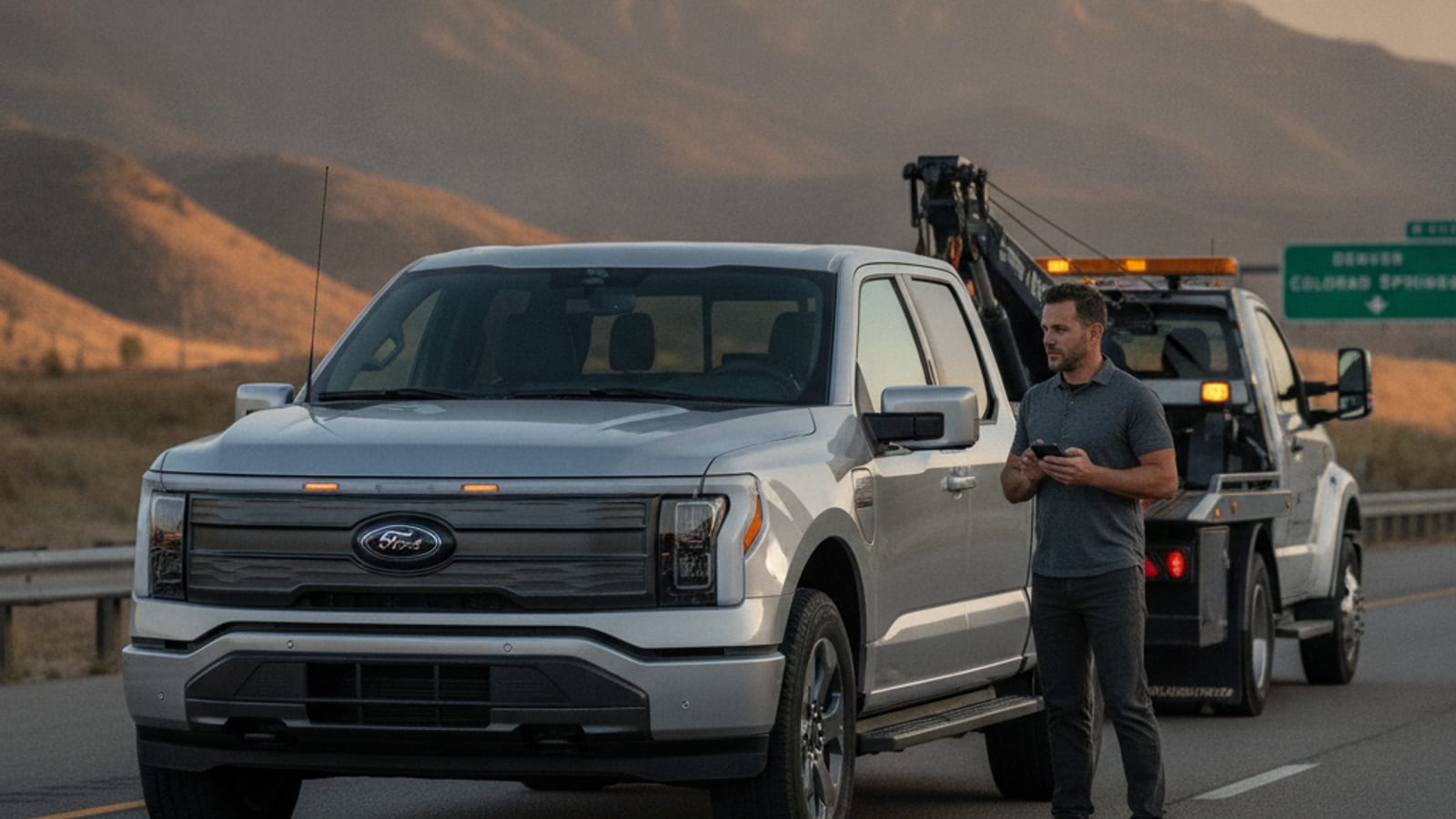
Geico Emergency Roadside Service is a gas-car toolkit with a mileage cap. It still does not bring 240 volts to a stranded EV. If you stall on I-25, on Peña, or in a Thornton neighborhood, that is the whole story. A jump can wake a dead 12-volt. A tow can move you to a plug. Neither one refills the traction pack at the bumper. If you need a charge where the car sits, the call is to a mobile operator, and the number is (720) 738-6950.
What Geico ERS actually lists
Geico publishes an Emergency Roadside Service menu. The items are towing to the nearest qualified repair facility with a mileage cap, battery jump-starts, tire changes with a working spare, lockout help with a dollar cap on covered causes, winching near a publicly maintained roadway with a distance cap, and fuel delivery with the fuel cost not included. Coverage moves with the state, and the mileage number sits on your policy contract, not on a blog. The page does not list on-site EV pack charging.
This page won’t quote your Geico mileage or lockout cap. Open the declarations page on the Geico app, or call Geico, and read the numbers before you wait on a truck.
A dead 12-volt is the call Geico can finish
Every EV hides a small 12-volt battery. It runs computers, locks, lights, and the contactors that wake the traction pack. After a January night near 18 degrees on the Denver plain, that 12-volt is often what quits. A week in a cold DEN garage often kills the 12-volt, not the pack. Geico can send a contractor to jump it, the same way it would a gas car. If the jump holds, you drive away on your own power. If the jump doesn’t hold, the next covered step is a tow to a shop. Operators we refer cover that same 12-volt jump on site. Other brands follow the same pattern with their own 12-volt access.
A January 2024 arctic blast swung Denver from 47 to minus 19 in about 48 hours. A long sit in a cold lot during a swing like that is a real 12-volt killer. A driver who returns to a dark Tesla or a dark Ioniq 5 should suspect the 12-volt before the pack. Recurrent Auto studied more than 30,000 U.S. EVs and found they keep about 78 percent of max range at 32 degrees and about 70 percent at 20 degrees on average. The pack is usually still there. The 12-volt is the visible failure.
Ask the dispatcher whether the contractor is bringing 240 volts, or only a jump and a flatbed. This site couldn’t confirm a published Geico policy for on-site EV pack charging in Colorado. Until Geico says otherwise on your contract, treat jump and tow as the default.
Towing miles live on your policy, not on a blog
Geico sells more than one roadside tier. Covered miles and per-call limits move with that paperwork. Some contracts bundle ERS, others add it as a rider, and the towing cap is part of that bundle. This page won’t invent your towing cap. Ask Geico how far they will tow an EV. Ask whether a separate cap applies to an electric vehicle. Do it before you are on the shoulder with hazards flashing.
CRS 42-4-1202 lets a disabled vehicle sit on the paved shoulder outside a business or residential district if it is impossible to move it further. Hazards must be on under CRS 42-4-230. Colorado has no separate statute for a dead EV, so the same disabled-vehicle rules apply. A driver is allowed to wait on the shoulder while the help line is on the phone.
A tow to a plug still is not 240 volts at the bumper
A flatbed moves the problem to a different parking stall. You still need a working stall, then you wait while the pack takes energy. Most EVs should ride a flatbed so the drive units and regen hardware stay off the pavement. Confirm that truck type with the Geico dispatcher. A wheel-lift is the wrong tool for a Model Y on a frozen shoulder.
If Geico tows you toward a charger, use Supercharger sites the inventory actually lists. Park Meadows in Lone Tree has 10 stalls. Highlands Ranch and Castle Rock each have 16. Idaho Springs has 8 on the west I-70 climb. They don’t put 240 volts on your port while you sit on the shoulder. They also don’t help if your port is frozen shut. A stuck charge port is a latch problem, not a tow problem, and a mobile operator can clear it on site before any cable goes in.
CDOT and E-470 jump a 12-volt, not the pack
CDOT Safety Patrol is free on covered metro freeway segments. Coverage includes I-25 South from 120th Ave to Arapahoe Rd. It also covers I-70 East from Wadsworth to Airport Blvd. Portions of US-6, C-470, and I-225 are on the same list. Front Range weekday hours are 6:00 to 9:30 a.m. and 2:30 to 7:00 p.m. Weekend hours run 10:00 a.m. to 7:00 p.m. Mountain Corridor hours run 6:00 a.m. to 7:00 p.m. Friday through Sunday, and during significant weather. CDOT’s published menu is tires, jumps, fuel, debris, and minor mechanical help. CDOT’s Safety Patrol and breakdown pages don’t mention electric vehicles. The free state program will jump a 12-volt, and it will not bring a charge to a stranded EV.
E-470 is a cashless toll loop on the east side. Pull to the shoulder and dial *470 for E-470’s own roadside assistance. The authority lists flat tires, jump-starts, fluid top-offs, phone help, and debris removal. State Patrol is *CSP, which is *277. E-470 doesn’t publish an EV charging service either. A jump from either program is still a 12-volt answer.
If the car is in a travel lane or another dangerous place, call 911 first. Hazards on, exit the travel lane if it is safe to do so, then work the help line.
A mobile charge is a different job than a tow
If the traction pack is empty, you need energy where the car sits. A mobile EV charging referral is that job. Charge Pro DEN is a referral line for the Denver metro. We don’t own trucks and don’t employ technicians. Independent operators we connect you with bring a 240-volt Level 2 source to the bumper. Teslas get a native NACS plug, and other brands use a CCS or J1772 adapter. Typical charging adds about 10 to 20 miles in 15 to 30 minutes of charging. The clock starts when charging starts, not before. It is not an arrival time, and we don’t promise one.
Those miles let you drive under your own power to a Supercharger or home. You are not waiting on a public stall from a flatbed. For an empty pack, use out-of-charge recovery. For the broader choice, read charge in place or tow.
Operators we refer cover Tesla, Rivian, Hyundai, Ford, and every major EV brand sold in Colorado. They quote you before any cable goes in, and they bill you directly for the work they do. Charge Pro DEN doesn’t set the price on any of these jobs. The operator who takes the call is the one who quotes and bills.
When Geico is still the right call
Keep Geico for flats, lockouts, and shop tows. Use the 12-volt jump when the 12-volt is the real fault. Call a mobile operator when the pack is what’s empty. Each tool does one job. The mistake is mixing them.
Allstate roadside for an EV runs on the same gas-car toolkit and the same gas-car cap. AAA’s charge-or-tow call is the same question from a club network. Read one of those if your policy sits with a different carrier. What a mobile EV charger actually brings walks through the truck, the cable, and the typical 10 to 20 mile result. Both are short reads for a shoulder moment.
When the 12-volt is the call and the pack is fine
If the dash went dark overnight and the traction gauge still shows range, that is a 12-volt fault, not an empty pack. A jump from Geico, from CDOT Safety Patrol, or from an operator we refer will finish it in most cases. If the 12-volt won’t hold a charge, an on-site replacement is the next step. Other brands follow the same pattern with their own 12-volt access.
If the dash showed low range first and the car is dark now, treat it as an empty pack. Geico’s covered answer is a tow. The mobile-charge answer is 10 to 20 miles added in place. The two jobs are different, and the dispatcher will not pick for you.
How to make the call from a Denver-metro shoulder
Turn hazards on and stay visible to traffic. Stay in the car if that is the safer choice. If you are on a listed CDOT Safety Patrol segment, check the clock. During published hours, that free jump is for a dark 12-volt. Skip it when the pack was already at zero.
If you hold Geico ERS, call and confirm what your tier covers. Ask whether anyone on the truck carries EV charging gear. Ask what the tow mileage cap is, and where it ends. Write the answers down before you hang up.
If the car is otherwise fine and the pack is empty, call for range. A mobile EV charging referral adds that range in place. We serve the Denver metro from the plains to the foothills. The operator quotes you before any cable goes in. Call (720) 738-6950 when you want that match. Treat it as a referral number, not a rolling promise.
Frequently asked questions
Does Geico bring a charge to a dead EV?
This site couldn’t confirm a published Geico policy for on-site EV pack charging in Colorado. Ask Geico directly before you wait on a truck. Geico’s published menu lists towing, jumps, tire changes, lockouts, winching, and fuel delivery. It does not list a Level 2 charge at the bumper.
Who shows up when I call Geico for a dead EV?
Geico sends a contracted provider from the same roadside network used for gas cars. Confirm they are sending a flatbed so the drive units stay off the pavement. A wheel-lift is the wrong tool for a Model Y or a Mach-E on a frozen shoulder.
Does Geico’s mileage cap change because the car is electric?
No, the cap follows your policy tier. Read the declarations page or call Geico rather than trusting a blog figure. The mileage cap is the same number Geico quotes for any vehicle on that tier.
Can I keep Geico and still call for a mobile charge?
Yes. Geico and a mobile charge solve different problems. Geico and CDOT Safety Patrol move or jump the car. A mobile operator adds range on site instead. Charge Pro DEN doesn’t run a membership. We match you with an independent operator who quotes before work starts.