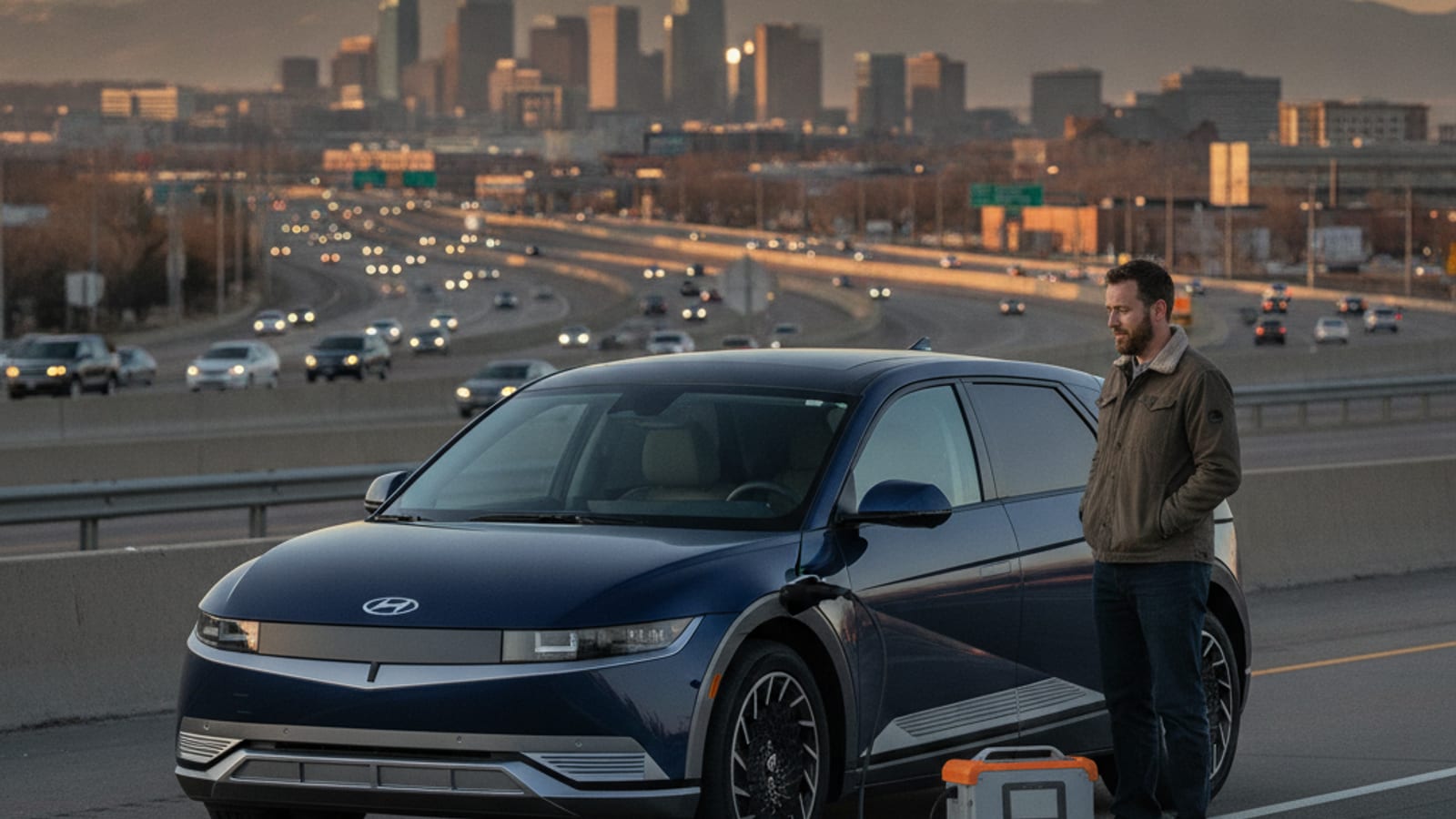
DC fast vs Tesla Supercharger in Denver comes down to where you are and what your car uses. Superchargers are the densest DC fast network in the metro. EVgo and Electrify America add stalls where Superchargers do not reach. None of the three brings a charge to a stranded car on a shoulder. If you’re stuck, call (720) 738-6950 and a local operator can match you with a 240-volt boost that gets you to the next stall.
Three networks, three jobs in the metro
All three are DC fast, which means a heavier cable and a faster charge than the Level 2 a home charger uses. The differences matter when your route puts you near some sites and far from others.
Tesla Superchargers sit at highway corridors, shopping centers, and along the dense south-metro I-25 spine. They use the NACS connector, the standard Tesla opened in 2022 and the industry has since adopted. Most non-Tesla EVs from 2025 onward can charge at a Supercharger with a NACS adapter or built-in NACS port. Older CCS vehicles often need an adapter, and availability varies by site.
EVgo runs an urban DC fast model with shorter cables, often co-located with grocery stores, pharmacies, and parking decks. EVgo publishes 24 sites across Colorado, with metro coverage that overlaps Superchargers in some places and adds coverage in others. EVgo has been adding NACS connectors at select stalls, so Tesla drivers and NACS-equipped non-Tesla cars can plug in without an adapter at those locations.
Electrify America is the CCS-built network that came out of the Volkswagen diesel settlement. It runs DC fast at highway-adjacent sites around the metro. Electrify America has begun adding NACS connectors at a subset of stalls, and the brand’s published direction is dual-connector coverage over time. The connector mix at a given site is the practical detail, not the brand’s overall plan.
Where Superchargers cluster in the metro
Tesla Superchargers are denser here than the other two networks. The current NREL pull shows metro sites with stall counts ranging from about 6 to 16 stalls per location. Denver itself has several sites, including a dense cluster around the central city. The south-metro I-25 spine is well covered: Lone Tree Park Meadows (about 10 stalls), Centennial (about 12), Highlands Ranch (about 16), and Castle Rock (about 16). Lakewood, Boulder, Thornton, Northglenn, Westminster, Arvada, Brighton, and Longmont each carry at least one Supercharger site.
For a driver on the metro grid, a Supercharger is rarely more than a few miles off the planned route. The density is part of why Tesla drivers default to them. It is also why a Supercharger-down or Supercharger-full question shows up in our other posts.
The I-70 corridor is the exception
The flagship corridor is I-70 west of Golden, where the Supercharger network is sparse by metro standards. The verified anchor on the climb is Idaho Springs at 7,526 feet, with about 8 stalls in town. It is the last Supercharger before the Eisenhower-Johnson Memorial Tunnel at 11,158 feet. Georgetown, sitting in between Idaho Springs and the tunnel, shows no Supercharger in the current inventory.
That makes Idaho Springs the point where a low-charge driver decides whether to commit. Past Georgetown without enough margin, the next confirmed Superchargers sit over the tunnel at Silverthorne and Frisco. We cover that scenario in the Idaho Springs Supercharger post, which addresses both the down-stall and the full-stall cases.
The climb eats range faster than the trip meter predicts. Cold and altitude combine with the grade, and the heater runs against the air. Recurrent Auto’s study of more than 30,000 U.S. EVs shows EVs retain about 78 percent of max range at 32 degrees and about 70 percent at 20. A driver who left Denver with a comfortable buffer can watch it vanish between Golden and Idaho Springs in January. The useful counterpart on the descent is regen. A Lucid Air GT used about 3 percent of its battery over a 77-mile descent from Loveland Pass, and a Hyundai Ioniq 5 about 10 percent over 75 miles, both crediting regenerative braking.
Where EVgo and Electrify America add coverage
EVgo’s strength is in metro areas, and Denver fits that model. The 24 Colorado sites include urban shopping centers and grocery-anchored locations that sit closer to homes and apartments than highway-adjacent Superchargers. For a Capitol Hill apartment dweller who street-parks, an EVgo site at a nearby grocery store can be a shorter detour than a Supercharger on a commercial arterial.
Electrify America’s role is the highway-adjacent site at retail boxes and freeway frontage roads. It is the third DC fast network in the metro, and where its stalls exist, they tend to be near I-25 and I-70 interchanges. The connector mix at a given Electrify America site is the practical question. A non-Tesla EV with a built-in NACS port can plug in at NACS-equipped stalls. A CCS-only EV needs CCS. A Tesla driver needs NACS, with or without an adapter, depending on the site.
The metro sits inside about 7,800 public charging ports statewide, and the share that is DC fast versus Level 2 varies by county. For a stranded driver, the relevant question is not the statewide port count. It is whether the nearest DC fast stall is operational, the right connector, and available right now. Three separate apps answer that question: Tesla’s app for Superchargers, the EVgo app, and the Electrify America app.
When each network fits, and when none do
A Tesla driver on a south-metro trip is closest to a Supercharger the majority of the time. A non-Tesla EV on the same trip checks the Electrify America and EVgo apps first, especially if the car is CCS-only. A driver in an older urban apartment building without a home plug uses EVgo at a co-located grocery store more often than a Supercharger on a highway. The networks are not interchangeable, and they were not designed to be.
When all three are down or full, the stranded driver still needs help. A mobile EV charging referral is the next step. The operators we refer bring a 240-volt Level 2 source with NACS, CCS, or J1772 adapters, depending on the car. Typical charging time adds 10 to 20 miles. That is enough range to drive under your own power to a working stall. Use mobile EV charging for the metro-wide referral option, or out-of-charge recovery for the broader empty-pack case.
Connector compatibility is the real answer
Connector compatibility decides whether a stall works for a given car, not the network name. NACS is the standard Tesla opened. CCS is the standard most non-Tesla EVs from 2014 through 2024 ship with. CHAdeMO is the older Japanese fast-charging standard that has largely faded from new installs.
A Tesla with the built-in NACS port plugs into a Supercharger without an adapter. A Tesla at an Electrify America site needs a NACS-equipped stall, which is increasingly common but not universal. A non-Tesla EV with a built-in NACS port (the 2025 and newer Ford, Rivian, Lucid, Hyundai, Kia, and others) needs a NACS-equipped stall at Electrify America and EVgo, or an adapter at a Supercharger. A CCS-only EV (most pre-2025 non-Tesla EVs) needs CCS hardware at EVgo and Electrify America, and a CCS-to-NACS adapter at a Supercharger.
Adapters exist and work. They are not always in the trunk when you need one, and not every stall configuration accepts them. The fastest answer is in the car app that matches the network. The fallback answer is non-Tesla EV rescue for a CCS or J1772 vehicle that cannot find a working stall.
What a metro-wide charging inventory actually shows
The NREL Alternative Fuels Data Center lists about 7,800 public charging ports across Colorado. Tesla Superchargers are the densest DC fast network in the metro. EVgo has 24 Colorado sites, with metro concentration in retail-anchored parking lots. Electrify America covers the highway-adjacent sites that the other two networks sometimes miss. ChargePoint runs the largest Level 2 footprint in the metro, but its stalls are mostly Level 2 and slower than DC fast.
For a Denver metro driver, the practical takeaway is that DC fast coverage is good but uneven. The dense south-metro I-25 spine, the central Denver sites, and the Boulder County cities are well served. The I-70 mountain corridor is one Supercharger in Idaho Springs and a gap until Silverthorne and Frisco. The far eastern plains toward Bennett and Watkins thin out fast, with services dropping away before the metro ends.
When a charging network will not help
A public charging network assumes the car can reach a working stall. Three situations break that assumption.
The car is dead at the shoulder. A car that lost the 12-volt battery in a cold lot, a car that will not ready, or a car that rolled to a stop on the highway cannot drive to a stall. CDOT Safety Patrol covers some Front Range and mountain corridors for free and will jump a 12-volt on those listed segments during published hours. It does not bring a charge. E-470 patrol answers *470 and does the same jumps and tire work. Neither is a charge.
The nearest stall is offline or full. Stalls go offline. Stalls fill up. The apps show real-time status, but a Saturday ski weekend on I-70 can stack six cars at the Idaho Springs Supercharger. The wait can stretch. A mobile boost from an independent operator is the fastest way to add the range to drive past the wait.
The pack is below what the stall can serve. A very low pack, especially in the cold, throttles DC fast charging. The car takes the charge, but at a much slower rate for the first 10 to 20 percent. A mobile Level 2 boost gets the car to a state where DC fast will accept a normal charge curve, which is faster than waiting for the throttled initial ramp.
For a dead-pack car anywhere in the metro, call (720) 738-6950. The operators we refer bring a 240-volt Level 2 source and quote you before they start. You pay them directly for the work.
How to plan around the gaps
A Denver metro driver planning an I-70 west weekend tops up at Idaho Springs. A driver heading south toward Colorado Springs tops up at Castle Rock, the last big Supercharger before Monument Hill and the Palmer Divide. A driver heading east past Watkins checks the range to Bennett, the last real town before the long empty run toward Limon and Kansas.
For a metro driver running daily life, the practical question is which network fits the car and the route. A Tesla is easiest. A NACS-equipped non-Tesla is nearly as easy. A CCS-only non-Tesla is doable but slower to plan, because every stop needs a CCS-equipped stall, which means the EVgo and Electrify America apps alongside the Supercharger app.
A mobile charge referral covers the day when the planning did not work, the stall was down, the pack was lower than expected, or the cold ate more range than the trip meter showed. The operators we refer are independent and quote you before they start. They are not Tesla, they are not EVgo, they are not Electrify America. They are a different kind of help, and they exist for the cases the networks cannot cover.
Frequently asked questions
Which network is densest in the Denver metro?
Tesla Superchargers. The current inventory shows multiple sites per city across the south-metro I-25 spine, the central Denver area, the Boulder County cities, and the western and northern suburbs. EVgo and Electrify America add stalls where Superchargers are not located.
Can a non-Tesla EV use a Supercharger in Denver?
Most 2025 and newer non-Tesla EVs have a built-in NACS port and plug into a Supercharger directly. Older CCS-only EVs need an adapter, and not every stall configuration accepts one. Check the Tesla app for your specific vehicle before you count on a Supercharger stop.
Does EVgo have NACS connectors?
EVgo has been adding NACS connectors at select stalls. Tesla drivers and NACS-equipped non-Tesla cars can use those stalls without an adapter. Tesla and CCS availability still varies by site, so check the EVgo app before you drive over.
What if all three networks show stalls down near me?
Call (720) 738-6950. The operators we refer bring a 240-volt Level 2 source with NACS, CCS, or J1772 adapters for the car. They quote you before they start, and they add enough range to drive to a working stall.