You left an EV in a cold Aurora lot near Buckley for a week. You come back, tap the handle, and the car won’t wake. That’s almost always the 12-volt battery, not an empty traction pack. Roadside help here is a jump or an on-site swap. If the pack is low, you still need enough charge to roll out.
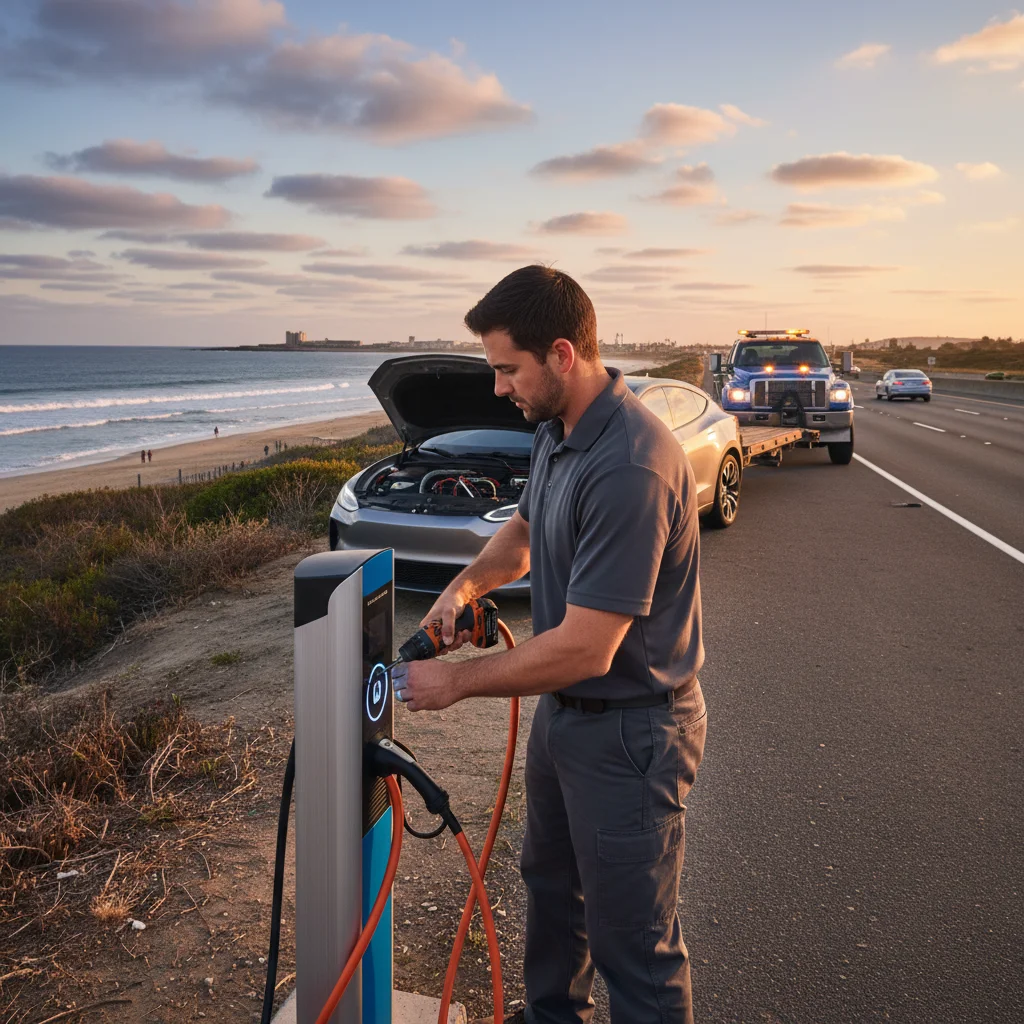
The big battery can still hold plenty of miles. The small 12-volt runs the computers, locks, and contactors. It sat through Front Range cold with nothing plugged in. After a long soak, it often won’t close the high-voltage loop. You’re locked out of a car that still has range.
Charge Pro DEN is a referral line for the Denver metro. We match stranded drivers with independent local operators. We don’t own trucks, and we don’t do the work. The operator quotes you before starting and bills you directly. The pros we connect you with are licensed and insured.
Why a week near Buckley kills the 12-volt
Buckley Space Force Base sits on Aurora’s east side. Base-adjacent commuters park through long shifts. Travelers use east-metro lots on the way to Denver International. The Anschutz Medical Campus adds long dwells of its own. In each case the EV soaks in open air. It’s not sitting in a warm garage.
January’s normal low around the metro sits near 18 degrees. In January 2024 an arctic blast hit Denver. Temperatures dropped from 47 to minus 19 in about 48 hours. You don’t need that extreme to kill a 12-volt. A week of ordinary January nights is enough. Wind on Aurora’s eastern edge makes a parked car colder still.
Teslas still use a 12-volt system to wake the car. So do most other EVs. Read whether Teslas have a 12-volt battery, and why cold parking kills it. Cadillac, Hyundai, Ford, and Rivian cars fail the same way. It happens after a long, cold sit. See this Cadillac Escalade IQ cold-lot writeup for the same failure in a larger body.
When the 12-volt is dead, the dash stays dark. Handles may not work. The app may show the car offline. None of that proves the traction pack is empty. A jump or an on-site 12-volt replacement is the first move. A flatbed is not. Start with the Tesla 12-volt jump path. Operators handle non-Tesla EVs with the same 12-volt job. If the car won’t unlock at all, use this locked-out 12-volt guide.
West Aurora and east Aurora sit differently
Aurora is the metro’s third-largest city. Census ACS figures put the population at 390,201. It’s also the most diverse city in the metro. The land area is 163 square miles. It crosses Adams, Arapahoe, and Douglas counties. The west side and the east side don’t strand for the same reason.
West of I-225 you get older apartments along Colfax Avenue and Havana Street. Original Aurora, Del Mar, and Hoffman Heights still have a lot of older stock. Census figures put pre-1980 housing at 37.8 percent. Many of those buildings have no home plug. Cars live on the street or in open lots. A cold morning with a weak 12-volt is a regular pattern there.
East toward E-470, Tower Road, and Peña Boulevard, the housing is newer. Southlands, Tallyn’s Reach, and Saddle Rock sit closer to the plains. Wind hits harder on that edge. Ground blizzards can wipe visibility on open ground. The cars still sit outside. A week in a lot near Buckley is the signature failure. So is a week in a DEN garage. You return from travel, and the car is a brick.
Xcel Energy serves most of Aurora. Confirm the utility on the far eastern and southern fringes. CORE Electric Cooperative serves Bennett and Foxfield. Confirm fringe Aurora addresses by the service address. Don’t assume every east-metro plug is an Xcel bill. For I-70 East toward the airport, see EV roadside assistance in Aurora. The Aurora city page has the local corridors in one place.
Buckley, Anschutz, and a week at the airport
Buckley adds a base-adjacent commuter pattern. Cars sit through a duty day, then another. A week-long sit happens when someone is traveling. We could not confirm Buckley gate rules from a public source we can cite. Visitor towing and on-base parking policy were not verified either. If you’re on the installation, follow the base’s own vehicle rules. If you’re in a civilian lot off the fence, stay with the car. A mobile operator can usually work it in place.
The Anschutz Medical Campus adds another long-dwell cluster. So do UCHealth and Children’s Hospital. Cars sit through long hospital shifts in January. Stanley Marketplace and the Town Center at Aurora produce shorter sits. A car left through a full workday in the teens still wakes poorly.
Denver International sits at the end of Peña Boulevard. Peña is an 11-plus-mile city-maintained freeway, not a state highway. It’s the only road in. It runs exposed across open plains. Ground blizzards have closed it, including the March 2019 bomb cyclone. The high-value airport call is still the lot, not the shoulder. You left the EV for a week in January. You came back to a dead 12-volt.
DEN parking includes terminal garages, shuttle lots, economy lots, valet, and a cell-phone lot. Stall counts inside those facilities were not independently confirmed from the airport’s own site. Don’t plan around a number from a search snippet. Treat the car as a 12-volt patient first. If the pack is truly empty, that’s a different job.
Jump the 12-volt before you call a flatbed
Stand away from traffic and try the obvious checks. Check whether the app sees the car. See if the lights flash. See if the door handles present. A Tesla with a dead 12-volt often looks fully bricked. A standard 12-volt jump to the designated posts is the usual path.
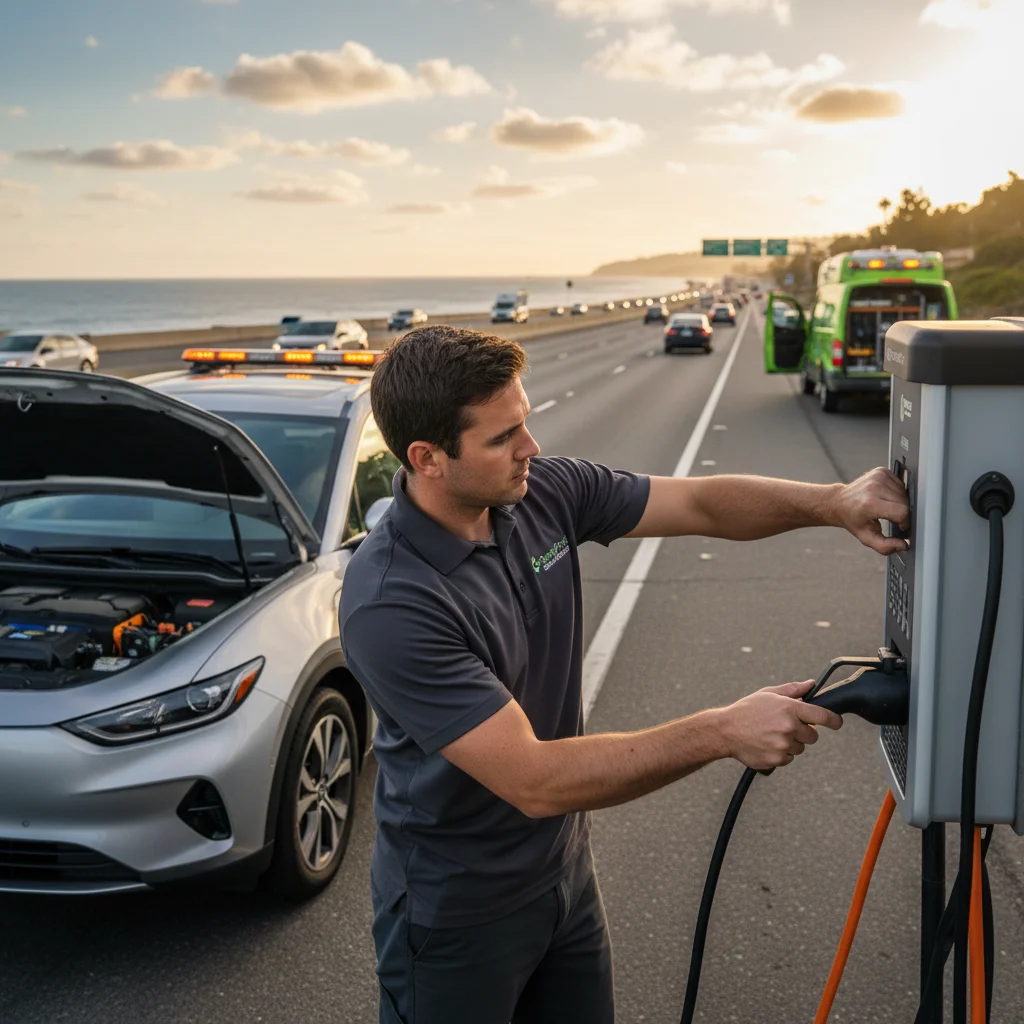
Operators we refer can jump the 12-volt on site. They can replace it on site when a jump won’t hold. They can also bring a 240-volt Level 2 source. That’s the tool when the traction pack is the problem. Native NACS plug for Teslas. CCS or J1772 adapters for everyone else. They handle Tesla and every major EV brand.
A tow still has a place. The car may be in a travel lane. The 12-volt may take a charge and die again. The pack may be empty, and the lot may not allow a long sit. Colorado towing carriers are regulated by the Public Utilities Commission. There’s no Colorado statute just for a disabled EV. The same disabled-vehicle rules apply as any other car.
If the pack is actually empty
Sometimes the 12-volt is fine and the traction pack is at zero. You ran errands on I-225. You sat on I-70. You climbed Parker Road or Smoky Hill with the heater on. Cold eats more miles than the dash promised. Recurrent Auto’s winter study measured cold-weather range loss. EVs kept about 78 percent of max range at 32 degrees. They kept about 70 percent at 20 degrees, on average. None of that is a promise for your car on Tower Road tonight.
If the car wakes, shows zero, and won’t move, you need a charge. Operators we connect you with bring a 240-volt Level 2 source to the car. Typical add is 10 to 20 miles of range. That takes 15 to 30 minutes of charging time. That’s charging time, not a clock on when someone arrives. Mobile EV charging is the referral path for that job.
What to tell the referral line
If the car died on a covered freeway shoulder, CDOT Safety Patrol can help. They jump-start, change a tire, and clear debris. Metro coverage includes I-70 East from Wadsworth to Airport Boulevard. It also includes portions of I-225. Weekday hours are 6:00 to 9:30 a.m. and 2:30 to 7:00 p.m. Weekends run 10:00 a.m. to 7:00 p.m. Those pages mention nothing about EV charging. On E-470, dial *470 for the authority’s published jump-start help. *CSP is *277 for State Patrol.
Say whether you’re in a lot or on a shoulder. Near Buckley is a start. A pin in your maps app is better. Name the lot if you can. Direction of travel matters on I-225, I-70, E-470, and Peña. Say the make, model, and what the car is doing. Doors dead, app offline, or awake at zero percent. Those are different jobs. The operator, not Charge Pro DEN, sets the price and the plan. You hear the quote before work starts. Confirm the current quote with the operator before they begin.
CRS 42-4-1202 is the disabled-vehicle-on-the-shoulder rule. The exception is a car so disabled you couldn’t keep going. Hazards go on under CRS 42-4-230. COtrip.org and 511 are the live sources for closures and traction-law status.
A week-cold car near Buckley doesn’t need a shop first. It needs a jump or a 12-volt replacement on site. Or 10 to 20 miles in the pack if that’s what failed. When you’re ready, call (720) 738-6950. We connect you with a local mobile rescue operator. They bring the 240-volt source or the 12-volt tools.