CDOT Safety Patrol covers I-70 East from Wadsworth to Airport Blvd. The peak windows are published, and they’re limited. A patrol truck will jump a 12-volt battery and change a tire. It won’t bring a charge to an empty EV on the Aurora shoulder. If the traction pack is dead, you need a local mobile operator.
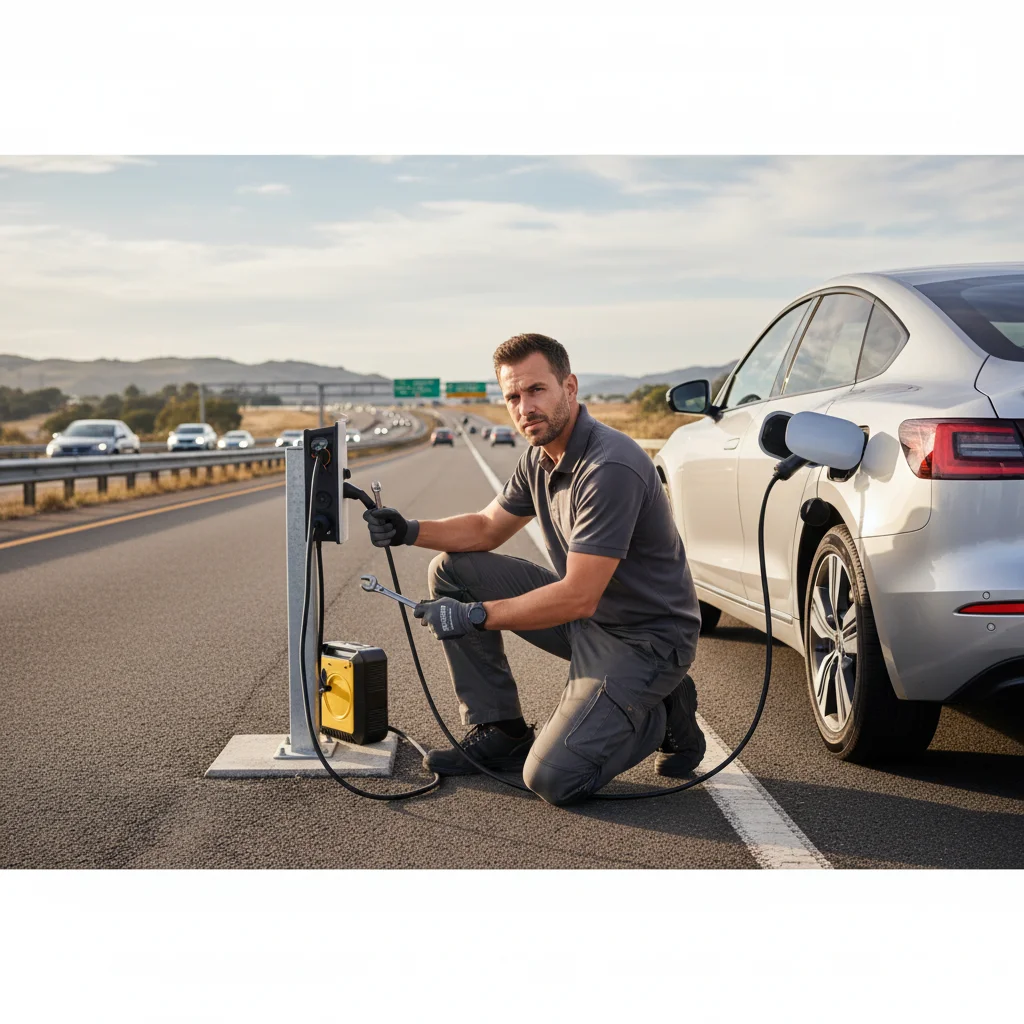
What CDOT covers on I-70 East, and what it skips
The free program sits under CDOT’s Division of Maintenance and Operations. It works I-70 East from Wadsworth to Airport Blvd. Front Range weekday hours are 6:00 to 9:30 a.m. The afternoon window is 2:30 to 7:00 p.m. Weekends run 10:00 a.m. to 7:00 p.m.
Inside those clocks, Safety Patrol can handle flats, jump-starts, and emergency fuel. It also handles minor mechanical help, debris, and incident support. CDOT’s Safety Patrol page doesn’t mention electric vehicles. The “my car broke down” page doesn’t mention charging. A dead traction pack isn’t on the list.
Plenty of Aurora cars fail on the 12-volt, not the pack. The patrol can try that jump when they’re on the segment in window. They can’t plug in a Level 2 cable and add range. That’s why EV roadside assistance exists as a separate call.
Colorado has no statute for a disabled EV as a special class. CRS 42-4-1202 treats your car like any other disabled vehicle. There’s no charging carve-out, and the state’s free truck isn’t a mobile charge.
Aurora’s eastbound problem is wind, cold, and the airport
Aurora is the metro’s third-largest city, about 390,000 people. It sprawls east across Adams, Arapahoe, and Douglas counties toward open plains. West Aurora runs along Colfax Avenue and Havana Street. Older apartments are common, and a lot of drivers have no home plug. East Aurora runs toward E-470, Tower Road, and Denver International.
I-70 is the eastbound spine through all of that. Peña Boulevard peels off as the only road into DEN. E-470 loops the east metro as an all-electronic toll road. Parker Road, Smoky Hill Road, and Tower Road all feed the same airport push. This isn’t a canyon climb: it’s flat, treeless, and fully exposed to wind.
January’s normal low sits near 18 degrees. Recurrent Auto’s winter study of more than 30,000 U.S. EVs found a clear pattern. Cars keep about 78 percent of max range at 32 degrees. They keep about 70 percent at 20 degrees.
Ground blizzards are common on this eastern flank. The March 2019 bomb cyclone closed I-70, I-25, and Peña Boulevard. Every runway at DEN shut in that same storm. Peña is city-maintained, not a state highway. It runs more than 11 miles across open ground. When that freeway ices, you’re sitting in wind with no terrain to hide behind.
Xcel Energy serves Aurora, which you should confirm on your bill. Confirm the bill at the far eastern and southern fringes. Bennett, farther out on I-70, is CORE Electric Cooperative. Don’t assume the same utility just because both sit on this interstate.
Empty pack or dead 12-volt: sort it before you call
The obvious stranding is a traction pack at zero. You left a Southlands lot with a thin buffer. Heat and a headwind ate the estimate. Airport traffic on Peña held you in a crawl. The car hit limp mode before you reached the garage.
The quieter stranding is the trip home from a week in a DEN lot. The pack still has charge, and the 12-volt doesn’t. Doors may not unlatch, and the dash may stay dark. That’s a jump or an on-site 12-volt replacement, not a flatbed by default.
Same 12-volt soak shows up after a long Anschutz shift in January. It also shows up after a Buckley lot sit through a cold night. A week in airport parking is the extreme version of that soak. DEN charging stall counts aren’t something we can confirm from the airport’s own pages.
Don’t treat those two failures as one job. An empty pack needs a 240-volt Level 2 top-up on the shoulder. A dead 12-volt needs a jump, and sometimes a replacement battery on site. Operators in the network handle both of those failures. If you can’t tell which one you have, start with out-of-charge recovery. Tell the operator what the dash is doing. A Tesla, a Rivian, a Ford, or a Hyundai can all land in either bucket. The plug changes, the first question doesn’t.
Stay on the shoulder, and stay in the car
CRS 42-4-1202 is Colorado’s disabled-vehicle rule. Outside a business or residential district, you may not stop on the paved travel lanes. The exception is a vehicle so disabled it can’t be moved off the roadway. Hazards must be on under CRS 42-4-230. A violation is a class B traffic infraction.
If the car truly couldn’t go farther, the shoulder is lawful with hazards lit. Sitting in a through lane isn’t a plan.
Abandoned-vehicle law sits in a different statute. CRS 42-4-1803 through 1805 let an officer act on reasonable grounds. The text sets no 24-hour or 72-hour clock. Don’t assume the car can sit until morning. Colorado State Patrol handles crash response and holds removal authority.
If you’re partly in a live lane, call 911 first. Traffic control comes before a charge cable goes on.
What to do on I-70 East when the car is done
- Signal right and start the pull-over as soon as the car warns you’re nearly empty. Don’t ride a through lane to zero.
- Turn hazards on before you finish stopping.
- Stay in the car with the seatbelt fastened. The east-plains shoulder isn’t a place to stand.
- Write down direction of travel, the nearest exit, and a mile marker if you can see one.
- Check COtrip.org or 511 if weather is why you stopped.
- If Safety Patrol is already there in window, take a 12-volt jump when that’s the failure. They can’t charge the pack.
The peak window ends. Your car doesn’t start.
Weekday metro patrol is off the clock between 9:30 a.m. and 2:30 p.m., then again after 7:00 p.m. Late-morning stalls on I-70 East through Aurora sit inside the map and outside the clock. Weekend hours run 10:00 a.m. to 7:00 p.m. A Sunday night return from DEN isn’t a Safety Patrol job.
That’s not a knock on CDOT’s program. The program was built for flats, jumps, and stalled gas cars in commute traffic. OEM roadside and insurer roadside often send a tow, and they rarely send a charger. Tesla roadside, CDOT patrol, or a local boost is the same fork from the Tesla side.
Charge Pro DEN is a referral line that matches you with independent local operators. It doesn’t own trucks, employ technicians, set prices, or publish hours. The operator quotes you before work starts and bills you directly.
What a mobile operator brings to an Aurora shoulder
The pro who arrives brings a 240-volt Level 2 source to the car. Tesla and other NACS cars take a native plug. CCS and J1772 cars take an adapter. This isn’t DC fast charging: it’s a parked on-shoulder top-up.
Typical charging time is 15 to 30 minutes. That’s cable-in time, never an arrival promise. In that charging window the car usually gains 10 to 20 miles. The added 10 to 20 miles gets you off I-70 or into a garage. You’re not filling the pack on the shoulder.
If the 12-volt is the failure, the same operator can jump it. Tesla and every major EV brand are in scope. For the charge itself, see mobile EV charging.
Peña, E-470, and I-70 aren’t the same call
I-70 East through Aurora is the CDOT Safety Patrol segment from Wadsworth to Airport Blvd. Peña Boulevard is city-maintained, and it’s the only road into DEN. If the car dies on that airport freeway, treat it as its own problem. We walked through it in ran out of charge on Peña Boulevard toward the airport.
E-470 is a separate public highway authority. Dial *470 for E-470’s own assistance, or *CSP (*277) for State Patrol. E-470 publishes flats and jump-starts. It doesn’t publish an EV charge.
Out of charge on I-70 is the wider interstate version. For the city itself, use the Aurora EV charging page.
Frequently asked questions
Does CDOT Safety Patrol charge an EV on I-70 East in Aurora?
No. The patrol will jump a 12-volt and change a tire in published peak windows. CDOT’s pages don’t mention EV charging. An empty pack still needs a mobile Level 2 charge from a local operator.
What if I stall after the weekday peak window?
Then the free state truck isn’t on that segment. Weekday hours are 6:00 to 9:30 a.m. and 2:30 to 7:00 p.m. Weekends are 10:00 a.m. to 7:00 p.m. Call a local operator and get a quote before any work starts.
Can a non-Tesla get a charge on this shoulder?
Yes. Operators bring a native NACS plug plus CCS and J1772 adapters. Confirm the car’s inlet when you call so the pro brings the right adapter.
If you’re on the I-70 East shoulder through Aurora, call (720) 738-6950. Charge Pro DEN will connect you with a local operator. The operator quotes the job before it starts. If a tow is the honest next step, that’s what you’ll hear.