Your EV died in Parker. You need power at the car, not a shop drop. Charge Pro DEN matches stranded drivers with independent local operators. Those operators bring a 240-volt Level 2 source to the vehicle. Tesla cars take a native NACS plug. Other brands use a CCS or J1772 adapter. That’s EV roadside assistance in CORE Electric Cooperative territory. Calls cluster on Parker Road, E-470, long retail lots, and the I-25 side.
Parker is CORE territory, not Xcel
Parker sits in Douglas County on rolling high plains east of I-25. The American Community Survey counts 60,115 people here. The Census 2024 estimate is 65,473. Only about 3.6 percent of homes went up before 1980. This town grew fast on new streets. A wall charger in the garage is the usual setup. When that overnight plug fails, the commute still starts.
Your utility is CORE Electric Cooperative, not Xcel Energy. CORE used to be Intermountain Rural, and it still owns this south-metro belt. Lone Tree, Castle Rock, Castle Pines, and Centennial share that co-op. So do Highlands Ranch, The Pinery, and Stonegate. Calling Xcel about a Parker driveway bill reaches the wrong company.
CORE names two EV programs you can check without guessing a rebate. COREV Charge is the residential charging program. CORE’s own page says it’s at capacity and closed to new applications. COREV Connect still accepts enrollments. It’s a bill credit for linking an EV or charger to CORE’s platform. Confirm current terms on core.coop. Other rebate amounts weren’t verified here.
A closed home program doesn’t empty the pack by itself. Skipping the plug, a tripped breaker, or a session that stopped overnight will. You leave Cottonwood or Newlin Meadows thinner than you thought. Parker Road at highway speed finishes the drop.
Parker Road, E-470, and the I-25 merge
Parker Road is State Highway 83. It runs northwest toward Denver and south toward Franktown. E-470 is the eastern metro loop, all-electronic and cashless. Mainstreet cuts through historic Downtown Parker. Hess Road, Lincoln Avenue, and Hilltop Road feed the subdivisions to those bigger roads.
Lincoln Avenue is the westbound cut toward I-25. E-470 is the other on-ramp to that freeway. Parker isn’t sitting on I-25. Lone Tree and Castle Rock sit closer to that interstate. Parker commuters still use it every weekday. You merge, you sit, and the estimate falls. That’s the I-25 rescue pattern for this town.
If the car dies on a highway shoulder, CRS 42-4-1202 is the rule. Outside a business or residential district, stay off the paved travel lanes. The exception is a vehicle so disabled it can’t be moved. Hit the hazard lights and stay with the car. CRS 42-4-230 covers that lighting. A violation is a class B traffic infraction. Colorado has no separate statute for a disabled EV.
CDOT Safety Patrol is free on covered freeway segments. Crews will jump a 12-volt, change a tire, and clear debris. Weekday Front Range hours are 6:00 to 9:30 a.m. and 2:30 to 7:00 p.m. Weekends run 10:00 a.m. to 7:00 p.m. I-25 South coverage is 120th Avenue to Arapahoe Road. That published stretch sits north of Parker. CDOT’s Safety Patrol pages never mention charging an EV. Don’t wait on a patrol truck for pack energy.
E-470 runs its own help line. Pull to the shoulder and dial *470. The E-470 Public Highway Authority lists flats, jump-starts, fluids, phone help, and debris. *CSP, which is *277, reaches State Patrol. None of that fills a traction pack. Read out of charge on E-470 before you assume the toll road can. For the interstate, stranded with no charge on I-25 covers the shoulder steps.
The current inventory names a Park Meadows Supercharger in Lone Tree, with 10 stalls. Centennial lists 12 stalls, Highlands Ranch lists 16, and Castle Rock lists 16. A short Level 2 boost may get you to one of those. A stall count isn’t a free cable. If the car won’t move, charge it where it sits.
Long retail parking and the hospital wait
The other Parker call is a lot, not a freeway. Errands on Downtown Mainstreet run long. So does a sit at Parker Adventist Hospital. An evening at the Parker Arts Culture and Events Center does the same. Salisbury Equestrian Park and Rueter-Hess Reservoir pull weekend dwells south of town. The traction pack can look fine when you park. The 12-volt is a separate battery, and cold still kills it.
Denver’s January normal low is around 18 degrees, and Parker shares that high-plains air. Recurrent Auto’s winter study covered more than 30,000 U.S. EVs. It found about 78 percent of max range left at 32 degrees. At 20 degrees the average was about 70 percent. Heat-pump vehicles held about 10 points more at 32 degrees. Your display won’t match a lab average, so leave margin.
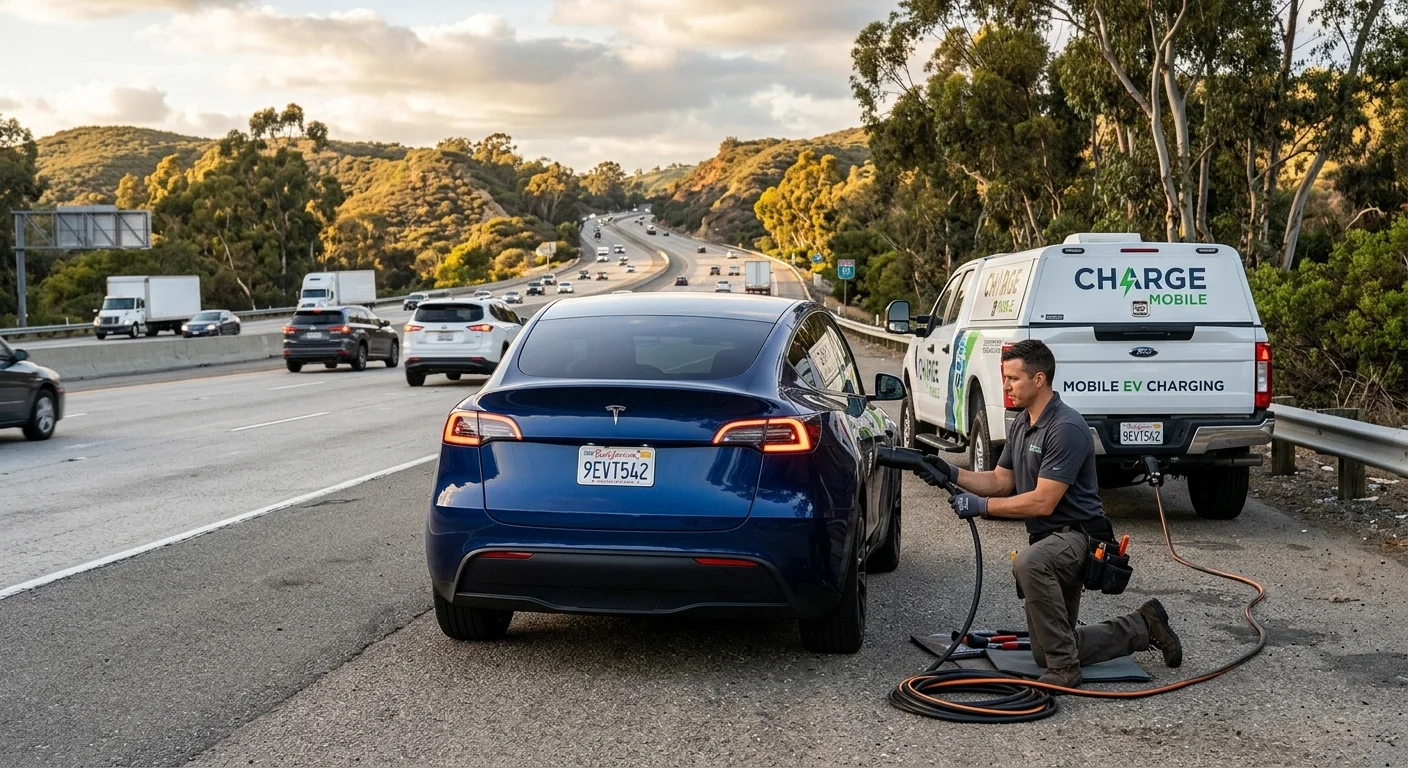
A car that won’t unlock or ready is often the 12-volt. Jump it or replace it on site. That doesn’t add highway miles. A car that readies and shows zero needs energy at the port. Mobile EV charging is that second job. Operators bring Level 2 power to the charge port. Typical added range is 10 to 20 miles. Charging takes 15 to 30 minutes. That window is charging time, never an arrival time.
Tesla, Rivian, Hyundai, Ford, and Chevy are all in play here. So are the other major EV brands. The operator quotes before work starts and bills you directly. Charge Pro DEN doesn’t own trucks, run a shop, or set rates.
Newer subdivisions, then the road south
Stroh Ranch, Canterberry Crossing, Cottonwood, Newlin Meadows, and Downtown Parker are the in-town names. Stonegate and The Pinery sit on the edge. Those streets are young, and pre-1980 stock is rare. People treat the garage plug as the fuel stop. Most of these houses put the charger on a CORE meter. COREV Charge is closed to new applications. You can’t lean on a co-op program you never joined. Check COREV Connect if you want the platform credit. Keep a plan for the morning the wall unit fails.
A roadside Level 2 session isn’t a home fill. It’s enough miles to reach a stall you can confirm, or to roll back to that garage. Give the operator a cross street when you call. Parker Road, Lincoln, and Mainstreet are different pins.
South on Parker Road toward Franktown the land opens. That’s the low-charge heading-out call. You might still reach a public stall. You might not want the last bar to decide it. Turn around while the car still moves. Or stay put and take a charge in place.
Castle Rock is the next I-25 city south, still on CORE. EV roadside assistance in Castle Rock covers that stretch. Centennial sits northwest on the same co-op. Read what to expect if your EV dies in Centennial on CORE. That’s the utility twin of this page. Parker’s place hub is EV charging in Parker.
Charge in place, or a tow
A mobile charge keeps the car where it already is. A tow puts a silent EV on a truck, then at a stall or a shop. The Colorado Towing Bill of Rights is HB22-1314, effective August 10, 2022. Twenty-four-hour written notice applies before most private-property tows. Exact drop-fee figures weren’t confirmed on the bill PDF we could read. Ask the company before the winch comes out.
CRS 42-4-1803 through 1805 cover abandoned vehicles on public property. Abandoned is an officer’s call on reasonable grounds. The statute doesn’t publish a 24-hour or 72-hour clock. After a tow, reporting and sale windows follow. Don’t treat a shoulder wait as a fixed countdown.
If the pack will take a charge, stay and take the charge. If a tire, a crash, or a dead connection is the real problem, say so. We connect you with an operator. We don’t dispatch a branded fleet.
Colorado crossed 200,000 registered EVs by October 2025, per the Colorado Energy Office. The cars are in Parker driveways. The weak point is the last commute and the long lot. COtrip.org and the 511 line are CDOT’s live sources for closures. Check them if weather is why you stopped on E-470 or the I-25 side.
When the car won’t move, call (720) 738-6950. We connect you with a local operator who quotes first. There’s no arrival promise and no shop we run. You get a Level 2 boost or a 12-volt jump on Parker pavement.