You rolled west on I-70 with a number that still looked comfortable. Then SH-74 left El Rancho and started the climb into Evergreen. Cabin heat stayed on, and the estimate dropped in chunks. That’s the real EV roadside assistance Evergreen problem on this hill. It’s not a shop issue with a broken car. It’s leftover miles from the plain versus a dark, cold climb. That climb from El Rancho is well over 1,000 feet.
The hill home is not the same drive as the hill down
Evergreen sits around 7,200 feet in Jefferson County. The town spreads between roughly 7,000 and 7,600 feet. Denver’s official mark is 5,280 feet at the Capitol. Drivers drop SH-74, Evergreen Parkway, to I-70 at El Rancho. They work the metro, then climb back after dark with the heat still running.
A running heater sits on top of that load. Snow arrives early here, and it stays. Cold, elevation, and a sustained climb eat range together. They eat it faster than the meter showed on I-70.
Going down is a different energy story. Regen can put a large share of the climb back into the pack. A widely cited InsideEVs analysis puts that recovery around two-thirds. A Lucid Air GT used about 3 percent of its pack over a 77-mile drop from Loveland Pass. A Hyundai Ioniq 5 used about 10 percent over 75 miles. Ice changes that bargain on SH-74. Plenty of drivers ease regen on a slick descent for traction. You spend the energy on the way up. You may not recapture it on the way down.
Why the I-70 number looked honest
Highway estimates love flat, warm, steady speed. Westbound I-70 through the metro can look like that, even in winter. Then you commit to the parkway, and speed, grade, and heat all hold at once. The car wasn’t lying on the interstate. It was answering a different road than SH-74.
Recurrent Auto’s winter study of more than 30,000 U.S. EVs is the picture to keep. At 32 degrees, packs held about 78 percent of max range on average. At 20 degrees, they held about 70 percent. Heat-pump cars kept about 10 more points at 32 degrees. An AAA dynamometer study found about 39 percent range loss at 20 degrees. Your dash may not replay those studies while you’re climbing.
January 2024 is the Front Range reminder. Denver swung from 47 degrees to minus 19 in about 48 hours on January 16 and 17. Evergreen sits about two thousand feet above that Capitol step. The same arctic blast soaks a car parked in Hiwan or Soda Creek. Then you still have the parkway home the next night.
Two different reasons the car won’t ready
An empty traction pack and a dead 12-volt battery look alike from the driver’s seat. They’re not the same rescue, and they need different gear.
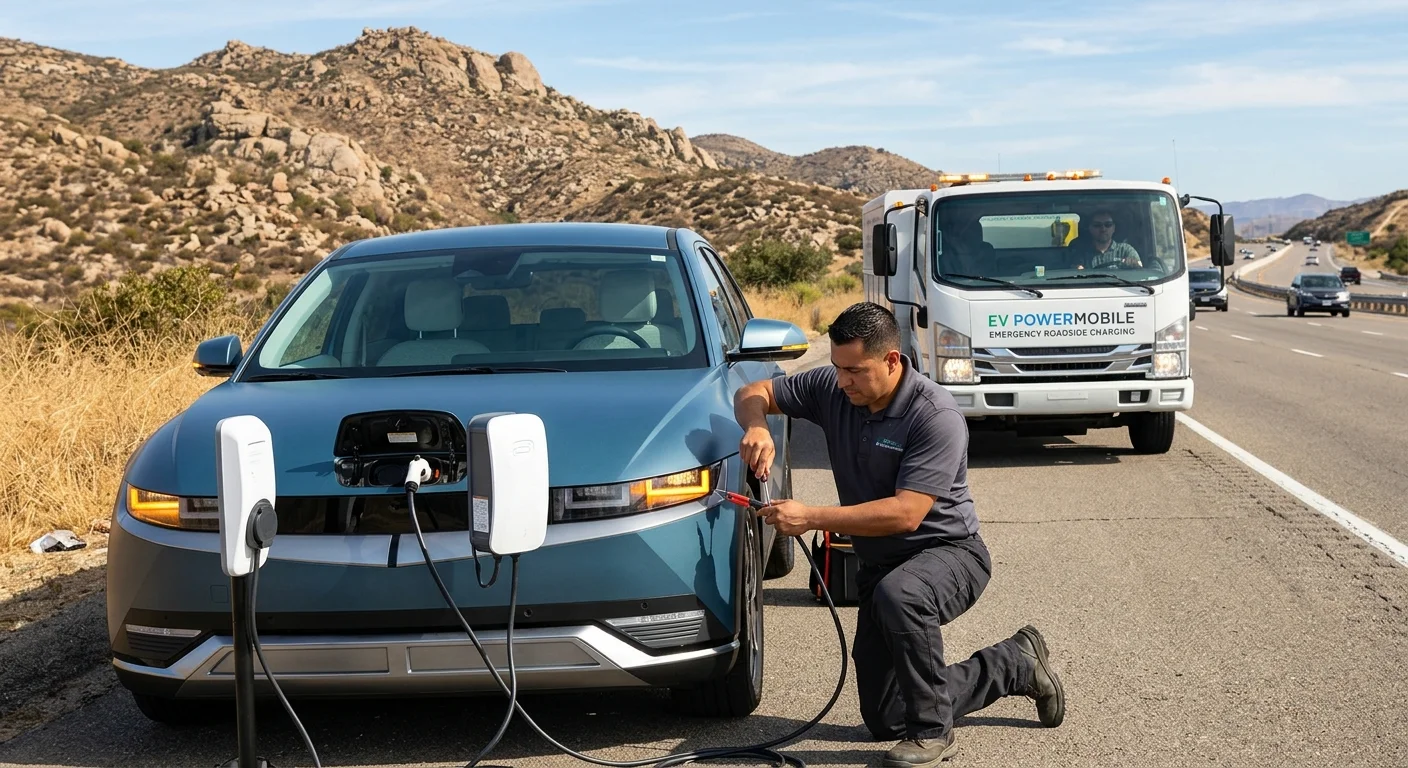
If the big pack is low, you need energy into the car. Charge Pro DEN is a referral line. It matches you with independent local operators. Those operators bring a 240-volt Level 2 source to the vehicle. They use a native NACS plug. Non-Tesla EVs get a CCS or J1772 adapter. Charging time, never travel time, is typically 15 to 30 minutes. That usually adds 10 to 20 miles of range. That’s often enough to finish the climb. The operator quotes you before starting and bills you directly.
If the 12-volt is dead, the car may not unlock, heat, or wake. Lights, computers, and contactors all lean on that small battery. Operators can jump it on site, or replace it on site. They handle Tesla and every major EV brand. A jump isn’t a pack fill, so don’t mix those calls.
Tesla’s own roadside is a separate path from a local mobile charge. For that split, see Tesla roadside, CDOT patrol, or a local boost.
SH-74, Bear Creek, and the last miles into the trees
Evergreen Parkway is the commute spine off I-70. It drops to I-70 at El Rancho. It also runs Bear Creek toward Morrison. Upper Bear Creek Road peels into the canyons. Squaw Pass Road, SH-103, heads toward Mount Blue Sky and over toward Idaho Springs. I-70 remains the way down to the metro.
The last miles aren’t a city grid. Downtown Evergreen, Hiwan, and Bear Mountain sit on winding streets. Soda Creek, Brook Forest, and Upper Bear Creek do too. Kittredge sits next door on the same fold. Aspen Park, Indian Hills, and Morrison sit on other folds of the same foothills. The census places this community at 8,643 people across about 11.5 square miles. Homes are spread out, and cell coverage thins in the draws.
Evergreen Lake and the Evergreen Lake House are easy to picture. So are Hiwan Homestead, the Evergreen Golf Course, Elk Meadow Park, and Alderfer/Three Sisters Park. A long dwell there, heater still on, spends miles you meant to save.
Idaho Springs has a Tesla Supercharger with 8 stalls. Conifer has another Supercharger with 8 stalls. Those are named sites, not a promise about every driveway in ZIP 80439. If you’re already short on the parkway, out of charge on SH-74 toward Evergreen walks the shoulder steps. Squaw Pass traffic can use EV roadside assistance in Idaho Springs for that I-70 side.
If you’re already stopped
Colorado treats a disabled EV like any other disabled car. There’s no separate EV breakdown statute in Colorado. CRS 42-4-1202 is the shoulder rule. Outside a business or residential district, you may not stop on the paved main-traveled part of a highway. The exception is a vehicle so disabled you can’t avoid stopping and can’t move it off the roadway. Hazards belong on, under CRS 42-4-230. A violation is a class B traffic infraction.
Pull as far right as the road allows. Turn hazards on if the 12-volt still has life. Stay out of the travel lane, and don’t stand between the car and traffic.
CRS 42-4-1803 to 1805 cover abandoned vehicles on public property. Abandoned is an officer’s call on reasonable grounds. The statute doesn’t set a 24-hour or 72-hour clock.
COtrip.org and the 511 line are CDOT’s live source for I-70 closures. They also carry traction-law and chain-law status. CDOT can impose the Passenger Vehicle Traction Law. That means AWD or 4WD, or mud-and-snow or winter tires with at least 3/16-inch tread. A 2WD car needs chains or an approved traction device. In a severe storm, the Passenger Vehicle Chain Law can require a device on every vehicle. It activates by highway signage and by what COtrip posts. Don’t memorize a seasonal date range the agency didn’t confirm here.
What the free patrol can do, and what it can’t
CDOT Safety Patrol is free on covered freeway segments. The I-70 Mountain Corridor listing runs from Morrison to Vail. Published mountain hours are 6:00 a.m. to 7:00 p.m. Friday through Sunday, and during significant weather. Patrol help includes flat tires, jump-starts, emergency fuel, minor mechanical help, debris, and incident support.
CDOT’s Safety Patrol pages, and the “my car broke down” page, say nothing about electric vehicles or bringing a charge. On I-70 during those hours, a patrol truck may jump a 12-volt or change a tire. It doesn’t publish an EV charging service. Once you’re on SH-74 into Evergreen, don’t assume the same truck is assigned to the parkway. Confirm the road before you wait for a patrol that covers a different corridor.
Charge in place, or a tow up the hill
A mobile charge keeps the car where it died. For an out-of-charge recovery, that’s often the cleaner move on a mountain street. A tow up or down SH-74 is a different job. A dead EV may need a flatbed. A car with no 12-volt power needs a driver who knows how to load it. Colorado has no separate disabled-EV tow statute.
Charge Pro DEN doesn’t own trucks, employ technicians, or set the price. It matches a stranded driver with an independent local operator. If a house battery or a garage plug is the other fork, home backup versus a charge to the car in Evergreen walks through that split.
Utility billing at home is a separate question from a roadside boost. Xcel Energy is commonly cited for Evergreen. CORE Electric Cooperative serves adjacent mountain areas. Confirm the utility by address before you blame the wrong company. Published dollar amounts for those programs aren’t confirmed here, so check the utility before you count on one.
About 59.7 percent of Evergreen housing predates 1980. Older houses weren’t designed around a 240-volt EV circuit. That doesn’t prove your garage lacks one.
When the remaining grade is the problem
Call when the estimate won’t cover the remaining grade with heat on. Call when the car won’t wake after a sit at Elk Meadow or along Upper Bear Creek. Call when you’re on the I-70 shoulder at El Rancho and you already know SH-74 is next.
Keep hazards on if the 12-volt still allows it. Stay in the car if the shoulder is narrow and traffic is fast. If you can share a pin, share it. Coverage is thin in the canyons. A clear landmark helps: Evergreen Lake, Hiwan, Bear Mountain, or the parkway marker you can still read.
Charge Pro DEN serves the Denver metro, including Evergreen and the SH-74 climb. The number to call is (720) 738-6950. You’ll be matched with a local operator who quotes before they start and bills you directly.