If your EV hits zero on SH-74 toward Evergreen, send a live map pin first. Copy the dash message before you label it an empty pack. Stay put if the car truly can’t move, with hazards on. A metro range cushion can vanish on this climb in the cold. Denver sits at 5,280 feet. Evergreen sits near 7,200. An independent operator can then judge a roadside Level 2 charge or a tow.
This climb spends a plains margin
You may have left I-70 with a number that felt safe. Golden sits near 5,675 feet. Denver’s official elevation is 5,280 feet. That’s the mark on the west steps of the State Capitol. The rise into Evergreen is work the pack is doing now.
Cabin heat, seat heat, and a cold headwind all draw from the same battery. January’s normal low around Denver is about 18 degrees. Recurrent Auto’s winter study covered more than 30,000 U.S. EVs. It found about 78 percent of max range at 32 degrees. At 20 degrees, the average was about 70 percent. AAA’s 2026 dynamometer study reported about 39 percent range loss at 20 degrees. Those are study averages, not a forecast for your car tonight.
In January 2024, Denver fell from 47 to minus 19 in about 48 hours. A pack can look merely low through Lakewood. It can be empty once you’re committed on SH-74. Descent later can give energy back through regen. A widely cited analysis puts recovery at roughly two-thirds of climb energy. That figure isn’t an SH-74 test. Drivers often ease regen on ice for traction. Don’t budget a full refund of the climb.
I-70 is the usual feeder from the metro. CDOT Safety Patrol covers the I-70 Mountain Corridor from Morrison to Vail. Published hours there are 6:00 a.m. to 7:00 p.m. Friday through Sunday. Coverage also runs during significant weather. Front Range metro weekday hours are 6:00 to 9:30 a.m. Afternoon coverage is 2:30 to 7:00 p.m. Weekend hours are 10:00 a.m. to 7:00 p.m. CDOT’s Safety Patrol pages mention nothing about EV charging. The free program will jump a 12-volt battery and change a tire. It doesn’t bring a charge to a stranded EV.
SH-74 isn’t on CDOT’s published Safety Patrol segment list. If you already left the interstate, don’t wait for a truck assigned to I-70. COtrip.org and the 511 line carry live closures and traction-law status. CDOT can impose the Passenger Vehicle Traction Law. In a severe storm it can impose the Passenger Vehicle Chain Law. Those activate by highway signage and by COtrip. CDOT’s traction-law page didn’t publish a confirmed seasonal date range. Watch COtrip and the signs. CDOT sets the activation.
Make the stop legal before you troubleshoot
Your first decision is the scene, not the pack. CRS 42-4-1202 limits stops on the paved main-traveled part of a highway. That rule applies outside a business or residential district. The exception is a vehicle so disabled that you can’t avoid stopping. You also can’t move it off the roadway. Hazard lights are required under CRS 42-4-230. A violation is a class B traffic infraction. If the car can’t go farther, stay off the travel lanes with hazards on.
This page can’t tell you to walk a curve or cross a lane. Don’t try one more roll on a guess. CDOT doesn’t publish SH-74 turnout maps or shoulder widths. Every stopping place on this highway is different. If anyone is in danger, call 911. Colorado State Patrol handles crash response and dispatch. Abandoned-vehicle rules in CRS 42-4-1803 to 1805 rest on officer discretion. There’s no published hour count. Colorado doesn’t have a statute that carves out a disabled EV. If an officer is already there, share any instruction about moving the car.
If a test would put someone in a travel lane, don’t try it. Report what the car will still do. Stopped in the lane isn’t the same as fully off the pavement.
Pin the stop, then describe access
Saying you’re toward Evergreen covers too much ground. Read the next sign exactly as it’s printed. Send SH-74 and your direction of travel. Add the last cross street or ramp you can see, and a live map pin. Say whether you’re on the roadway, a pull-out, or private ground. Name which side you’re on. If the app and a road sign disagree, share both. A screenshot helps when the pin jumps. Mention a median, a closed gate, or a split driveway if you see it.
Also describe the last approach. Note a height limit, a blocked path, or another vehicle in the way. Report room at the charge port and which side it sits on. Don’t move the EV just to make space. Wait unless the scene is safe and someone on scene directs you. Mention a locked door, a missing key, crash damage, or a flat. If the ground is private, say whether you can admit the operator.
Our Evergreen roadside guide is for once you’re in town. This page is the SH-74 stop. If you never left the interstate, use the I-70 out-of-charge checklist. Evergreen’s hub page is EV charging in Evergreen.
Separate an empty pack from a dead 12-volt
A car that won’t ready hasn’t named the failed battery for you. Copy the displayed percent and any out-of-energy message. Add any low-voltage warning and whether the screen stays on. Say whether doors and the charge port still respond. Use the vehicle app if it still connects. Missing app data isn’t a diagnosis. A screenshot preserves wording that later vanishes.
If the car reports a low-voltage problem, say that. Don’t call it an empty traction pack unless the vehicle also reports depleted charge. A zero-range message isn’t a 12-volt failure either. Don’t open panels or clip jumper cables on a guess.
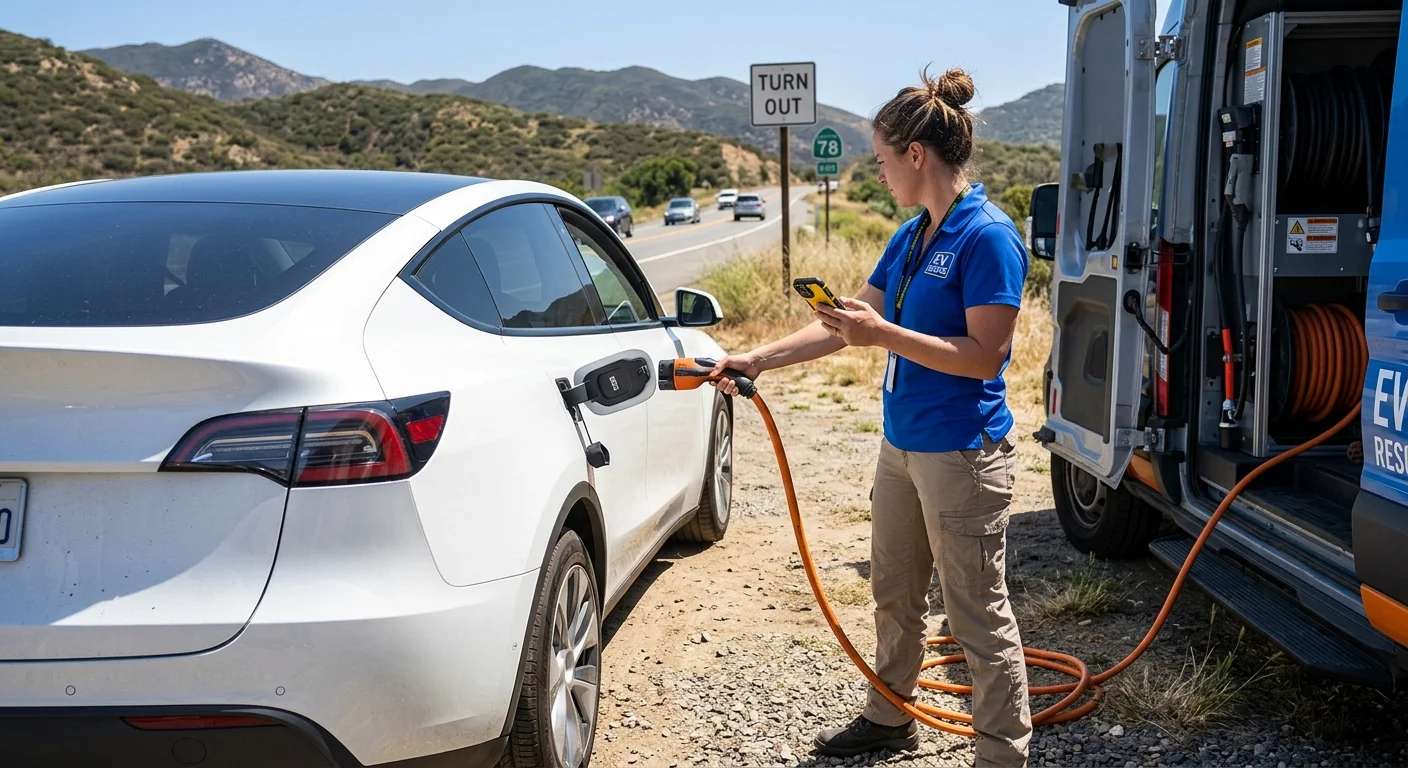
Charge Pro DEN is a referral line. It doesn’t hold a trade license and doesn’t do the work. It matches stranded drivers with independent local mobile rescue operators. The EV roadside assistance page is that match. Share make, model, year, connector, and the dash text. The pros we connect you with are licensed and insured. They typically bring a 240-volt Level 2 source to the car. Native NACS covers Tesla and other NACS EVs. CCS or J1772 cars use an adapter. A session of this kind typically adds 10 to 20 miles of range. That takes 15 to 30 minutes of charging. That’s charging time. It isn’t an arrival time. The U.S. Department of Energy publishes connector and level background. See the AFDC electricity page.
Decide on a roadside charge or a tow
Mobile charging is one recovery path. It isn’t automatic. Ask the operator whether a charge fits the symptoms. Confirm that the connector matches, and where the equipment would stand. Ask what output they can provide, and whether transport is better. Don’t treat 10 to 20 miles as a guarantee. Confirm what the proposed service is meant to do before you agree.
If charging is the plan, name the next destination. Research names Superchargers in Lakewood. Conifer has an 8-stall Supercharger. Idaho Springs has an 8-stall Supercharger on I-70. Those are named sites. This isn’t a claim that one is open, in range, or on your remaining path. Check the live app before you aim there. This page doesn’t estimate a distance from SH-74 to any of them.
Transport is in play when the EV can’t accept a charge. It’s also in play when another fault is unresolved, or the stop can’t be serviced. The transport provider should confirm loading method, destination, access, and price. Charge Pro DEN doesn’t set those terms. The operator quotes you before starting and bills you directly.
For a boost on this highway, start with out-of-charge recovery. If the pack is empty, use mobile EV charging. That’s the path when the 12-volt isn’t the story. A house plug in Evergreen is a later question. Read Evergreen home backup or an EV charge. The city-by-city utility list names Xcel for Golden and CORE for Conifer. Evergreen isn’t on that list. Confirm on your bill. Don’t assume Xcel.
When to call
Call when the EV has stopped on SH-74 toward Evergreen. You need an operator to assess a mobile charge or transport. Charge Pro DEN is a referral service. It performs no work, owns no trucks, and promises no arrival time. Call (720) 738-6950 and we’ll connect you with a local EV rescue operator.