The pack still shows range. The car won’t wake. That mismatch is the usual Cherry Hills Village call. A luxury EV sat through a cold night on a large lot. The 12-volt died, and the traction battery was never empty.
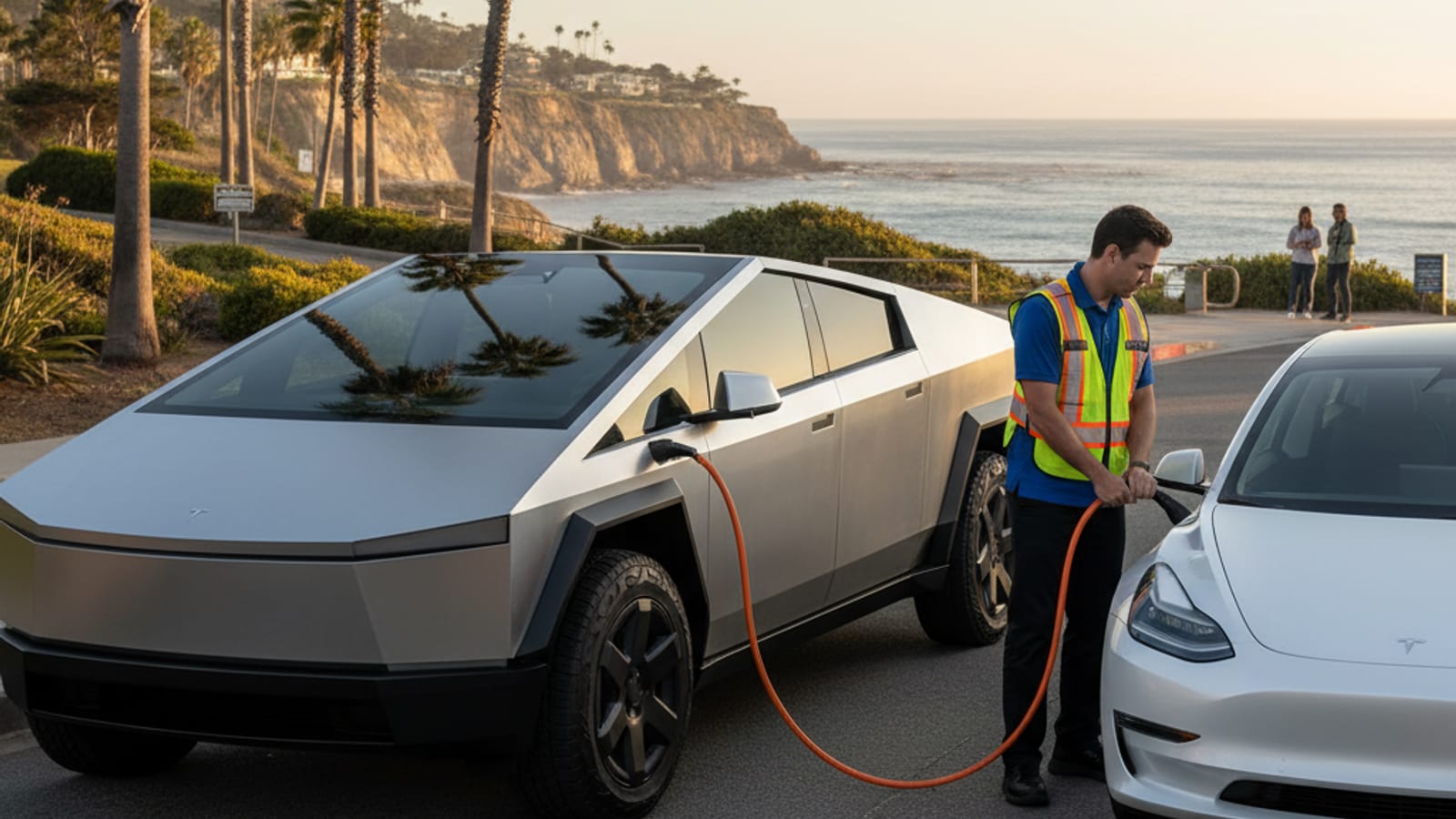
EV roadside assistance in Cherry Hills Village is rarely about a house with no plug. This Arapahoe County town is about 6.2 square miles of estate lots. Home charging is typical on those lots. The car that won’t wake usually sat cold after the owners were away. Or it ran short on the University Boulevard and Hampden Avenue commute. Charge Pro DEN is a referral line. We serve Cherry Hills Village and the rest of the Denver metro. We match stranded drivers with independent local operators. We don’t own trucks or equipment. We don’t employ technicians. The operator quotes you before any work starts. Then that operator bills you directly.
Two dead-car problems that look identical
A Tesla or another luxury EV can fail two ways that feel the same from the seat. The high-voltage pack can be too low to drive. Or the small 12-volt battery can be too weak to wake the car. Only one of those is an empty pack. The other can leave miles on the display, if the display even comes up.
The 12-volt runs the computers, the contactors, and the door logic. If it can’t hold voltage, the pack stays isolated. You get a silent cabin, maybe a lockout, and no drive-ready state. That’s why a cold residential dwell is the local pattern. The car wasn’t climbing toward Evergreen. It was sitting on a Cherry Hills Village lot.
If the screen is dark and the charge port won’t open, start with the 12-volt. If the car is awake and range is truly near zero, you need energy in the pack. Those two jobs are different. The operators we connect can jump a Tesla 12-volt on site. They can also bring a 240-volt Level 2 source for mobile EV charging when the pack is the problem.
For a deeper split of which battery failed, read which EV battery matters when you’re stranded. For Tesla-specific cold behavior, see whether Teslas even have a 12-volt battery.
Porsche, Lucid, Mercedes, Cadillac, BMW, and Audi luxury EVs use the same split. The 12-volt still wakes the car. The pack still moves it. CCS or J1772 on those cars is just the plug. It doesn’t change the cold-soak failure. A native NACS Tesla fails the same way on these streets. A jump is a short-term wake-up. If the 12-volt dies again after you drive home, it’s tired. Replacement on site is the next conversation with the operator. Don’t keep jumping a battery that won’t hold.
Why this town’s strandings look like a driveway
Cherry Hills Village sits in Arapahoe County on the south side of the metro. The ACS population estimate is 6,366. The 2024 Census PEP estimate is 6,349. Land area is 6.206 square miles. ZIPs include 80111, 80113, and 80121. It’s the wealthiest community in the metro by median household income. About 52.5 percent of the housing predates 1980. The stock is older in vintage and high in value. Lots are large, and density is low.
The grid is University Boulevard, Hampden Avenue (US-285), Colorado Boulevard, Quincy Avenue, and Belleview Avenue. I-25 runs to the east. Neighbors are Englewood, Greenwood Village, Denver, Glendale, and Centennial. Pins that actually help a dispatcher include the Cherry Hills Country Club and the Kent Denver School. John Meade Park, Alan Hutto Commons, and the High Line Canal Trail work as pins too. Residents also name the estate core, the Buell Mansion area, Old Cherry Hills, and the Southmoor Park edge.
This isn’t a downtown garage story. It isn’t a canyon story. It’s a quiet street, a long sit, and a car that won’t wake on a cold morning. Xcel Energy serves the town. That’s the house utility, not a street rescue.
A long school pickup at Kent Denver is still a dwell. So is a sit near the Country Club. So is a trailhead pause along the High Line Canal Trail. The car is parked, and cabin systems may stay alive. In January that’s enough to sag a weak 12-volt. The pack can still show a comfortable number when you come back.
Cold soak is what kills the 12-volt here
National Weather Service normals for Denver put the January low around 18 degrees. Average annual snowfall sits in the low-to-mid 50s of inches. The all-time record cold is minus 29 degrees, on January 9, 1875. You don’t need that record for a 12-volt to fail. You need a long sit and a weak battery.
The January 2024 arctic blast dropped Denver from 47 to minus 19 in about 48 hours, on January 16 and 17. A car that sat through that swing doesn’t fail like a car that just left a warm garage. Cherry Hills Village is south-side estate ground, not Evergreen at about 7,200 feet. The elevation story here is still Front Range cold. It isn’t a mountain climb.
Recurrent Auto’s winter range study covered more than 30,000 U.S. EVs. Packs retain about 78 percent of max range at 32 degrees. At 20 degrees the average is about 70 percent. Heat-pump models hold about 10 points more at 32 degrees. An AAA dynamometer study in 2026 reported about 39 percent range loss at 20 degrees, with about 35.6 percent efficiency loss. Those figures describe the pack. The 12-volt is a different, smaller battery. Cold raises its internal resistance. A long sit lets voltage sag. Cabin climate, security modes, and scheduled preconditioning keep drawing from it.
That’s the overnight here. Owners travel, and the car sits on the lot. The pack still has miles, and the 12-volt doesn’t. In the morning the car is silent. A tow is the wrong first move if the pack is fine.
Colorado has no separate statute for a disabled EV. The car is a disabled vehicle like any other. There’s no EV carve-out in the breakdown rules. That absence was confirmed against the statutes on September 18, 2026. The EV-specific laws on the books are CRS 38-33.3-106.8, HOA charging-access rights, and CRS 42-4-1213, charging-space parking enforcement. Neither is a breakdown law.
The University and Hampden commute is the other call
Not every stranding is a driveway. Some cars leave the estate streets with a thin margin. University Boulevard and Hampden Avenue (US-285) are the local spines. Belleview and Quincy feed the same grid. Colorado Boulevard is the western edge of that pattern. I-25 is the eastern freeway.
A low pack on those roads is a charge problem, not a 12-volt problem. The car is awake. The range number is the story. Public DC fast sites are confirmed in neighboring cities. NREL’s inventory, pulled September 18, 2026, lists a 12-stall Supercharger in Centennial. It also lists a 10-stall site at Lone Tree / Park Meadows, and a 16-stall site in Highlands Ranch. Don’t treat those names as a promise that a stall is open. Check the car’s nav and a charging app before you roll. A roadside Level 2 top-off is meant to add enough miles to reach a working stall or to get home. Operators typically add 10 to 20 miles of range in 15 to 30 minutes of charging. That’s charging time. It isn’t an arrival time.
If you were already thinking about the house circuit on these lots, start with Cherry Hills Village EV charging when the driveway still leaves you short. The city hub is EV charging in Cherry Hills Village.
Greenwood Village sits next door, including the Denver Tech Center side. A different dwell, a similar 12-volt failure, shows up there after a long work day. That pattern is in EV roadside assistance in Greenwood Village.
What a mobile rescue actually brings
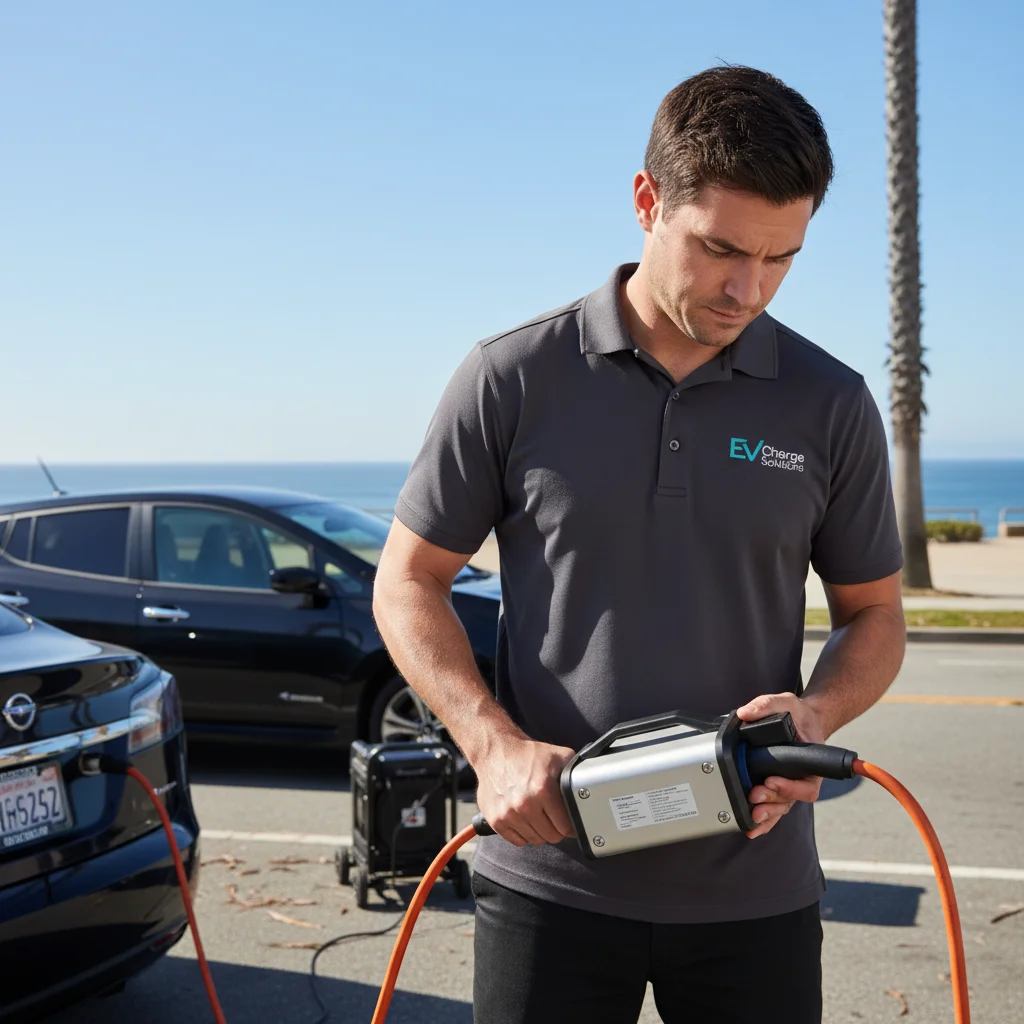
Charge Pro DEN doesn’t perform the work. We connect stranded drivers with independent local mobile rescue operators. Those operators bring a 240-volt Level 2 source to the car. Tesla and other NACS cars get a native NACS plug. CCS and J1772 cars get the matching adapter. They handle Tesla and every major EV brand. They can jump a dead 12-volt on site. They can replace a 12-volt on site when that’s the job.
They don’t set a Charge Pro DEN price. The operator quotes you first. You accept or you don’t. A Level 2 roadside session isn’t a Supercharger. It’s a short, local boost. The point is enough energy to roll. Full charging belongs at home on Xcel, or at a DC fast stall you can actually reach.
The pros we connect you with are licensed and insured. That’s a claim about the network. Charge Pro DEN itself holds no trade license. We own no fleet, stock no parts, and publish no hours. We promise no arrival window.
Stay with the car if it’s safe. Tell the operator the year, make, and model. Say whether the car is silent or showing a range number. That’s how they know whether to walk up with a 12-volt kit or a charge cable.
What CDOT Safety Patrol covers, and what it doesn’t
CDOT Safety Patrol is free on covered freeway segments. Metro coverage includes I-25 South from 120th Avenue to Arapahoe Road. That’s the freeway to the east of this town, not University Boulevard. The patrol also covers listed segments of I-70 East from Wadsworth to Airport Boulevard, plus portions of US-6, C-470, and I-225. Published Front Range hours are 6:00 to 9:30 a.m. and 2:30 to 7:00 p.m. on weekdays. Weekends are 10:00 a.m. to 7:00 p.m. Source: CDOT’s Safety Patrol page, read September 18, 2026.
What they list is flat tires, jump-starts, emergency fuel, minor mechanical help, debris removal, and incident support. CDOT’s Safety Patrol page and the “my car broke down” page mention nothing about electric vehicles, EV charging, or a charging truck. They can jump a 12-volt. They don’t bring a charge to a stranded EV.
If you’re on I-25 during those hours with a dark 12-volt, the patrol is a real option for a jump. If the pack is empty, the patrol won’t fill it. COtrip.org and the 511 line cover closures and traction-law status. They don’t dispatch a mobile charger. Colorado State Patrol handles enforcement, crash response, and dispatch. It also holds abandoned-vehicle removal authority under CRS 42-4-1803.
If you’re on a shoulder, the law is ordinary traffic law
CRS 42-4-1202 is the disabled-vehicle-on-the-shoulder statute. Outside a business or residential district, you may not stop on the paved main-traveled part of a highway. The exception is a vehicle so disabled it is impossible to avoid stopping and to move it off the roadway. Hazard lights are required under CRS 42-4-230. A violation is a class B traffic infraction. Plain read: if the car truly couldn’t go farther, the shoulder with hazards on is lawful.
Most Cherry Hills Village streets are residential. That statute is written for highways, not for a driveway on an estate lot. On I-25 to the east, it’s the rule that matters. CRS 42-4-1803 to 1805 govern abandoned vehicles on public property. Abandonment is officer discretion, on reasonable grounds to believe. The statute sets no 24-hour or 72-hour clock. Don’t wait on a made-up deadline.
If someone wants the car towed from a private lot, Colorado’s Towing Bill of Rights, HB22-1314, effective August 10, 2022, regulates nonconsensual tows. It requires 24-hour written notice before most private-property tows. The Colorado Public Utilities Commission regulates towing carriers. Exact tow-fee figures aren’t confirmed in this research. Confirm them with the carrier and the PUC. There’s still no Colorado statute that creates a special process for mobile EV charging.
Your Cherry Hills Village house bills Xcel
Xcel Energy, the Public Service Company of Colorado, serves Cherry Hills Village. That isn’t CORE Electric Cooperative. CORE covers much of the south-metro Douglas County corridor, including Centennial. If you live in Cherry Hills Village, your home bill is Xcel. Don’t call CORE about a driveway circuit here. Greenwood Village is also Xcel. The utility line isn’t the city line you might expect from a south-metro map.
Xcel’s CPUC-filed 2024-2026 Transportation Electrification Plan names programs you can look up on Xcel’s own EV pages. Those names include EV Accelerate At Home, the EV Home Wiring Rebate, Optimize Your Charge, and Charging Perks. They also include the RE-TOU residential time-of-use rate, the Residential EV Rebate, and the Public Charging Acceleration Network, or PCAN. Rebate dollar amounts aren’t confirmed in this research. Check Xcel for the current figure before you plan a panel or a charger. A roadside charge doesn’t replace a working home circuit. It also doesn’t diagnose why a garage unit failed overnight.
About 52.5 percent of local housing predates 1980. Older high-value homes can still have a 240-volt circuit. Many do. When the car sat plugged in and still won’t wake, you’re usually looking at the 12-volt, a tripped breaker, or a charger that never started. You aren’t looking at a mystery empty pack until you prove the pack is empty.
Colorado crossed 200,000 registered EVs by October 2025, per the Colorado Energy Office. Battery-electric vehicles were 12.5 percent of new Denver-metro registrations year-to-date through June 2026. That’s down from 23.7 percent a year earlier, per CADA’s Q2 2026 Auto Outlook. This town still has Tesla and other luxury EVs on large lots. The local failure mode stayed the same: cold sit, dead 12-volt, or a thin commute margin on University and Hampden.
What to try before you call anyone
Stay out of the travel lanes if you’re on Hampden or I-25. Put the hazards on. Get people out of the car only if it’s safer outside. On an estate street, stay with the car if you can.
See whether the car will unlock and whether the screen comes up. If nothing lights, think 12-volt first. If the car talks to you and shows a near-zero range, think pack. Don’t keep key-cycling a silent car. You can flatten a weak 12-volt further.
Check the obvious house side if you’re in the driveway. Look at the breaker. Confirm the charge handle is seated. Check the app schedule. Check Xcel’s outage map if the block is dark. Then stop guessing.
If you’re on I-25 inside Safety Patrol hours, you can ask CDOT for a 12-volt jump. If you need energy in the pack, that’s a mobile Level 2 job or a tow to a stall you’ve already confirmed is working. Don’t assume a named Supercharger has an open stall. Centennial, Lone Tree / Park Meadows, and Highlands Ranch are confirmed sites in the inventory. Availability is a live question.
How a Charge Pro DEN referral works
You tell us where the car is and what it is. Cherry Hills Village, a cross street off University or Quincy, a lot near Kent Denver School, a pin on Belleview. Give the make, model, and whether the car is silent or showing range. We pass that to an independent operator. That operator calls you with a quote. You decide. If you accept, the operator comes to the car and does the work. Charging time, when a charge is the job, is typically 15 to 30 minutes for about 10 to 20 miles. A 12-volt jump or replacement is a different on-site task.
We don’t quote a price for them. We don’t promise when they’ll arrive. Traffic on I-25, Hampden, and Belleview changes. Only the operator can give you a window, and only after they have the pin.
Frequently asked questions
If the pack still shows range, why won’t the car start?
The 12-volt is what wakes the car. The pack is what moves it. A cold overnight sit on a Cherry Hills Village lot can kill the 12-volt while the pack still holds miles. Jump or replace the 12-volt first. Don’t assume you need a tow or a pack charge.
Will CDOT Safety Patrol charge my EV on I-25?
The patrol won’t bring a charge. It covers I-25 South from 120th Avenue to Arapahoe Road, among other listed segments. It will jump a 12-volt, change a tire, and handle listed mechanical help. CDOT’s own pages don’t offer EV charging. An empty pack needs a mobile Level 2 charge or a proper tow.
What do the operators you connect actually do on site?
They bring a 240-volt Level 2 source with a native NACS plug and CCS or J1772 adapters. They jump or replace a dead 12-volt. They handle Tesla and every major EV brand. They quote you before they start. They bill you directly. Charge Pro DEN doesn’t do that work.
A silent luxury EV on these estate streets is usually a 12-volt story. A car that’s awake with no miles is a pack story. Either way, you want the right job at the bumper, not a default flatbed. For EV roadside assistance in Cherry Hills Village, call (720) 738-6950. We’ll connect you with a local operator who can quote the work.